
What Makes a Boomerang Come Back? Spin, Lift and Precession
Key takeaways
- Each boomerang arm is an airfoil, so the faster-moving arm at the top generates more lift than the bottom one.
- That uneven lift creates torque, and the boomerang's spin converts it into a steady turning motion through gyroscopic precession.
- A correct throw at about 15 degrees, nearly upright, is what lets the physics do the work.
A returning boomerang looks like a trick. You throw it hard and flat-ish into the wind, it climbs, it curves, and a few seconds later it settles back into your hand.
Nothing is guiding it. The return is pure physics: shaped wings, spinning fast, meeting air unevenly.
This article takes a closer look at what makes a boomerang come back, including how its arms act as wings, why uneven lift bends its path, how gyroscopic precession turns tilt into a circle, and the throw that makes it all work.
What a boomerang actually is
A returning boomerang is two or more blades joined at a center, carved from wood or molded from plastic. Cross-sectioned, the top of each blade is curved and the underside is flat, exactly like an airplane wing. Mark Maughmer, a professor of aerospace engineering at Penn State, explains that this curvature is what lets each blade produce lift as it spins through the air.
The blades are also set at a slight tilt from the horizontal. That tilt pushes air downward as the arms turn, like a propeller, which adds more lift. The whole object is thrown nearly upright, spinning rapidly, which gives it the angular momentum its flight depends on.
A maple seed does something similar. As Maughmer points out, a boomerang works like the seedpods of a maple tree spinning through the air as they fall.
The difference is that a boomerang is thrown hard, so it carries forward motion on top of its spin. That combination of spin and forward flight is the key to the return.
How uneven lift bends the flight
Picture a boomerang thrown upright, spinning as it flies forward. At the top of each rotation, one arm is moving forward, in the same direction as the flight.
At the bottom, the other arm is moving backward, against it. The forward-moving arm meets the air at a higher relative speed than the backward-moving one.
More speed means more lift. So during every rotation, the top arm pulls harder than the bottom arm. Darren Tan, a physics PhD student at Oxford University, explains in Popular Science that this difference in lift force between the two sides produces a consistent torque, the twisting force that gradually turns the boomerang.
Stanford physics course notes on boomerang flight dynamics put it in an equation: lift force equals one half times the lift coefficient times wing area times air density times velocity squared. Because velocity differs between the two arms, the lift forces on the two sides have different magnitudes. That imbalance is the raw material of the turn.
Lift does not always point straight up here. With the boomerang spinning almost upright, much of the lift acts sideways.
A sideways force bends the flight path into a curve. So the torque alone starts the boomerang turning.

A boomerang throw at a park. Photograph: Sdbenny/Wikimedia Commons
Why spin turns a tilt into a circle
Torque alone would tip the boomerang over. The spin saves it, through a phenomenon called gyroscopic precession.
Anyone who has spun a toy gyroscope has felt it: when you push on a spinning object, it does not move in the direction of the push. The effect lands 90 degrees around the direction of rotation.
The boomerang is a gyroscope in flight. The uneven lift tries to tilt its plane of spin, but precession redirects that tilt.
Instead of flipping over, the axis of the spin axis shifts sideways, and the sideways aerodynamic force keeps bending the flight path. The result is not a tip-over but a slow, steady circular turn.
Stanford's treatment of boomerang dynamics identifies two types of precession. The first, driven by the uneven lift on the forward and backward arms, is what turns the boomerang back toward the thrower. The second type of precession controls the tilt of the spinning plane and shapes the overall flight pattern, deciding how long the boomerang stays up and how wide its loop runs.
This is the part most simple explainers skip. Lift alone cannot explain a circle. It takes the coupling of torque and angular momentum to keep the flight path bending in the same direction the whole time.
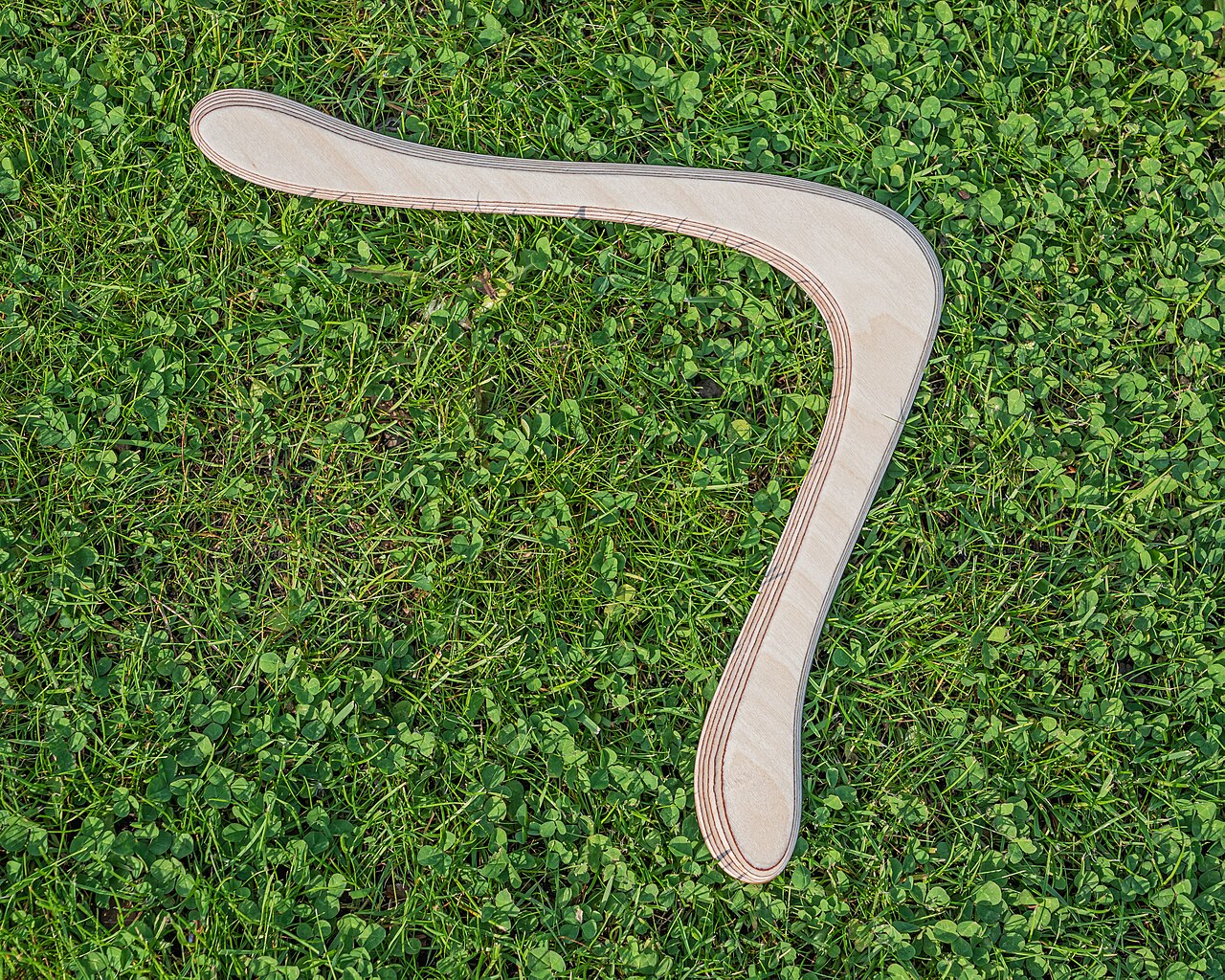
A wooden returning boomerang. Photograph: A.Savin/Wikimedia Commons
The throw that makes it come back
Physics needs a decent throw to work with. Maughmer stresses that you cannot hurl a boomerang flat like a Frisbee and expect it to return. The correct release is nearly upright, at roughly a 15-degree angle from vertical.
The thrower also needs wind awareness. A returning boomerang flies best in light wind; the incoming air helps the forward arm bite cleanly at the top of the rotation.
Spin matters as much as angle. A weak, wobbly throw does not generate enough angular momentum, and without it there is no strong precession. Practice counts too: Maughmer puts it plainly, that with the right angle, the right throw, and practice, the boomerang comes back.
When all three are right, the flight follows a familiar script. The boomerang climbs, levels off, sweeps through a wide arc, and comes down near the thrower, often hovering for a second before dropping into the waiting hands.
When it does not come back
Not every boomerang is a returning boomerang. Hunting boomerangs, the non-returning type, are heavier and shaped to fly straight and hit targets. If you buy one by mistake, no amount of spin will bring it home.
Wind is the other spoiler. A strong gust can overwhelm the gentle precession and drag the flight path off course. That is why experienced throwers prefer calm mornings or a light, steady breeze.
Damage matters as well. A warped or cracked arm changes the lift on one side, and asymmetric damage creates asymmetric forces the precession cannot clean out. Store a wooden boomerang flat and dry, and check that both arms have the same curve before throwing.
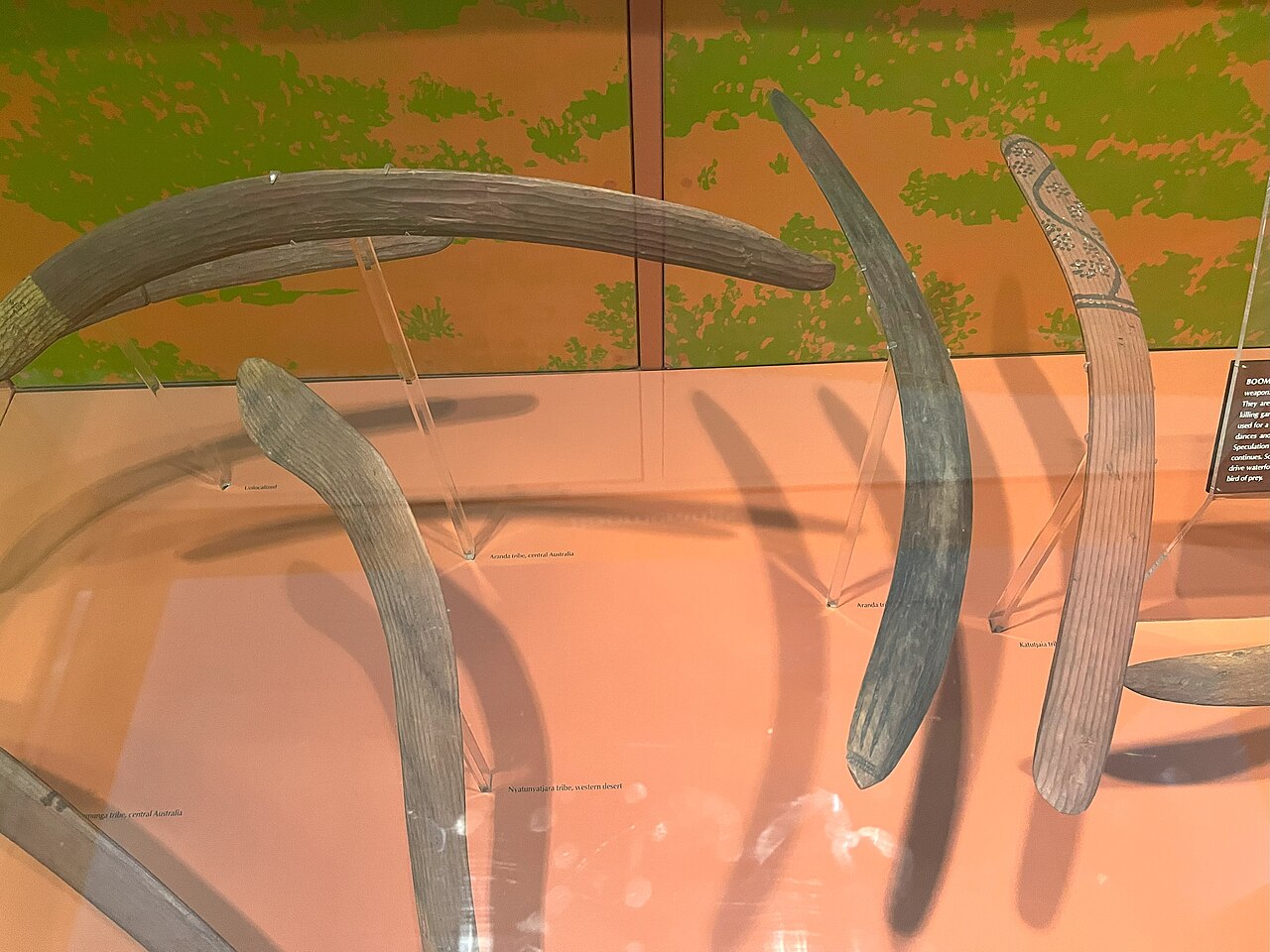
Traditional boomerangs on display. Photograph: Vicpeters/Wikimedia Commons
For a related piece of flight physics, see how trees survive freezing winters without moving.
Frequently asked questions
Why does a boomerang come back instead of flying straight?
Because its spinning arms generate uneven lift. The arm moving forward at the top of each rotation meets the air faster and produces more lift than the backward-moving arm. That imbalance creates torque, and gyroscopic precession turns the torque into a circular flight path that loops back.
What is gyroscopic precession in simple terms?
It is the behavior of spinning objects where a push does not move them in the direction of the push, but 90 degrees around their rotation instead. On a boomerang, the uneven lift keeps pushing, and precession keeps converting that push into a sideways turn.
At what angle should you throw a boomerang?
Nearly upright, at roughly 15 degrees from vertical, according to aerospace engineer Mark Maughmer. Throwing it flat like a Frisbee does not work for a returning boomerang.
Do all boomerangs return?
No. Returning boomerangs are shaped and balanced to precess back.
Non-returning or hunting boomerangs are built to fly straight and far. The two types look similar but behave completely differently in the air.
The bottom line
A boomerang comes back because uneven lift across its spinning arms creates torque, and gyroscopic precession converts that torque into a steady circular turn. The airfoil shape, the spin, and the 15-degree throw angle all work together, and the math says the flight path has to bend. To see the same precession idea in other rotating systems, read about the Mars rock older than Earth itself and why climbers tape their fingers.
Latest in Science
- How do trees survive freezing winters without moving?
- Teghaza 001: the 4.1 billion year old Mars rock
- Why do climbers tape their fingers?
Subscribe for one clear explainer every morning.
Image Credits: Wikimedia Commons / Sdbenny, A.Savin, Vicpeters
Related stories
Why diamond is hard and graphite is soft when both are carbon
Diamond and graphite are both pure carbon, yet diamond is 10 on the Mohs scale and graphite is 1 to 2. The difference is not the atoms;
Why Hot Water Can Freeze Faster Than Cold: The Mpemba Effect Explained
Hot water can freeze faster than cold under specific conditions. The Mpemba effect, named for a 1963 schoolboy experiment, still divides
How Magnets Work at the Atomic Level: Spins, Domains, and Iron
Magnetism comes from electrons: their spin and orbits make each atom a tiny magnet. In iron, quantum forces align these atomic magnets into