
Why does ice float but most solids sink?
Key takeaways
- Ice floats because it is about 9% less dense than liquid water: hydrogen bonds lock water molecules into an open crystal that takes up more space.
- Liquid water is densest at 4°C, not at freezing. Cooling below that starts building the open structure that becomes ice.
- Most solids do the normal thing and pack tighter than their liquids, so solid benzene and solid acetic acid sink in their own melts.
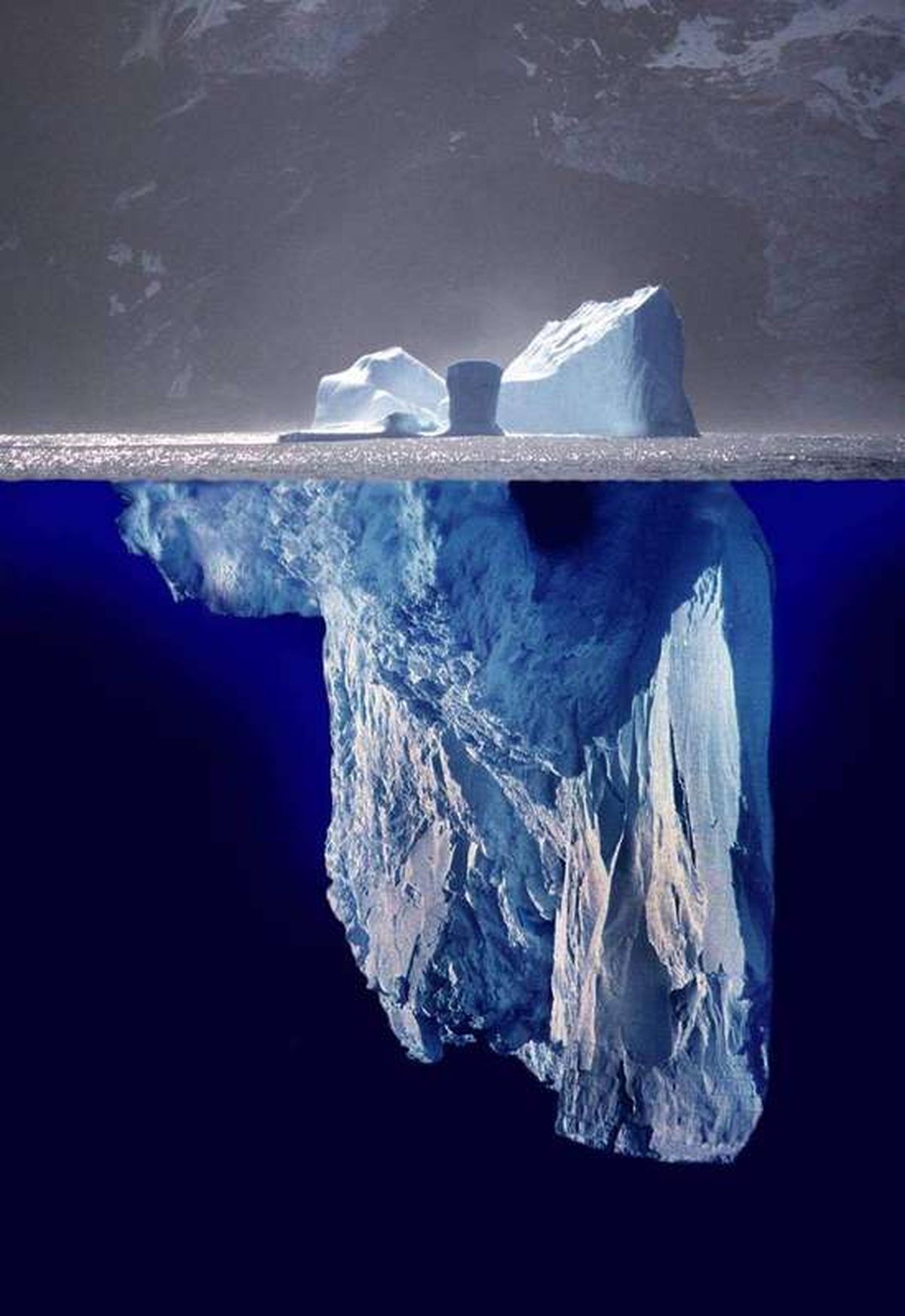
Drop an ice cube in a glass and it bobs at the surface. Drop almost any other solid into its own melted liquid and it sinks straight down.
The rule for most substances is simple: solids pack their particles tighter than liquids do, so the solid is denser and goes under. Water breaks the rule. Ice takes up about 9% more space than the same mass of liquid water, which makes it lighter per unit of volume, so it floats.
This article explains the anomaly. It covers how hydrogen bonds build an open crystal, why water is densest at 4°C, how most solids behave instead, and why floating ice matters for life.
The short answer
Things float when they are less dense than the fluid around them. Density is just mass divided by volume: how much stuff is packed into a given space.
Ice has a density of about 0.917 grams per cubic centimeter at 0°C, while liquid water at the same temperature sits near 1 gram per cubic centimeter. Same mass, more volume, lower density. The heavier liquid displaces the lighter ice upward, and the cube rises.
That 9% gap is the whole story at the surface level. The interesting part is why water, almost alone among common substances, expands when it freezes instead of contracting.
How hydrogen bonds build an open crystal
A water molecule is one oxygen atom bonded to two hydrogen atoms. The oxygen end carries a slight negative charge and the hydrogen ends a slight positive one. That makes each molecule a tiny magnet for its neighbors. The attraction between the hydrogen of one molecule and the oxygen of another is called a hydrogen bond.
In liquid water, these bonds form and break constantly, trillions of times per second. The molecules jostle, slide past each other, and pack together fairly tightly. The liquid is dense because the packing is efficient.
Cool the water down and the molecules slow. The hydrogen bonds last longer and start organizing the molecules into fixed positions. Below about 4°C, the bonds begin holding the negatively charged oxygen atoms apart from each other, propping the molecules into an open, cage-like framework.
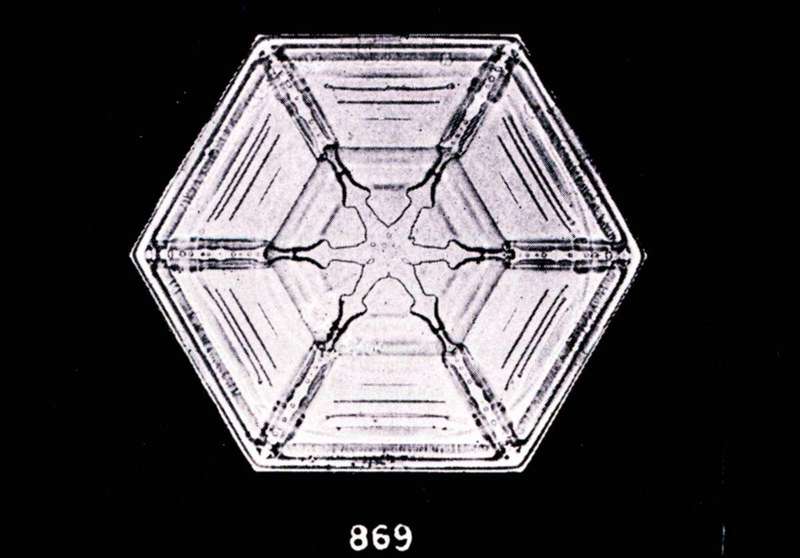
Freeze it fully and that framework locks in: a rigid hexagonal lattice with generous empty space between the molecules. The CK-12 Foundation's chemistry explainer gives the one-line version: stable hydrogen bonds keep the water molecules in ice farther apart than the molecules in liquid water. More space for the same mass means lower density, and lower density means floating.
You can see the hexagonal habit with your own eyes. Every snowflake's six-sided symmetry is the same open lattice, grown large enough to catch light.
Why water is densest at 4 degrees, not at freezing
Here is the detail that surprises most people. Water does not get steadily denser all the way down to freezing. It hits maximum density at about 4°C (39°F), then gets slightly less dense as it keeps cooling toward 0°C.
Cooling from room temperature to 4°C, water behaves normally: the molecules slow down, pack closer, and density rises.
Below 4°C, the hydrogen-bond organizing starts winning against the packing. The molecules begin arranging into the open clusters that will become ice, and those clusters take up more room.
Density falls again even though the water is still liquid.
So the densest water in a winter lake sits at the bottom at 4°C, while the colder, lighter water floats near the surface where it freezes. That layering is not a curiosity. It is the reason lakes freeze from the top down instead of from the bottom up.
Why does ice float but most solids sink: the comparison
For comparison, look at substances that follow the normal rule.
Benzene's liquid has a density of about 0.88 g/cm³ and its solid about 1.03 g/cm³, so solid benzene sinks in liquid benzene. Acetic acid goes from 1.05 liquid to 1.27 solid, and it sinks too.
Their molecules simply pack closer when they freeze, exactly as intuition suggests.
Water stands nearly alone in doing the opposite. A few other substances show quirks, but among everyday materials, water's expansion on freezing is the famous exception, and hydrogen bonding is the reason. No hydrogen-bond network, no open lattice, no floating.
Why floating ice matters for life on Earth
If ice sank, winter would be a catastrophe for freshwater life. Ice forming at the surface would drop to the bottom, exposing fresh water to the cold air, which would freeze and sink in turn. Lakes and rivers would fill with ice from the bottom up and freeze solid.
Because ice floats, the opposite happens.
The surface freezes into an insulating lid while the denser 4°C water stays liquid below. Fish, plants, and microbes ride out the winter in that liquid layer.
When spring comes, the lid melts from the top down.
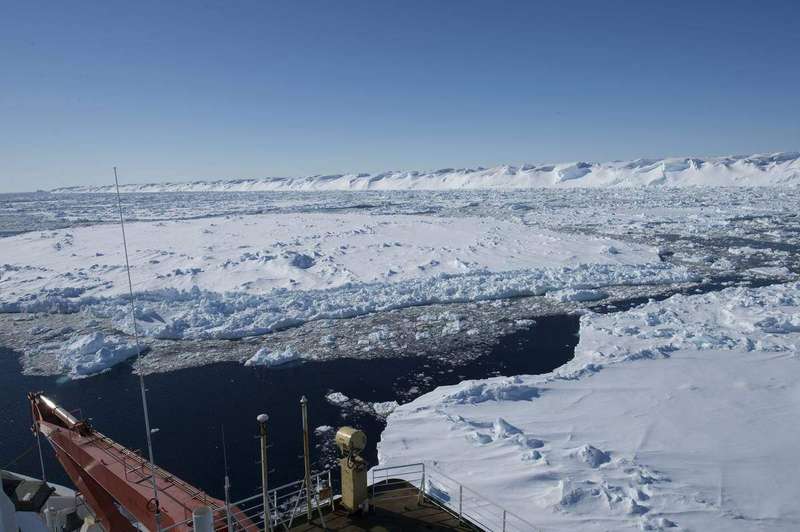
The same physics scales up to the planet. Icebergs are freshwater ice floating in the sea, and sea ice regulates how the oceans exchange heat with the atmosphere. An ordinary ice cube in a drink is a small demonstration of chemistry with planetary consequences.
FAQ
Is water the only substance that floats as a solid in its own liquid?
It is the most famous example, but not the only one. A handful of substances, including silicon and gallium, also expand on freezing. Among everyday materials, though, water is the standout exception.
Why is ice less dense than water if cold things are usually denser?
Cold usually means tighter packing, and water follows that rule down to 4°C. Below that, hydrogen bonds start building an open crystal structure that takes up more space. That structural effect outweighs the thermal contraction.
Does hot water really freeze faster than cold water?
That is the Mpemba effect, a separate and still-debated phenomenon. It does not change the density story: whatever the starting temperature, the ice that forms is less dense than the liquid it came from.
How much of an iceberg is underwater?
Typically around 90%, which follows directly from the density ratio. With ice at 0.917 g/cm³ floating in water near 1 g/cm³, about nine-tenths of the mass must sit below the surface to displace its own weight.
The bottom line
Ice floats because hydrogen bonds force water molecules into a roomy hexagonal crystal instead of letting them pack tight. That quirk reverses the normal solid-sinks rule, and it is why lakes freeze top-down, why icebergs ride high enough to see, and why aquatic life survives the winter.
Rive News's research desk writes plain-English explainers on technology, health, money, home, and science.
Latest in Science
- eSIM vs physical SIM for international travel: what changes abroad
- Leg cramps vs restless legs syndrome difference, explained
- What is a daily periodic rate on a credit card?
- Why does condensation form on windows in winter?
Get one practical explainer in your inbox every morning. Subscribe to the Rive News newsletter.
Corrections: spotted an error? We fix verified mistakes promptly and note the update with a timestamp.
Related stories

Why diamond is hard and graphite is soft when both are carbon
Diamond and graphite are both pure carbon, yet diamond is 10 on the Mohs scale and graphite is 1 to 2. The difference is not the atoms;

Why Hot Water Can Freeze Faster Than Cold: The Mpemba Effect Explained
Hot water can freeze faster than cold under specific conditions. The Mpemba effect, named for a 1963 schoolboy experiment, still divides

How Magnets Work at the Atomic Level: Spins, Domains, and Iron
Magnetism comes from electrons: their spin and orbits make each atom a tiny magnet. In iron, quantum forces align these atomic magnets into