
Why Is Altitude Sickness Worse for Some People?
Key takeaways
- Fitness does not protect against altitude sickness: the CDC states plainly that training and physical fitness do not affect risk.
- What matters most is how fast you ascend, how high you sleep, and how your body handled altitude before.
- Susceptibility is partly genetic, and people with lung conditions, recent illness, or dehydration face higher risk.

Trekkers on the way to Everest Base Camp, where sleeping altitudes far exceed the 8,000-foot threshold where altitude illness becomes common. Photograph: Icicles Adventure Treks & Tours (P.
) Ltd. /Wikimedia Commons.
Image Credits: Wikimedia Commons
Altitude sickness is what happens when your body cannot adapt fast enough to thin air. Above about 8,000 feet, the air holds noticeably less oxygen, and anyone whose body lags behind the ascent can develop headaches, nausea, fatigue, and dizziness.
What puzzles most travelers is the unfairness of it. A marathon runner can be flattened while their out-of-shape friend feels fine. That randomness is real, and researchers have spent decades figuring out what actually separates the sick from the spared.
This article explains what altitude sickness is, why fitness does not protect you, which factors actually raise your risk, and how to lower it.
What altitude sickness is
The umbrella term covers three related conditions. Acute mountain sickness (AMS) is the common one: headache plus fatigue, dizziness, nausea, or poor sleep, usually starting 2 to 12 hours after arrival and lasting a day or two. MIT's environment, health, and safety office notes that above 8,000 feet, roughly 75 percent of people feel at least some symptoms.
The other two are rare and dangerous. High-altitude pulmonary edema (HAPE) happens when lung arteries constrict in low oxygen and fluid leaks into the lungs, causing breathlessness and cough.
High-altitude cerebral edema (HACE) is swelling in the brain, with confusion and loss of coordination. Doctors at CU Anschutz report that HAPE kills around half of its victims without rapid evacuation to lower elevation.
All three share one cure that never changes: go down. Every other treatment buys time for descent.
Why fitness does not protect you
This is the finding people resist most. The CDC's Yellow Book chapter on high-altitude travel states it without hedging: "Training and physical fitness do not affect risk." Your VO2 max says nothing about how your body handles hypoxia.
A CU Anschutz medical Q&A goes further, listing the factors that do not appear to affect the likelihood of developing AMS: previous altitude exposure without symptoms, physical fitness level, age, sex, and smoking. The fittest person on the trip is not the safest; they are just the one most likely to overexert on day one, which does make things worse.
There is a nuance worth stating honestly. The CDC also says susceptibility and resistance are "in part, genetically determined traits," while noting there are no simple screening tests to predict risk. So individual biology matters, but it is not the kind of biology you can train, and you cannot test for it in advance.
What about age and sex? The CDC notes that travelers over 50 have slightly less risk and that sex plays a minimal role, if any. CU Anschutz lists age and sex among factors that do not appear to matter.
The two sources do not fully agree, which itself is informative: the honest answer is that demographic factors are weak predictors at best.
What actually raises your risk
How fast you climb. The CDC identifies two main risk factors beyond inherent susceptibility: the altitude where you enter high country and your subsequent rate of ascent. Flying from sea level straight to a ski town is the classic trigger, because the body gets no gradual adjustment.
How high you sleep. Sleeping altitude matters more than daytime altitude. Swiss Alps data cited by News-Medical found AMS in 9 percent of mountaineers at 2,850 meters but 53 percent at 4,559 meters. The mountaineer's rule is simple: climb high, sleep low.
Where you normally live. Visitors to a Colorado ski resort who lived at sea level faced a 27 percent risk of AMS, compared with 8.4 percent for visitors who lived at about 1,000 meters, according to research summarized by News-Medical. Coming from the plains puts you at a disadvantage.
Your history. How you responded to altitude before is the most reliable guide to future trips, the CDC says, provided the altitude and ascent rate are similar. It is not infallible, but it beats every other predictor. People who have had HAPE before face about a 60 percent recurrence risk on similar ascents, per clinical reviews.
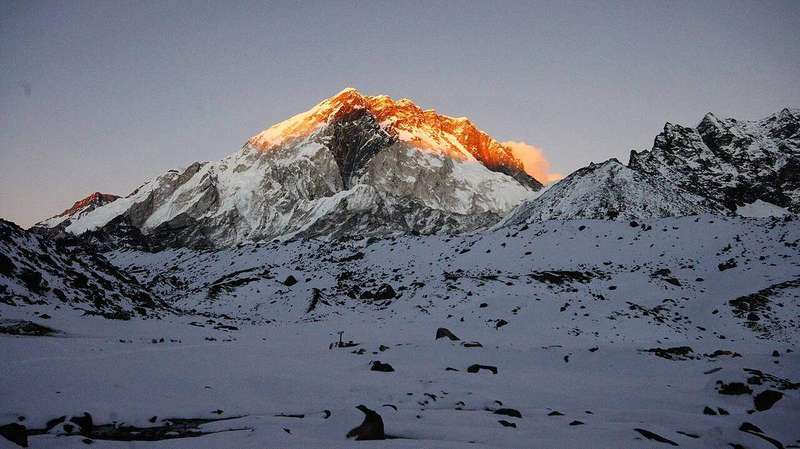
The Everest Base Camp trek route: rapid altitude gain on itineraries like this is exactly the pattern that produces the most cases of altitude illness. Photograph: Parashu98512/Wikimedia Commons
Image Credits: Wikimedia Commons
Your health that week. Anything that interferes with acclimatization raises risk, CU Anschutz notes: asthma, COPD, viral illnesses, alcohol consumption, dehydration, and obesity. Drugs.com similarly lists obesity as a risk factor and notes that genetics may raise HAPE risk specifically.
Your genes. Communities that have lived at altitude for thousands of years, such as Himalayan and Andean populations, carry genetic adaptations for thin air. For the rest of us, individual genetic differences in the hypoxia response likely explain much of the mystery, though researchers have not pinned down a simple test.
How to lower your risk
Ascend gradually. Above 8,000 feet, the standard guidance is to raise your sleeping altitude by no more than about 1,000 to 1,600 feet per day and to take a rest day every few days. It feels slow, and that is the point.
Take it easy at first. Vigorous exercise during the first days at altitude worsens hypoxemia and can tip borderline AMS into something serious. Save the summit push for after you have acclimatized.
Stay hydrated and go easy on alcohol. Dehydration is a listed risk factor, and alcohol both dehydrates and masks symptoms. Neither is a cure, but both shift the odds in your favor.
Watch your companions, not just yourself. HACE impairs judgment, so the sick person is often the last to notice. Headache plus clumsiness or confusion means descend immediately, day or night.
Consider the itinerary before the gear. Choosing a route with a sane trail difficulty rating and a gradual profile matters more than any supplement. Good boots that fit prevent blisters, but only pacing prevents AMS.
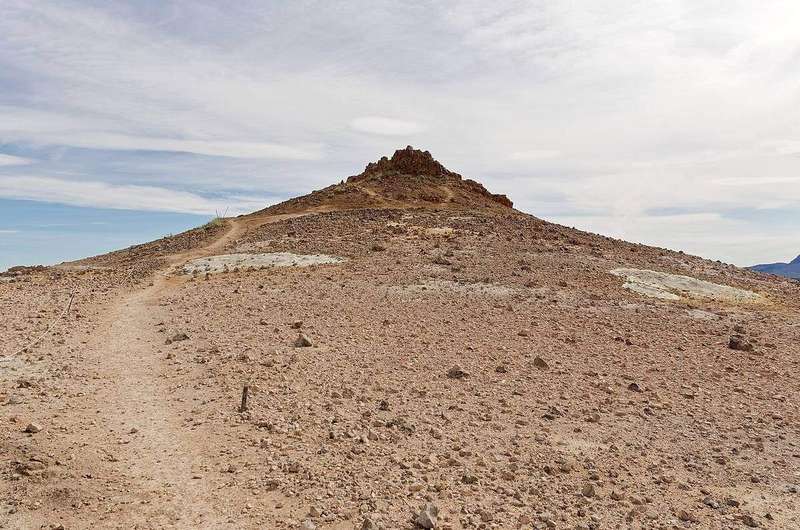
A mountain hiking trail: gradual routes with sensible daily altitude gains give your body the time it needs to acclimatize. Photograph: Jakubhal/Wikimedia Commons
Image Credits: Wikimedia Commons
Frequently asked questions
At what altitude does altitude sickness start?
Usually above 8,000 feet (about 2,450 meters), though sensitive individuals occasionally feel symptoms as low as 5,000 feet, according to CU Anschutz. Risk climbs steeply with every additional thousand feet of sleeping altitude.
Can you build immunity to altitude sickness?
Not immunity, but acclimatization. Spending days at moderate altitude before going higher lets your body adjust, and the protection lasts roughly one to two weeks after you descend. Past symptom-free trips are the best predictor of future ones.
Does drinking more water prevent altitude sickness?
Hydration helps because dehydration is a risk factor, but water alone does not prevent AMS. The factors that matter most are ascent rate and sleeping altitude. Think of hydration as removing a disadvantage rather than gaining protection.
When should I descend?
Descend if symptoms worsen despite rest, or immediately if you notice breathlessness at rest, a wet cough, confusion, or loss of coordination. Those signal HAPE or HACE, and both can turn fatal within hours. Do not wait for morning.
The bottom line
Altitude sickness hits some people harder because of their genes, their ascent profile, and their health on the trip, not because of their fitness. Climb gradually, sleep low, hydrate, and respect the first headache.
This article is for information only and is not medical advice. If you have heart or lung conditions, talk to a travel-medicine clinician before any high-altitude trip, and treat worsening symptoms as a reason to descend, not to push on.
Tags: altitude sickness, hiking, mountaineering, travel health, outdoor safety
Rive News is the research desk behind this publication, covering sports, the outdoors, and adventure with sourced, practical guidance.
Latest in Sports
- Why do you get blisters when hiking and how to prevent them
- What Does Hiking Trail Difficulty Rating Actually Mean?
- How to choose hiking boots for beginners: fit, features, and break-in
- What to Do If You Get Lost Hiking: Step by Step
Subscribe for one practical outdoors guide in your inbox every week.
Related stories

Why Do You Get Blisters When Hiking and How to Prevent Them
Friction plus moisture plus heat equals a blister. Learn why hiking breeds all three, and the boots, socks, and tape system that keeps

How to choose hiking boots for beginners: fit, features, and break-in
Beginners should buy for fit first: snug everywhere, tight nowhere, with a thumb's width at the toes. Here is how to size, test,
What Does Hiking Trail Difficulty Rating Actually Mean?
Hiking trail difficulty ratings work differently by system: the US Yosemite Decimal System and Europe's SAC scale from T1 to T6. Learn