
Working memory: what it is and why it limits study multitasking
By Rive News / Research desk | Rive News / Published October 24, 2026 at 9:00 AM PKT
Key takeaways
- Working memory is your brain's short-term workspace for holding and using information. Baddeley and Hitch's 1974 model splits it into an attention controller and two specialist stores.
- It holds roughly four chunks of information, not seven. Nelson Cowan's 2001 review found the classic "seven plus or minus two" estimate overstates the real limit.
- Every switch between study tasks pays a time tax through goal-shifting and rule reactivation. Rubinstein, Meyer and Evans found these costs climb with task complexity.

Students reading at desks in a public library, books open and heads down. Photograph: Samircreator
Image Credits: Wikimedia Commons
Working memory is the part of your mind that holds information for a few seconds while you actively work with it. When you solve a problem in your head, follow spoken directions, or keep the start of a sentence in mind while reading its end, you are using working memory.
Its defining feature is a strict capacity limit. Psychologist Nelson Cowan's 2001 review concluded that young adults hold roughly four chunks of information at once, which is why study multitasking fails: every extra task competes for the same few slots.
This article explains working memory, including how Baddeley's working memory model works, the four-chunk capacity limit, why switching tasks drains your study session, and studying without overloading working memory.
How Baddeley's working memory model works
The most influential account of working memory comes from British psychologists Alan Baddeley and Graham Hitch, who proposed their model in 1974. They wanted a replacement for the older multi-store model of Atkinson and Shiffrin (1968), which treated short-term memory as a single passive box that information simply passed through.
Baddeley and Hitch argued that short-term memory is active and divided into parts. At the center sits the central executive, a controller that directs attention and coordinates the other components. It plans, switches between tasks, and decides what gets priority, and it has limited capacity of its own.
Under it work two specialist stores. The phonological loop handles words and sounds: an "inner ear" briefly holds what you hear, while an "inner voice" silently repeats it to keep it alive for a second or two. The visuospatial sketchpad is the mind's eye, holding images and spatial layouts, like picturing the route through a building you have never visited.
In 2000, Baddeley added a fourth piece, the episodic buffer, which binds information from the other parts together and links it to long-term memory. That addition turned the model into the version most textbooks teach today, according to Simply Psychology's overview of the model.
The evidence for separate parts came from dual-task experiments. When people did a visual task and a verbal task at the same time, performance was nearly as good as doing each alone. But two tasks sharing the same subsystem, like reading while repeating "the the the" aloud, slowed both down, as tutor2u's psychology reference describes.
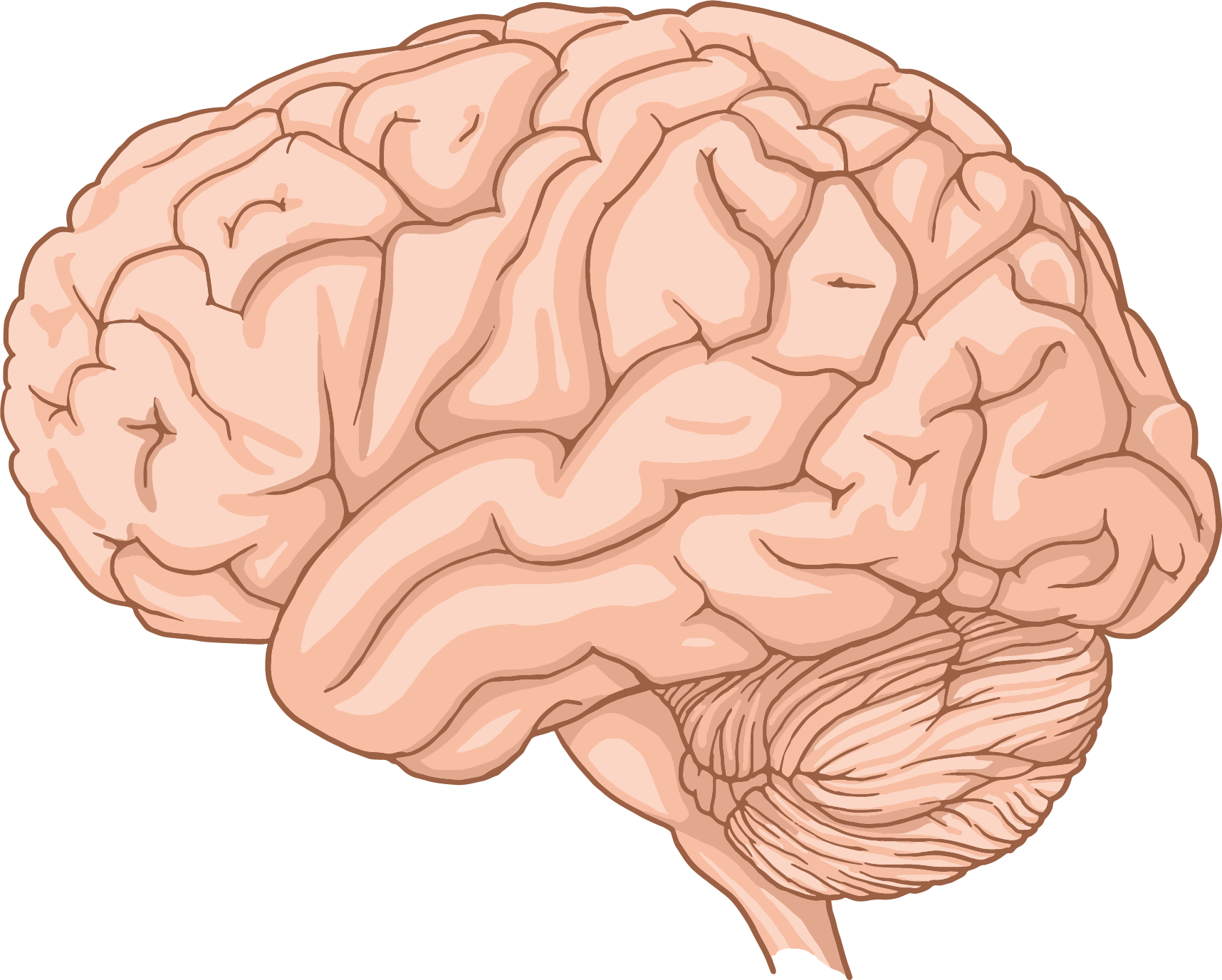
A lateral illustration of the human brain, whose working-memory architecture sets the limit on how much we can juggle at once. Photograph: NIAID / Ryan Kissinger
Image Credits: Wikimedia Commons
For studying, this split matters more than it looks. Reading a chapter while a podcast plays is two tasks fighting over the same phonological loop. Sketching a diagram while listening to a lecture splits cleanly across two stores, which is one reason that combination tends to feel easier.
The four-chunk capacity limit
The capacity question goes back to 1956, when psychologist George A. Miller published a paper called "The Magical Number Seven, Plus or Minus Two." He reported that young adults could hold about seven chunks, whether digits, letters, or words, in immediate memory.
The number shrank under closer inspection. Memory span turned out to depend on the material: roughly seven for digits, six for letters, and five for words, with worse performance for long or unfamiliar words. A span measured one way did not predict a span measured another way.
Then Nelson Cowan revisited the question in a 2001 paper, "The magical number 4 in short-term memory: a reconsideration of mental storage capacity," published in the journal Behavioral and Brain Sciences, volume 24, issue 1, pages 87 to 114. After pulling together results from many different experiments, he concluded that pure working memory capacity in young adults averages about four chunks, with lower figures for children and older adults, according to the paper's abstract on PubMed.
A chunk is whatever counts as one meaningful unit to you. A ten-digit phone number is ten chunks to a stranger and two chunks to someone who reads it as an area code plus a local number. This is why experts can hold more: their knowledge compresses information into bigger chunks, not because their raw capacity is larger.
Four chunks is not much. It means that while you study, there is room for the question you are answering, the two or three facts it depends on, and almost nothing else. Anything beyond that gets dropped or pushed out, and that is exactly where multitasking starts to hurt.
Why switching tasks drains your study session
The uncomfortable truth about multitasking is that you are not doing two things at once. You are switching between them in rapid sequence, and every switch costs time.
Joshua Rubinstein, David Meyer, and Jeffrey Evans tested this in four experiments published in 2001 in the Journal of Experimental Psychology: Human Perception and Performance, volume 27, number 4, pages 763 to 797. Participants switched between tasks like solving arithmetic problems and classifying geometric objects. Switching always cost time, and the cost grew with the complexity of the task's rules, according to a Medscape report on the study.
First comes goal shifting: the brain disengages from one objective and registers the next. Then comes rule activation: it loads the procedures and context the new task needs.
According to the study's reporting, rule activation can take several tenths of a second to a full second each time.
Tenths of a second sound trivial until they stack. A 2006 summary from the American Psychological Association, cited in a review of task-switching research, reported Meyer's suggestion that multitasking can reduce task productivity by as much as 40 percent. An hour of "studying while checking your phone" can quietly become 36 minutes of actual studying.
There is also residue. Psychologist Sophie Leroy's 2009 research described attention residue: when you leave a task unfinished, part of your attention stays stuck on it, dragging down whatever you do next. That quick phone check between problems keeps taxing your focus after the phone is back in your pocket.
The same interference logic explains why blanking out on a test despite studying feels so sudden: overload the workspace and retrieval fails at the worst possible moment.

Students writing an examination in a hall, each relying on the same small mental workspace under time pressure. Photograph: Hauwasysy
Image Credits: Wikimedia Commons
Studying without overloading working memory
The research points at a simple strategy: stop making the workspace do jobs it was never built for. Offload, chunk, and do one thing at a time.
Write things down. Notes act as an external loop: once a fact lives on paper, it no longer occupies one of your four slots. Students who sketch the structure of a topic before diving into details give the visuospatial sketchpad something concrete to hold while the phonological loop handles the words.
Chunk deliberately. Group vocabulary into themed sets of four or five, turn a long proof into named steps, and memorize formulas as single labeled units. Each chunk costs one slot no matter how much meaning it packs, so bigger chunks buy you more room.
Study in single-task blocks. Twenty-five focused minutes on one subject beats an hour of bouncing between the textbook, the group chat, and a video. Decide your task order before you start, so the central executive is not burning attention on deciding what to do next.
This is the opposite of last-minute cramming, which floods all four slots at once and leaves nothing stable enough to reach long-term memory. Spaced, single-task sessions respect the limit instead of fighting it.
Frequently asked questions
Is listening to music while studying really multitasking?
It depends on the music and the material. Lyrics engage the phonological loop, the same subsystem that handles reading and verbal reasoning, so songs with words compete directly with word-based study. Instrumental music shares less of that machinery, though for demanding verbal work, silence asks the least of the workspace.
Why do I feel productive when I switch between subjects?
Switching delivers a small jolt of novelty, and busy hands can feel like a busy brain. The switching research suggests the feeling is misleading: each return to a task pays a reactivation cost, and errors creep in where the old task's rules still linger. Time on task and learning are not the same thing.
Can I train my working memory to be bigger?
The evidence suggests the core limit is fairly stable in adults. What improves is how you use the space you have: chunking information into larger units, automating basics like times tables so they cost less, and offloading to paper. Think bigger chunks, not more slots.
Does taking notes while reading count as multitasking?
Not in the harmful sense. Note-taking serves the same goal as the reading and uses partly different machinery, like the motor system and the visual store. The research concern is switching between unrelated goals, not working on one goal through several channels.
The bottom line
Working memory is a small, active workspace: about four chunks, split across verbal and visual stores, run by an attention controller that cannot truly divide itself. Every task switch spends some of that space on reconfiguration instead of learning.
Study one thing at a time, write ideas down instead of juggling them, and pack your material into chunks of four. The limit will not move, but you will stop wasting it.
Tags: working memory, study habits, multitasking
Rive News's research desk covers the science of learning and memory, building every explainer from peer-reviewed research and documented experiments.
Related
- How to Prepare for a Maths Exam Step by Step
- Why Do You Blank on Names but Remember Faces?
- Why Do I Blank Out During Tests Despite Studying
Study smarter every week: subscribe to the Rive News newsletter for one research-backed learning tip in your inbox.
Rive News's standards: every factual claim is sourced, every image is licensed for reuse, and corrections are published openly.
Related stories
Why Does Cramming Not Work for Long-Term Learning? The Science
Cramming fails for long-term learning because of the spacing effect: a UC San Diego study of 1,000+ subjects found wider study gaps raised
Why Do We Forget Things Right After the Test? Memory Science Explains
Forgetting after a test follows the Ebbinghaus curve: about half of new learning fades within an hour. See why cramming fades and what

Why you blank on answers you knew during the test
Blanking on a test is usually retrieval failure under pressure, not lost knowledge. Research on working memory and test anxiety explains