
Why Are Airplane Wings Swept Back? Transonic Drag Explained
Key takeaways
- Swept wings delay the shock waves that cause drag to spike near the speed of sound, letting airliners cruise efficiently at about Mach 0.85.
- The concept was proposed by Adolf Busemann at a 1935 aeronautics conference in Rome and proven in German wind-tunnel tests by 1939.
- Sweep is a trade-off: it trims high-speed drag but reduces low-speed lift, which is why airliners need slats and flaps for takeoff and landing.
An airplane wing looks like it is being pulled backward by the wind. That arrow shape is not styling. It is one of the most consequential ideas in aviation history, and it exists to solve a single problem: the violent increase in drag that appears as an airplane approaches the speed of sound.
Slow airplanes wear straight wings, which are the most efficient shape at low speed. Fast airplanes wear swept wings, because a straight wing near Mach 1 develops shock waves that act, in the words of FLYING magazine, "somewhat like large spoilers," ballooning the airplane's drag. Sweeping the wing back is the standard engineering answer.
This article explains what swept wings do to airflow, where the idea came from, why the design involves real trade-offs, and why a few airplanes sweep their wings forward instead.
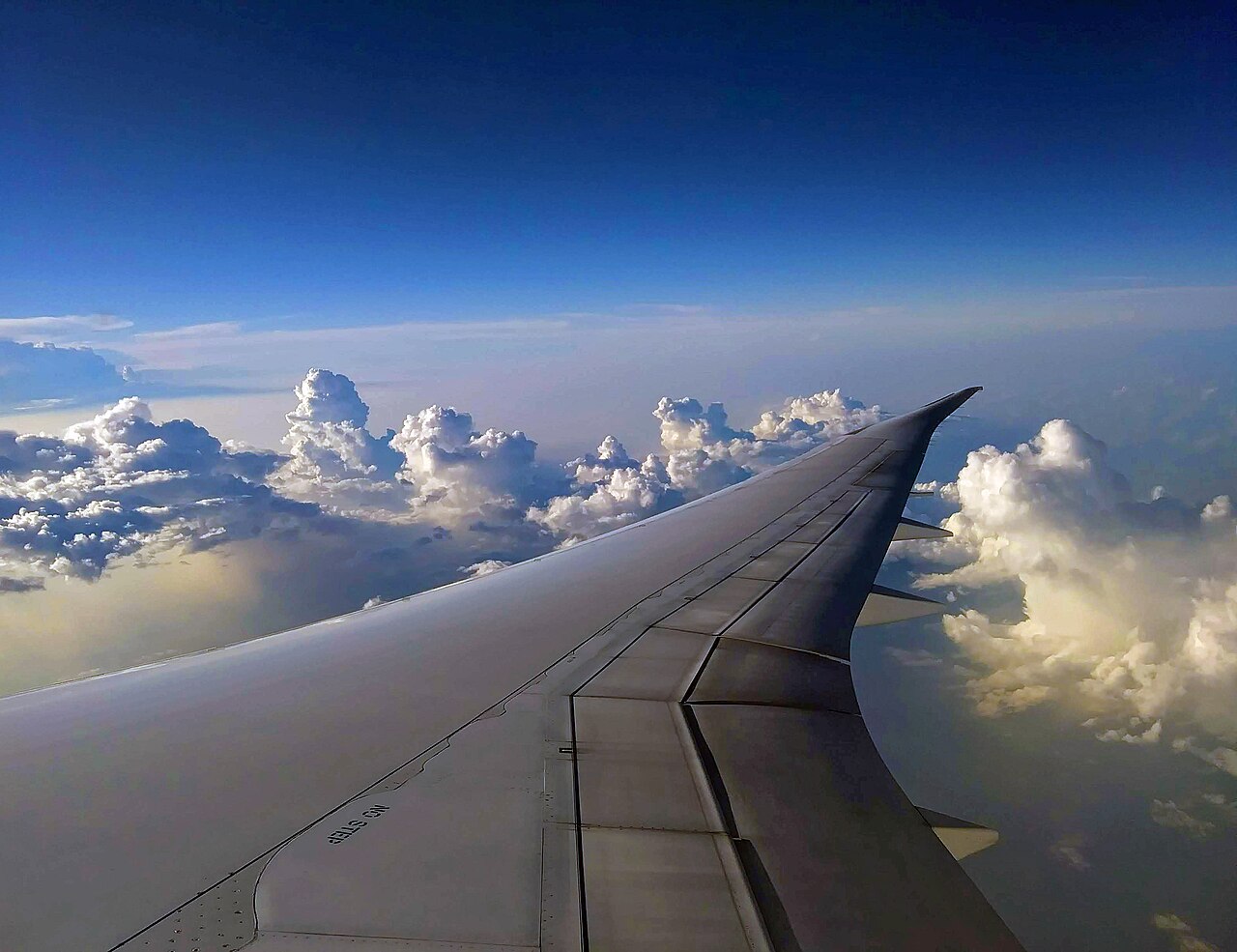
The swept wing of an airliner seen from a cabin window. The angle delays shock-wave formation at cruise speed. Photograph: Daniel Case
Image Credits: Wikimedia Commons / Daniel Case, Andrey Filippov, Olivier Cleynen
What sweep does to the air
As an airplane accelerates, the airflow over the top of its wing moves faster than the airplane itself. That means parts of the wing can reach the speed of sound while the airplane is still flying subsonically. When that happens, shock waves form: sudden discontinuities in air pressure and temperature that create a huge, turbulent wake behind the wing.
Drag then rises extremely fast with small increases in speed. The speed at which the shock waves first appear is called the critical Mach number.
For the straight wings of the 1940s, that threshold arrived too early for the jet engines of the era to push past. No engine then available could muscle an airplane much beyond its critical Mach number, because the drag increase was, as FLYING puts it, "as steep as a cliff."
Sweeping the wing changes the geometry of that encounter. Only the component of airflow striking the wing at right angles to its leading edge contributes to lift, drag, and shock formation.
Air sliding along the wing's length can, in a rough theory, be ignored. So if the wing is angled back by a sweep angle s, the wing effectively "feels" only v times cos s, a slower speed than the airplane is actually flying.
This is the core trick, and NASA's educational pages state it plainly: sweepback lets the airplane fly a little closer to the speed of sound without paying the associated drag penalty. The Airbus A320, for instance, carries about 25 degrees of sweepback, which buys its designers exactly the margin needed for efficient cruising near Mach 0.8.
Where the idea came from
The swept wing was born in the 1930s, in Germany, out of pure theory. At the Volta Conference in Rome in 1935, aerodynamicist Adolf Busemann suggested angling wings for supersonic flight.
He argued that the airspeed over the wing was dominated by the airflow component perpendicular to the leading edge, not the freestream velocity, so setting the wing at an angle would push shock-wave formation to a higher forward speed. Max Munk had noted a similar geometric point in 1924, but Busemann put it in the context of high-speed flight, and Albert Betz immediately saw the same logic would work in the transonic range.
From wind tunnels to the F-86 Sabre
Theory became data in 1939, when Hubert Ludwieg of the AVA Gottingen wind-tunnel group tested a straight wing against a 45-degree swept wing at Mach 0.7 and 0.9 in a small 11 by 13 centimeter tunnel. The swept wing showed the promised drag reduction at transonic speeds. The tests were expanded in 1940 to sweep angles of 15, 30, and even negative 45 degrees, at Mach numbers up to 1.21. The results went to Willy Messerschmitt in December 1939, and swept wings soon appeared on the Messerschmitt Me 262, one of the first operational jet fighters.
After the war, Operation Paperclip carried Germany's swept-wing research to the United States. The documents arrived just in time for American manufacturers to scrap straight-wing designs and adopt swept ones for the F-86 Sabre and the B-47 Stratojet.
FLYING notes that the swept wing proved "manifestly superior for airplanes flying faster than about 70 percent of the speed of sound," which is exactly the regime every jet airliner lives in. Passengers feel one more effect of that history on every flight: cruising at 35,000 feet only makes economic sense because swept wings keep drag low at those speeds.
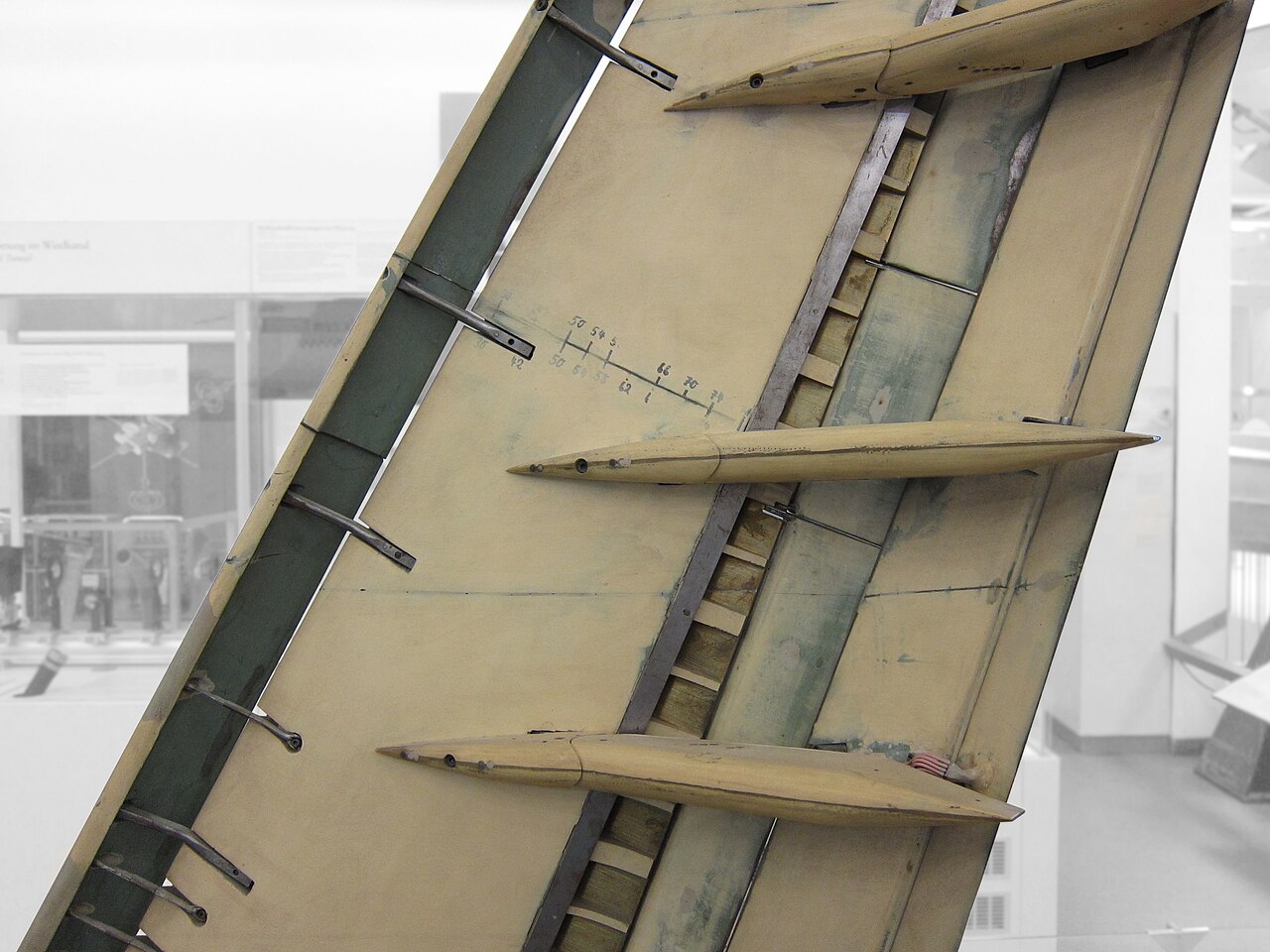
A wind-tunnel model of an airliner wing. Tests like Hubert Ludwieg's 1939 experiments at Mach 0.7 and 0.9 proved sweep cut transonic drag. Photograph: Olivier Cleynen
The trade-offs sweep forces on designers
Sweep is not free. A swept wing produces less lift per degree of angle of attack than a straight wing of the same size, which means worse performance at the slow speeds of takeoff and landing. Airliners compensate with elaborate high-lift systems: slats that extend from the leading edge and multi-segment flaps at the trailing edge, all of which unfold for the slow phases of flight and tuck away for cruise.
Why swept wings stall differently
Sweep also moves the wing's lift distribution outward, making the wingtips prone to stalling first. A tip stall on a swept wing can pitch the nose up and deepen the stall, a nasty handling trait.
Designers fight it with wing twist, fences, and carefully shaped leading edges. The spanwise flow that sweep induces also adds its own drag at low speeds, which is why no one puts swept wings on a crop duster.
A hidden stability bonus
There is even a subtle stability story. Sweep provides a dihedral-like effect, rolling the airplane out of a sideslip.
That is why the very first swept-wing airplane, built by Dunne in 1907, used sweep partly for stability rather than speed. The modern transonic reason came decades later.
Why not sweep the wings forward?
Forward sweep works aerodynamically: the same cosine rule applies, and the wing root stalls before the tip, which is actually nicer for handling. NASA flew the X-29 experimental aircraft with forward-swept wings to explore exactly this.
The problem is structural. Air loads on a flexible forward-swept wing twist it in a way that increases the angle of attack, which increases the load, which twists it further: a divergence spiral that can tear the wing apart.
Carbon-fiber composites, which can be laid up to resist that twisting, make forward sweep feasible today, and some designs use it. But for metal airliner wings, the swept-back layout remains the lighter, simpler answer. Watch the wing from your window seat on a humid day: the visible airflow patterns are the pressure field that sweep is designed to tame.
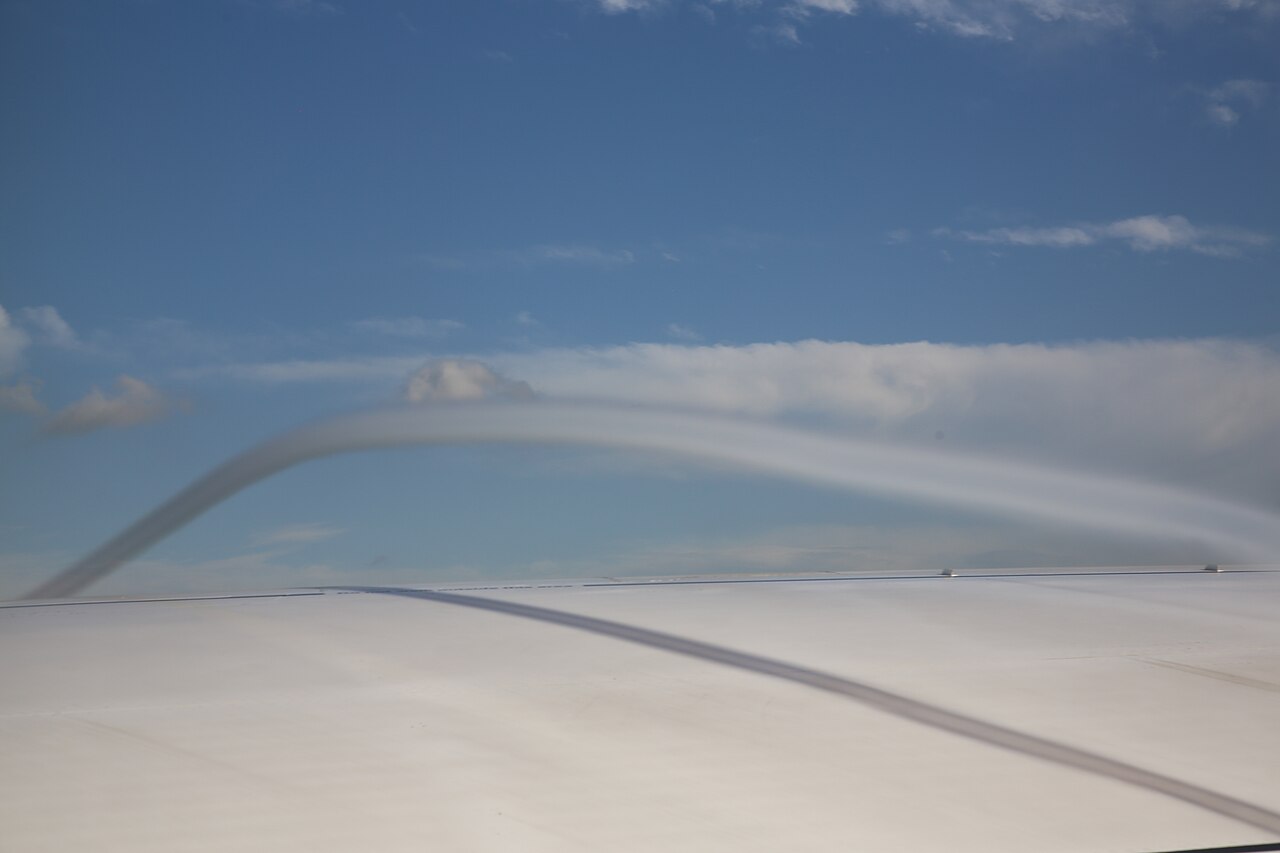
Condensation streaming over a swept wing reveals the airflow the design manages at high subsonic speed. Photograph: Andrey Filippov
Do swept wings make planes faster?
They let planes cruise faster without a drag penalty, which is slightly different. A swept wing raises the critical Mach number, so the same engines can push the airplane to a higher efficient cruise speed, typically around Mach 0.85 for airliners. Top speed still depends on thrust.
Why do small propeller planes have straight wings?
Below about 70 percent of the speed of sound, shock-wave drag is not a factor, and the straight wing is simply more efficient: more lift per angle of attack and gentler stall behavior. Sweep would add weight and complexity for no benefit. That is why trainers and bush planes keep their wings square to the fuselage.
What is the sweep angle on a typical airliner?
It varies with design cruise speed. The Airbus A320 uses about 25 degrees of sweepback, according to NASA. Larger long-haul jets like the Boeing 747 use more, around 37.5 degrees, because they cruise slightly faster and the extra sweep buys extra margin against shock formation.
Could a plane have variable sweep like a fighter jet?
Military swing-wing aircraft such as the F-14 did exactly that: wings out for slow flight, swept back for speed. The mechanism is heavy and maintenance-intensive, so no airliner has adopted it. Modern airliners accept the compromise of a fixed moderate sweep plus high-lift devices.
The bottom line
Airplane wings sweep back for one reason: to cheat the speed of sound. By angling the wing, designers reduce the airflow component the wing actually feels, delaying the shock waves that make drag explode near Mach 1.
The idea traveled from Busemann's 1935 Rome lecture through wartime wind tunnels to every jet airliner flying today. The price is weaker low-speed lift, paid back with slats, flaps, and careful wing design. Next time you board, glance out at the wing: that angle is ninety years of aerodynamics, holding your cruise speed steady.
Latest in Travel
- The 3-1-1 rule for liquids on planes
- Why your ears pop on planes, and how to stop it
- Why airplane food tastes bland at altitude
- Why planes cruise at 35,000 feet
Get one practical travel explainer like this every morning. Subscribe to the Rive News newsletter.
Related stories

The 3-1-1 liquids rule for planes: what each number means
TSA's 3-1-1 rule limits carry-on liquids to 3.4-ounce containers in one quart bag. Where the 2006 rule came from, what counts, and how
Why Is Airplane Food So Bland at Altitude?
A 2010 Fraunhofer study found altitude cuts sweet and salty perception by up to 30 percent. Low humidity, cabin pressure, and noise all
Carry-on size limits: why airlines each set their own
Airlines set their own carry-on limits because the FAA only requires each carrier to have a policy, not one global size. Why 22 x 14 x