
Why Cabin Air on Planes Is So Dry and What It Does to You
Key takeaways
- Cabin air typically sits at 5-12% relative humidity, and can fall to 2-3%, which is drier than the Sahara Desert's average of about 25%.
- The dryness comes from engine bleed air: compressed to 200-250C and cooled to 15-20C, a process that wrings out nearly all moisture.
- Airlines keep cabins dry on purpose, because humidity accelerates corrosion in aluminum airframes; newer composite jets run slightly more humid.
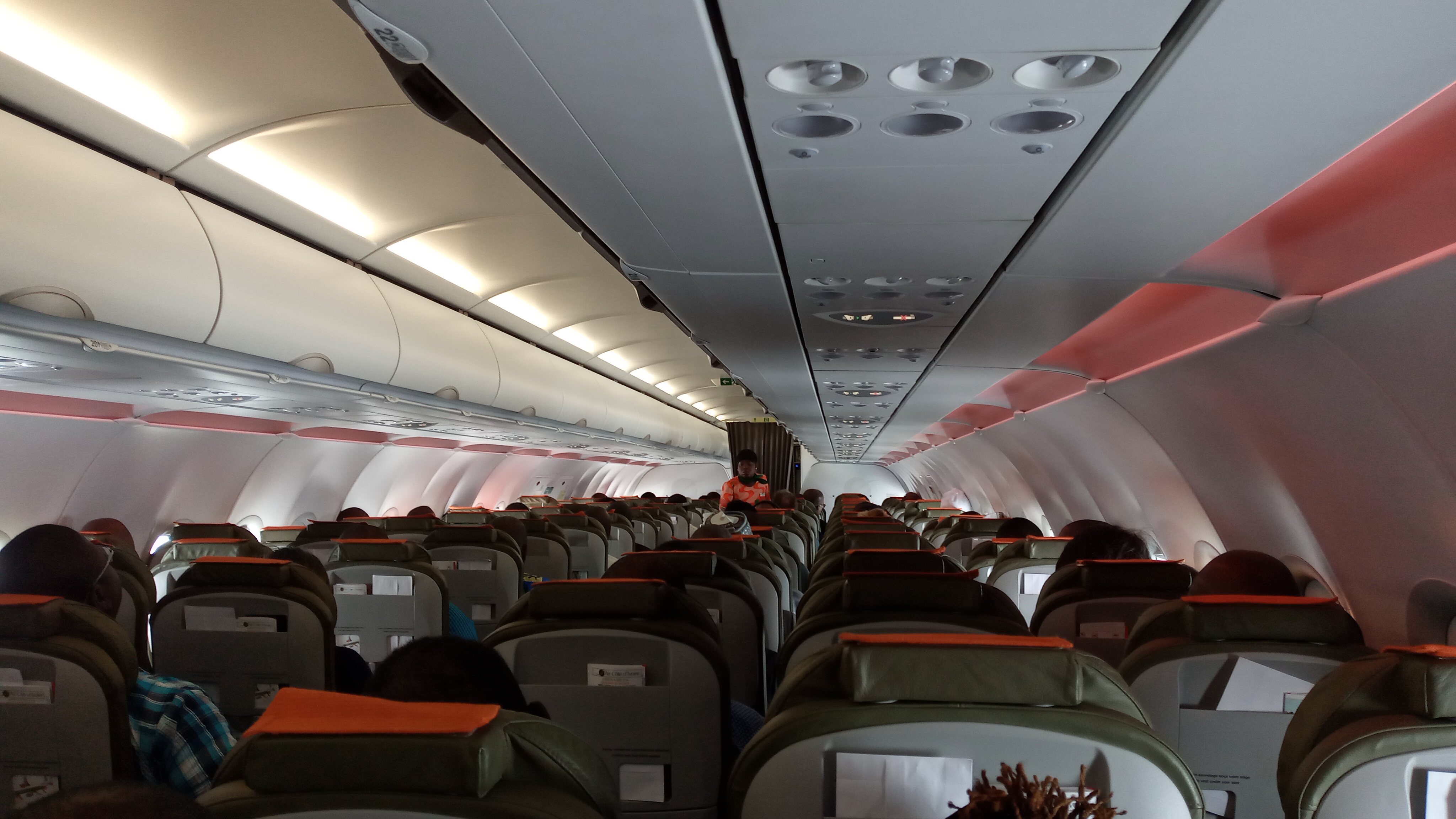
Passengers in a typical economy cabin, breathing some of the driest air most people will ever encounter.
Image Credits: Wikimedia Commons
Step onto a long-haul flight and you are breathing air that can measure as little as 2 to 3 percent relative humidity, according to Daybreak Wire's analysis. The Sahara Desert averages about 25 percent. Your living room on an ordinary day sits somewhere between 40 and 60 percent.
Somewhere over the ocean, the cabin around you is drier than one of the driest places on Earth, and it is not an accident or a cost-cutting shortcut. It is what happens when you compress air hot enough to cook a chicken and then cool it back down.
This article explains where cabin air comes from, why the engineering that makes it breathable also makes it bone dry, why airlines keep it that way on purpose, and what you can do about it.
Where cabin air actually comes from
Most of the air in a commercial cabin starts outside the plane. At cruising altitude the outside air is extremely cold and thin, so jet engines compress it to make it breathable. A portion of this compressed air, called bleed air, is drawn off before the fuel is burned, meaning it never passes through combustion, as Monroe Aerospace explains.
That bleed air leaves the compressor at roughly 200-250C and 40 psi, Daybreak Wire reports, citing aviation-wellness outlet Good Flyte. It then runs through an air cycle machine that cools it to a cabin-friendly 15-20C before it reaches a single passenger.
The cooling step is where the moisture disappears. Compressing air and then cooling it wrings out nearly all the water vapor it started with, and it did not start with much, since outside air at cruising altitude is itself close to bone dry.
The numbers are stark. A peer-reviewed study published via the NIH's PMC archive reports that bleed air has a relative humidity of just 0.5 to 1 percent, and that typical cabin humidity at cruise is 5 to 20 percent, occasionally as low as 2 percent.
Kuvola's cabin-humidity guide puts the usual range at 5 to 12 percent, noting that the only meaningful source of moisture is the breath of passengers and crew. That is why a full economy cabin, at around 12 percent, is marginally less dry than a sparsely occupied first class cabin at around 5 percent, according to Business Traveller's reporting.
Why airlines keep it dry on purpose
The obvious fix, running a humidifier, creates a bigger problem than it solves. Moisture and bare metal do not mix well at altitude, and a fuselage exposed to years of elevated humidity corrodes faster. Daybreak Wire cites an internal Lufthansa Technik analysis concluding that pushing cabin humidity up to just 30 percent would roughly double corrosion-related maintenance work on an aircraft.
That trade-off is deliberate. Humidifying the dry air would also require airlines to carry enormous amounts of water, Kuvola notes, adding weight that burns fuel on every flight. So most airplanes intentionally use dry cabin air, as Monroe Aerospace puts it, because humidity and corrosion go hand in hand.
There is one more factor working against moisture. Cabin air is completely exchanged roughly every two to three minutes, about 20 to 30 air changes per hour, according to a cabin-air guide published by Daily Buzzz. That constant refresh, far more frequent than in offices or homes, means the small amount of moisture passengers exhale is filtered out almost as fast as it is produced.
Newer aircraft do a little better
Aircraft built mostly from carbon-fiber composite instead of aluminum do not corrode the way older all-metal fuselages do, so their manufacturers could afford to raise cabin humidity a little. The Boeing 787 and Airbus A350 typically run in the mid-teens rather than the single digits of an older 737 or A320, Daybreak Wire reports. Kuvola puts the figure at 15-20 percent for these jets, still well short of the 30-60 percent range people find comfortable.
The 787 goes further than most. It is the only airliner that does not use engine bleed air at all, instead using electrically driven cabin air compressors, Business Traveller reports. Combined with the composite fuselage, that design holds temperature more evenly and allows slightly more humid air, which is one reason many passengers report feeling better after long flights on those models.
What the dryness does to your body
Below roughly 20 percent relative humidity, the tear film across your eyes evaporates faster than your body can replace it, which is why eyes feel gritty on long flights. Your body also dehydrates quickly in such an environment. Ola Haggfeldt, chief commercial officer at Swedish humidity specialist CTT Systems, told Business Traveller that passengers lose about 70 grams of water every hour in dry cabin air, so even steady drinking may not fully keep up.
The NIH-published study found a measurable effect on the middle ear: low cabin humidity was associated with about a 20 percent decrease in eardrum admittance compared with measurements at the airport, which the researchers said could affect automatic pressure regulation of the middle ear during descent. Dry nasal passages and a scratchy throat round out the familiar list of complaints. None of this is dangerous for healthy travelers, but it explains why you step off a long flight feeling wrung out.
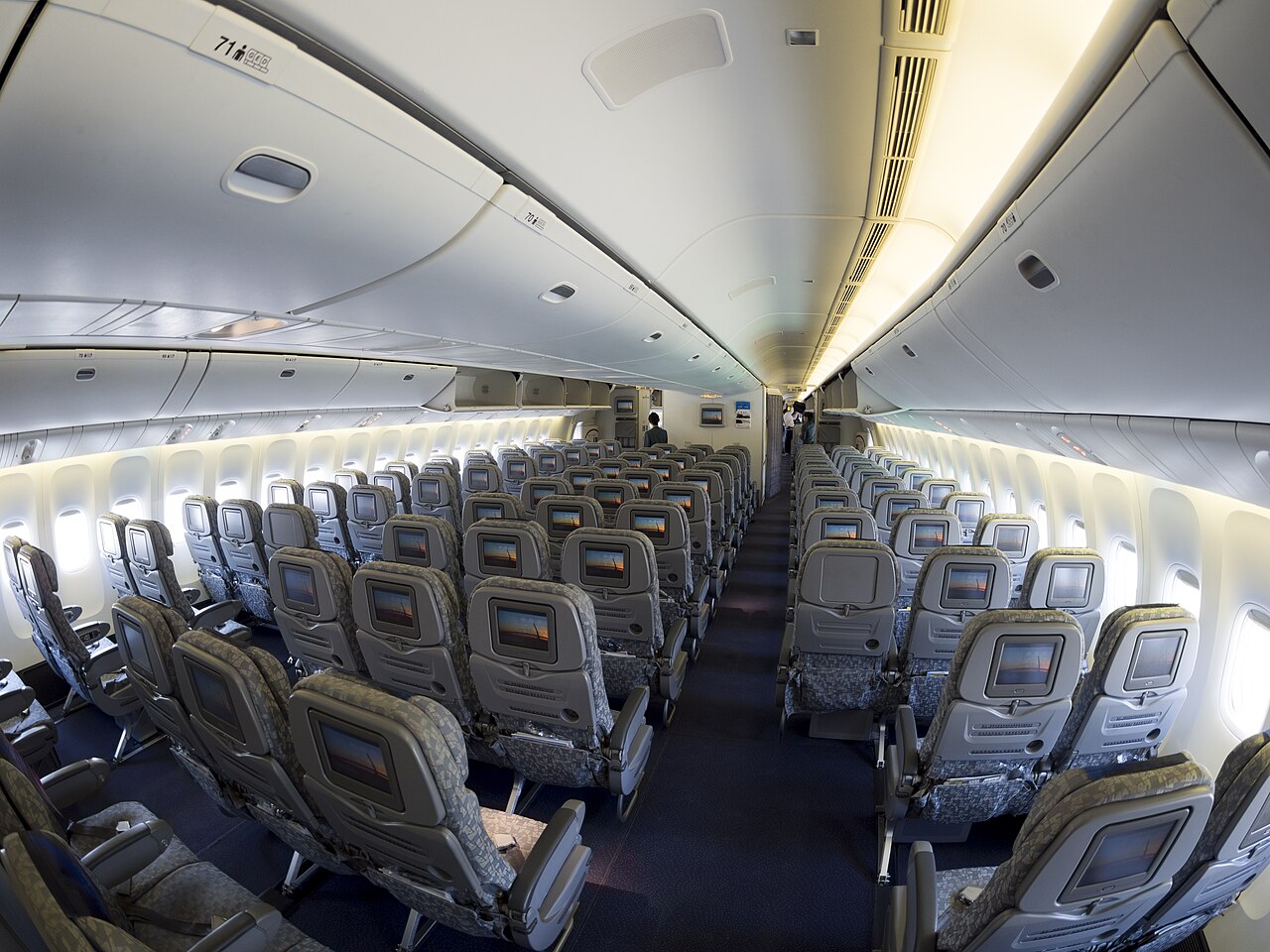
The cabin of a Boeing 777. Newer wide-body jets with composite fuselages can sustain slightly higher humidity than older aluminum aircraft.
Image Credits: Wikimedia Commons
How to cope with dry cabin air
You cannot change the cabin's humidity, but you can blunt its effects. Drink water regularly through the flight, since cabin humidity is lower than anything your body is used to. Lip balm, moisturizer, and nasal saline spray help with the surfaces that dry out first.
Contact lens wearers often do better switching to glasses on long sectors, and anyone prone to dry eyes can bring lubricating drops.
One thing not to worry about is the air being stale. With a full air exchange every two to three minutes and half the air being fresh bleed air mixed with HEPA-filtered recirculated air, cabin air is replaced far more often than the air in most buildings. The dryness is a humidity issue, not a filtration problem.
Frequently asked questions
What is the humidity inside an airplane cabin?
Typically 5 to 12 percent relative humidity at cruising altitude, occasionally as low as 2 percent. That is drier than the Sahara Desert, which averages about 25 percent, and far below the 40-60 percent of a typical home.
Why don't airlines just add humidifiers?
Two reasons: weight and corrosion. Humidification would require carrying large amounts of water, and moisture accelerates corrosion in aluminum airframes. An internal Lufthansa Technik analysis found that raising cabin humidity to 30 percent would roughly double corrosion-related maintenance.
Is the air on planes recycled and dirty?
Only half of cabin air is recirculated, and that half passes through HEPA filters. The other half is fresh bleed air from the engines, and the entire cabin volume is exchanged roughly every two to three minutes.
Why do my eyes and skin feel dry after flying?
At humidity below about 20 percent, moisture evaporates from your eyes, skin, and airways faster than your body replaces it. You also lose roughly 70 grams of water per hour through respiration and evaporation in dry cabin air.
Do newer planes have better cabin air?
Somewhat. The Boeing 787 and Airbus A350 use composite fuselages that tolerate more moisture, so they typically sustain 15-20 percent humidity instead of single digits. The 787 also uses electric compressors instead of engine bleed air.
The bottom line
Cabin air is dry because physics demands it: frigid, moisture-free outside air is compressed to 200-250C, cooled to 15-20C, and the process strips out nearly all water vapor. Airlines keep it dry deliberately to protect aluminum airframes from corrosion.
Newer composite jets are a little kinder, but no airliner approaches the humidity of your living room. Drink water, moisturize, and give your eyes a break, and you will step off the plane feeling far less wrung out.
Latest in Travel
- Another pressure-related annoyance: why your ears pop on planes and how to stop it.
- Packing for the trip? Our guide to the 3-1-1 rule for liquids on planes.
- Why airport codes look nothing like city names and the history behind them.
- Money matters too: how to exchange money abroad without losing money to fees.
Subscribe to the Rive News newsletter for one practical travel explainer every morning.
Related stories

The 3-1-1 liquids rule for planes: what each number means
TSA's 3-1-1 rule limits carry-on liquids to 3.4-ounce containers in one quart bag. Where the 2006 rule came from, what counts, and how
Why Is Airplane Food So Bland at Altitude?
A 2010 Fraunhofer study found altitude cuts sweet and salty perception by up to 30 percent. Low humidity, cabin pressure, and noise all
Carry-on size limits: why airlines each set their own
Airlines set their own carry-on limits because the FAA only requires each carrier to have a policy, not one global size. Why 22 x 14 x