
How does phone GPS work with no cell signal?
Key takeaways
- Your phone locates itself by timing signals from at least four of 32 active GPS satellites; it never needs to talk to a cell tower.
- The GPS receiver only listens and never transmits, which is why airplane mode and zero bars do not stop positioning.
- Offline maps are the real requirement: without downloaded maps, the phone knows your position but cannot show the route.
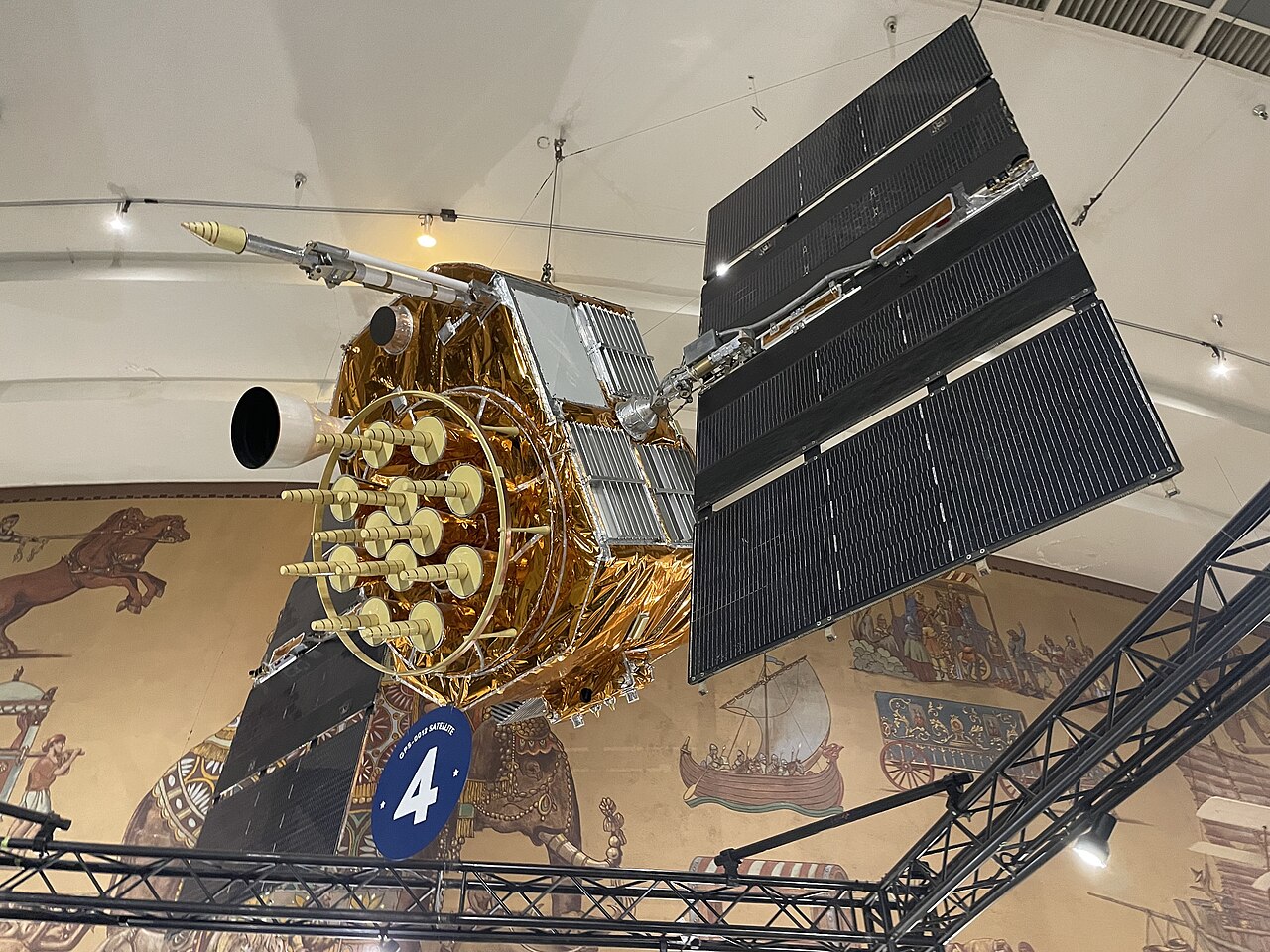
A full-scale GPS satellite model: the space segment broadcasting the signals your phone listens to. Photograph: Blervis
Image Credits: Wikimedia Commons / Blervis
Lose your signal on a mountain trail or a foreign highway and the blue dot usually keeps moving. That surprises people who assume GPS comes from the cellular network.
It does not. GPS is a separate satellite system that your phone receives passively, with no data plan, no bars, and no internet required.
This article explains how your phone talks to satellites it never transmits to, what cell service actually adds, and how to navigate reliably when the signal is gone.
Your phone is a radio that only listens
The Global Positioning System is run by the United States Space Force and works as a one-way broadcast. Each satellite beams down its exact position and the exact time it sent its signal, on radio signals your phone's built-in antenna picks up directly.
As of October 2026, 32 GPS satellites are active, after the final GPS III satellite launched in April 2026. Each orbits about 20,200 kilometers (roughly 12,550 miles) above Earth.
Your phone measures how long the signals from at least four satellites take to arrive, converts those times into distances, and finds the single point where all the distances meet. This method, called trilateration, needs four satellites rather than three because the fourth corrects your phone's own imperfect clock against the satellites' atomic clocks.
The critical detail: your phone never transmits anything back. Like a car FM radio, the GPS receiver is purely passive.
That is why GPS works with zero cell service and serves unlimited users at once. On most modern iPhones and Android phones, the GPS chip stays fully active in airplane mode.
What A-GPS does and why it is optional
If GPS needs nothing from the network, why does your phone find you in seconds while a standalone receiver can take minutes? The answer is a shortcut called Assisted GPS.
When a receiver starts cold with no recent data, it must hunt the whole sky for satellites and slowly download each satellite's orbital details, the ephemeris and almanac. The wait for that first position is called the time to first fix.
A-GPS hands the phone that orbital information over the cellular network instead, along with a rough location from nearby cell towers and Wi-Fi networks. When you lose cell service, positioning still works; the first lock simply takes a little longer because the assistance data cannot download without a network.
Accuracy, meanwhile, is determined entirely by the satellite calculation: the number of satellites visible, their geometry across the sky, atmospheric conditions, and the quality of the GPS chip. None of those factors involves the cellular network. Under open sky, a typical smartphone is accurate to within about 16 feet, with or without bars.
The real catch: the map around your blue dot
GPS tells your phone where it is. It does not know where the roads are, which route is fastest, or when to tell you to turn. That part comes from the navigation app, which is where the cell connection usually matters.
Navigation apps add the intelligence: road maps, routing, live traffic, and turn-by-turn guidance. With downloaded maps saved before you leave coverage, a phone can show its position and even give turn-by-turn directions with zero cell service.
The practical catch is that the map must be saved first. If it was never downloaded, the GPS may know your exact coordinates while the app has little useful background to display.
Before a trip into dead zones, download the map region in Google Maps or your preferred offline app, and it helps to have connectivity arranged in advance for the rest of the trip, such as regional eSIM plans that cover multiple countries. Then your phone's sensors can keep counting steps and movement even without GPS alongside the satellite fix.
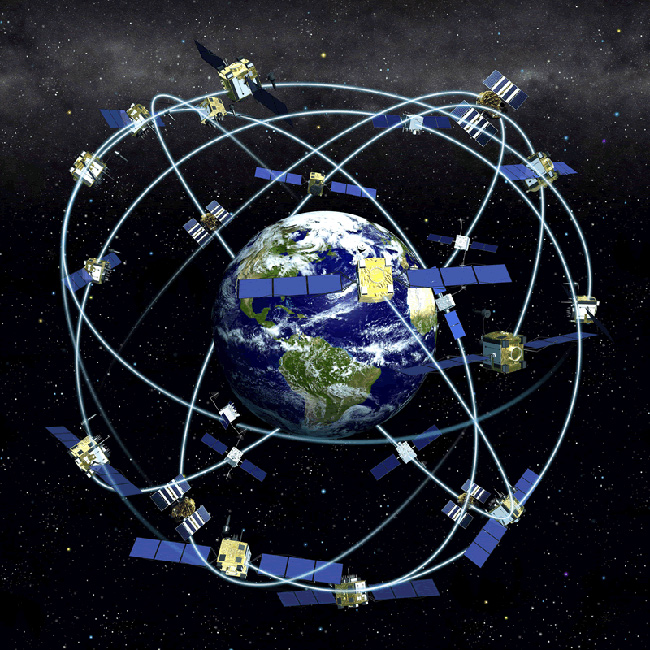
The GPS constellation: at least 24 satellites must be operational, with 32 active as of October 2026. Image: US government source
Image Credits: Wikimedia Commons / US government source
What GPS can and cannot do offline
A few practical boundaries complete the picture. Seeing your position on a downloaded map works without cell service, and turn-by-turn directions with offline maps work too.
Live traffic, re-routing, and searching for new addresses generally do not, because they need a data connection to fetch fresh information.
Sharing your location with someone else also needs a connection. Your phone calculates its coordinates from the satellites entirely on its own, but sending those coordinates to a friend travels over the cellular network or Wi-Fi.
Most people conflate the two jobs, which is why they assume GPS and cellular are the same thing. They are not: GPS is the receiver, and the cell connection is just the messenger.
One more myth worth clearing: GPS does not consume your data plan by itself. There is no separate data subscription required to receive satellite positioning. What costs data is the map tiles and the live services layered on top.
The bottom line
Phone GPS works with no cell signal because it is a passive satellite receiver, not a network service: it times signals from at least four of 32 satellites orbiting 20,200 kilometers overhead to trilaterate your position. Cell service only speeds the first fix through A-GPS and fetches the maps and traffic that make navigation useful. Download your maps before you lose coverage, and the blue dot will keep working long after the bars disappear.
FAQ
Does GPS work in airplane mode?
Yes, on most modern phones. Airplane mode switches off cellular, Wi-Fi, and Bluetooth transmitters, but the passive GPS receiver keeps listening and can position you normally.
Why does my GPS lock take longer in remote areas?
Without A-GPS assistance data from the network, the phone must download orbital details directly from the satellites, which takes longer on the first cold start.
Can I share my location without cell service?
Not in real time. The phone still knows where it is, but sending the coordinates to someone else needs a cellular or Wi-Fi connection.
Is GPS accuracy worse without internet?
No. Accuracy comes from the satellite geometry and your receiver chip; a clear sky gives the same precision online or offline.
Latest in Travel
- Regional eSIM Plans for Multi-Country Travel
- How to Pack for Two Weeks in One Bag
- Why Airplane Wings Are Swept Back
- How Your Phone Counts Steps Without GPS
Subscribe to Rive News's weekly newsletter for practical travel explainers before your next trip.
Related stories

The 3-1-1 liquids rule for planes: what each number means
TSA's 3-1-1 rule limits carry-on liquids to 3.4-ounce containers in one quart bag. Where the 2006 rule came from, what counts, and how
Why Is Airplane Food So Bland at Altitude?
A 2010 Fraunhofer study found altitude cuts sweet and salty perception by up to 30 percent. Low humidity, cabin pressure, and noise all

Carry-on size limits: why airlines each set their own
Airlines set their own carry-on limits because the FAA only requires each carrier to have a policy, not one global size. Why 22 x 14 x