
How Planes Avoid Hitting Each Other Midair: TCAS and ATC
Key takeaways
- Airliners are kept apart by layered defenses: ATC separation with a 1,000-foot vertical minimum, plus onboard TCAS as the final backup.
- TCAS interrogates nearby transponders within about 40 nautical miles several times per second and orders a climb or descend roughly 25 seconds before a predicted collision.
- Since a 2002 collision over Uberlingen killed 71 people, global rules require pilots to obey a TCAS order even if it contradicts air traffic control.
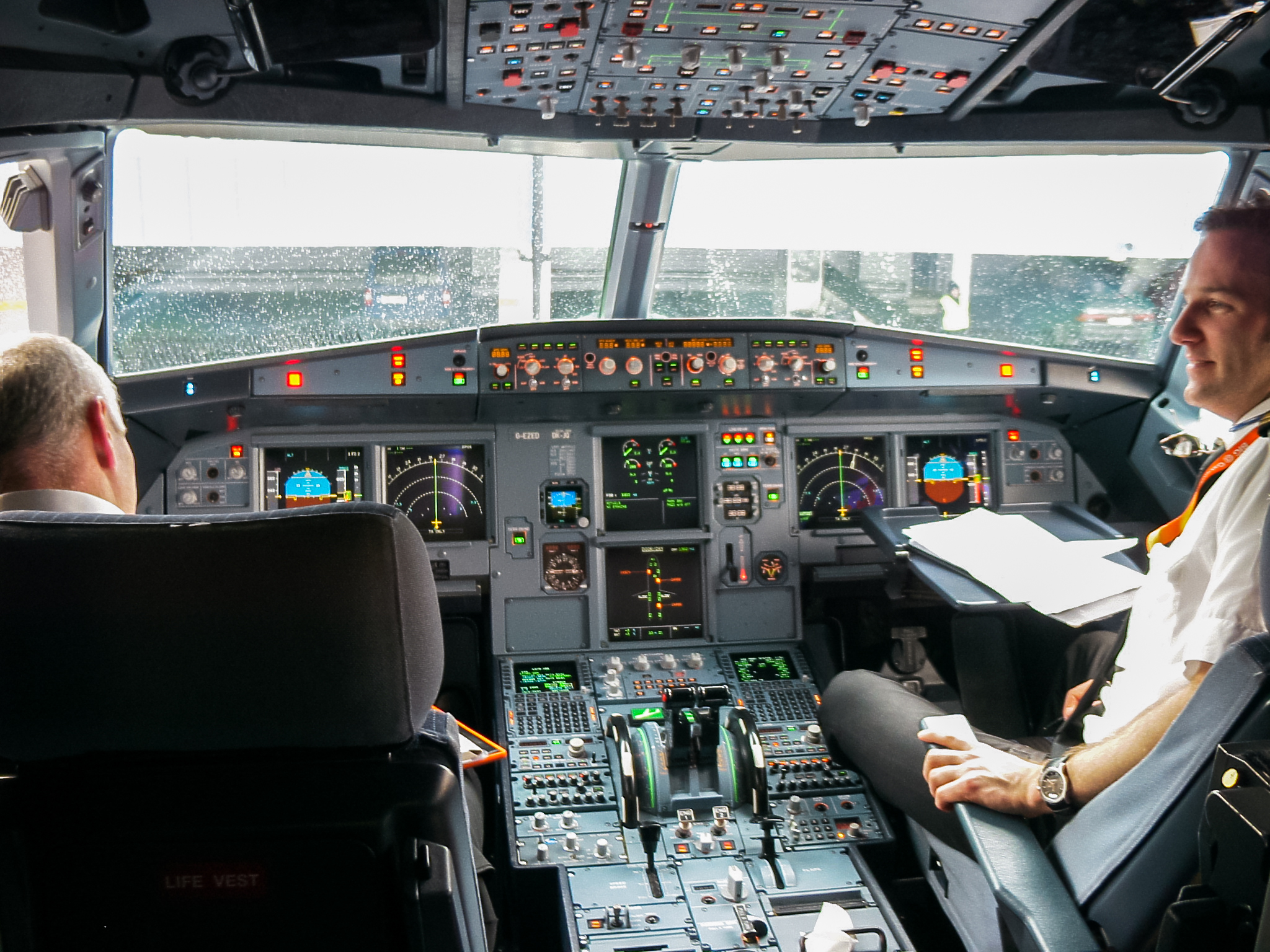
The flight deck of an Airbus A319. TCAS warnings appear here as both visual alerts and spoken climb or descend commands.
Image Credits: Wikimedia Commons
Thousands of aircraft share the sky at any moment, many of them converging on the same airways at 500 miles per hour. Midair collisions are extraordinarily rare, and that is not luck. It is the product of layered defenses, from air traffic controllers on the ground to a computerized guardian in every cockpit that can order pilots to climb or descend on its own authority.
This article explains those layers in order: how controllers keep aircraft apart, what the onboard Traffic Collision Avoidance System does when separation fails, and the tragedy that wrote the rule pilots follow today.
The first layer: controllers and separation rules
The primary defense is air traffic control. Controllers assign each aircraft a specific altitude, route, and speed, and they are responsible for keeping a minimum bubble of empty space around every flight.
Under instrument flight rules, the International Civil Aviation Organization requires a minimum of 1,000 feet of vertical separation between aircraft, Simple Flying reports. Lateral and longitudinal minimums apply as well, depending on the airspace and the surveillance available.
This system works well, but it depends on humans and radios. Controllers get busy, pilots mishear clearances, and aircraft deviate.
That is why aviation safety is built in layers: when one layer fails, the next one catches the error. The final airborne layer is TCAS.
The final layer: TCAS, the guardian in the cockpit
TCAS, the Traffic Collision Avoidance System (also called the Airborne Collision Avoidance System, or ACAS, in some regulations), is an independent onboard computer that monitors the airspace around the aircraft and warns the crew of collision threats, according to Learn ATC. It works independently of air traffic control radar and does not need ATC instructions to generate alerts.
Every airliner carries a TCAS computer connected to a Mode S transponder. The transponder interrogates every other Mode S or Mode C transponder within roughly 40 nautical miles, several times per second, WhoThatPlane explains.
From each reply it extracts the other aircraft's altitude and computes its range from the reply delay. By tracking those returns over time, TCAS builds a three-dimensional picture of surrounding traffic and predicts whether any aircraft is on a converging track that will close inside a danger threshold.
When the geometry looks bad, TCAS speaks up in stages. A Traffic Advisory ("TRAFFIC, TRAFFIC") comes first, issued about 40 seconds before the closest point of approach, alerting the crew to look for the threat.
If the danger persists, a Resolution Advisory follows at about 25 seconds, commanding a specific vertical maneuver: "CLIMB, CLIMB" or "DESCEND, DESCEND," WhoThatPlane reports. The current airline standard, TCAS II versions 7.0 and 7.1, issues these coordinated advisories, and ICAO mandates the system on all turbine aircraft over 5,700 kg maximum takeoff weight or carrying more than 19 passengers.
The cleverest part is the coordination. When both aircraft carry TCAS II, their transponders negotiate a complementary pair of orders over the radio link, roughly once per second during the encounter.
If aircraft A is told to climb, aircraft B is told to descend, never the same direction. Each computer announces its chosen sense and reserves the opposite for the other, so the two flight paths diverge.
TCAS has limits. It only sees transponder-equipped aircraft, so a plane flying without a working transponder is invisible to it. For that reason, the FAA requires working transponders on all high-speed aircraft and everything operating in crowded airspace near major airports.
TCAS also issues only vertical guidance, never turns, because altitude changes are the fastest, most predictable escape.
The rule written in tragedy
On July 1, 2002, a Bashkirian Airlines Tupolev Tu-154 and a DHL Boeing 757 converged at 36,000 feet over Uberlingen, Germany. Both crews received TCAS Resolution Advisories at the same moment: the 757 was told to descend, the Tu-154 to climb.
The DHL crew followed its TCAS order. The Tupolev crew followed a conflicting instruction from air traffic control instead and descended into the 757's path. All 71 people aboard both aircraft died, as documented by Simple Flying and WhoThatPlane.
The accident rewrote global procedure. ICAO doctrine since 2003 is explicit: when a Resolution Advisory sounds, pilots must respond immediately by following it, even if it conflicts with an air-traffic-control instruction.
Safety and collision avoidance take priority over ATC clearances, Learn ATC notes. After the maneuver, pilots inform ATC as soon as practicable, typically with the phrase "TCAS RA," and return to their cleared altitude once the system announces "clear of conflict."
The push for an automated last line of defense began even earlier. In 1981 the FAA announced the TCAS concept, and the 1986 collision of Aeromexico Flight 498 with a small plane over California accelerated development and implementation, Professional Aviation reports. The next generation, ACAS X, was certified by the FAA in 2018 and is rolling out on new Airbus A350, Boeing 787, and 777X aircraft, using optimized logic that reduces nuisance alerts and integrates better with ADS-B traffic data.
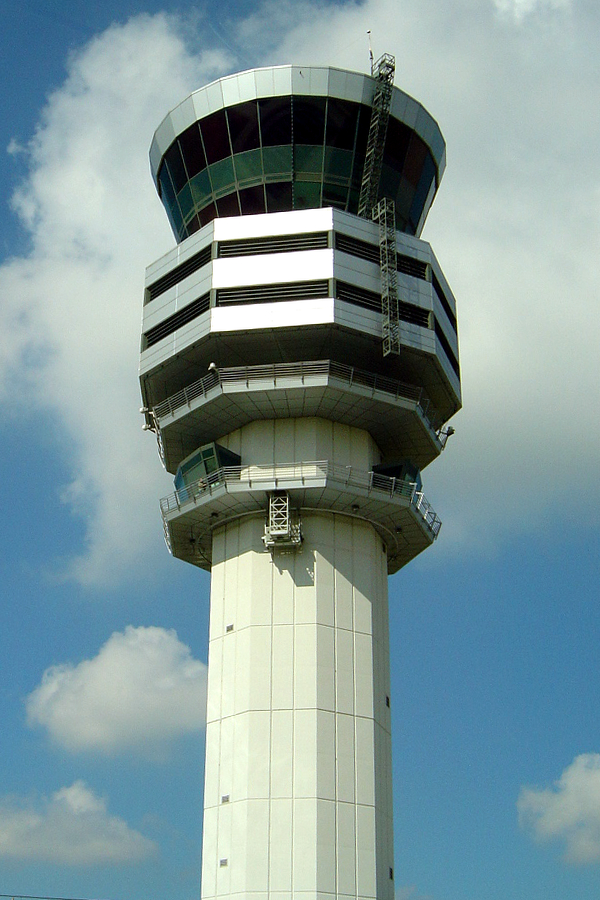
An airport control tower. Controllers provide the first layer of separation; TCAS is the independent backup when that layer fails.
Image Credits: Wikimedia Commons
What pilots actually do day to day
In normal operations, TCAS is mostly a quiet situational-awareness tool. Its traffic display shows nearby aircraft with relative altitude and trend information, which helps crews visualize surrounding traffic in clouds or high-workload moments. Traffic Advisories are uncommon, and full Resolution Advisories are rare events that trigger mandatory incident reporting and investigation.
That rarity is the point. The layered system means TCAS almost never has to fire. Controllers keep the 1,000-foot bubbles intact, pilots follow clearances, and the computer watches silently, ready to shout "CLIMB" in the seconds when everything else has gone wrong.
Frequently asked questions
What does TCAS stand for?
Traffic Collision Avoidance System, also known as the Traffic Alert and Collision Avoidance System. In ICAO regulations it is often called ACAS, the Airborne Collision Avoidance System. All three names describe the same onboard anti-collision computer.
How far ahead can TCAS see other aircraft?
The transponder interrogates traffic within roughly 40 nautical miles, several times per second. A Traffic Advisory is typically issued about 40 seconds before the closest point of approach, and a Resolution Advisory about 25 seconds before.
Do pilots have to obey TCAS over air traffic control?
Yes. Since the 2002 Uberlingen collision, ICAO doctrine requires pilots to follow a Resolution Advisory immediately, even when it contradicts an ATC instruction. Collision avoidance outranks clearances.
Why doesn't TCAS order turns instead of climbs and descents?
Vertical maneuvers are faster to execute, easier to coordinate between two aircraft, and more predictable. Ordering one aircraft to climb and the other to descend guarantees their paths diverge, which is harder to assure with turns.
Can TCAS fail to prevent a collision?
It can miss aircraft without operating transponders, since it depends on transponder replies. That is why transponders are mandatory in controlled and crowded airspace. Within its design limits, TCAS remains the most reliable last line of defense ever deployed in aviation.
The bottom line
Planes avoid each other through defense in depth: controllers maintaining at least 1,000 feet of vertical separation, pilots following clearances, and TCAS watching every transponder within 40 nautical miles as the final guardian. When it speaks, pilots obey, no matter what the controller just said. That rule, written after 71 deaths over Uberlingen, is why the crowded sky stays as safe as it is.
Latest in Travel
- Why your ears pop on planes and how to stop it, another pressure-related flight mystery.
- Why airport codes look nothing like city names.
- Packing rules matter too: the 3-1-1 rule for liquids on planes.
- Why passports come in different colours and what the colours mean.
Subscribe to the Rive News newsletter for one practical travel explainer every morning.
Related stories
The 3-1-1 liquids rule for planes: what each number means
TSA's 3-1-1 rule limits carry-on liquids to 3.4-ounce containers in one quart bag. Where the 2006 rule came from, what counts, and how
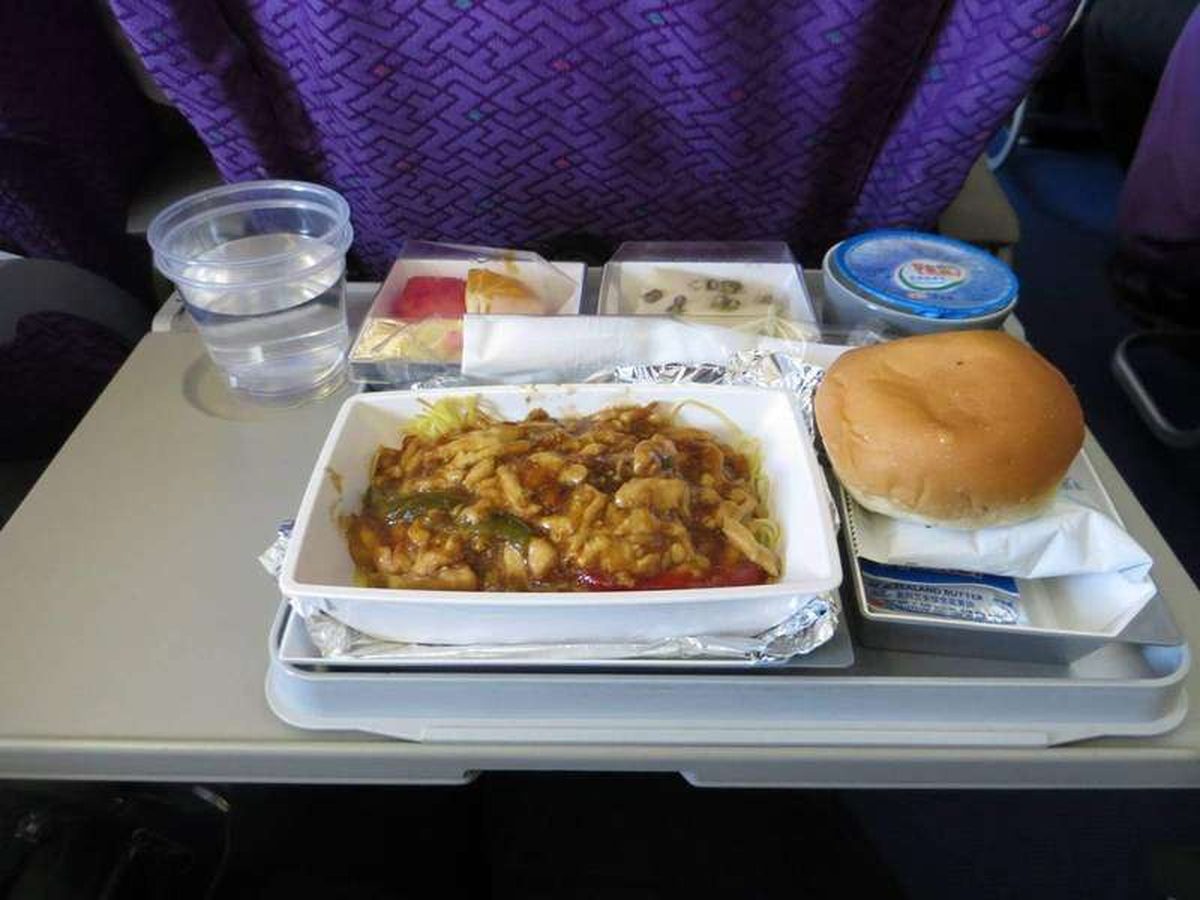
Why Is Airplane Food So Bland at Altitude?
A 2010 Fraunhofer study found altitude cuts sweet and salty perception by up to 30 percent. Low humidity, cabin pressure, and noise all
Carry-on size limits: why airlines each set their own
Airlines set their own carry-on limits because the FAA only requires each carrier to have a policy, not one global size. Why 22 x 14 x