
How Does a Turbocharger Actually Work? A Plain-English Guide
Key takeaways
- A turbocharger recycles wasted exhaust energy to spin a turbine past 150,000 RPM, driving a compressor that forces extra air into the engine.
- More air means more fuel can burn, so a small turbocharged engine can match the power of a much larger one.
- A wastegate caps boost pressure and an intercooler cools the compressed air, while turbo lag is the brief delay before boost arrives.
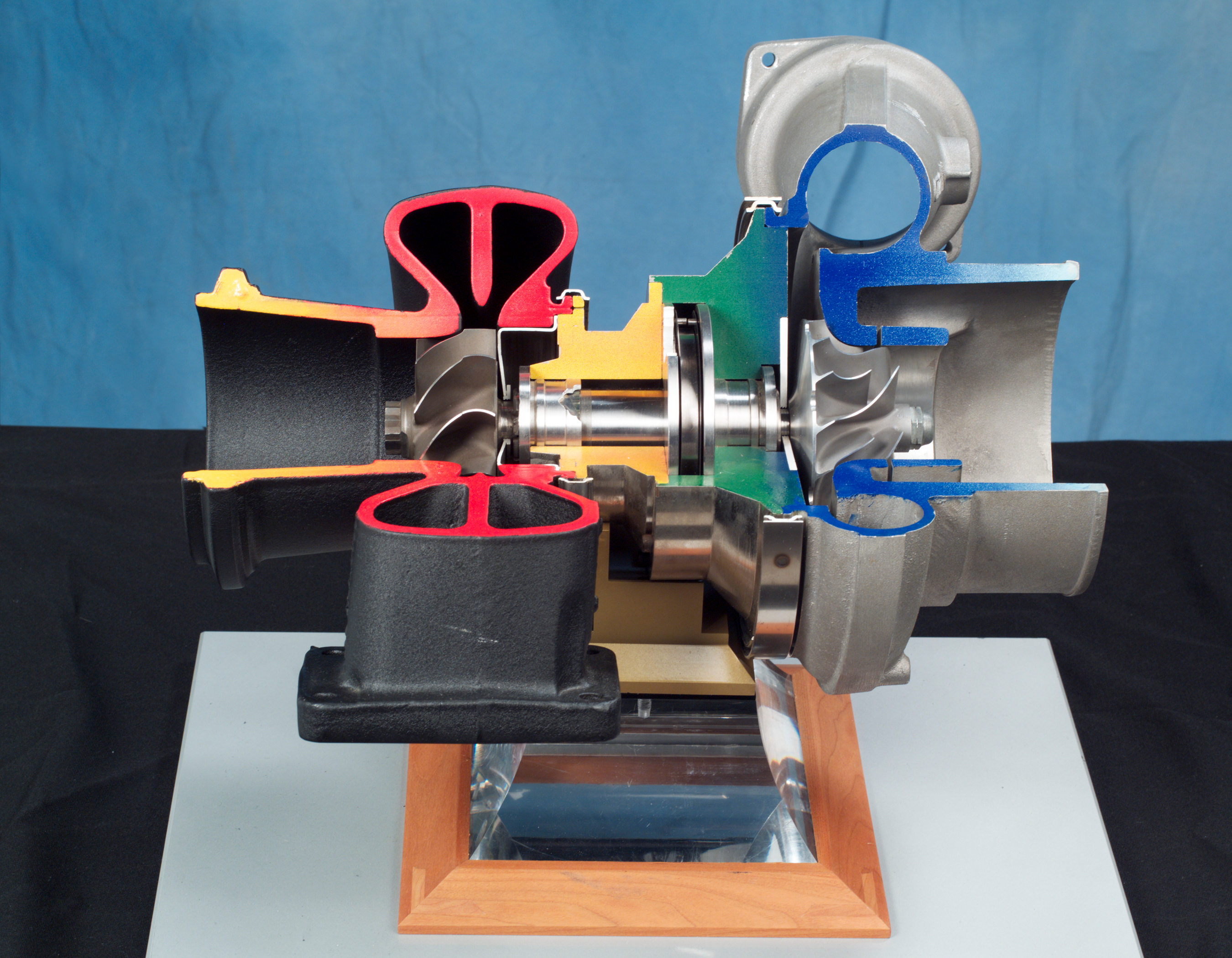
Cutaway view of a turbocharger, with the hot-side turbine and cold-side compressor joined by a single shaft. Photograph: Wikimedia Commons
A turbocharger is an exhaust-gas-driven air pump that lets an engine breathe far more air than it could on its own. It takes energy the engine would otherwise throw away out the tailpipe and converts it into extra power. That single idea explains why a 2.0-liter turbocharged four-cylinder can now outrun a naturally aspirated V6.
This article takes a closer look at how a turbocharger actually works, including the exhaust-energy path, the four core parts, why compressed air makes more power, what causes turbo lag, and how modern designs fight it.
What a turbocharger is, in one paragraph
A turbocharger is a forced-induction device: it forces air into the cylinders at above-atmospheric pressure instead of letting the pistons draw it in on their own. More air packed into each cylinder means more oxygen, and more oxygen lets the engine burn more fuel per combustion event. The result is more horsepower and torque from the same displacement, according to engineering explainers from AET Turbos and EngineerFix.
The idea is over a century old. Swiss engineer Alfred Buchi patented the turbocharger concept in 1905, aiming to recover exhaust energy that engines were wasting, as documented on the Turbocharger entry of Wikipedia.
It took decades of materials science before the idea worked reliably in passenger cars. Today turbos are standard on everything from economy hatchbacks to heavy trucks.
Unlike a supercharger, which is belt-driven off the crankshaft and steals some engine power to make more, a turbocharger is powered entirely by exhaust flow. That makes it more efficient in principle, but it also introduces the famous delay known as turbo lag.
The energy path: exhaust gas in, boost out
The whole cycle starts at the exhaust manifold. After each combustion event, hot exhaust gases rush out of the cylinders at high velocity and temperature.
In a naturally aspirated engine, that energy simply leaves through the exhaust system. A turbocharger intercepts it.
The exhaust gas is funneled into the turbine housing on the "hot side" of the turbo. The gas strikes the blades of the turbine wheel and spins it at extraordinary speed. Engineering sources put typical operating speeds at 150,000 to 200,000 revolutions per minute, and some sources report peaks beyond that in small, low-inertia designs.
The turbine wheel shares a rigid forged-steel shaft with the compressor wheel on the "cold side." When the turbine spins, the compressor spins at the same speed. The compressor acts like a centrifugal fan, drawing in ambient air through the intake and flinging it outward at high velocity.
That action compresses the air and pushes it toward the engine's intake manifold as pressurized "boost. "
One engineering explainer notes that the pressurized air can reach roughly 30 percent above normal atmospheric pressure, around 19 pounds per square inch, in a typical diesel application. Exact numbers vary by engine and turbo sizing, but the principle holds across all of them.
The four parts that matter
Strip a turbocharger to its essentials and you find four components doing the work. The turbine housing and wheel form the hot side, capturing exhaust energy.
The compressor housing and wheel form the cold side, pressurizing intake air. A center housing rotating assembly, or CHRA, links the two wheels with the shared shaft and carries the bearings and oil passages.
The fourth part is the wastegate, and it is the safety valve of the whole system. Because a turbo can spin far faster than the engine needs, boost pressure must be capped.
The wastegate is a bypass valve on the turbine side that opens once the target intake pressure is reached, diverting excess exhaust gas around the turbine. Without it, the turbine would overspeed and the engine would face destructive over-boost, as described by AET Turbos.
There is a closely related fifth player: the intercooler. Compressing air heats it, and hot air is less dense, so it carries fewer oxygen molecules per liter.
The intercooler is a heat exchanger, similar to a small radiator, mounted between the compressor outlet and the intake manifold. It cools the charge, raising its density and packing more oxygen into each cylinder for maximum power.
Why boost makes more power
An engine is fundamentally an air pump that burns fuel. Its power is limited by how much oxygen it can get into the cylinders on each intake stroke. A naturally aspirated engine fills its cylinders at roughly atmospheric pressure, so displacement sets a hard ceiling on airflow.
A turbocharger raises that ceiling. Since the amount of air drawn into a cylinder is largely a function of time and pressure, increasing the pressure at the intake point crams more air molecules into the same cylinder volume.
More oxygen allows more fuel to be injected and burned efficiently. The combustion event gets bigger and more powerful, producing more horsepower and torque from an engine of the same size.
This is why downsizing works. A carmaker can replace a 3.5-liter V6 with a 2.0-liter turbocharged four and keep similar peak output.
Under light load, the smaller engine sips fuel; when the driver asks for power, the turbo supplies the extra air. It is also why the air-to-fuel ratio matters: one diesel-focused explainer notes that engines target a precise ratio, and the only way to raise output is to force more air and fuel into the chamber together.
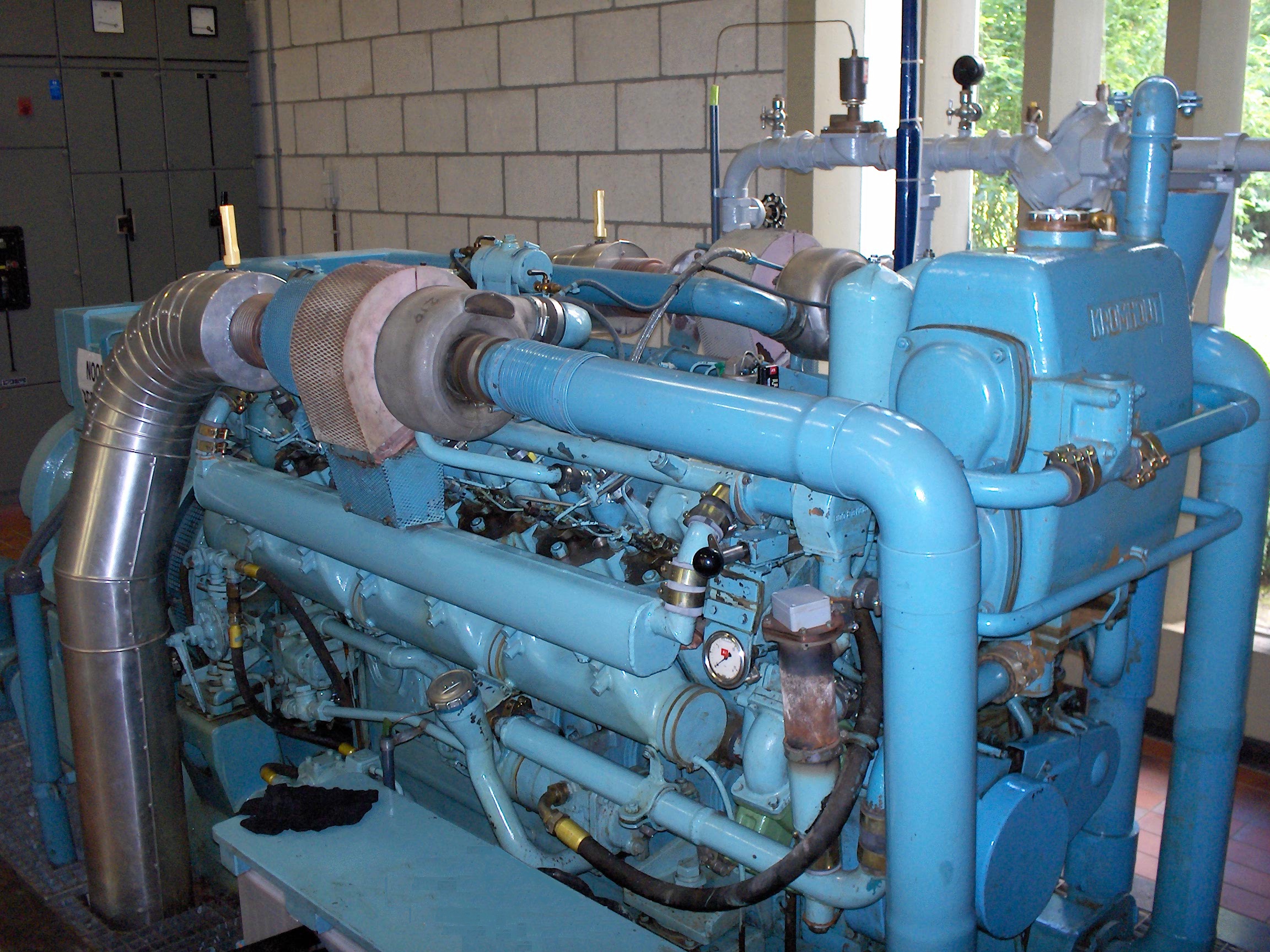
Two Holset turbochargers fitted to a 450-horsepower V12 diesel engine, showing how turbos scale up to heavy applications. Photograph: Sonett72 / Wikimedia Commons
Turbo lag and how engineers fight it
Turbo lag is the brief pause between pressing the throttle and feeling the boost arrive. It happens because the turbo is exhaust-driven: at low RPM the engine is not producing enough exhaust flow to spin the turbine up to boost-making speed. Building that flow takes a moment, and during that moment the car feels sluggish.
Lag is worst at low engine speeds and in large turbos, which have heavier wheels that take longer to spool. Most passenger-car systems run in a continuous boost loop once the engine is producing enough exhaust flow, typically above about 2,000 RPM. Below that threshold, response is soft.
Engineers have several answers. Smaller turbos spool faster but run out of breath at high RPM. Twin-turbo setups use a small turbo for low-end response and a larger one for top-end power.
Twin-scroll designs split the exhaust pulses into two passages to keep the gas energy organized. Variable-geometry turbos adjust the angle of vanes around the turbine wheel, tightening the nozzle at low flow for quick spool and opening it at high flow for capacity.
Modern engine management helps too. Some performance cars keep the throttle slightly open or retard ignition timing on lift-off to maintain exhaust energy, a trick borrowed from rally anti-lag systems. Electric turbochargers, which add a small motor to spin the compressor before exhaust flow arrives, are now reaching production and nearly erase lag.
How a turbo differs from a supercharger
Both devices do the same job, forcing extra air into the engine, but they get their power differently. A supercharger is belt-driven from the crankshaft, so it responds instantly to throttle input and has no lag. The trade-off is parasitic loss: the engine spends some of its own power turning the supercharger.
A turbocharger costs the engine almost nothing to drive, since it runs on waste energy. That makes it more efficient, especially at steady cruise. The price is lag and heat: the hot side runs extremely hot, and the whole unit depends on exhaust flow that takes time to build.
For most modern road cars, the turbo wins on efficiency and packaging. Superchargers survive mainly in applications where instant throttle response matters more than fuel economy, such as some American V8 performance cars.
How fast does a turbocharger spin?
Most automotive turbochargers operate between 150,000 and 200,000 RPM at full boost, according to multiple engineering explainers. Small, low-inertia units can exceed that range. For comparison, a typical car engine redlines near 6,000 to 7,000 RPM, so the turbo shaft spins roughly 25 to 30 times faster than the crankshaft.
Does a turbocharger use extra fuel?
Not directly. The turbo itself runs on waste exhaust energy.
But the extra air it supplies lets the engine burn more fuel when you ask for full power, so fuel consumption rises under hard acceleration. Driven gently, a turbocharged engine can be more economical than a larger naturally aspirated one making the same peak power.
What breaks on a turbocharger?
The most common failures involve the bearings and seals in the center housing, oil starvation, and foreign-object damage to the compressor wheel. Symptoms include a whining noise, blue exhaust smoke, and falling boost pressure. Regular oil changes with the correct grade are the best prevention, since the bearings live in extreme heat.
Can any car be fitted with a turbocharger?
In principle yes, with a kit designed for the engine, but it is rarely simple or cheap. The engine management, fuel system, cooling, and internals may all need upgrades to handle the extra pressure and heat. Factory-turbocharged cars are engineered for boost from the start, which is why aftermarket installs demand care.
The bottom line
A turbocharger is elegant recycling: exhaust energy that would be wasted spins a turbine at up to 200,000 RPM, driving a compressor that packs more air into the engine. The wastegate keeps boost in check, the intercooler keeps the charge dense, and the result is big-engine power from a small-engine package. Lag is the one real compromise, and a generation of clever designs has nearly engineered it away.
If you are shopping for a car, the practical takeaway is simple. A turbocharged engine gives you efficiency when cruising and power when you need it, at the cost of slightly more complex maintenance. Treat the oil well, let the turbo cool after hard driving, and it will return the favor for years.
Latest in Automotive
- Why do cars have a rev limiter?
- Why do some messages show as green and others as blue?
- How do trees survive freezing winters without moving?
- Why do pilots dim the cabin lights before night landings?
Subscribe for one clear explainer like this every morning.
Image Credits: Wikimedia Commons (turbocharger cutaway); Sonett72 / Wikimedia Commons (Holset turbochargers)
Related stories

Why Does Tire Pressure Drop in Cold Weather?
Cold weather can cut tire pressure by 1 psi for every 10°F drop, thanks to the ideal gas law. Here is what happens inside the tire and what
Why Do Brake Rotors Warp, or Do They Actually?
Mechanics rarely see a truly warped rotor. The shudder usually comes from uneven pad deposits a few thousandths of an inch thick. Here
How to Buy a Used Car Without Getting Scammed: The Checklist
Over 450,000 cars a year have rolled-back odometers, NHTSA says. This checklist covers VIN checks, title washing, and the inspection that