
Recognition and recall on exams: what sets them apart
By Rive News / Research desk | Rive News / Published October 26, 2026 at 9:00 AM PKT
Key takeaways
- Recognition means identifying a correct answer when it is shown to you, as in multiple-choice tests.
- Recall means producing an answer from memory with no options, as in essays and short answers.
- Recall demands more effort and usually produces lower scores, but it also builds stronger learning.
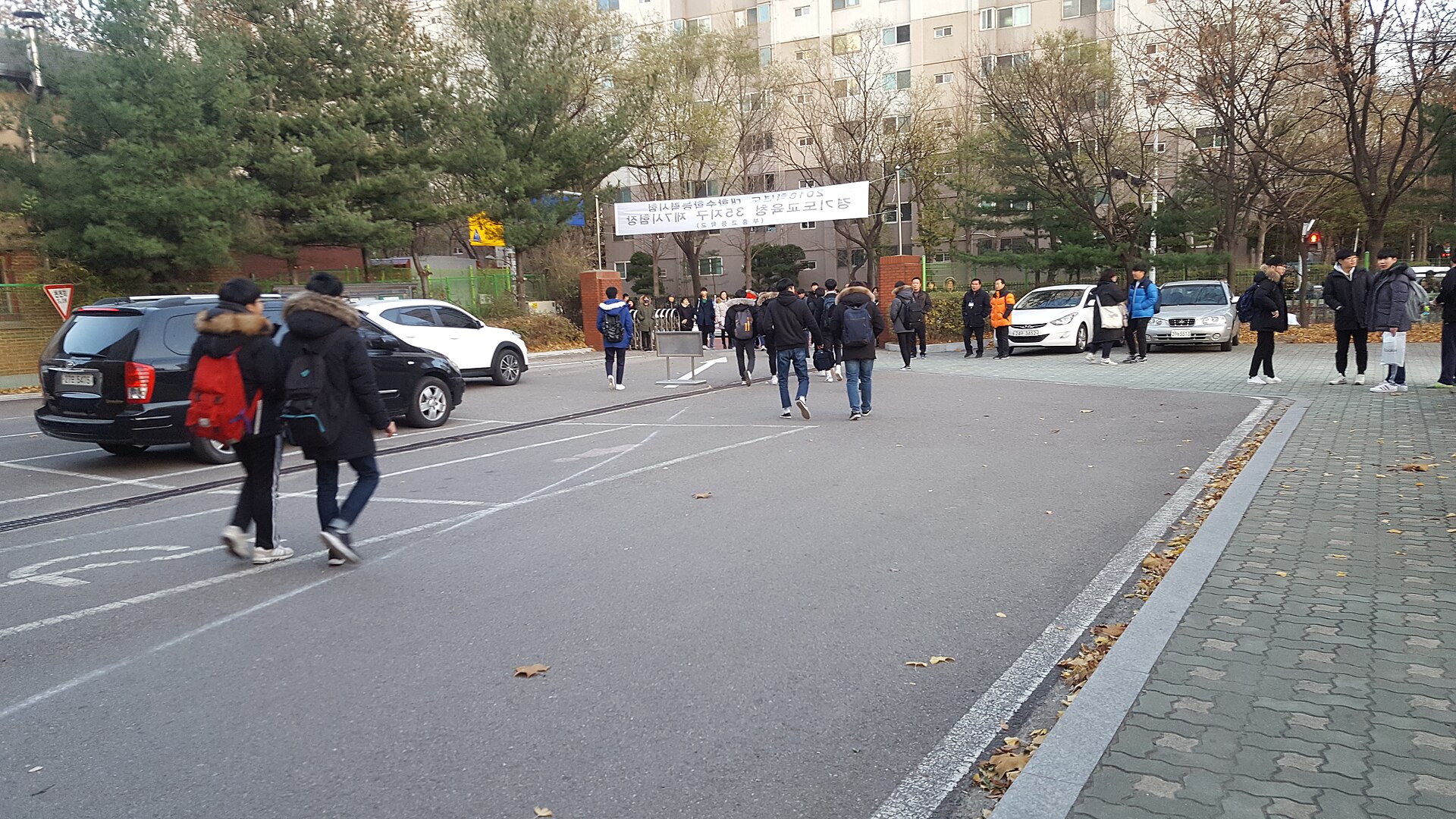
[Students returning from an exam location in South Korea after the College Scholastic Ability Test in 2018, a high-stakes exam mixing both formats. Photograph: Wikimedia Commons contributor]
Image Credits: Wikimedia Commons
Recognition and recall are the two ways memory is tested, and they feel very different in an exam hall. Recognition asks whether something looks familiar when you see it again, while recall asks you to generate the answer yourself from nothing but the question.
The difference matters because the two formats reward different kinds of studying. This article explains what each process is, how exam formats map onto them, why recall feels harder, and how to study for each type of test.
What recognition means
Recognition is the process of identifying previously encountered information when it is presented again. A multiple-choice question is the classic recognition task: the answer is sitting in front of you among several options, and your job is to pick the one you learned.
ScienceDirect's overview of recognition memory describes the task as distinguishing previously learned information from new information. The test gives you both the targets and the distractors, and you judge which ones you have seen before.
Recognition is not a single process, according to the dual-process framework developed by cognitive neuroscientists Andrew Yonelinas and Endel Tulving. It draws on two separable processes: familiarity, the bare sense that something has been encountered before, and recollection, the retrieval of details about where and when you encountered it.
What recall means
Recall is the process of retrieving information from memory without any external prompt. You are given a question and must generate the answer from scratch, with no options to jog your memory.
A blank sheet of paper and the instruction to write down everything you remember from a chapter is a recall task. So is the fill-in-the-blank section of an exam, or any moment where you need to produce a name, fact, or sequence with no supporting cues.
ScienceDirect's overview puts the contrast plainly: recall places a much greater demand on the retrieval system, whereas recognition tests place less demand on retrieval by simply requiring the subject to distinguish learned items from new ones.
The analogy the overview uses is now standard in psychology teaching. Recognition tests resemble multiple-choice exams, where the answer is present but must be identified from false lures, while recall tests resemble fill-in-the-blank exams, where the answer must be generated from long-term memory.
Why recall feels harder
Recall is harder because it asks the brain to do two jobs instead of one. It must first find the right memory trace, and then reconstruct the answer in usable form, all without cues to narrow the search.
Recognition skips the first job. The options do part of the searching for you, so the brain only has to judge which option matches something stored in memory.
Research consistently finds that people recognize far more items from a study list than they can recall. ScienceDirect notes that if subjects are first given a recall test and then a recognition test, they usually recognize many items they were unable to recall.
That gap is visible in everyday life. A person may be unable to recall someone's name on demand, yet pick it out instantly from a list of names, because the list supplies the cue that unaided retrieval lacked.
How exam formats map onto the two processes
Multiple-choice questions are recognition tests, but not all of them are equal. A question that asks you to identify a definition rewards familiarity, while one that asks you to apply a rule to a new case rewards recollection plus reasoning.
Short-answer and fill-in-the-blank questions are recall tests. The answer is not present, so the student must generate it, though a word bank turns the same question back into a recognition task.
Essays are the purest recall format. They demand generation, organization, and expression, which is why they are the hardest to score consistently and the most feared by students who studied by rereading alone.
The testing effect and why it matters
One of the most replicated findings in learning science is that being tested improves later memory more than restudying the same material. This is called the testing effect, and it works because retrieval itself strengthens the memory trace.
Practice testing beats rereading on almost every comparison researchers have run. A student who closes the book and writes out what they remember will retain more a week later than a student who spends the same time rereading the chapter.
The reason connects directly to the recognition-recall gap. Rereading is largely a recognition activity: the material looks familiar as it passes before your eyes, and that familiarity feels like learning.
Retrieval practice is a recall activity. It forces the brain to do the harder job of finding and reconstructing the answer, and that effort is what makes the memory more durable.
The practical rule follows from this. Study sessions should end with a closed-book attempt to reproduce the material, even if that attempt is imperfect, because the attempt itself is the learning event.
How to study for recognition tests
For multiple-choice exams, the goal is to make recognition discriminating rather than vague. You need to know each concept well enough to reject its close neighbours, not just to nod at the right answer.
Flashcards help here, but only if used in the right direction. Reading the term and trying to produce the definition is recall practice, while reading the definition and naming the term is closer to recognition, and the two build different strengths.
Practice questions are the single best preparation for recognition tests. They train you on the exact skill the exam measures: telling the right option from plausible wrong ones under time pressure.
How to study for recall tests
For essay and short-answer exams, the study method must itself be recall. Reading notes over and over will not prepare you to generate answers from a blank page.
The core technique is free recall: after studying a topic, close everything and write down as much as you can remember. Then open your notes, check what you missed, and repeat the process for the gaps.
Spaced repetition strengthens this further. Returning to the same material after a delay forces a harder retrieval than immediate repetition, and harder successful retrievals produce stronger memories.
Elaboration helps too. Explaining a concept in your own words, connecting it to an example, or teaching it to someone else forces you to reconstruct it rather than recognize it, which is the skill the exam will demand.
Past papers are the best rehearsal for recall exams. They reveal the question styles your examiner favours, and answering them under timed conditions trains both retrieval and the organization of an answer.

[Students leaving an exam venue, where the mix of question formats decides which memory process was tested. Photograph: Wikimedia Commons contributor]
Image Credits: Wikimedia Commons
Common mistakes students make
The biggest mistake is studying with the book open and mistaking recognition for knowledge. Material that looks familiar while you read it can vanish completely when the book closes and the exam paper appears blank.
A second mistake is re-reading notes the night before a recall exam. Rereading boosts familiarity, which helps on multiple choice, but it does almost nothing for the generation skill that an essay demands.
A third mistake is ignoring the format of the exam you will actually sit. A student preparing for a multiple-choice paper needs distractor training, while a student preparing for an essay paper needs timed writing practice, and the two preparations are not interchangeable.
A fourth mistake is confusing confidence with accuracy. Feeling sure about an answer is a poor guide to being right, especially on recognition tests, where familiarity can masquerade as knowledge.
The fix for all four is the same: test yourself in the format you will face, with the book closed, and treat every gap you find as information rather than failure.
What teachers and examiners should know
Exam format is a choice about what to measure, and it changes results. A class tested only by multiple choice will appear to know more than the same class tested by essay, because recognition scores run higher than recall scores for the same underlying learning.
That does not make multiple choice dishonest, but it does mean scores from different formats are not directly comparable. A teacher who switches formats mid-year should expect scores to move for reasons that have nothing to do with student effort.
Mixing formats gives the fairest picture. A paper that combines multiple choice, short answer, and one essay samples both processes and rewards both kinds of preparation.
For high-stakes decisions, recall formats carry an extra cost: they are slower to mark and harder to score consistently. That practical pressure is one reason multiple choice dominates large-scale testing, even though it measures the easier process.
Frequently asked questions
Is a multiple-choice test easier than an essay test?
Usually yes, for the same material, because recognition scores run higher than recall scores. A student who can pick an answer from options may still be unable to generate it from a blank page.
Why does rereading feel effective but fail in exams?
Rereading is mostly a recognition activity, so the material looks familiar as it passes before your eyes. That familiarity feels like learning, but it does not train the generation skill that recall exams demand.
What is the fastest way to improve recall?
Close the book and write out what you remember, then check what you missed. That closed-book retrieval attempt is itself the learning event, and repeating it after a delay strengthens the memory further.
The bottom line
Recognition and recall are not two names for the same thing. Recognition asks whether a presented item matches something stored in memory, while recall asks you to generate the answer with no help at all.
Recall is harder, scores lower, and fades first when memory declines, but it is also the process that builds durable learning when practised. Recognition is easier and faster to test, but it is vulnerable to familiarity tricks and plausible distractors.
The smart approach is to match your studying to your exam. Train recognition with practice questions and distractor discrimination, train recall with closed-book writing and past papers, and never mistake the feeling of familiarity for real knowledge.
Related reading includes what active recall is and how to use it, how flashcards work best for recognition versus recall, and why practice tests beat rereading every time.
Tags: recognition vs recall, memory, exam technique, study skills
Rive News is a research desk that explains everyday topics from public sources, with no single author behind the byline.
Related
- What is active recall and how to use it for studying
- How do flashcards work best: recognition vs recall
- Why do practice tests beat rereading every time
- Why do I blank out during tests despite studying
Subscribe to the Rive News newsletter for one plain-English explainer each morning.
Rive News publishes explainers from verifiable public sources; claims are attributed in the text, and corrections are noted when a source changes.
Related stories

Why Do I Blank Out During Tests Despite Studying: Test Anxiety and Retrieval Failure
Blanking out in exams is retrieval failure, not missing knowledge. Anxiety drains working memory; rereading builds false confidence. Here

How to Study for Exams Without Burning Out
Sleep 7-8 hours, study in 25-50 minute blocks, and exercise daily. The science-backed way to study for exams without burning out, and what

Why Do I Forget What I Just Read? Science Has an Answer
You forget what you just read because of the forgetting curve, mapped by Ebbinghaus in 1885. Science explains why memory fades fast and how