
How Does Handwriting Speed Limit Note Taking in Lectures?
Key takeaways
- Adults handwrite at roughly 13 words per minute while lecturers speak at 125 to 160 words per minute, so notes always trail the lecture.
- The slow pace forces a filter, and research finds that summarizing in your own words beats copying verbatim for learning.
- Recording, reviewing, and pre-reading lectures close the gap that your pen cannot.

Photograph: Shixart1985
Your hand cannot keep up with a lecturer's mouth. This is not a flaw in your penmanship. It is a physical bottleneck, and it shapes everything you learn in a classroom.
Handwriting speed limits note taking because spoken language outruns the hand by roughly ten to one. The average adult copies text at about 13 words per minute, while a lecturer typically speaks at 125 to 160 words per minute. Every lecture is therefore a losing race, and students must decide, sentence by sentence, what to capture and what to lose.
This article explains the handwriting speed limit, including the transcription bottleneck, what the research shows, and smarter note-taking strategies.
The transcription bottleneck: why the lecturer outpaces your hand
Think of a lecture as a stream of spoken words arriving far faster than any pen can record them. Research summarized on the Words per minute page reports that adults aged 18 to 64 copy text at an average of 68 letters per minute, roughly 13 words per minute, with a range from about 5 to 20 words per minute. That figure comes from measured copying tasks, and real lecture notes, written under pressure, run at the slow end.
Compare that with the pace of a typical lecturer. Published speech-rate figures summarized by Vext from Tauroza and Allison's 1990 work, as reviewed by Huang and Graf in 2020, put lecturers at 125 to 160 words per minute. Conversational speech is faster still, around 190 words per minute in some studies, but lecture delivery sits squarely in that 125 to 160 range.
The arithmetic is unforgiving. At 13 words per minute of handwriting against 150 words per minute of speech, you capture less than one tenth of the words spoken. Even a fast hand, at 20 words per minute, records only about 13 percent.
Your notes are not a record of the lecture. They are a thin slice of it.
This gap is the transcription bottleneck. It means note taking is never a passive recording task.
Every line you write is a split-second choice about what deserves your limited writing budget. Students who try to transcribe everything fail. Those who take notes well have simply learned to choose.
The bottleneck also explains why handwriting and typing feel so different. The average typist manages about 52 words per minute, according to Dhakal and colleagues' 2018 study of 168,000 volunteers.
That is still slower than speech, but it is fast enough to tempt a typer into word-for-word transcription. A handwriter has no such option. The slow pen forces a choice.
What the research shows about speed and learning
The speed gap between hand and lecture would be a curiosity if it did not change what you learn. It does, and the clearest evidence comes from a well-known 2014 study by Pam Mueller of Princeton and Daniel Oppenheimer of UCLA, published in Psychological Science.
Their paper, "The Pen Is Mightier Than the Keyboard: Advantages of Longhand Over Laptop Note Taking," ran three experiments with 67 to 151 students each. Participants watched lectures and took notes either longhand or on a laptop. In the first experiment, laptop users wrote an average of 309 words, while longhand writers wrote just 173. The typists captured far more of the lecture.
More notes, however, did not mean more learning. On factual recall questions given right after the lecture, both groups did the same.
On conceptual questions, which asked students to apply ideas rather than repeat them, the laptop users did significantly worse. The authors traced the difference to how the notes were written: laptop users tended to transcribe the lecture verbatim, while longhand writers, limited by the slow pen, were forced to synthesize and rephrase.
The study's own conclusion is blunt. Mueller and Oppenheimer wrote that laptop use "can negatively affect performance on educational assessments, even, or perhaps especially, when the computer is used for its intended function of easier note taking."
In a delayed test given a week later, the longhand group outperformed laptop users on both factual and conceptual questions. The slow hand had forced deeper processing, and deeper processing paid off when it mattered.
Later research has added nuance. A 2019 replication and extension by Morehead, Dunlosky, and Rawson, published in Educational Psychology Review, found that the longhand advantage was small and not always statistically significant, especially after students had a chance to study their notes. The replication did confirm the underlying mechanism: laptop users wrote more words and copied more verbatim, and verbatim copying was linked to weaker performance.
Taken together, the research tells a consistent story. The hand's slowness is both the constraint and the advantage.
It caps how much you can record, which forces you to think about what you are writing, and that thinking is where the learning happens. The students who learn the most are not the ones with the fullest notebooks. They are the ones whose slow pens forced them to process ideas in real time.
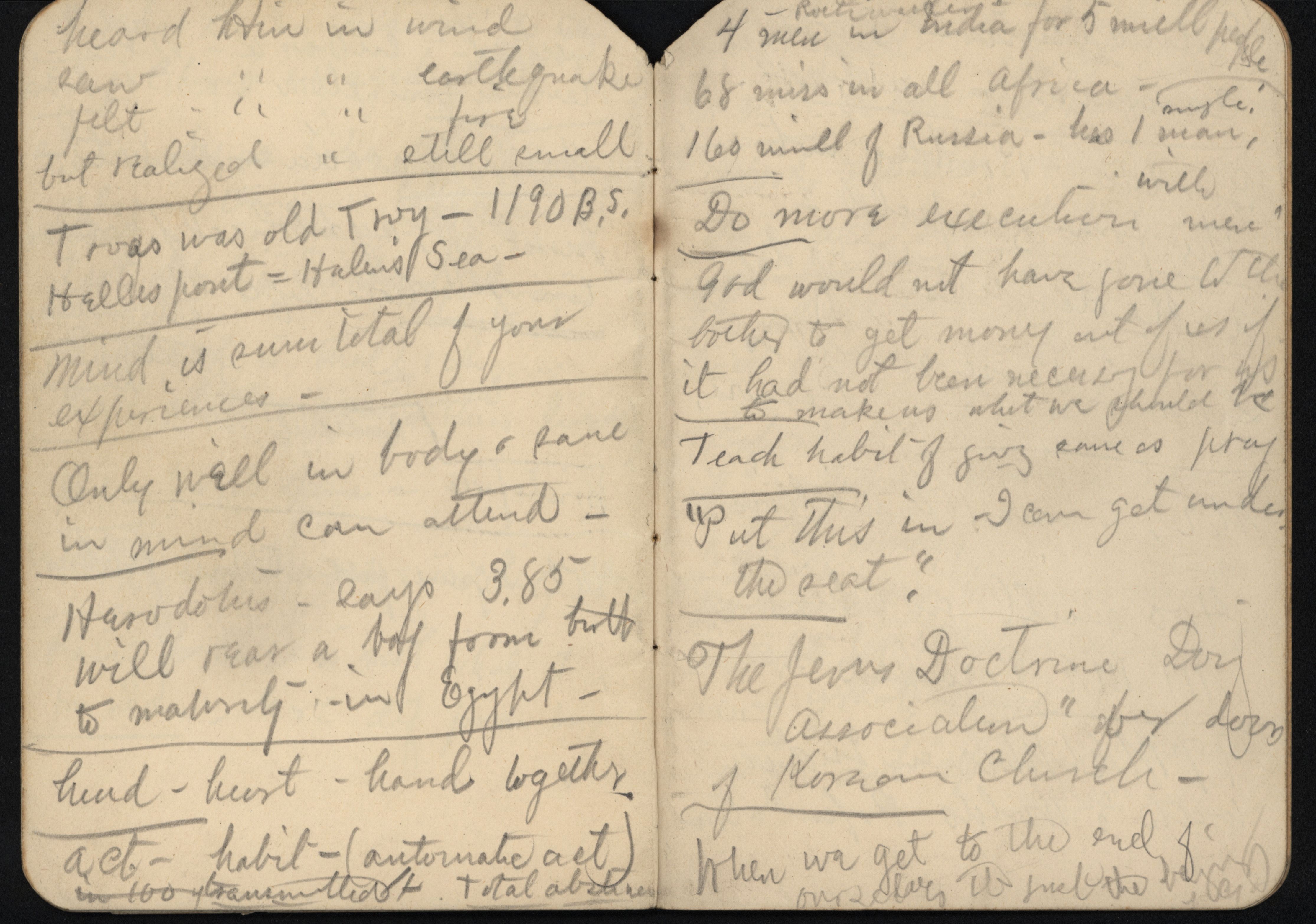
Photograph: Columbus Metropolitan Library / DPLA
Smarter note-taking strategies that respect the speed limit
Since the hand will never match the mouth, the best strategies work around the bottleneck instead of fighting it. The research points toward a clear set of habits.
First, pre-read before the lecture. When you already know the topic's skeleton, you spend your limited writing budget on details and explanations instead of scrambling to follow the basic thread. This is one of the most reliable ways to make a slow pen effective.
Second, aim to summarize, not transcribe. Mueller and Oppenheimer's work shows that students who rephrase ideas in their own words learn more than those who copy sentences verbatim.
If you find yourself writing down whole sentences, you are transcribing, and your hand is too slow to win that game. Abbreviations, symbols, and short phrases stretch your writing budget further.
Third, review and revise your notes after class. The longhand advantage partly comes from the notes working as an "external storage" device, and that storage only works if the notes get revisited. Fill in gaps from the textbook or a recording within a day, while the lecture is still fresh in memory.
Fourth, consider recording the lecture where permitted. A recording removes the bottleneck entirely for capture, which frees your pen for the one job it does best: thinking. You can then transcribe the important parts later, at your own pace, without the pressure of real-time speech.
Finally, try structured formats like the Cornell system, which splits the page into cues, notes, and a summary. The summary section, written after class, forces exactly the kind of reprocessing that the research favors. For more on how active recall techniques beat passive review, see why quizzing yourself beats re-reading the chapter.
Frequently asked questions
How fast is average handwriting in words per minute?
Measured copying studies put the average adult handwriting speed at about 68 letters per minute, roughly 13 words per minute, with a range from about 5 to 20 words per minute. Note taking under lecture pressure typically runs at the slow end of that range.
How fast do lecturers speak?
Measured lecturer speech rates run about 125 to 160 words per minute, according to published figures summarized from Tauroza and Allison (1990). That is roughly ten times faster than typical handwriting, which is why verbatim lecture notes are impossible by hand.
Does handwriting or typing produce better notes?
Typing captures more words, with laptop users writing about 309 words versus 173 for handwriting in the Mueller and Oppenheimer experiments. But handwriting produced stronger performance on conceptual questions, because the slow pace forced students to synthesize instead of transcribe.
Can I improve my handwriting speed enough to keep up?
Practice can push you toward the faster end of the handwriting range, but no one writes at 150 words per minute without shorthand systems that require serious training. Strategies like abbreviations, summaries, and recordings do more for your notes than raw speed ever will.
Why do my handwritten notes feel incomplete after class?
Because they are. At 13 words per minute against 150 words per minute of speech, a full hour of lecture contains roughly 9,000 words, while your notes hold perhaps 800. Reviewing and filling gaps afterward is a normal part of effective note taking, not a sign of failure.
The bottom line
Handwriting speed limits note taking through a simple physical mismatch: the pen moves at about 13 words per minute while lectures flow at 125 to 160, so notes will always be selective, never complete. The research shows this constraint is also an advantage, because it forces the summarizing and rephrasing that deepen learning. Students can get the most from their slow pens by pre-reading, summarizing instead of transcribing, and reviewing notes within a day.
Latest in Education & Study
- Why quizzing yourself beats re-reading the chapter
- Why your phone vibrates differently for calls and notifications
- Why your tiled floors sound hollow in some spots
- Why sunflowers follow the sun when young but stop when old
Subscribe to the Rive News newsletter for one practical study tip every week.
Image Credits: Wikimedia Commons / Shixart1985
Related stories

Why Do I Blank Out During Tests Despite Studying: Test Anxiety and Retrieval Failure
Blanking out in exams is retrieval failure, not missing knowledge. Anxiety drains working memory; rereading builds false confidence. Here

How to Study for Exams Without Burning Out
Sleep 7-8 hours, study in 25-50 minute blocks, and exercise daily. The science-backed way to study for exams without burning out, and what

Why Do I Forget What I Just Read? Science Has an Answer
You forget what you just read because of the forgetting curve, mapped by Ebbinghaus in 1885. Science explains why memory fades fast and how