
How Does Sleep Deprivation Change Exam Scores and Grades
Key takeaways
- Sleep-deprived volunteers learned about 40 percent less in a UC Berkeley study, because sleep loss shuts down memory encoding in the hippocampus.
- Deep sleep replays what you studied and transfers it from the hippocampus to long-term storage in the cortex.
- College students who averaged at least 8 hours of sleep during finals week earned higher grades than those who did not.

Exhausted students napping in a university library, a common sight during finals season. Photograph: Woyeamhopes
Sleep deprivation means getting less sleep than your brain and body need, usually under 7 hours for adults. For students, it often happens during exam season, when late nights of revision push bedtimes later and later.
This article explains how sleep loss changes exam results, including memory consolidation, attention effects, and what the research says about all-nighters.
How sleep turns studying into lasting memory
Sleep is not just rest. It is when your brain files away what you learned during the day.
New memories start as fragile traces in the hippocampus, a small region deep in the brain that acts like an inbox for new information. According to sleep researcher Matthew Walker of the University of California, Berkeley, deep slow-wave sleep does the heavy lifting of moving those traces to the cortex, where they become durable long-term memories.
During slow-wave sleep, the brain replays the neural patterns of recent learning, firing the same sequences again while you sleep. This replay was first shown in rats in 1994, when Matthew Wilson and Bruce McNaughton recorded brain cells firing in the same order during sleep as during a maze run earlier that day.
Three brain rhythms coordinate the handover, Walker explains in a 2009 review in the Journal of Clinical Sleep Medicine: slow oscillations set the pace, sleep spindles open a transfer window, and sharp-wave ripples in the hippocampus carry the replay. Without enough slow-wave sleep, the "save button" never gets pressed, and studied material fades instead of sticking.
The cost of skipping sleep before learning is stark. In Walker's lab, volunteers kept awake for one night learned about 40 percent less the next day than rested participants, and brain scans showed a sharp drop in hippocampal encoding activity. You need sleep before learning to soak up information, and after learning to hold onto it.
Sleep also processes emotional memories and folds new facts into existing knowledge, which is one reason strong feelings and vivid experiences stick so well. For a different window into how the brain handles emotion, see why music gives you goosebumps.
What sleep loss does to attention and thinking
Even before memory enters the picture, tiredness wrecks the mental tools you need in an exam room: attention, focus, and working memory.
A laboratory study by Ann Williamson and Anne-Marie Feyer, published in 2000 in Occupational and Environmental Medicine, kept 39 participants awake for up to 28 hours and compared their test performance with measured doses of alcohol. After 17 to 19 hours without sleep, performance on some tests was equivalent to, or worse than, a blood alcohol concentration of 0.05 percent. Response speeds were up to 50 percent slower, and accuracy fell sharply.
Seventeen hours awake is not an extreme scenario. It is a normal long day for a student who wakes at 7 AM and sits an evening exam, or pulls an all-nighter and tests at noon.
That decline matters because exams reward exactly the skills sleep loss erodes. Reading comprehension needs sustained attention, essay questions need working memory to hold several ideas at once, and multiple-choice traps need the sharpness to catch a trick option. A tired brain misreads questions, loses its place, and runs out of mental bandwidth sooner.
Sleep loss also makes people overconfident. Fatigued participants often rate their own performance as fine, even as their scores drop. That mismatch helps explain why students walk out of exams after an all-nighter feeling they did better than their mark suggests.
Why all-nighters usually backfire: the research
The direct evidence on sleep and exam grades is some of the clearest in education research.
In 2019, Baylor University sleep researcher Michael Scullin published the "Eight Hour Sleep Challenge" in the journal Teaching of Psychology. Fewer than 10 percent of students sleep 8 hours before final exams, he noted, so he offered extra credit to undergraduates who averaged at least 8 hours of sleep during finals week, tracked by wrist actigraphy.
The 24 students who took the challenge averaged 8.5 hours per night. On the final exam, students who slept at least 8 hours performed better than those who opted out or slept under 7.9 hours, even after controlling for grades before the final. "Better sleep helped rather than harmed final exam performance, which is contrary to most college students' perceptions that they have to sacrifice either studying or sleeping," Scullin said.
After adjusting for prior grades, sleeping 8 hours was linked to roughly a 4-point grade boost.
A separate study in 2019 by Kana Okano and colleagues tracked 100 MIT students in a chemistry course with wearable sleep monitors across a full semester. Sleep duration, quality, and consistency accounted for nearly 25 percent of the variance in grades.
Notably, sleep on the single night before a test did not predict performance. What mattered was sleep across the weeks before the exam.
The pattern holds at huge scale. A 2019 survey of 50,054 Norwegian college and university students found that those sleeping under 5 hours had about 1.46 times the odds of failing examinations compared with students sleeping 7 to 9 hours.
Taken together, the research points one way: the night before an exam is the wrong night to cut sleep. Consistent sleep through the study period beats a last-minute cram every time.
Simple ways to protect sleep before an exam
Treat sleep as part of your study plan, not a reward for finishing it. Aim for a regular bedtime in the weeks before exams, and stop revision at least an hour before bed so your mind can wind down.
Use the hours you gain wisely. Study techniques with real evidence behind them, like self-quizzing instead of re-reading the chapter, make each study session more efficient, which removes the pressure to study until 3 a.m.
Keep screens, caffeine, and heavy meals out of the last hour before sleep. If anxiety keeps you awake, write tomorrow's study list on paper before bed. Emptying the list from your head tends to quiet the mind faster than scrolling.
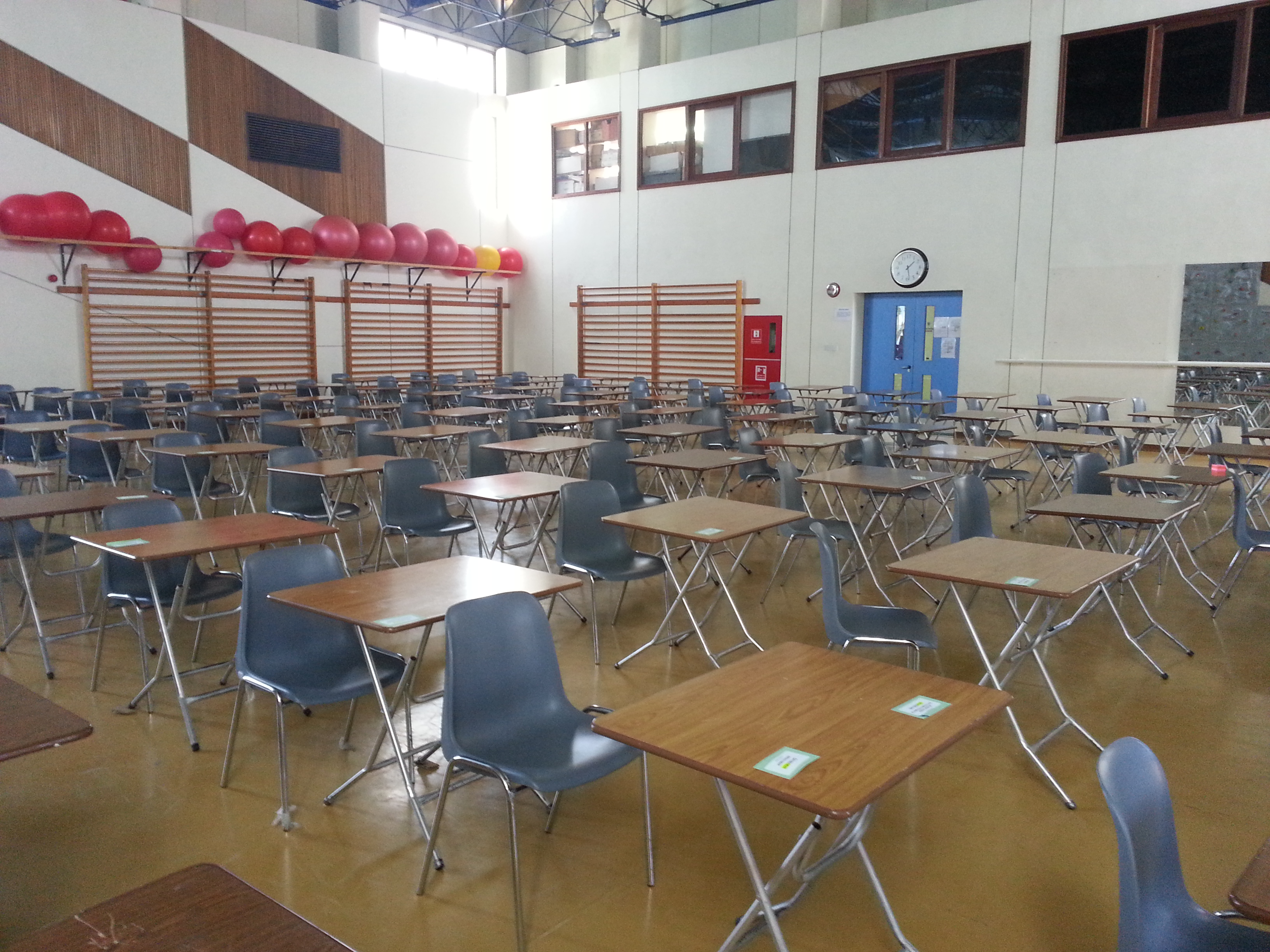
An examination hall set up for students. Photograph: Wing045
Frequently asked questions
Should I sleep or keep studying the night before an exam?
Sleep. The 2019 Baylor study found that students who averaged 8 hours during finals week scored higher than short sleepers, and a 2019 MIT study found no link between the single night before a test and performance. Protecting your normal sleep beats cramming through the night.
How much sleep do I need before an exam?
Most research points to 7 to 9 hours for adults, and the Baylor findings showed benefits at 8 hours or more during finals week. The Norwegian study of 50,054 students found failure odds rose sharply below 5 hours. Consistency across the study period matters most.
Can I recover lost sleep after an all-nighter?
You can pay back some of the debt, but you cannot fully recover the lost memory consolidation. Deep slow-wave sleep must happen soon after learning to transfer memories to long-term storage. A catch-up nap helps alertness, but the replay window for that night's studying has passed.
Do naps help exam performance?
Short naps of 20 to 30 minutes can restore alertness and focus, and stage 2 sleep spindles during naps have been linked to learning restoration in Walker's research. They help with tiredness, but they do not replace a full night's consolidation cycle.
The bottom line
Sleep deprivation changes exam performance through two channels: it blocks the overnight consolidation that turns studying into lasting memory, and it degrades the attention and speed you need in the exam room. Students who protect their sleep through the study period consistently outscore those who trade it for extra cramming.
Start tonight. Set a non-negotiable bedtime for exam season and spend your final study hour testing yourself instead of re-reading. Your memory will do the rest of the work while you sleep.
Latest in Education & Study
- Why quizzing yourself beats re-reading the chapter
- How your body switches from walking to running without thinking
- Why do you get goosebumps from music?
Want more study science in your inbox? Subscribe for one practical learning article every day.
Image Credits: Wikimedia Commons / Woyeamhopes
This article is for general information only and is not medical advice.
Related stories
Why Do I Blank Out During Tests Despite Studying: Test Anxiety and Retrieval Failure
Blanking out in exams is retrieval failure, not missing knowledge. Anxiety drains working memory; rereading builds false confidence. Here

How to Study for Exams Without Burning Out
Sleep 7-8 hours, study in 25-50 minute blocks, and exercise daily. The science-backed way to study for exams without burning out, and what

Why Do I Forget What I Just Read? Science Has an Answer
You forget what you just read because of the forgetting curve, mapped by Ebbinghaus in 1885. Science explains why memory fades fast and how