
Why do you get goosebumps from music? The science of frisson
By Rive News / Research desk | Rive News / Published October 31, 2026 at 9:00 AM PKT
Key takeaways
- Music-induced goosebumps are called frisson: a pleasurable chill paired with visible piloerection on the skin.
- Brain imaging found dopamine release in two waves: in the caudate while anticipating a peak, in the nucleus accumbens when the peak arrives.
- People who feel chills more often show denser fiber connections between the auditory cortex and emotional brain areas.
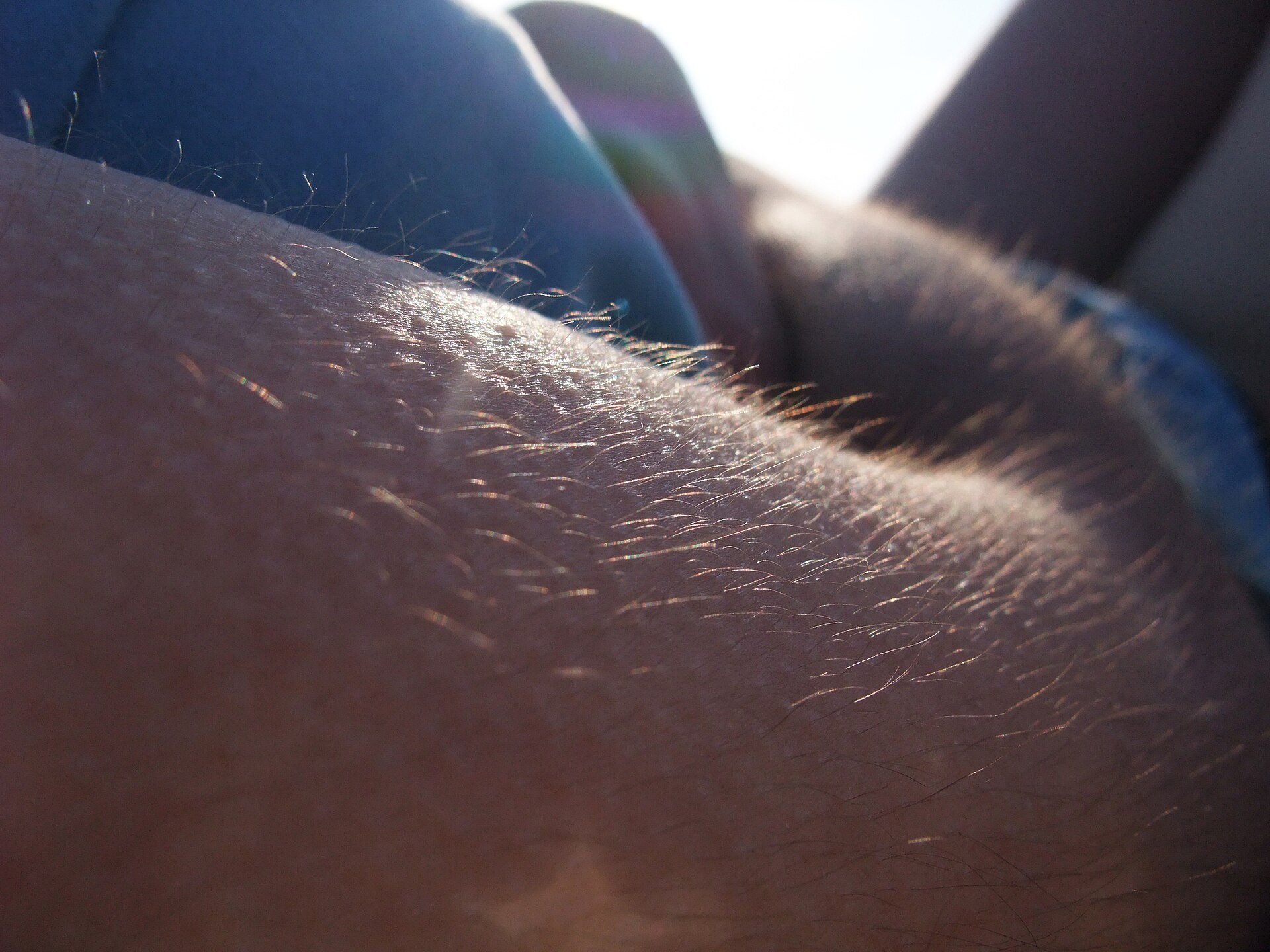
Goosebumps raised on a woman's forearm, the visible sign of piloerection. Photograph: Pilettes
Image Credits: Wikimedia Commons
The bump on your skin has a name, and so does the shiver behind it. Neuroscientists call the music-chill sensation frisson, a French word for "shiver," and it pairs a rush of pleasure with a measurable physical change on the surface of the skin.
The bumps themselves are piloerection. Tiny muscles called arrector pili sit at the base of every hair follicle, and when they contract, each hair stands upright and dimples the skin around it. The same reflex fires in cold air and during moments of fear.
This article explains music-induced goosebumps, including what frisson is, how the piloerection reflex works, what dopamine does during the build-up and the peak of a song, why some brains respond more strongly, and what tends to trigger the sensation.
What frisson actually is
Frisson is not a mood or a metaphor. In neuroscience it describes a transient, pleasurable physiological reaction to something aesthetically powerful, most famously a passage of music.
During a chill, the autonomic nervous system shifts into higher gear. Heart rate can change, breathing can quicken, and skin conductance shifts. Those are the same body-wide signals tied to emotional arousal, which is why researchers study frisson with the same instruments they use for fear and excitement.
This article is for general information only and is not medical advice; talk to a clinician about any symptoms.
Estimates of how many people experience musical frisson vary by study and method, roughly from half of participants to more than four in five. Some people feel it weekly, some rarely, and some never, and all of those patterns show up in published research.
How goosebumps form: the piloerection reflex
Piloerection is controlled by the sympathetic branch of the autonomic nervous system. The signal travels to the arrector pili muscles, each one pulls its hair upright, and the skin shows the familiar bump.
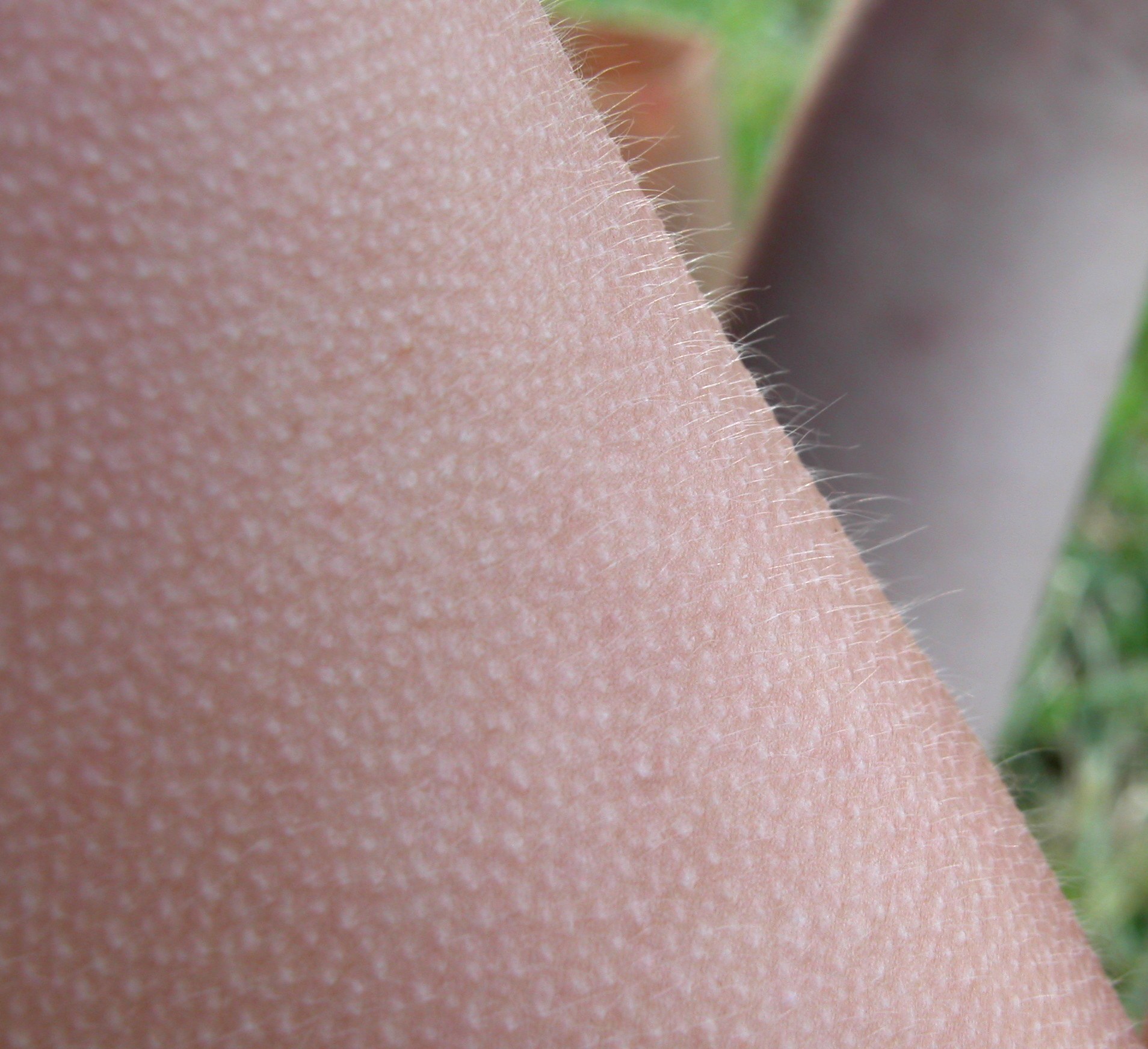
Close-up of goosebumps on skin, each bump a contracted arrector pili muscle at work. Photograph: Ildar Sagdejev (Specious)
Image Credits: Wikimedia Commons
In furred animals the reflex serves obvious purposes: raised fur traps warm air, and a puffed-up silhouette looks bigger to predators. Humans lost most of the fur but kept the wiring, which makes the response look pointless when it fires for a guitar solo.
The key detail is that music recruits a threat-and-temperature system for an emotional job. Shivering and that dropping-stomach feeling run through the same kind of autonomic channel: the brain treats a powerful sound as a biologically significant event and answers with the body.
Dopamine's role: anticipation and peak
In 2001, Anne Blood and Robert Zatorre reported in the journal PNAS that chill intensity while listening to music tracked activity in brain regions tied to reward and emotion, including the ventral striatum. That finding first connected the shiver to the brain's reward circuitry.
A decade later, Valorie Salimpoor and colleagues at McGill University showed which chemical was involved. Their study, "Anatomically distinct dopamine release during anticipation and experience of peak emotion to music," was published online January 9, 2011, in Nature Neuroscience.
The team scanned eight volunteers who were chosen because they reliably felt chills from particular moments in favorite songs. PET imaging showed endogenous dopamine release in the striatum during peak emotional arousal. The same paper reported a functional split: the caudate lit up during the 15 seconds leading up to a thrilling moment, while the nucleus accumbens took over when the peak itself arrived.
That split is the finding that still stands out. Anticipation and arrival turned out to be neurochemically distinguishable events, two waves of dopamine rather than one burst.

Live music on stage, the setting where many listeners report their strongest chills. Photograph: Shixart1985
Image Credits: Wikimedia Commons
The volunteers' music ranged from classical to jazz to punk and even bagpipes, and the study used only instrumental music, showing voices were not required for the response.
Why some people feel it more strongly
A 2016 study led by Matthew Sachs, then an undergraduate at Harvard, asked a different question: are chill-people wired differently from no-chill people? Ten regular chill-experiencers and ten who never felt them listened to chill-inducing music while the researchers mapped their brains with diffusion tensor imaging, which shows how well regions are interconnected.
The result, published in Social Cognitive and Affective Neuroscience, was structural. People who felt chills had a higher volume of nerve fibers connecting the auditory cortex, where sound is processed, to the anterior insular cortex and other areas involved in emotional processing. Better connected regions, in effect, communicate better.
"The idea being that more fibers and increased efficiency between two regions means that you have more efficient processing between them," Sachs told USC Today in February 2017. His summary of the implication was careful: the findings applied to music because the study focused on the auditory cortex, but the principle could extend to other senses.
How a listener hears a sound is only the first step; in frequent frisson responders, the sound then travels a better-paved road to the emotion centers. The study was small, so its conclusions come with the usual caution for small samples.
What tends to trigger a chill
Across the research literature, certain musical features show up again and again. Sudden dynamic changes, unexpected harmonic turns, the entry of a voice or solo instrument, and a big expansion of range all rank as common triggers.
Expectation violation is the thread connecting them. The brain constantly predicts where the music is going, and a moment that breaks the prediction while staying emotionally coherent seems to be the recipe. That fits the dopamine timing from the Salimpoor study, since dopamine is deeply involved in prediction and reward.
Memory plays a role too. Many listeners chill hardest at songs tied to personal history, which makes laboratory replication tricky. A scanner cannot supply your teenage summers, so self-selected music is standard in this research.
One small EEG experiment (Chabin et al., 2020) measured the chills themselves at about 8.75 seconds on average, with linked activity in the right temporal and prefrontal regions. Like any anticipated moment, the build-up matters as much as the arrival.
FAQ
Why does only some music give me goosebumps?
Because the trigger depends on your brain's predictions and your personal history, not just the song's qualities. Familiar pieces let the brain build precise expectations, so the violation of those expectations can land harder.
Is it normal to never get goosebumps from music?
Yes. Studies consistently find a real divide between people who experience frisson and people who do not. The 2016 Sachs study recruited a full "no chill" group, and they simply showed less white-matter connectivity between auditory and emotional areas.
Are goosebumps from music a sign of a more emotional brain?
Partly, in a specific sense. Sachs and colleagues found that the connectivity difference related to emotional processing of sound. It does not make someone more emotional in every domain, and the authors were careful not to claim that.
Can getting goosebumps from music ever be a problem?
Frisson itself is a normal physiological response. It's a good idea to see a clinician if chills or skin sensations appear with symptoms that worry you, such as racing heart, dizziness, or numbness, since this article cannot diagnose anything.
The bottom line
Music-induced goosebumps are piloerection, an old sympathetic reflex, recruited by a modern reward response: dopamine rises as the brain anticipates a musical peak and again when the peak lands. People who chill often have denser wiring between sound processing and emotion centers.
If you get frisson, there is nothing to fix. If you never get it, that is equally normal. And if any body sensation comes with symptoms that concern you, it's a good idea to talk to a clinician rather than guessing from an article.
Tags: frisson, music, brain
The Rive News research desk writes evidence-led explainers on science, health, and everyday phenomena.
Related
- Why you shiver when you're nervous even if it's warm
- Why your voice sounds different on recordings
- Why you wake up just before your alarm
- Why your stomach drops on a roller coaster
Subscribe to the Rive News newsletter for one science explainer like this every day.
Rive News publishes evidence-led explainers; facts are checked against primary sources and corrected when errors are found.
Related stories
ADHD linked to fourfold dementia risk in Pitt study of 187,000 adults
Adults with ADHD face four times the risk of dementia, a University of Pittsburgh study of 187,000 adults published in JAMA Psychiatry

Why Do Athletes Get Cramps Despite Drinking Water?
Muscle cramps strike even well-hydrated athletes because sweat drains electrolytes that plain water cannot replace. Here is why water alone

Do bananas actually prevent muscle cramps?
A medium banana has 422 mg of potassium, but the evidence says it cannot stop cramps. Here is what the research shows, and what actually