
Why Do You Feel Your Stomach Drop on a Roller Coaster?
Key takeaways
- The "dropping" feeling is your internal organs briefly lagging behind your body as the coaster plunges, creating near-weightlessness inside you.
- The drop exposes you to negative g-forces, where downward acceleration approaches or briefly exceeds 9.8 meters per second squared.
- Your inner ear's balance system senses the fall before the rest of you, adding a sensory mismatch that sharpens the sensation.
The car tips over the crest, and for one strange second your insides feel like they are trying to leave without you. Riders call it the stomach drop, and it is the signature sensation of every great coaster. It feels like your stomach is falling, floating, or flipping, yet nothing in your body has actually moved more than a fraction of an inch.
This article explains what is physically happening during that second, what negative g-forces do to the human body, why your inner ear makes the feeling stronger, and why some riders feel it intensely while others barely notice.
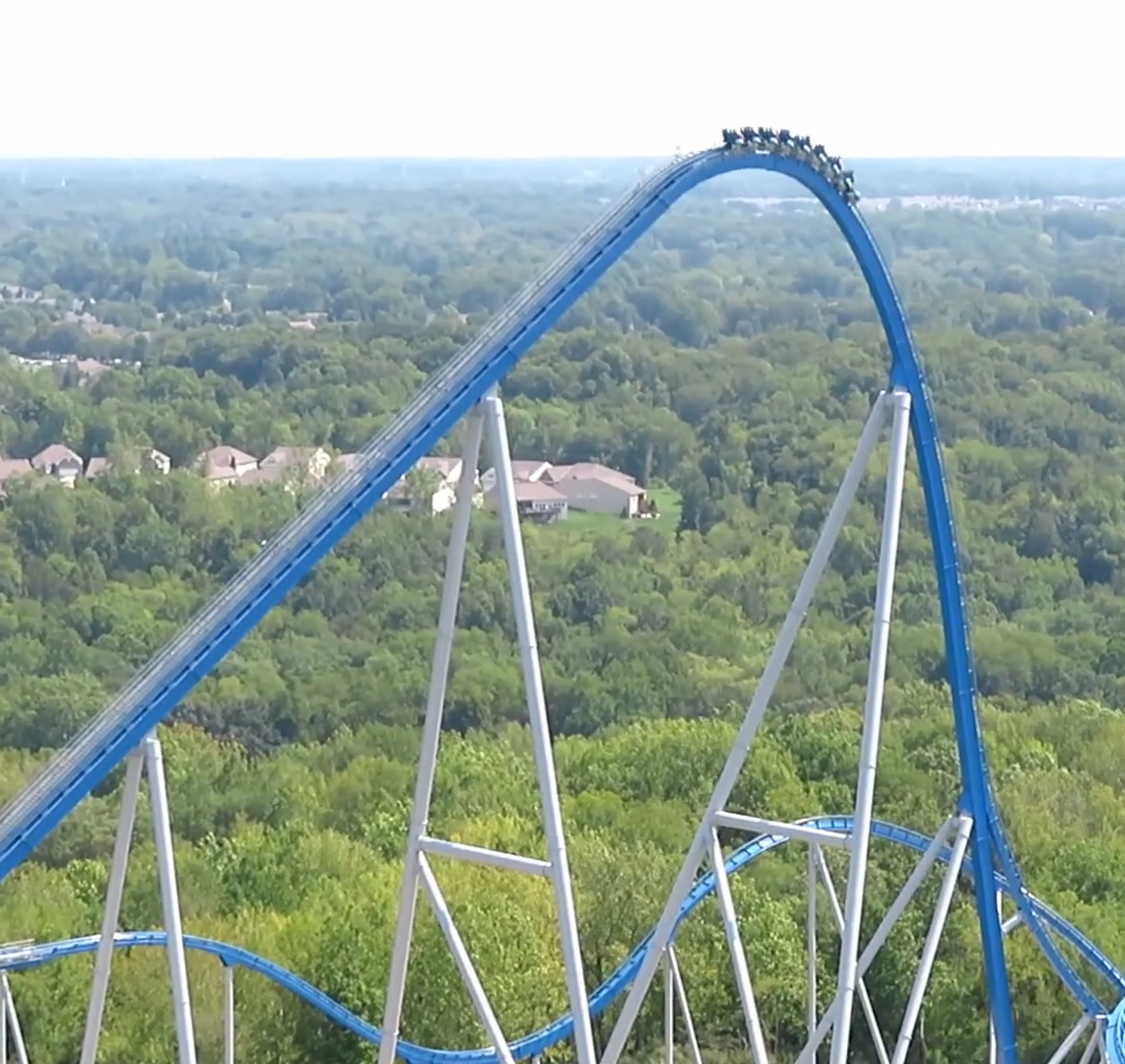
The first drop of Orion at Kings Island. The stomach-drop sensation peaks exactly here, where downward acceleration is greatest. Photograph: Airtime Thrills Raw Footage / Wikimedia Commons
What is actually happening inside your body
Your skeleton is strapped into the car, so it follows the track exactly. Your internal organs are not strapped to anything. The stomach, intestines, liver, and other abdominal organs sit in soft tissue, held loosely in place, free to shift slightly within the body cavity.
When the coaster plunges, the car and your skeleton accelerate downward together. Your organs, obeying Newton's first law, briefly resist the change: they want to keep doing what they were doing. For a split second, your body falls faster than its own insides.
The organs effectively float, weightless, until they catch up. That internal lag is what you feel as the stomach "dropping."
Dr. Brad Sagura, a surgeon at the University of Minnesota's Amplatz Children's Hospital, described the mechanism in a Pitsco article on coaster physics: while the body is secured by restraints, the organs remain free to move to some extent, and that movement contributes to the free-fall floating sensation riders feel. It is, in miniature, what astronauts experience in orbit: the body falling freely, with nothing pushing back.
Normally you never notice your organs at all, because gravity presses everything together constantly. The parts of your body push on each other all day, and your nerves treat that pressure as the background of existence. Remove the pressure for even a fraction of a second and the nerves report the change instantly.
The sensation is fleeting because the drop is fleeting; as the coaster levels out, normal forces return and the organs settle back where they started.
Negative g-forces, explained simply
Physicists describe the drop in terms of g-force, which measures acceleration relative to freefall. At rest you experience 1 g, the familiar pull of Earth's gravity. Climbing a coaster hill or whipping through a valley pushes you into your seat at more than 1 g, and you feel heavier.
Cresting the top and plunging down does the opposite.
During the initial descent, your downward acceleration can approach, and momentarily exceed, 9.8 meters per second squared, the acceleration of gravity itself. When the track falls away beneath you faster than gravity alone would pull you, the seat stops pushing up against you almost entirely. You experience negative g-force: a reduction, and briefly a near-elimination, of your perceived weight.
This is why the feeling is strongest on the first drop and weaker on gentle slopes. The first drop produces the largest and most sudden change in acceleration, which means the largest gap between what your skeleton is doing and what your organs are doing. Later hills repeat the effect at smaller scale, which is why seasoned riders chase coasters with the steepest, tallest first drops.
The same physics shows up in milder form when a car crests a hill fast or an elevator starts descending suddenly, which is why those moments give you a faint echo of the same feeling.
Your inner ear joins the confusion
The organs are only half the story. Your vestibular system, the balance apparatus in the inner ear, is the other half, and it makes the sensation sharper.
Deep in each inner ear sit the otolith organs, tiny sensors that detect linear acceleration and the direction of gravity. They are faster than conscious perception. As the coaster tips over the crest, your otoliths register the plunge immediately, while your eyes are still taking in the view and your body is still processing what is happening.
The result is a sensory mismatch: one system screaming "we are falling" while the others have not caught up.
That mismatch does two things. First, it amplensifies the weirdness of the organ lag, because your brain is receiving an urgent falling signal with no matching visual confirmation yet. Second, it triggers the adrenaline response.
The brain interprets a sudden, unexpected fall as a potential emergency and releases adrenaline, which is why the stomach drop comes bundled with a racing heart, heightened alertness, and sometimes a scream you did not plan. The pounding heart after a sprint runs on the same adrenaline machinery, just triggered by effort instead of falling.
For most riders this cocktail reads as thrill. For some it reads as nausea, because the same vestibular mismatch that creates excitement in small doses creates motion sickness in larger ones. The line between the two is personal and varies day to day, which is why a coaster you loved last summer can feel awful on an empty, tired morning.
Why some people feel it more than others
Not everyone gets the same drop. Several factors tune the intensity.
A full stomach amplifies the sensation because there is more mass inside to lag behind the skeleton. Riding right after a heavy meal makes the floating feeling stronger, which is why regulars advise against it. An empty stomach does not eliminate the physics, but it quiets the signal.
Body position matters too. Riders in the front car get a longer, more gradual tip-over-the-crest moment, while riders in the back get yanked over the top as the train's weight pulls them down, producing a sharper acceleration change and a stronger drop feeling. Hands-up riding removes bracing, which makes the weightlessness feel more complete.
Anxiety plays a role as well. A nervous rider's adrenaline is already elevated before the drop, so the vestibular alarm lands on a primed system. The shaky hands of nervousness and the coaster scream share a root cause: a sympathetic nervous system doing exactly what it evolved to do when the body suddenly falls.
Age and repetition dull it. Children often feel drops more intensely because the sensation is novel; veteran riders feel it less because the brain has learned the pattern and stops flagging it as an emergency. The physics never changes, but the brain's interpretation of it does.
Is the stomach drop dangerous?
For healthy riders, no. The organ shift is tiny, temporary, and within what the body handles routinely. People with certain heart conditions, high blood pressure, or recent surgeries should follow ride warnings and check with a doctor, but the sensation itself is not a sign of injury.
Why do I feel it on small hills but not big ones sometimes?
Expectation shapes perception. A surprise dip on a "mild" ride can produce a stronger drop feeling than a towering coaster you have mentally rehearsed, because the vestibular alarm is loudest when the fall is unexpected.
Does holding on tight reduce the feeling?
Bracing changes your perception more than the physics. Gripping the bar gives your brain proprioceptive input that says you are secure, which damps the alarm response. The organs still lag; you just notice it less.
Why do my legs feel weird too?
Blood shifts with g-forces just like organs do. Under negative g, blood moves upward, which can cause a lightheaded, floaty feeling in the legs and a flush in the face. Under positive g in valleys, blood pools downward and you feel heavy.
The bottom line
Your stomach drops on a roller coaster because the car falls faster than your loosely anchored organs, leaving them briefly weightless inside you while your inner ear sounds a falling alarm your eyes have not confirmed yet. It is Newtonian physics, vestibular biology, and adrenaline arriving all at once, and it lasts exactly as long as the track keeps falling away beneath you.
Image Credits: Wikimedia Commons / Airtime Thrills Raw Footage, Wikimedia Commons / Vsatinet, Wikimedia Commons / Talor Berthelson
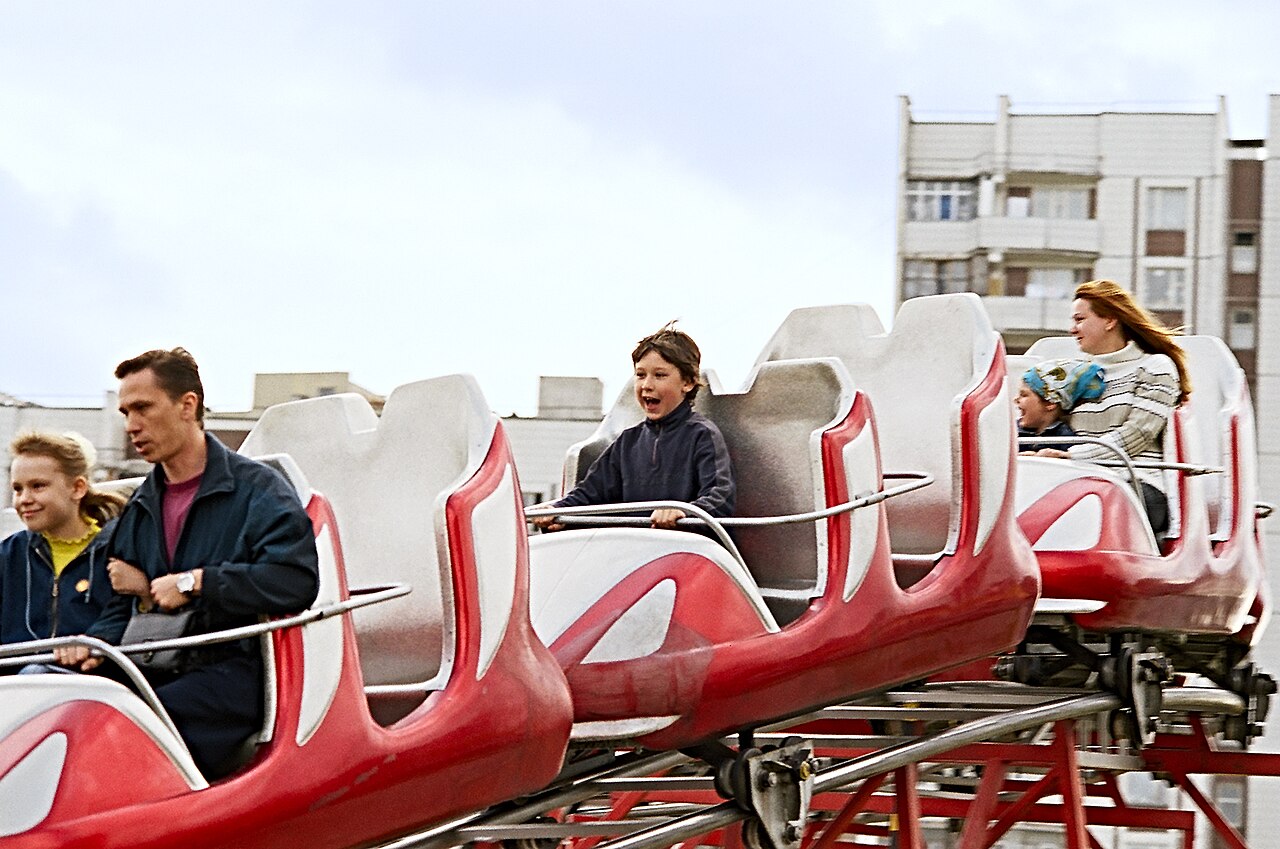
A coaster train at the crest of a hill, the moment before negative g-forces take over. Photograph: Vsatinet / Wikimedia Commons
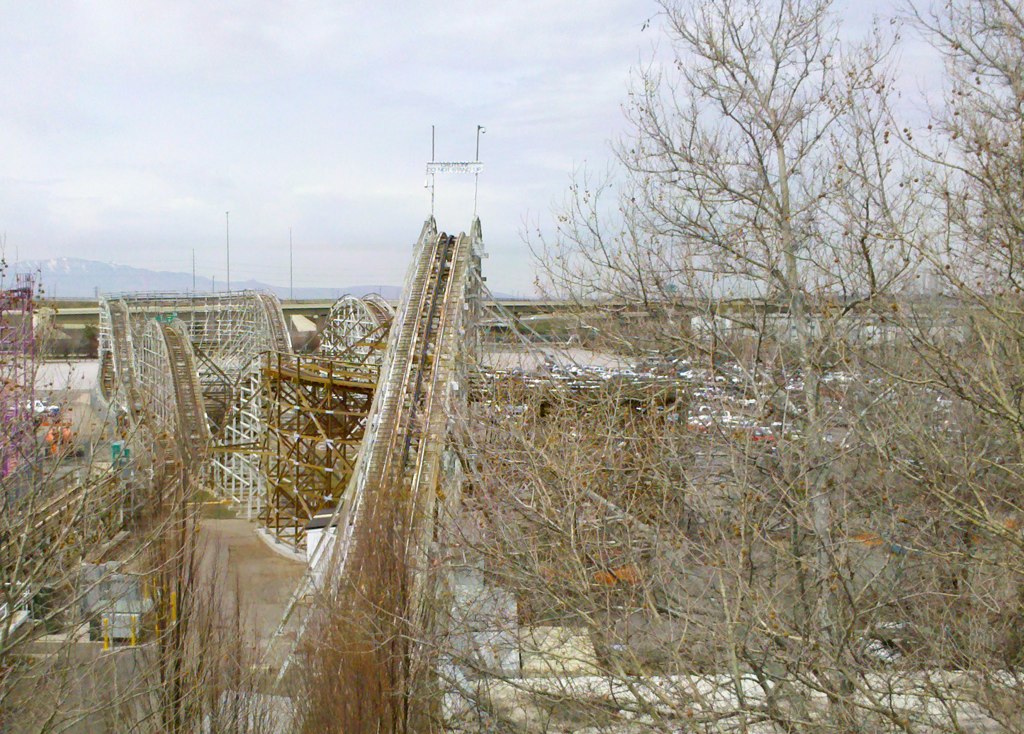
Climbing the lift hill. The higher the crest, the greater the acceleration change on the way down. Photograph: Talor Berthelson / Wikimedia Commons
Latest in Science
- Why your heart pounds after you stop sprinting
- Why your hands shake when you are nervous
- Why you have to put your seat upright for landing
- Why you breathe through your mouth when you run hard
Subscribe to the Rive News newsletter for one clear science explainer every morning.
Related stories

Why diamond is hard and graphite is soft when both are carbon
Diamond and graphite are both pure carbon, yet diamond is 10 on the Mohs scale and graphite is 1 to 2. The difference is not the atoms;

Why Hot Water Can Freeze Faster Than Cold: The Mpemba Effect Explained
Hot water can freeze faster than cold under specific conditions. The Mpemba effect, named for a 1963 schoolboy experiment, still divides
How Magnets Work at the Atomic Level: Spins, Domains, and Iron
Magnetism comes from electrons: their spin and orbits make each atom a tiny magnet. In iron, quantum forces align these atomic magnets into