
Why Altitude Training Boosts Sea-Level Performance: The Blood Story
Key takeaways
- Thin air at altitude triggers the kidneys to release EPO, which builds more red blood cells.
- In a landmark 1997 study, runners living at 2,500 metres raised red cell mass 9 percent and ran faster.
- The smartest version is "live high, train low": bank the blood gains while keeping workout speed.
Every summer, packs of elite distance runners vanish into mountain towns like Flagstaff and Iten. They are not there for the views. They are there because breathing thin air for a few weeks can make them measurably faster back at sea level.
The mechanism is almost embarrassingly simple: less oxygen in each breath forces the body to build more blood. More blood means more oxygen delivery, and oxygen delivery is the ceiling on endurance performance.
This article explains how thin air triggers the blood-building cascade, what the landmark 1997 experiment proved, why "live high, train low" beats training at altitude, and how long the boost lasts.

A runner training high in the mountains, where thin air forces the body to adapt. Illustration: Rive News.
Image Credits: Original illustration, Rive News
Thin air forces the body to make more blood
At altitude, the air holds the same fraction of oxygen as at sea level, but at lower pressure, so each breath delivers less. The body reads this shortfall as hypoxia, low blood oxygen, and launches a fix.
The kidneys sense the shortfall and release erythropoietin, the hormone usually abbreviated EPO. EPO tells the bone marrow to manufacture red blood cells. More red cells mean more hemoglobin, the iron-carrying protein that ferries oxygen, and more hemoglobin means a higher VO2 max, the ceiling on how much oxygen the muscles can burn per minute.
The timeline is well documented. According to Athletic Lab's review, the kidneys release EPO within 24 to 48 hours of altitude exposure, although significant increases in red cell mass take roughly two to three weeks of living at moderate altitude, typically 2,000 metres or higher. Studies with elite athletes show hemoglobin rising by around one percent per week at altitude.
The body makes other adjustments too: increased capillary density in muscle, better buffering of the acidic byproducts of hard effort, and stronger respiratory muscles. But the red-cell cascade is the headline adaptation, the one the whole method is built on.
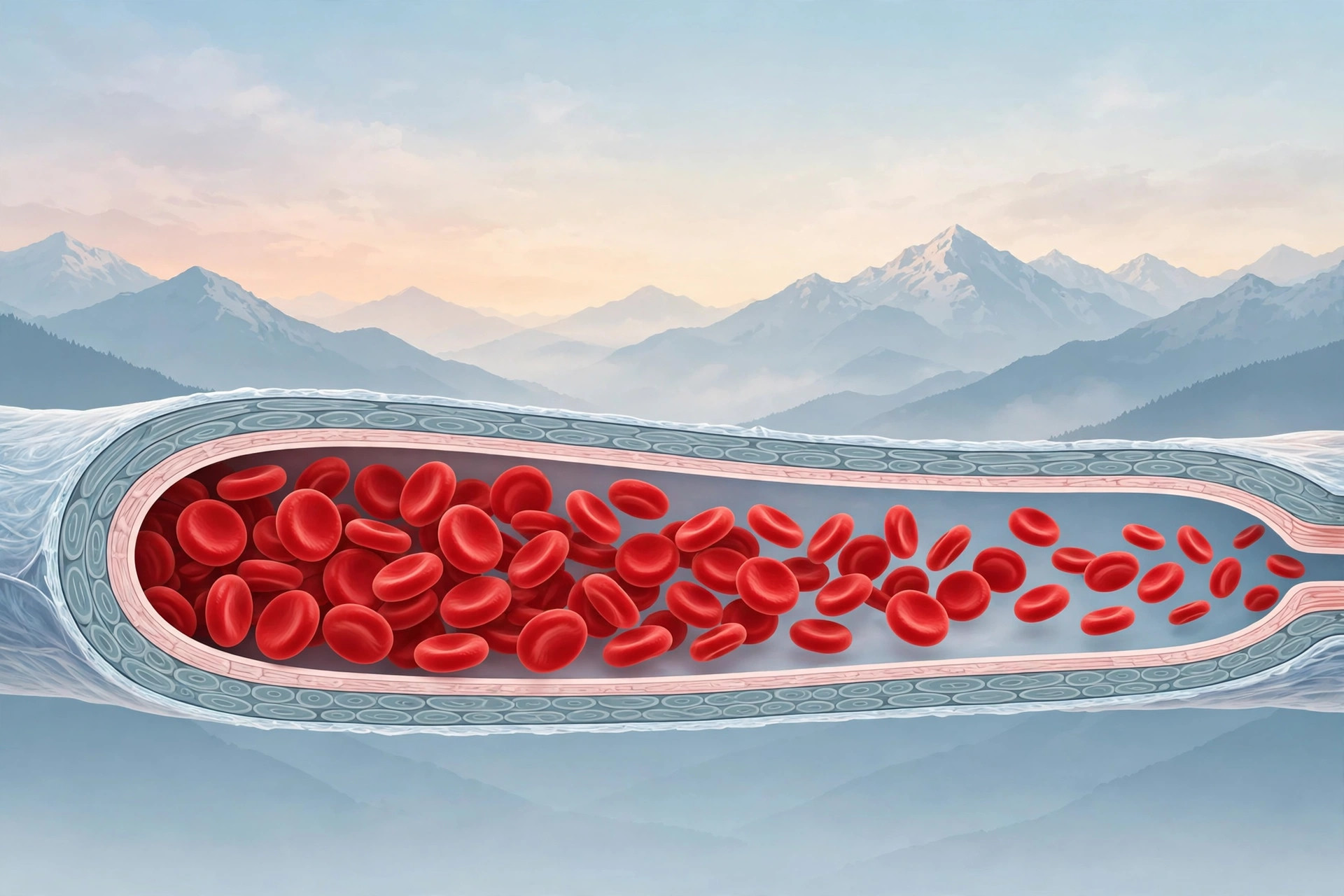
An illustration of the payoff: more red blood cells carrying more oxygen. Illustration: Rive News.
Image Credits: Original illustration, Rive News
The 1997 experiment that proved the blood story
The modern altitude boom began with a failure. At the 1968 Mexico City Olympics, staged at about 2,300 metres, the distance events slowed to a crawl while sprinters set records in the thin air. If thin air wrecked sea-level endurance, coaches reasoned, then adapting to thin air must build something sea-level athletes lacked.
The decisive test came from Benjamin Levine and Jim Stray-Gundersen at the Institute for Exercise and Environmental Medicine in Dallas. Their 1997 study, published in the Journal of Applied Physiology, split 39 competitive runners into three groups of thirteen. One group lived and trained at sea level.
One lived and trained at 2,500 metres. The third lived at 2,500 metres but drove down to 1,250 metres for every hard session. Only the third group, the live-high-train-low runners, improved their 5,000-metre time, by 13.4 seconds.
Only the third group, the live-high-train-low runners, improved their 5,000-metre time, by 13.4 seconds. Both altitude groups raised their red cell mass by about 9 percent and their VO2 max by roughly 5 percent. The difference was that only the train-low group could still run fast enough in training to convert that new blood into a faster race.
That result built the whole method on a single assumption: the payoff is the blood. It also exposed the method's weakness, because a large share of the altitude subjects grew new red cells and ran no quicker at all. Individual response varies widely, and identical altitude exposure can produce large gains in one athlete and almost nothing in another.
Why live high, train low beats training high
Training at altitude has a hidden cost: the thin air slows every hard session. Runners cannot hit true race pace, mechanics decay, and training quality drops. Levine and Stray-Gundersen reported that training workloads frequently decrease at altitude, which can offset the physiological benefits if athletes cannot maintain intensity.
Living high while training low splits the difference. Sleeping and living at 2,500 metres keeps the EPO signal switched on around the clock.
Dropping to 1,250 metres for hard workouts lets the legs still turn over at genuine 5,000-metre speed while the blood keeps building. The body gets the hypoxic stimulus without paying the training-quality tax.
Most practitioners aim for altitudes between 1,800 and 3,000 metres, with many coaches settling around 2,400 metres as a practical sweet spot. Below that, the stimulus is weak; much higher, and sleep, recovery, and illness risk start eating the gains.
For runners who want the aerobic engine without the travel, breathing settles into rhythm after the first few minutes of a run at any altitude, but only sustained exposure builds the blood.
How long the boost lasts
The bad news: the body treats extra red cells as a temporary adjustment, not a permanent upgrade. Athletic Lab notes that the adaptation decays and returns to normal levels within one to four weeks of staying at sea level. Hemoglobin built over a month at altitude fades in a matter of weeks back home.
That is why elite calendars are choreographed around it. Runners typically finish an altitude block two to three weeks before a target race, arriving at the start line with red-cell mass still elevated and training freshness restored. Arrive too early and the blood fades; arrive straight from the mountains and the fatigue of altitude living is still in the legs.
Non-elite athletes may actually benefit more, since lower starting hemoglobin leaves more room to grow. But the same rule applies to everyone: the boost is rented, not owned.
Frequently asked questions
How high is high enough for altitude training?
Research generally points to 1,800 to 3,000 metres as the useful band, with most benefits demonstrated at 2,000 metres and above. Below that, the oxygen shortfall is too small to trigger a meaningful EPO response.
How long before a race should an athlete go to altitude?
About three to four weeks of living high is the standard block, since significant red-cell gains need two to three weeks to develop. Athletes then usually return to sea level roughly two weeks before the race to let the gains settle in.
Does altitude training help sprinters?
Not through the blood pathway. Sprinting is fueled anaerobically, so extra oxygen delivery barely matters. Sprinters did, however, set records at the 1968 Mexico City Olympics because thin air means less aerodynamic drag over 100 and 200 metres.
Can I simulate altitude at home?
Altitude tents and hypoxic rooms exist and can raise EPO, but the evidence is weaker than for real altitude, and sleeping in one for weeks is uncomfortable. Most physiologists still rank actual mountain living as the gold standard.
The bottom line
Altitude training works because thin air is a legal, natural form of blood doping: EPO from the kidneys builds more red blood cells, and more red cells deliver more oxygen to working muscles. The 1997 Levine and Stray-Gundersen study showed 13.4 seconds off a 5,000-metre time for live-high-train-low runners, but the gains are individual, temporary, and only useful if training quality survives. Live high, train low, race within a few weeks.
Latest in Fitness
- Why you get out of breath so fast when running
- Why breathing settles after the first few minutes of a run
- Why you yawn during hard workouts
Subscribe for one clear fitness explainer a week: training science without the hype.
Related stories
How long does it really take to build noticeable muscle?
Strength gains start in week one, but visible muscle takes 8-12 weeks for most beginners. What the Oklahoma CT-scan study measured,
Why you feel dizzy after a workout: the 5 common causes
Post-workout dizziness usually comes from a blood pressure dip, dehydration, or low blood sugar. The numbers behind each cause, and when
Why Do Knees Hurt When Squatting but Not Running?
Knees hurt when squatting but not running because deep bends multiply force on the kneecap. Learn the mechanics, common causes, fixes,