
How to Build a Home Workout With No Equipment
Key takeaways
- A good home workout covers four moves: push, pull, legs, and core, three times a week.
- Progress comes from harder variations, slower reps, and shorter rests, not from more random exercises.
- The WHO baseline is 150 minutes of moderate activity a week plus muscle work on 2 or more days.
You do not need a gym to get stronger. You need a floor, a wall, a sturdy chair, and a plan that gets harder over time. Bodyweight training, also called calisthenics, uses your own weight as resistance for multi-joint moves such as push-ups, squats, and planks.
That is enough to build real strength for months when you are starting out.
This article explains how much activity you need, how to pick your exercises, how to structure a week, how to progress without weights, and how to avoid the mistakes that stall home training.
How much activity do you actually need
The World Health Organization recommends that adults aged 18 to 64 do at least 150 minutes of moderate-intensity activity through the week, or at least 75 minutes of vigorous activity, or an equivalent mix. It also recommends muscle-strengthening work on 2 or more days a week, covering the major muscle groups.
A home workout can cover both halves. Brisk walking, jogging in place, or a fast circuit covers the aerobic side. Push-ups, squats, lunges, and planks cover the strength side.
Three sessions a week of 30 to 45 minutes, plus some daily walking, lands most beginners inside the guideline.
Do not chase the number in week one. Start with two or three short sessions and build the habit. A 20-minute workout you repeat beats a 60-minute workout you quit.
Consistency is the engine, and progression is the steering.
If you already run or cycle, a home plan still helps. Strength work fills the gap that cardio leaves. Readers who want to start running when they have never run can pair runs with two strength days for a balanced week.
Pick four moves that cover the body
Every solid home session has four slots: push, pull, legs, and core. One move per slot keeps the plan simple and makes sure no muscle group is forgotten.
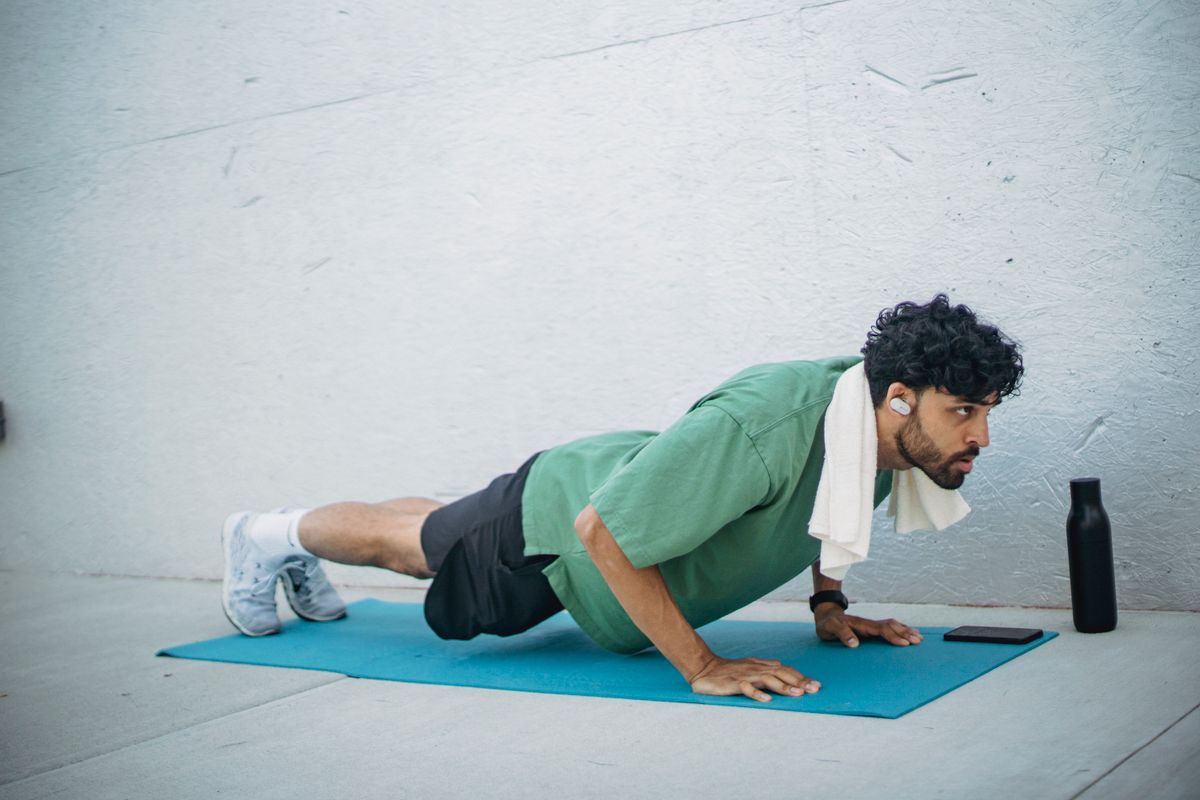
Push means a press-up variation. Start with wall push-ups, move to knee push-ups, then full push-ups. A standard push-up works the chest, shoulders, triceps, and core.
Research cited on the push-up notes that a person supports about 69 percent of body mass in the up position, which is a serious load with zero gear.
Pull is the hard one at home, because pulling needs something to pull against. Use a sturdy table for inverted rows: lie under the table, grip the edge, and pull your chest up. A closed door with a towel looped over the top can work for rows too, if the door is solid and the hinges hold.
Check any setup before you trust it with your weight.
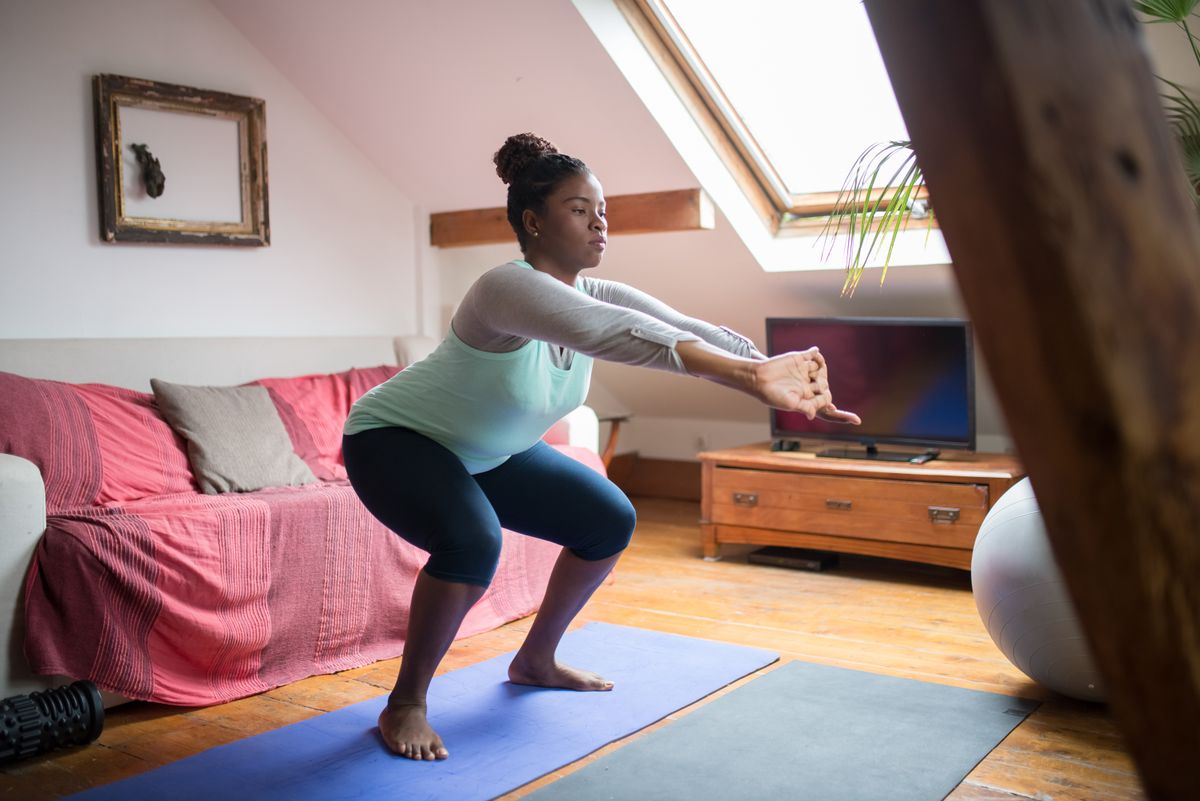
Legs mean squats and lunges. A bodyweight squat trains the quadriceps, hamstrings, glutes, and core. Stand with feet shoulder-width apart, sit back until your thighs are near parallel with the floor, and drive up through your heels.
Lunges add single-leg strength and balance.
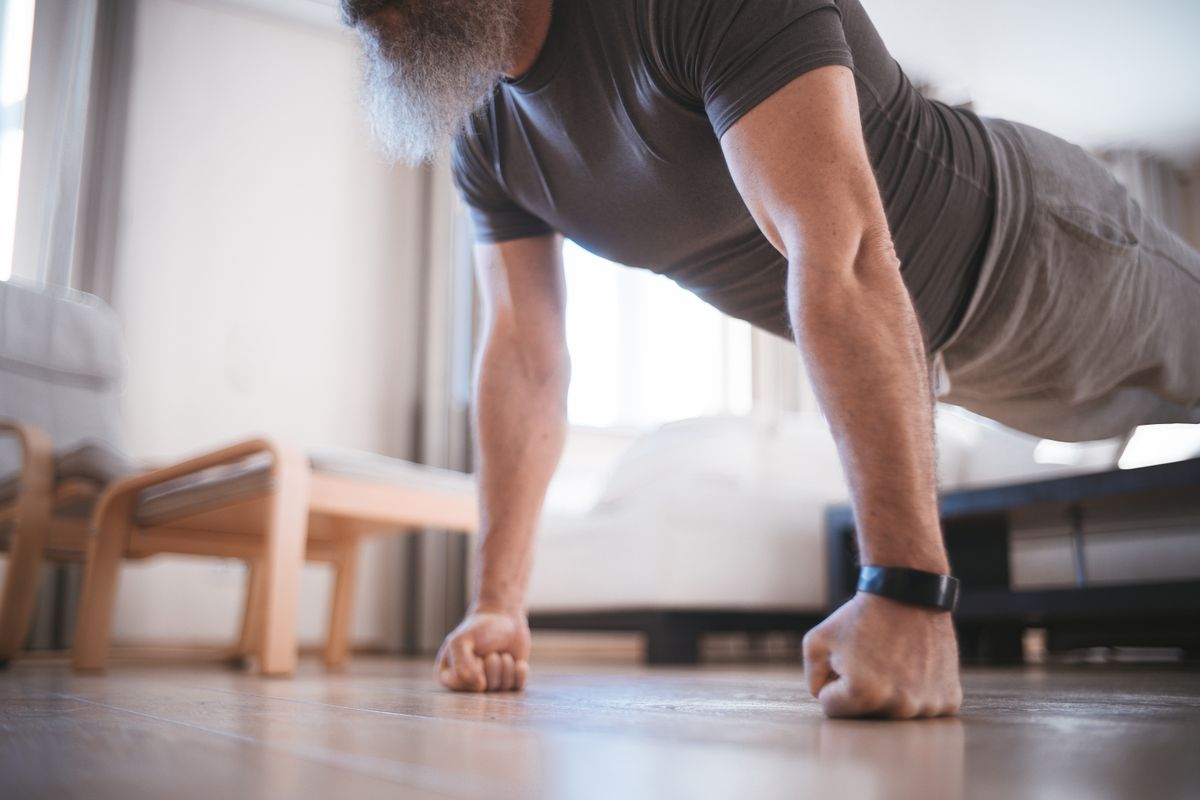
Core means planks and dead bugs. A plank is the top position of a push-up held for time. Keep a straight line from head to heels, brace as if expecting a gentle poke in the stomach, and breathe steadily.
Stop when your hips sag. A short plank with good form beats a long plank with a sagging back.
Structure a week that you will keep
Train three days a week with a rest day between sessions. Monday, Wednesday, and Friday is the classic shape. Each session follows the same skeleton: warm up for 5 minutes, train for 20 to 35 minutes, cool down for 3 to 5 minutes.
A beginner session looks like this. Warm up with marching in place, arm circles, leg swings, and 10 easy squats. Then do 3 rounds of: 8 to 12 push-ups, 10 rows, 12 squats, and a 20 to 30 second plank.
Rest 60 to 90 seconds between rounds.
On day two, swap in variety. Try pike push-ups for shoulders, reverse lunges for legs, glute bridges for the back of the body, and a side plank for the core. On day three, go full body with a faster pace: squats, push-ups, mountain climbers, and a plank, done as a circuit.
The difference between cardio and strength training matters here. Slow, controlled reps with short rests build strength. Fast, continuous circuits with longer work periods build conditioning.
A home plan can lean either way by changing pace and rest.
Progress without adding weight
Progressive overload is the rule behind every training gain. Muscles grow stronger when they face gradually increasing resistance over time. In a gym, you add plates.
At home, you change the move, the tempo, the reps, or the rest.
Use this ladder for each move. First, add reps until you hit the top of your target range. A set of 12 easy push-ups means it is time for a harder version.
Second, slow the tempo. Lower for 3 seconds, pause for 1 second, then rise. Third, shorten rests from 90 seconds to 60, then to 45.
Fourth, move up the variation ladder. Wall push-ups lead to knee push-ups, then full push-ups, then feet-elevated push-ups, then diamond push-ups. Squats lead to split squats, then Bulgarian split squats with a chair, then jump squats.
Planks lead to side planks, then plank reaches, then longer holds with a slow march.
Track every session in a notebook or a notes app. Write the move, the sets, the reps, and the rest. Progress you can see is progress you will keep.
When a move gets easy for two sessions in a row, make it harder next time.
Warm up, cool down, and protect your joints
Warm-ups are standard practice before exercise to raise performance and cut injury risk. Spend 5 minutes on easy movement: marching, arm circles, hip circles, and a few slow reps of the moves you are about to do. Your first working set should never be your coldest set.
Form beats speed on every rep. Squat with knees tracking over your toes, not caving inward. Keep your back flat on rows.
Keep your neck neutral on planks. If a move causes sharp joint pain, stop. Muscle burn is normal.
Joint pain is a stop sign.
Soreness after the first sessions is common, especially two days later. That delayed ache is called DOMS, and it fades as your body adapts. Light walking and gentle movement help more than total rest.
If you want the full picture, read why muscles get sore two days after exercise.
Watch your squat depth if your knees complain. A shallower squat to a chair is a valid step, not a failure. Guidance on proper squat form that does not hurt knees can help you find a pain-free range before you add depth.
Avoid the five home workout traps
Random workouts are the first trap. A different video every day feels fresh, but it never builds on last week. Pick a plan, run it for four weeks, then change it.
Boring and progressive beats exciting and random.
Skipping warm-ups is the second. Cold muscles move stiffly, and stiff reps invite strains. Five minutes is the price of a safe session.
Chasing soreness is the third. Soreness is not a score. A good session can leave you fresh, and a sloppy one can leave you wrecked.
Judge sessions by performance, not by pain.
Training daily without rest is the fourth. Muscles adapt between sessions, not during them. Three hard days with rest days between them outperform seven tired days.
On rest days, walk, stretch, or do nothing.
Quitting at week three is the fifth. Results arrive slowly, and motivation fades before they show. Fix a workout time, keep your gear in one corner, and track each session.
When motivation drops while results feel slow, a fixed schedule carries you through the flat weeks.
A four-week starter plan
Weeks one and two build the base. Do three sessions a week, 3 sets of each move, with 60 to 90 seconds of rest. Use the easiest variation you can do with good form.
Sessions last about 25 minutes plus the warm-up.
Weeks three and four add load. Move to 4 sets of the main moves, or move up one variation on each move, and cut rest to 45 to 75 seconds. Sessions last about 35 to 45 minutes.
If you finish a week feeling strong, keep going. If you finish it feeling beaten up, repeat the week before advancing.
After week four, reassess. Test your max good-form reps on push-ups and squats, and your longest good-form plank. Those three numbers set the next four weeks.
Pick the next harder variation for any move where you passed your target.
Short sessions suit most beginners, and longer sessions suit the step up.
Frequently asked questions
Can you build muscle with no equipment?
Yes, especially as a beginner. Muscle responds to effort and progression, not to a building. Push-ups, squats, lunges, rows, and core work create plenty of stimulus when you make them harder over time.
What if I cannot do one push-up?
Start on the wall. When 3 sets of 15 wall push-ups feel easy, move to a countertop, then a chair, then your knees on the floor. Most beginners reach a full push-up within weeks by climbing this ladder.
Do I need a pull-up bar?
It helps, but it is not required. Table rows and door rows cover pulling for months. If you later buy one item, a doorway pull-up bar unlocks the best back exercise there is.
Should I train every day?
No. Three focused sessions a week with rest days between them build strength and skill. Daily hard training without rest stalls progress and raises injury risk.
The bottom line
A home workout needs four moves, three days a week, and a plan that gets harder. Start with wall push-ups, table rows, squats, and planks. Add reps, slow the tempo, shorten rests, then climb to harder variations.
Track every session, rest between hard days, and give the plan four weeks. Your floor is a gym already. The plan is what turns it into one.
Tags: home workouts, bodyweight, fitness, beginners
Latest in Fitness
- How to start running when you have never run
- Cardio vs strength training: what is the difference
- How to do a proper squat without hurting your knees
- How to stay motivated when exercise results feel slow
Subscribe for one practical fitness guide each week.
Related stories

How long does it really take to build noticeable muscle?
Strength gains start in week one, but visible muscle takes 8-12 weeks for most beginners. What the Oklahoma CT-scan study measured,

Why you feel dizzy after a workout: the 5 common causes
Post-workout dizziness usually comes from a blood pressure dip, dehydration, or low blood sugar. The numbers behind each cause, and when

Why Do Knees Hurt When Squatting but Not Running?
Knees hurt when squatting but not running because deep bends multiply force on the kneecap. Learn the mechanics, common causes, fixes,