
How to Fix Bad Posture From Sitting All Day
Key takeaways
- The fix is movement variety, not one perfect pose held all day.
- Break up sitting every 45 minutes, and add back-strengthening work twice a week.
- Set the top of your screen near eye level so your head stops drifting forward.

This article is for general information, not medical advice. If you have pain, numbness, tingling, or weakness, speak to your doctor or a physiotherapist before starting a new routine.
Bad posture from sitting all day is less about one wrong position and more about staying in any one position for hours. You can hold a textbook-perfect spine for ninety seconds. Nobody holds it for four hours.
What actually helps is changing position often, moving more across the whole day, and strengthening the muscles that hold you up.
That framing comes from the evidence. A 2025 systematic review and meta-analysis in BMC Public Health pooled 25 studies covering 43,184 people and looked at sedentary behaviour and neck pain. It found a significant association overall, with an odds ratio of 1.46, and a dose response: the more hours of sitting, the stronger the association.
At 6 or more sedentary hours a day, the odds ratio rose to 1.88.
An odds ratio is an association, not proof of cause. Most of the included studies were cross-sectional snapshots rather than long follow-ups. Still, the pattern is hard to dismiss: the number climbs as the hours climb.
The useful response is to cut the hours of stillness, not to chase a single perfect pose.
This article explains what sitting does to posture, the desk-day routine that counters it, the exercises that help, and how to set up your workspace.
What sitting all day does to posture
Sitting folds the body into the same shape for hours. Hips stay bent, the upper back rounds, the head drifts forward, and the shoulders roll in. Over time, the muscles that hold you upright get less practice, and the front of the chest and the hip flexors spend the day shortened.
The NHS describes several recognisable patterns. Slouching in a chair is one. A poking chin, where the head sits forward of the shoulders, is another.
A hunched back, a flat back with the lower spine tucked straight, and standing on one leg round out the list. These are behavioural descriptions, not diagnoses, and the NHS pairs each with movement and strengthening rather than with a brace or a single correction.
For slouching, the NHS guidance is: "Exercises to strengthen your core and buttock muscles, and back extensions, will help correct a slouching posture."
For a poking chin, the fix given is to "gently lengthen your neck upwards as you tuck in your chin; bring your shoulder blades down and back towards your spine." For a hunched back, the recommendation covers "upper back, neck and rear shoulder strengthening exercises, chest stretches and neck posture drills."
None of the NHS guidance claims that one of these postures will injure you, or that you must hit a precise angle. What it offers is a set of muscles to strengthen and a set of habits to build.
The other trap is the gadget. A chair, a cushion, or a posture strap can make a good position easier to fall into, but none of them add movement to your day. Movement is the variable with the dose response behind it.
A desk day that moves
Set one alarm, not six. Every 45 minutes, stand up. Not to exercise, just to be vertical for sixty seconds.
Fill a glass, open a window, walk to the other end of the room.
Do the chin tuck at the alarm. Sitting or standing, lengthen the back of your neck upwards and draw your chin very slightly back, like making a small double chin without tipping your head down. Hold for 5 slow breaths.
Open the front of your chest once a day. Stand in a doorway, forearms on the frame at roughly shoulder height, and step one foot forward until you feel a stretch across the chest. Hold for 3 slow breaths, twice.
Micro-breaks add up. Physiotherapists quoted in recent desk-health coverage recommend standing at least every 30 to 60 minutes, with one to two minutes of movement every 30 to 45 minutes as a working target. Shoulder circles, neck stretches held for about ten seconds, and a few seated cat-cow movements fit inside those windows without breaking your flow.
The weekly baseline matters too. The NHS recommends at least 150 minutes of moderate intensity activity a week, or 75 minutes of vigorous intensity activity a week, spread over 4 to 5 days or every day. It also advises people to reduce time spent sitting or lying down and to break up long periods of not moving with some activity.
Strengthen the back twice a week
Posture is a strength problem as much as a habit problem. The muscles that pull your shoulders back and hold your trunk upright need regular work, or they lose the contest with gravity and the keyboard.
NHS guidance for adults aged 19 to 64 is to do strengthening activities that work all the major muscle groups on at least 2 days a week. For posture specifically, prioritise rows, any pulling movement, and glute work.
Scapular squeezes are the simplest start. Sit or stand with a straight back, bend your elbows to 90 degrees, and pull both shoulder blades back and slightly down, as if tucking them into your back pockets. Hold for 10 seconds and repeat 10 times.
Thai Rath's exercise guide lists the same move for strengthening upper back muscles and preventing a hunched posture from looking down at work.
Cat-cow on all fours restores spinal movement. Inhale as you drop your belly, lift your chest, and raise your tailbone. Exhale as you round your back and tuck your chin to your chest.
Repeat for 8 to 10 breathing cycles. The move warms up the whole spine and wakes up the core.
Glute bridges wake up the muscles that sitting switches off. Lie on your back with knees bent, press through your heels, and lift your hips until your body forms a straight line from shoulders to knees. Hold briefly, lower, and repeat for 2 sets of 10 to 15.
Strong glutes help the pelvis sit in a better position when you stand.
Hip flexor stretches address the front of the hip, which shortens during long sitting. Kneel with one foot forward, keep your trunk tall, and shift gently forward until you feel a stretch at the front of the back hip. Hold 30 to 45 seconds per side.
Pair it with the chest stretch above, and you have covered the two areas that sitting shortens most.
The same twice-weekly sessions that build your back also build the legs, chest, and arms the NHS guidance names. Variety across muscle groups is the point, and it supports everything from progressive overload in simple terms to everyday stamina.
Set up the desk so your body stops fighting it
Move the screen, not your spine. Raise the top of the monitor to roughly eye level so your eyes drop to the screen rather than your head. If you work on a laptop, that means a stand, or a stack of books, plus a separate keyboard.
This is the single change that removes the most effort, because it works whether or not you remember it.
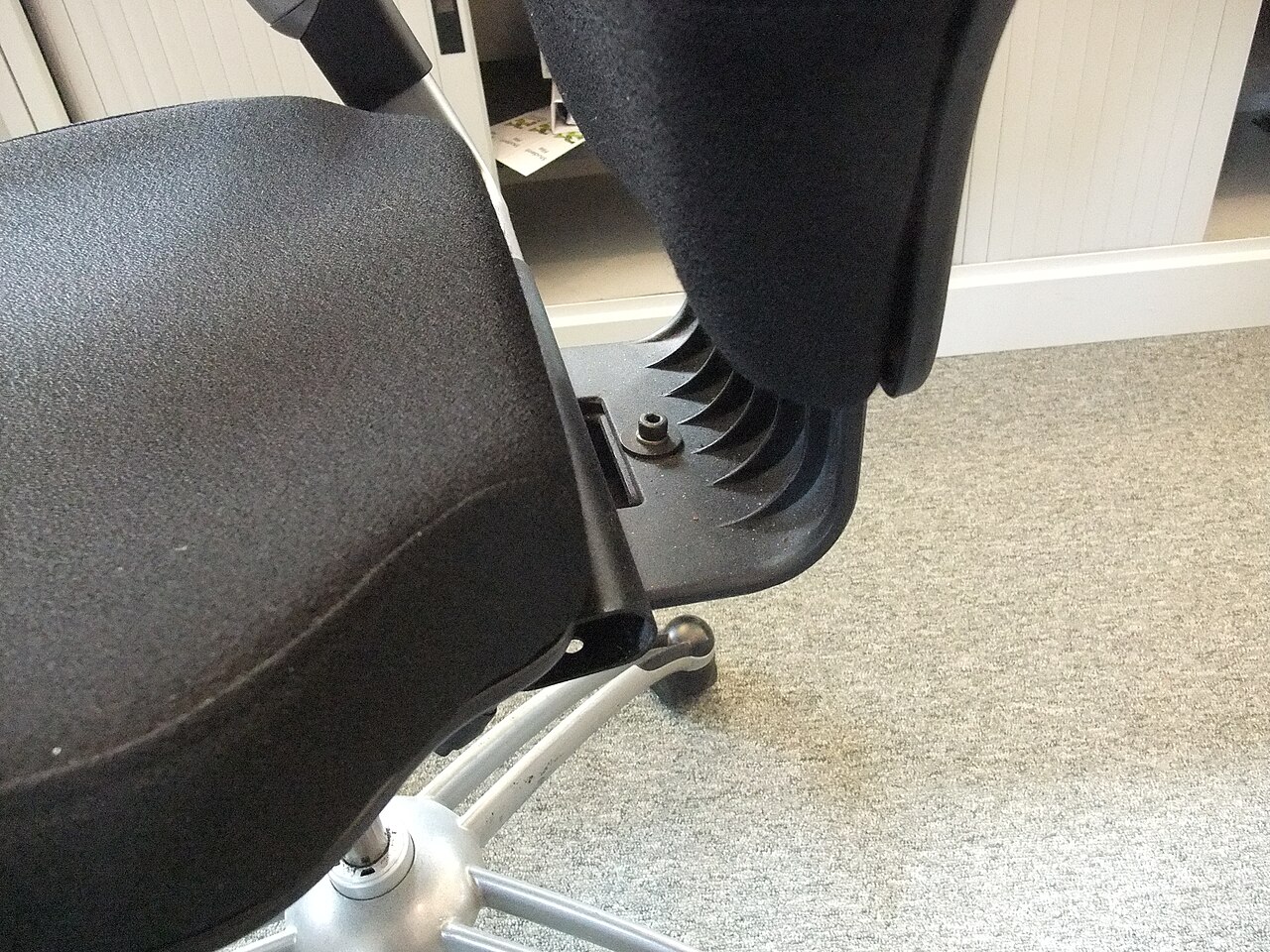
Check the chair basics. Feet flat on the floor or on a footrest, knees and hips each near a right angle, back resting against the chair. Keep the things you use most within easy reach so you are not twisting for them.
Then treat that setup as a starting position rather than a cage, and get out of it every 45 minutes.
Alternate sitting and standing if you can. Standing still for eight hours is its own kind of static loading, and it commonly brings foot, leg, and low-back complaints.
Watch the phone habit too. Cradling a phone against your shoulder to free your hands strains the neck.
For neck relief, NHS guidance gives a simple stretch: gently lower one ear toward the same-side shoulder, hold for 10 to 15 deep breaths, then repeat on the other side.

Can bad posture be fixed, or is it permanent?
You can change how you habitually hold yourself, and you can change how strong the muscles that hold you are. What you cannot do is reach one fixed correct shape and stay there. The realistic goal is variety and strength: more position changes across the day, and two strengthening sessions a week.
How long does it take to improve posture?
Comfort often changes within one to two weeks once you break up long sitting, because static loading is a big part of what makes the end of a desk day feel stiff. Strength changes take longer, typically a couple of months of consistent twice-weekly work before holding yourself upright feels less effortful.
Do posture correctors and braces work?
They can make a good position easier to find, which some people find useful as a short-term reminder. They do not add movement to your day or strengthen anything, and those are the two variables with evidence behind them. Treat a brace as a cue, not a cure, and do not wear one all day.
Should I see a doctor about my posture?
Speak to your doctor or a physiotherapist if you have neck or back pain that wakes you at night, does not settle, follows an injury, or comes with numbness, tingling, weakness, or unexplained weight loss. General movement advice is written for people without a current problem.
Outlook
Your neck and shoulders may feel easier within a week or two of breaking up sitting, because sustained static loading is uncomfortable and removing it helps quickly. Actual strength changes take longer, measured in months rather than days. None of this is a treatment for pain you already have.
It is a description of what the evidence links with fewer problems in large groups of people.
Start small and keep it regular. One alarm every 45 minutes, one chin tuck, one doorway stretch, and two strengthening sessions a week will do more than a perfect chair or a week of heroic effort followed by nothing. If pain appears or persists, talk to your doctor or a physiotherapist before pushing on.
For the movement side of the routine, see why warming up before exercise matters and how daily stretching routines improve flexibility.
Tags: posture, desk work, back health, fitness
Latest in Fitness
- Progressive Overload in Simple Terms
- Why Warming Up Before Exercise Is Important
- How to Improve Flexibility With Daily Stretching Routines
Subscribe to the Rive News newsletter for one practical explainer each week.
Related stories

How long does it really take to build noticeable muscle?
Strength gains start in week one, but visible muscle takes 8-12 weeks for most beginners. What the Oklahoma CT-scan study measured,

Why you feel dizzy after a workout: the 5 common causes
Post-workout dizziness usually comes from a blood pressure dip, dehydration, or low blood sugar. The numbers behind each cause, and when

Why Do Knees Hurt When Squatting but Not Running?
Knees hurt when squatting but not running because deep bends multiply force on the kneecap. Learn the mechanics, common causes, fixes,