
Headache after working out? 5 causes and how to fix them
By Rive News / Research desk | Rive News / Published October 24, 2026 at 9:00 AM PKT
Key takeaways
- A workout headache most often comes from a blood pressure spike, low fuel, dehydration, or neck tension, not from one single cause.
- The fuel-sleep-intensity triage finds your trigger: check what you ate, how you slept, and how hard you pushed.
- Most episodes fade within 48 hours, but sudden severe pain or vision changes need medical attention.

[Runners push through kilometer 34 of the Berlin Marathon. High-intensity efforts like these are the classic trigger for exercise headaches.] Photograph: Dirk Ingo Franke
Image Credits: Wikimedia Commons
A headache that arrives during or after a workout is called an exertion headache, sometimes an exercise-induced headache. It usually feels like a pulsing or throbbing pain on one or both sides of the head, and it can show up mid-set or minutes after you stop moving.
This article takes a closer look at exercise headaches, including what they feel like, the five most common causes, how to tell the benign ones from the red flags, and the prevention habits that stop them coming back.
What an exercise headache actually feels like
The Cleveland Clinic describes exertion headaches as pain that comes on quickly during or after physical activity and fades within minutes, hours, or occasionally a couple of days. Neck pain often rides along with it.
The pain is typically pulsating or throbbing. Some episodes feel like a migraine and add nausea, light sensitivity, or blind spots to the mix.
Most exercise headaches last from five minutes to 48 hours, according to the Cleveland Clinic. They also tend to cluster: a stretch of three to six months where episodes recur, then stop.
The intensity trigger: blood pressure spikes
When you exert yourself, your body demands more blood and oxygen. Scientists believe the headache starts when activity forces veins and arteries to expand to carry that extra blood flow, and the expansion plus rising blood pressure creates pressure inside the skull, per the Cleveland Clinic.
Heavy lifts can spike blood pressure dramatically. A review in US Pharmacist notes that in studies of weightlifters, systolic pressure exceeded 400 mm Hg and diastolic exceeded 300 mm Hg during maximal lifts.
Holding your breath under load makes it worse. The strain-and-hold maneuver, known as the Valsalva maneuver, drives a sharp extra spike in blood pressure on top of the effort itself.
Sprinting, heavy compound lifts, and hot-weather sessions raise the odds. The pain often lands in the back of the head or the temples, right at the end of a hard set.

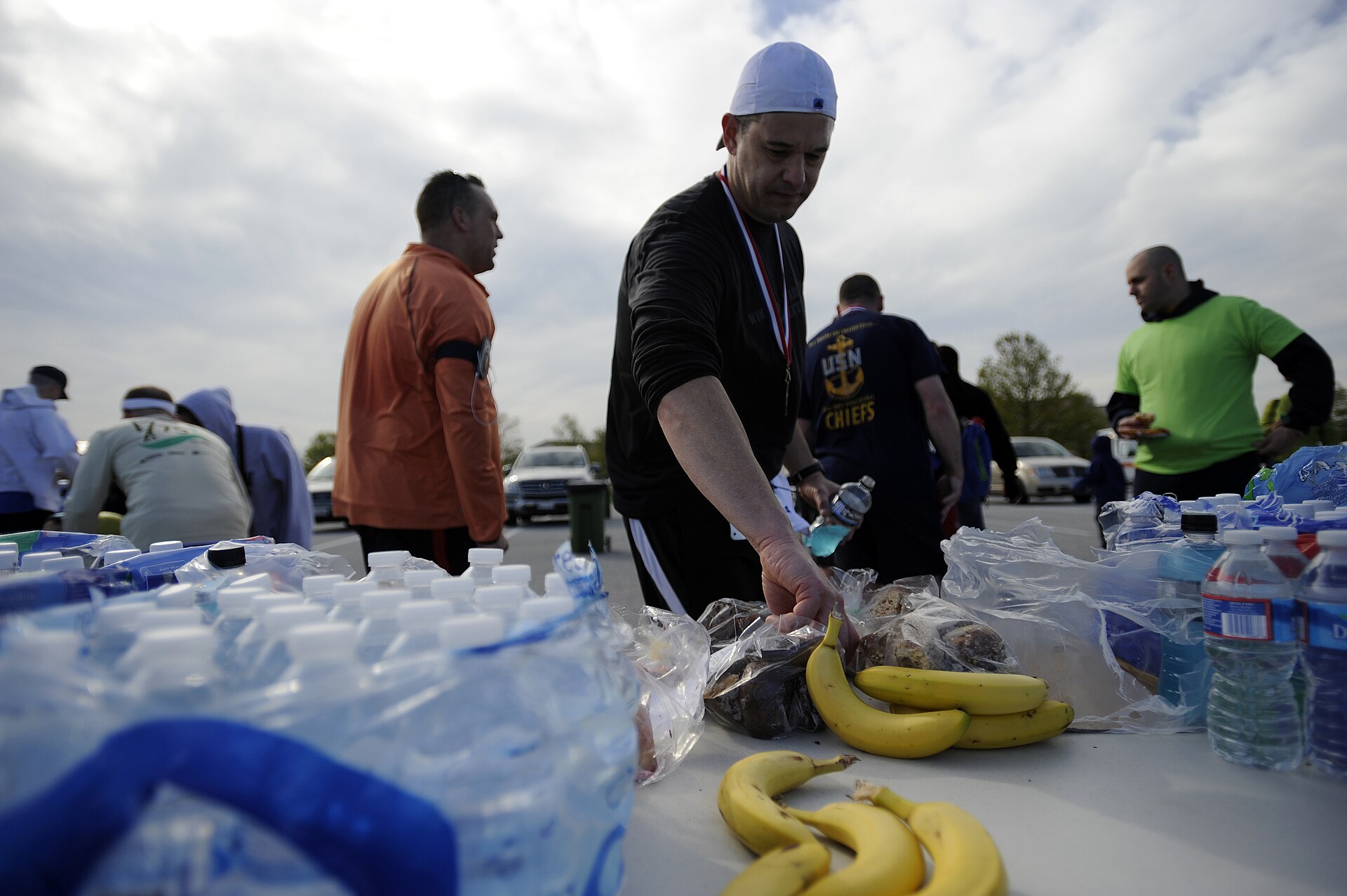
[Soldiers run in an annual race. High-intensity group efforts like these are classic exertion-headache territory.] Photograph: Mark Miranda
Image Credits: Wikimedia Commons
The fuel trigger: low blood sugar
Training on an empty stomach is a classic setup for a post-workout headache. Marathon Handbook lists low blood sugar among the five main causes, and notes it pairs badly with hard efforts.
Your brain is an expensive organ to run. When glycogen runs low during a session, the dip in available fuel can trigger a throbbing headache along with shakiness and fatigue.
The fix is boring and effective. Eat a normal meal or a solid snack one to two hours before training, and keep fasted workouts easy rather than hard.
US Pharmacist adds that eating three to six small, balanced meals through the day helps keep fuel levels steadier for people prone to these headaches.
The hydration and sleep trigger
Dehydration gets the blame most often, and it earns it. Sweating through a workout without replacing fluids thickens the blood and reduces plasma volume, which your body compensates for with higher pressure.
But sleep matters just as much and gets mentioned far less. A review in US Pharmacist recommends a regular sleep cycle with eight hours of restful sleep each night, limiting lights, noise, and warm rooms.
A short night plus a hard morning session is a reliable recipe for a headache. If the pain keeps showing up on days you slept badly, you have found your trigger.
The tension trigger: neck and shoulders
Not every workout headache starts in the blood vessels. Marathon Handbook lists muscle tension in the neck and shoulders among its five causes, and poor posture under load feeds it.
Overhead presses, heavy shrugs, and long runs with a stiff upper body all tighten the same muscles. That tension pulls on the muscles of the head and refers pain upward.
A proper warm-up lowers the risk. A study by Varkey and colleagues, cited in US Pharmacist, had participants do a 15-minute light warm-up before 45 minutes of harder work, with no worsening of headache status.
When a headache after exercise is a red flag
Most exertion headaches are benign, but a few signs mean stop guessing and get checked. A sudden, thunderclap-level pain that arrives at full force is the biggest one.
Watch for fainting, a stiff neck, confusion, vomiting, or vision problems alongside the headache. These symptoms point to vascular problems that need urgent evaluation.
Timing matters too. If a headache lasts longer than 48 hours, or if this is your first-ever exercise headache and the pain is severe, see a clinician rather than training through it. A first severe episode deserves a proper workup to rule out anything serious.
How to prevent the next one
Start with the warm-up. Fifteen minutes of easy-to-moderate movement before hard work lets blood pressure rise gradually instead of spiking.
Hydrate through the day, not just during the session. Drinking water hours before you train keeps you ahead of the fluid loss.
Then fix the fuel and the sleep. Eat before you train, keep a regular bedtime, and avoid high-intensity workouts in extreme heat or at altitude until you are conditioned for it.
Finally, breathe. Exhale on the effort phase of each rep instead of bearing down and holding your breath. It sounds small, but the pressure spike it prevents is not.
[Runners at a half marathon. A proper warm-up before efforts like these lowers headache risk.] Photograph: Brittany Jones
Image Credits: Wikimedia Commons
Can you work out again the same day?
Yes, if the headache has fully faded and you feel normal. Dial the intensity down and see how your body responds.
Do exercise headaches mean something is wrong with my brain?
Usually not. Primary exertion headaches have no underlying disease behind them. Recurring or severe episodes still deserve a medical check.
Why do I only get them when I lift, not when I run?
Lifting produces sharper blood pressure spikes, especially with breath-holding. Running spreads the effort more evenly, though sprinting can trigger them too.
Will they go away on their own over time?
Many people find episodes fade as fitness improves. Cardiovascular conditioning makes the same workout less of a shock to your system.
The bottom line
A headache after working out is your body flagging one of five things: too much intensity too fast, too little fuel, too little water, too little sleep, or too much tension. Run the triage in that order, fix what you find, and most episodes stop.
If headaches are new, severe, or come with alarming symptoms, talk to a clinician. This article is for general information only and is not medical advice; talk to a clinician about any symptoms.
Tags: exercise headaches, workout recovery, fitness health
The Rive News research desk writes explainers from primary sources and published research, with every claim traceable to a named source.
Related
- Why your heart rate stays elevated after exercise
- How many rest days beginners actually need
- Why you get a stitch in your side while running
- The difference between flexibility and mobility
Subscribe to the Rive News newsletter for one evidence-based explainer every morning.
Rive News publishes research-backed explainers. Corrections: reply to any article and we review every report.
Related stories
How long does it really take to build noticeable muscle?
Strength gains start in week one, but visible muscle takes 8-12 weeks for most beginners. What the Oklahoma CT-scan study measured,
Why you feel dizzy after a workout: the 5 common causes
Post-workout dizziness usually comes from a blood pressure dip, dehydration, or low blood sugar. The numbers behind each cause, and when
Why Do Knees Hurt When Squatting but Not Running?
Knees hurt when squatting but not running because deep bends multiply force on the kneecap. Learn the mechanics, common causes, fixes,