
How Does Altitude Training Actually Change Your Blood?
Key takeaways
- Thin air at altitude triggers the kidneys to release EPO, a hormone that orders the bone marrow to manufacture more red blood cells.
- In the landmark 1997 study, altitude exposure raised red cell mass by about 9 percent and VO2 max by roughly 5 percent.
- The gains take two to three weeks to build and fade within one to four weeks back at sea level.
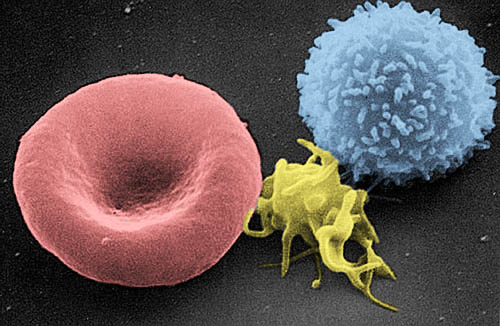
Colorized scanning electron microscope image: a red blood cell (red), a platelet (yellow) and a white blood cell (blue). Altitude training increases the red ones. Image: National Cancer Institute / Wikimedia Commons (public domain)
Altitude training is one of endurance sport's oldest legal performance tricks: live or train up high, race down low, and arrive with blood that carries more oxygen. The mechanism behind it is a hormonal chain reaction that starts in the kidneys and ends in the bone marrow.
This article explains how altitude training actually changes your blood, including why thin air triggers the response, the EPO-to-red-cell cascade, what the landmark study found, how "live high, train low" works, and why the gains fade. This is a general explainer about exercise physiology, not medical advice. Talk to a clinician before trying altitude training.
The core problem: thin air, same lungs
At altitude, the air still contains the same roughly 21 percent oxygen, but the barometric pressure is lower. Each breath therefore delivers fewer oxygen molecules to the lungs. At 2,500 meters, the altitude used in the most famous study of this effect, the body must work noticeably harder to saturate the blood with oxygen.
The body reads this shortfall as a crisis. Specialized sensors detect the drop in blood oxygen, and the kidneys respond through a pathway built around hypoxia-inducible factors, proteins that switch on when oxygen runs low. The result, described in a 2025 systematic review and meta-analysis published via PubMed Central, is a coordinated adaptation aimed at one goal: carrying more oxygen per liter of blood.
Training camps cluster where this effect is strongest. Iten, Kenya, sits at about 2,400 meters above sea level and calls itself the "Home of Champions."
Hundreds of runners from around the world attend its High Altitude Training Centre, where the air carries considerably less oxygen than at sea level, according to D+C Development and Cooperation. Names like Mo Farah and Paula Radcliffe have trained there.
The EPO cascade: kidneys to bone marrow
The centerpiece of the adaptation is erythropoietin, universally abbreviated EPO. It is a hormone produced primarily by the kidneys. When hypoxia-inducible factors signal that oxygen is scarce, the kidneys release EPO into the bloodstream within 24 to 48 hours of altitude exposure, according to Athletic Lab's review of the physiology.
EPO travels to the bone marrow, where it promotes the differentiation of red blood cell precursor cells into mature red blood cells. More red blood cells mean more hemoglobin, the iron-carrying protein inside each cell that ferries oxygen. More hemoglobin means a greater total oxygen-carrying capacity, which raises VO2 max, the ceiling on how much oxygen the muscles can use per minute.
This is the "hematological mechanism" the research literature points to: the hypoxic environment raises EPO concentration, EPO builds red cell mass, and red cell mass lifts aerobic capacity. Supporting adaptations come along for the ride, including increased capillary density, which shortens the distance oxygen must travel from blood to muscle, plus improved muscle buffering capacity and more efficient respiratory muscles.
What the landmark study found
The study that defined the field was published in 1997 by Benjamin Levine and Jim Stray-Gundersen in the Journal of Applied Physiology. Working from the Institute for Exercise and Environmental Medicine in Dallas, they designed an experiment to isolate a single variable, as recounted in a detailed history of the method.
Thirty-nine competitive runners were split into three groups of thirteen. One group lived and trained at sea level. One lived and trained at 2,500 meters.
The third lived at 2,500 meters but drove down to 1,250 meters for every hard session. Only that last group, the live-high-train-low runners, improved their 5,000-meter time, by 13.4 seconds.
Both altitude groups raised their red cell mass by about 9 percent and their VO2 max by roughly 5 percent. The difference was that only the train-low group could still run fast enough in training to convert the new blood into a faster race. The researchers measured total hemoglobin mass with carbon-monoxide rebreathing, a direct method, and tracked the early EPO surge with blood assays.
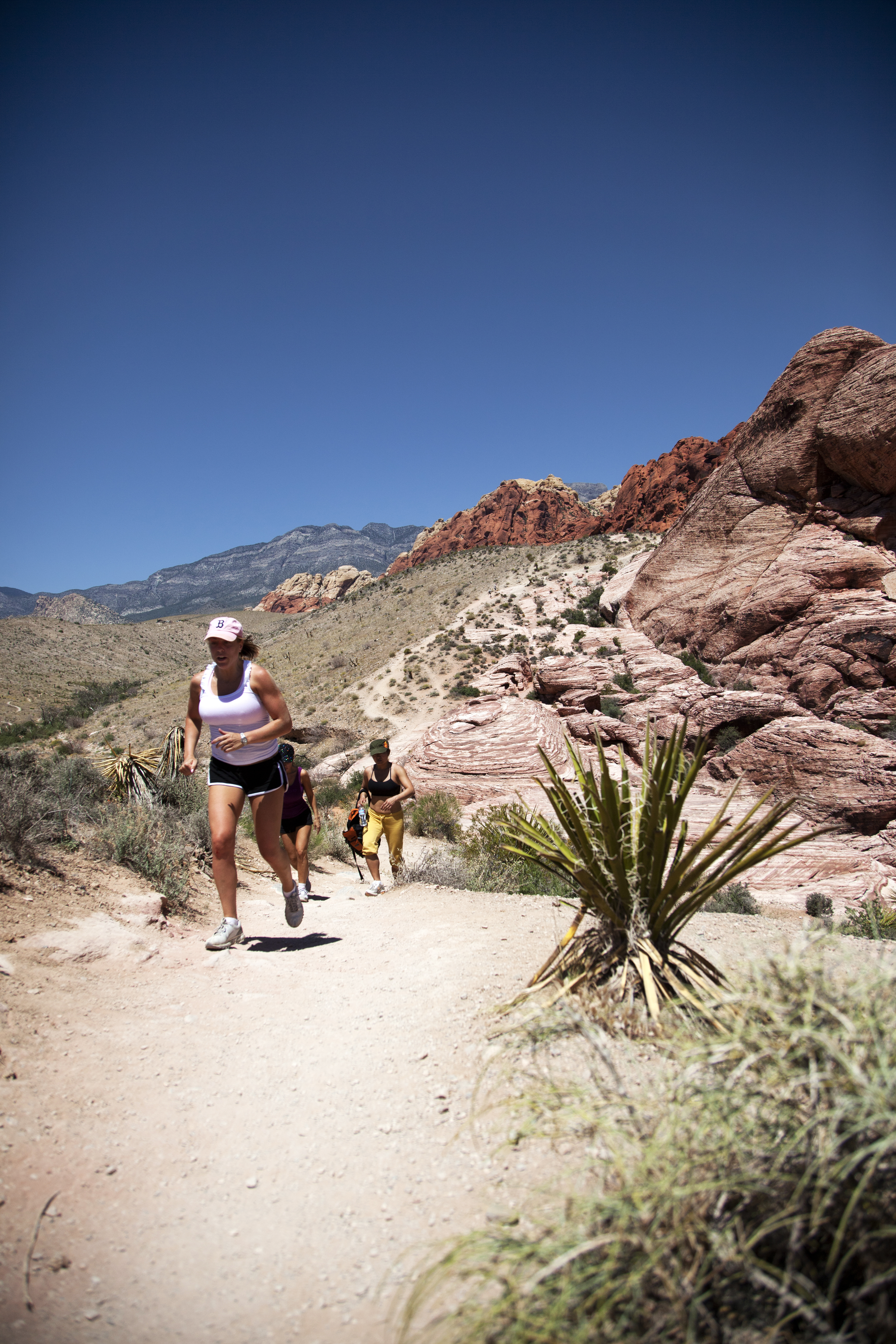
Trail runners training on high terrain. Hard sessions suffer at altitude, which is why many athletes sleep high and train low. Photograph: BLM Nevada / Wikimedia Commons
Live high, train low
The study's result built an entire training philosophy. Living high drives the blood adaptation around the clock.
Training low preserves workout quality, because thin air slows every hard session and lets race-pace mechanics decay. Drop to 1,250 meters and the legs can still turn over at genuine race speed while the blood keeps building.
Modern altitude camps are organized around this split. Athletes sleep in hypoxic rooms or at mountain lodges and descend for interval sessions.
Some use altitude tents at home to simulate the "live high" half without traveling. The dose matters: research suggests spending multiple weeks at 2,000 meters or higher is needed for significant hemoglobin mass gains, and the red cell increase takes roughly two to three weeks of exposure to materialize.
There is a catch the original researchers flagged. Training workloads frequently decrease at altitude, which can offset the physiological benefits if athletes cannot maintain training quality. Altitude training is not free fitness; it is a trade between better blood and worse workouts.
Why the gains fade
The body treats extra red blood cells as a temporary adjustment, not a permanent upgrade. Once the athlete returns to sea level, red cell mass and hemoglobin concentration decay back toward baseline within about one to four weeks, according to Athletic Lab. EPO levels fall quickly once oxygen is plentiful again, and the surplus cells reach the end of their lifespan without accelerated replacement.
That decay curve shapes how athletes time altitude camps: arrive at the key race with the adaptation near its peak, usually within days of descending. Wait too long and the blood advantage is gone.
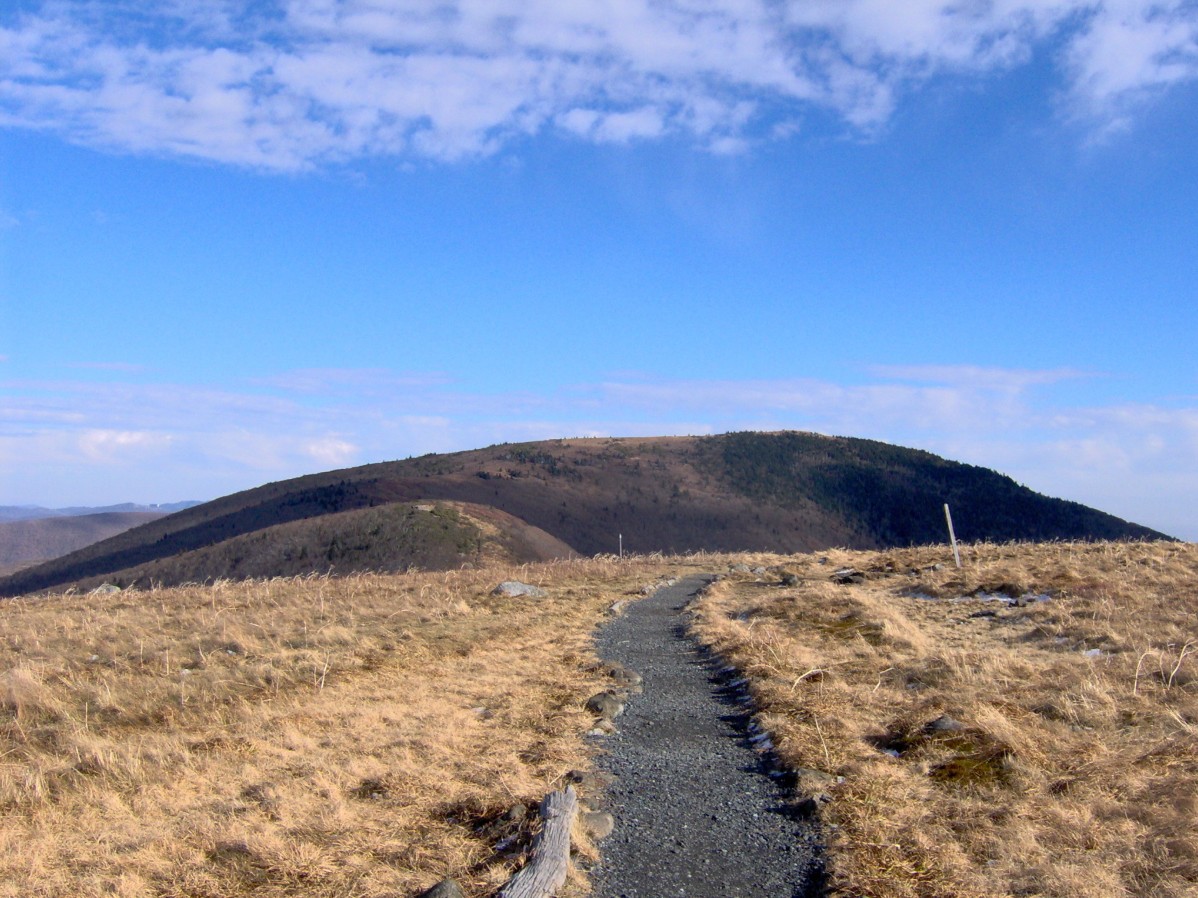
Highland trails near 1,776 meters. Meaningful blood adaptations generally require sleeping at 2,000 meters or higher for weeks. Photograph: Brian Stansberry / Wikimedia Commons
Who responds and who does not
Not everyone gets the same payoff. Research consistently shows wide individual variation: some athletes gain substantial hemoglobin mass and performance, while others show minimal changes despite identical altitude exposure. Genetics, iron status, and baseline training all play a role.
Iron deserves special attention. Building red blood cells consumes iron, and athletes who arrive at altitude iron-deficient may fail to respond at all.
Sports physicians routinely check ferritin levels before an altitude camp and supplement where needed. Without the raw material, the EPO signal has nothing to build with.
There are also non-responders for less understood reasons. The 1997 study itself found that a large share of altitude subjects produced new red cells yet ran no quicker. Blood is only one link in the performance chain; if the muscles, economy, or training quality do not cooperate, extra oxygen-carrying capacity sits unused.
How long do you need at altitude to change your blood?
The kidneys release EPO within 24 to 48 hours of exposure, but meaningful increases in red cell mass take about two to three weeks of living at 2,000 meters or higher. Most protocols recommend three to four weeks for a full response.
Is altitude training the same as blood doping?
No, though they target the same pathway. Altitude training stimulates the body's own EPO production, which is legal.
Injecting synthetic EPO or transfusing blood is banned by the World Anti-Doping Agency. The distinction is the source of the stimulus, not the end result.
Can you simulate altitude at home?
Altitude tents and hypoxic rooms lower the oxygen fraction of the air you breathe while sleeping, mimicking the "live high" stimulus. They are widely used by endurance athletes. The evidence suggests they can raise hemoglobin mass, though less reliably than real altitude, and they do nothing for the training-quality half of the equation.
Does altitude training help sprinters?
Very little. The adaptation targets aerobic capacity, which matters for events lasting minutes to hours. Sprinters rely on anaerobic energy systems that do not benefit from extra oxygen delivery, and the reduced training quality at altitude can actually hurt explosive performance.
The bottom line
Altitude training rewrites the blood through a clean chain of cause and effect: thin air triggers kidney EPO release, EPO tells the marrow to build red cells, and more red cells carry more oxygen to working muscles. The landmark data shows about 9 percent more red cell mass and 5 percent more VO2 max, convertible into real race times only if training quality is protected. The effect is real, legal, and temporary, which is exactly why the world's best endurance athletes keep climbing the mountain.
Latest in Fitness
- How does your body switch from walking to running without thinking?
- Why do you get goosebumps from music?
- How do trees survive freezing winters without moving?
- Why does grilled food taste smoky even on a gas grill?
Subscribe for one clear explainer like this every morning.
Image Credits: National Cancer Institute / Wikimedia Commons, public domain (blood cells); BLM Nevada / Wikimedia Commons (trail runners); Brian Stansberry / Wikimedia Commons (highland trail)
Related stories
How long does it really take to build noticeable muscle?
Strength gains start in week one, but visible muscle takes 8-12 weeks for most beginners. What the Oklahoma CT-scan study measured,
Why you feel dizzy after a workout: the 5 common causes
Post-workout dizziness usually comes from a blood pressure dip, dehydration, or low blood sugar. The numbers behind each cause, and when
Why Do Knees Hurt When Squatting but Not Running?
Knees hurt when squatting but not running because deep bends multiply force on the kneecap. Learn the mechanics, common causes, fixes,