
Why your nose runs when you exercise in cold air
By Rive News / Research desk | Rive News / Published October 29, 2026 at 9:00 AM PKT
Key takeaways
- Cold, dry air forces the nose to warm and humidify every breath, which widens vessels and raises mucus.
- Exercise-induced rhinitis is common: outdoor exercise raised nasal symptoms in 56.1 percent of one surveyed group.
- It usually clears after exercise and differs from allergy, which involves the immune system.
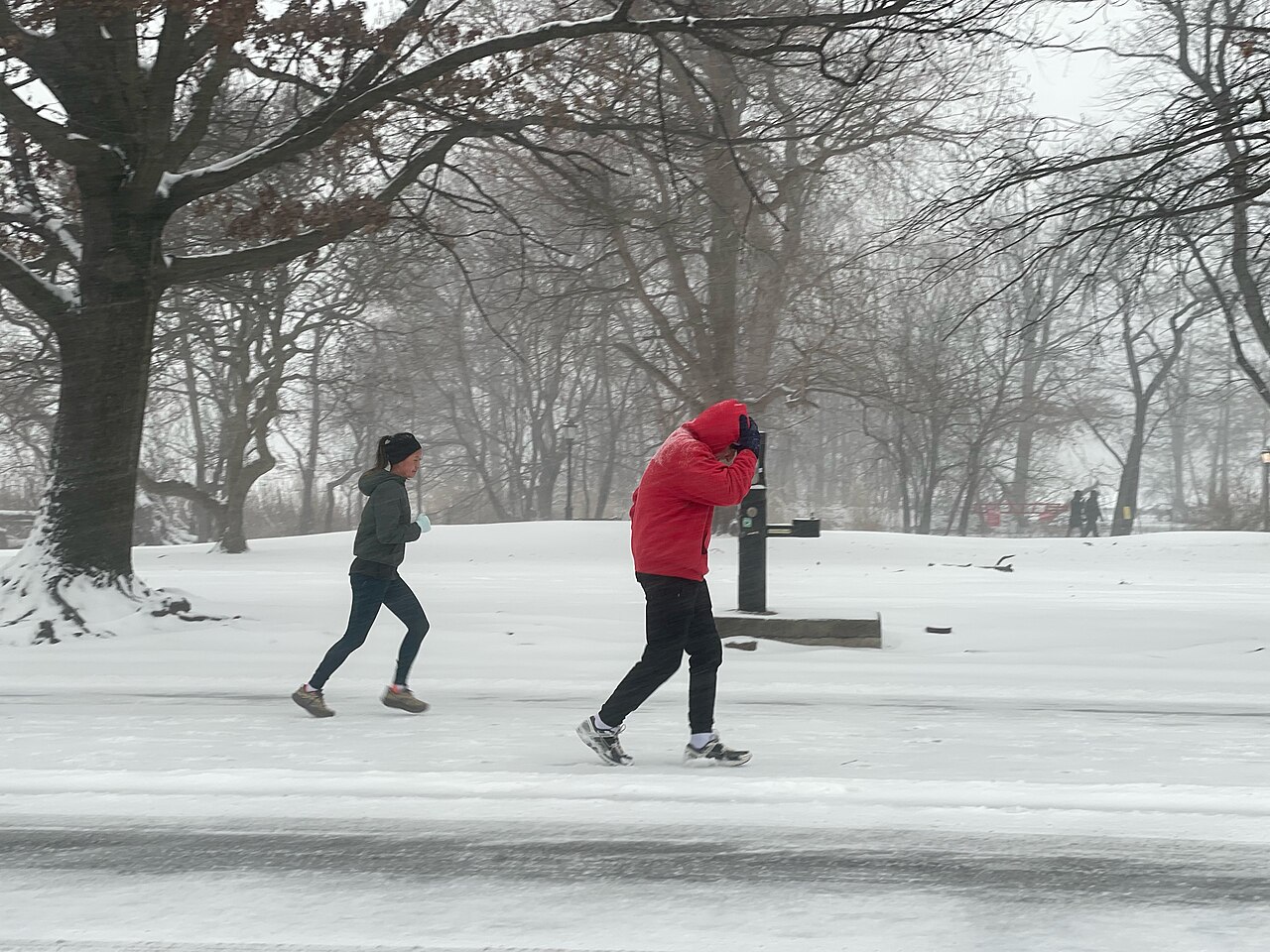
[Two joggers running through falling snow in a park in winter.] Photograph: Wikimedia Commons contributor
Image Credits: Wikimedia Commons
A runny nose in cold air is not a cold, and it is not poor fitness. It is the nose doing its job under harder conditions: warming and moistening a much larger volume of cold, dry air than it handles at rest.
This article explains the reflex behind the drip, including blood vessels, mucus glands, and breathing rate, plus how exercise-induced rhinitis differs from allergy and when it deserves a clinician's look.
The nose is an air conditioner
At rest, you breathe modest volumes of air, and the nose has time to warm and humidify each breath before it reaches the lungs. During exercise, breathing volume rises sharply, and in cold air each breath arrives colder and drier.
The nasal lining responds by widening its blood vessels, sending warm blood to the surface to heat the incoming air. Glands in the lining add moisture at the same time. Both responses are useful, and both produce fluid.
That fluid is mucus and watery secretion, and when production outpaces drainage, it drips. The faster and deeper you breathe, the more air needs conditioning, and the stronger the response becomes.
Mouth breathing bypasses some of this conditioning, which is why switching to mouth breathing at high effort can change symptoms, but it also sends colder, drier air further down the airway. That trade-off is part of why lungs can feel raw in cold air when running.
Blood vessels drive the drip
The key mechanism is vascular. Cold air first narrows nasal vessels, then the body rebounds with widening, a pattern called reactive hyperaemia. Wider vessels leak more fluid into the surrounding tissue and glands, and secretion rises.
The autonomic nervous system controls this balance. Sympathetic activity rises during exercise to support the heart and muscles, while parasympathetic signals to the nasal glands can increase secretion at the same time.
That combination explains a paradox: exercise raises sympathetic drive overall, yet the nose still drips. Different branches of the nervous system are pulling different levers in different tissues.
Temperature change alone can trigger the same reflex. The Australasian Society of Clinical Immunology and Allergy (ASCIA) lists cold weather, dry air, and exercise among the physical triggers of non-allergic rhinitis, a group of conditions that inflame the nasal lining without involving allergy.
This article is for general information only and is not medical advice; talk to a clinician about any symptoms.
How common is exercise-induced rhinitis?
Common enough that researchers gave it a name: exercise-induced rhinitis, or EIR. A study published in the Annals of Allergy, Asthma & Immunology surveyed adults who exercised regularly, including people with and without nasal allergy.
Outdoor exercise raised rhinitis symptoms in 56.1 percent of the total surveyed population. Among those with nasal allergy, 71.6 percent reported more rhinitis with outdoor exercise, against 41.0 percent of those without allergy.
Rhinorrhoea, the medical term for a runny nose, was the most common symptom with indoor exercise too, reported by 48.8 percent of those whose rhinitis increased indoors. The same study found that 40 percent of 164 patients said indoor exercise-induced rhinitis adversely affected athletic performance.
A systematic review of rhinitis in athletes, published in PMC, found only one study that separated out cold-environment training, reporting rhinitis in 46 percent of that group. The numbers vary by sport and definition, but the direction is consistent: cold-air athletes report nasal symptoms often.
Why cold air is worse than warm air
Cold air is usually dry air, and dry air is the harder half of the problem. Warming cold air is one job; humidifying dry air is another, and the nose must do both for every breath.
Winter adds a second factor: the gap between outdoor air and body temperature is larger, so each breath needs more warming. A mild autumn run and a freezing January run are not the same conditioning load, even at the same pace.
Speed matters as well. Sprinting or fast running moves far more air per minute than easy jogging, so the conditioning load rises with intensity. That is why a gentle winter walk may leave the nose alone while a hard interval session does not.
Indoor exercise can trigger the same symptoms, though usually less strongly, because the air is warmer and the temperature gap is smaller. The Annals study's indoor figures show the reflex is not cold-only; cold simply amplifies it.
[A dog running across a snow-covered field in winter.] Photograph: Wikimedia Commons contributor
Image Credits: Wikimedia Commons
Allergy is a different mechanism
It is easy to confuse exercise-induced rhinitis with hay fever, because both produce a runny nose. The mechanisms differ in an important way.
Allergic rhinitis involves the immune system reacting to an allergen such as pollen or dust. Non-allergic rhinitis, including the vasomotor type, involves blood-vessel and nerve responses without that immune reaction, according to ASCIA.
The pattern helps tell them apart. Exercise-induced symptoms start during or shortly after exertion, track with cold or dry air and effort, and usually clear within an hour or so of stopping. Allergy symptoms follow allergen exposure instead, and they often bring itching, sneezing, and eye symptoms with them.
Both can exist in the same person. The Annals study found indoor exercise-induced rhinitis more often in people with nasal allergy (69.1 percent) than in those without (53.0 percent), so an allergic nose can also be a reactive nose.
What usually helps, and what to watch
For most people, the drip is a nuisance rather than a danger. A light face covering in cold weather warms and humidifies air before it reaches the nose, reducing the conditioning load. A gradual warm-up, rather than a sudden sprint into cold air, gives the nasal vessels time to adjust.
Breathing through the nose during easier efforts keeps more conditioning in the nose, where it belongs, though at high effort mouth breathing becomes unavoidable. Saline rinses can clear excess mucus after a session.
Persistent symptoms deserve a check. If a runny nose comes with wheezing, chest tightness, or breathlessness, or if it happens every session despite simple measures, a clinician can rule out allergy, asthma, or structural nasal problems.
For breathing patterns more broadly, see how to breathe properly while running without getting winded and why you breathe harder exercising at high altitude.
Frequently asked questions
Is a runny nose in cold air a sign of being unfit?
No. Exercise-induced rhinitis is common in trained athletes, including endurance athletes, and it reflects a responsive nasal system rather than poor conditioning.
Why does my nose run more when I run than when I walk in the cold?
Running moves much more air per minute, so the nose must warm and humidify a larger volume. The vascular and glandular response scales with that conditioning load.
Does a runny nose in winter mean I have an allergy?
Not necessarily. Non-allergic rhinitis is triggered by cold, dry air and exercise without an immune reaction. Allergy testing can separate the two when the pattern is unclear.
Will my nose stop running if I keep training through winter?
It may ease as you adapt, but cold air will always raise the conditioning load. A face covering and a gradual warm-up usually help more than simply enduring it.
When should I see a clinician about a runny nose during exercise?
If symptoms come with wheezing or breathlessness, disrupt sleep or performance regularly, or persist despite basic measures, a clinician can check for allergy, asthma, or other nasal conditions.
The bottom line
Your nose runs in cold air because exercise multiplies the volume of cold, dry air it must warm and moisten, and the blood-vessel and mucus response to that load produces a drip. It is common, it usually clears after the session, and it is distinct from allergy.
Warm the air before it reaches your nose, warm up gradually, and treat persistent or worrying symptoms as a reason to get checked. The drip is your air conditioner working overtime, not a sign the run went wrong.
Tags: running, cold weather, rhinitis, breathing
The Rive News research desk writes plain-English explainers from published studies and authoritative sources, with no invented experts or first-hand claims.
Related
- Why do your lungs burn in cold air when running?
- How to breathe properly while running without getting winded
- Why you breathe harder exercising at high altitude
- Why do you get a stitch in your side while running?
Subscribe for one plain-English fitness explainer each week.
Rive News standards: every factual claim is traced to a named public source; corrections are noted, never made silently.
Related stories

How long does it really take to build noticeable muscle?
Strength gains start in week one, but visible muscle takes 8-12 weeks for most beginners. What the Oklahoma CT-scan study measured,

Why you feel dizzy after a workout: the 5 common causes
Post-workout dizziness usually comes from a blood pressure dip, dehydration, or low blood sugar. The numbers behind each cause, and when
Why Do Knees Hurt When Squatting but Not Running?
Knees hurt when squatting but not running because deep bends multiply force on the kneecap. Learn the mechanics, common causes, fixes,