
Why Sprinters Look Muscular and Marathoners Look Lean
Key takeaways
- Sprinters' bodies are shaped by fast-twitch fibers, which generate huge force in bursts and grow thicker with explosive training.
- Marathoners rely on slow-twitch fibers built for aerobic endurance, which resist fatigue but barely grow in size.
- Elite sprinters carry up to 80 percent fast-twitch fibers in their legs, while elite distance runners run the reverse ratio.
Watch a 100-meter final, then a marathon, and the contrast is startling. The sprinters look carved from stone: thick thighs, broad shoulders, visible power. The marathoners look wiry and light, built from cable rather than concrete.
Both are runners. Both train brutally hard. Yet their bodies tell opposite stories.
This article explains why sprinters look muscular and marathoners look lean, including the two muscle fiber types, how each responds to training, the role of genetics, and what it means for ordinary training.
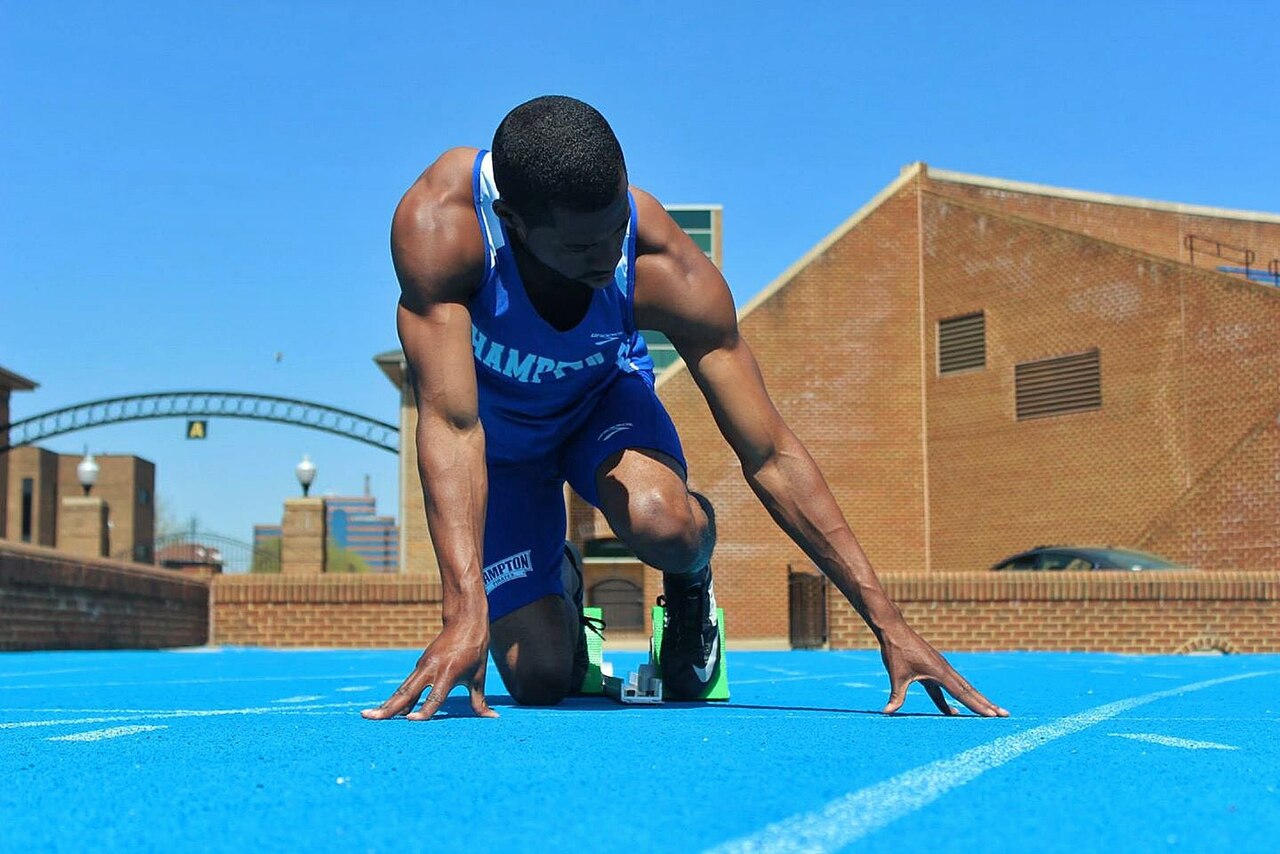
Sprinters settle into their starting blocks. The explosive power of a 100-meter start comes from fast-twitch fibers built for maximum force in minimum time. Photograph: Captain Cobra16
Image Credits: Wikimedia Commons / Captain Cobra16
Your muscles run on two fiber types
Every skeletal muscle is a mosaic of two basic fiber types, and the ratio between them shapes how you move and how you look.
Slow-twitch fibers, also called Type I, are the endurance specialists. They are packed with mitochondria, rich in the oxygen-carrying protein myoglobin (which gives them a reddish color), and surrounded by dense blood vessels. They generate energy aerobically, burning fat and glycogen with oxygen over long periods.
They contract slowly, produce modest force, and resist fatigue for hours. You are using them right now to sit upright.
Fast-twitch fibers, or Type II, are the power specialists. They run on anaerobic metabolism, burning stored glycogen without waiting for oxygen. They contract fast and hard, generating far greater force per contraction.
The tradeoff is brutal: they fatigue quickly. Freeletics' physiology explainer puts the key point plainly: white fibers are thicker and have a bigger potential to grow.
That last clause is the whole story in one line. Slow-twitch fibers are built not to tire, and fatigue is one of the prerequisites for muscle growth, so they grow very little. Fast-twitch fibers fatigue fast and grow readily when loaded.
The training each athlete does selects which population gets developed.
What sprint training builds
A sprinter's job is maximum force in minimum time. A 100-meter race lasts about 10 seconds. The start alone demands an explosive push from the blocks that recruits nearly every fast-twitch fiber in the legs and glutes.
Sprint training, heavy lifting, and plyometrics all load muscles at high percentages of their maximum contraction strength. That high-intensity work is exactly what triggers fast-twitch hypertrophy. The fibers thicken, their cross-section grows, and the muscle belly visibly expands.
Muscle biopsies show that sprinters tend to carry a high proportion of fast-twitch fibers in their leg muscles, according to New Zealand's Science Learning Hub, and their training develops the size of those fibers further.
Diet and body composition sharpen the effect. Sprinters carry low body fat so the muscle they built shows, and extra mass is only a penalty if it slows them. For a sprinter, every kilogram of contractile tissue pays for itself in the first 30 meters.
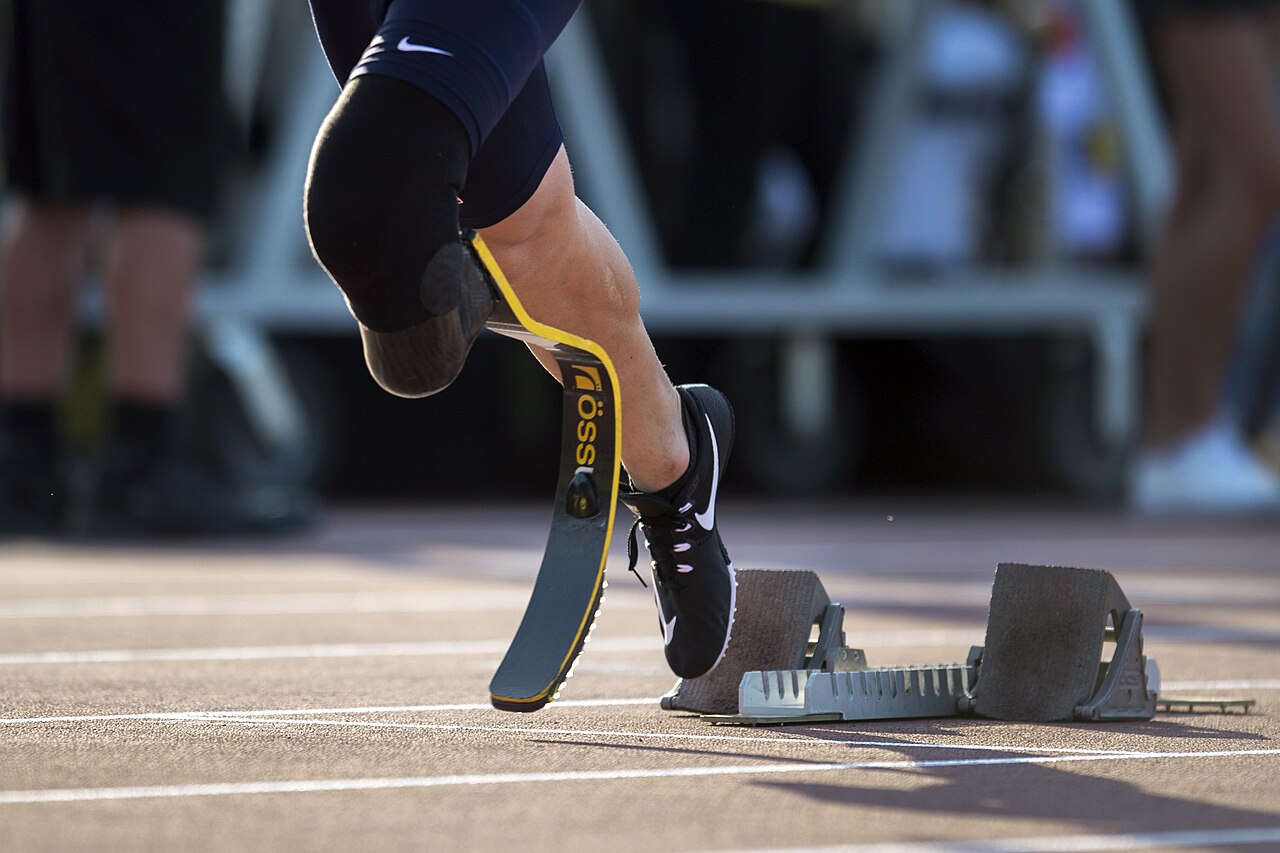
An athlete launches from the starting blocks. Sprint training loads muscles near their maximum contraction strength, which is precisely the stimulus that thickens fast-twitch fibers. Photograph: DoD News
Image Credits: Wikimedia Commons / DoD News
What marathon training builds
A marathoner faces the opposite problem: sustaining a moderate effort for over two hours. The winning strategy is efficiency, not force. Every extra kilogram of muscle is mass that must be carried 42.2 kilometers, fed with oxygen, and cooled.
The ideal marathon body is light.
Long, steady running trains slow-twitch fibers and the aerobic systems that feed them: more capillaries, more mitochondria, better fat utilization. It produces very little of the mechanical tension that drives hypertrophy. Slow-twitch fibers have high fatigue tolerance, which means the growth signal stays weak.
The result is a runner whose muscles are extraordinarily capable and barely larger.
There is also selection pressure in both directions. People born with a high percentage of slow-twitch fibers gravitate toward distance running because they are good at it; years of high-volume training then refine the package. It is a feedback loop between genes and mileage.
Genetics deals the cards, training plays the hand
Fiber-type ratio starts with genetics. Muscle biopsies, as summarized by the Science Learning Hub, show that sprinters tend toward fast-twitch dominance while marathon runners lean slow-twitch, and the rest of the population sits near a 50/50 split.
The numbers at the extremes are striking. As exercise physiologist Dr. Andy Galpin of Cal State Fullerton has noted through athlete muscle biopsies, elite sprinters often carry up to 80 percent fast-twitch fibers in their legs, while elite distance runners show roughly the reverse, around 80 percent slow-twitch.
Average people land near 50/50.
But the ratio is not destiny. Galpin's work also highlights hybrid Type IIa fibers, the middle children of the muscle world, with the strength of fast-twitch fibers plus surprising endurance. Training shifts how these hybrids behave: sprinting and heavy lifting push them toward the fast side, endurance work toward the slow side.
Your body adapts to the stress you impose, which is why a committed recreational runner slowly starts to look like a runner.
Recruitment order adds a final wrinkle. Henneman's Size Principle describes how the nervous system activates fibers: light work uses only slow-twitch fibers, and fast-twitch reserves join only as the load climbs. A marathoner running easy miles never fully calls in the fast-twitch population, while a sprinter's every rep summons them.
Different training, different fibers, different bodies.

A runner celebrates finishing a marathon. Two hours of aerobic work builds capillary networks and mitochondria, not bulk, which is why distance runners stay lean. Photograph: Shixart1985
Image Credits: Wikimedia Commons / Shixart1985
Can a marathoner build muscle too?
Yes, with strength training. Many elite distance runners lift to improve running economy and injury resistance. They stay lean because their total training volume favors endurance, not because muscle is impossible.
Will sprinting make me bulky?
Sprint training builds powerful legs and glutes, but getting genuinely bulky requires heavy resistance training plus a calorie surplus. A few weekly sprint sessions improve power and body composition without turning you into a 100-meter specialist.
Do sprinters and marathoners eat differently?
Broadly, yes. Sprinters eat to fuel explosive training and support muscle, with plenty of protein and carbohydrates. Marathoners eat to sustain enormous energy expenditure, often exceeding 100 kilometers a week, which keeps body fat low almost by default.
Which body type is healthier?
Both. Sprinters typically have more muscle mass, which protects joints and metabolism; marathoners typically have exceptional cardiovascular fitness. The healthiest choice is the training you will actually sustain.
The bottom line
Sprinters look muscular because their sport demands explosive force, and explosive training grows fast-twitch fibers. Marathoners look lean because their sport rewards efficiency, and endurance training refines slow-twitch fibers without growing them. Underneath the aesthetics is a simple division of labor in your own muscles, one you can shift with how you train.
Related reading: how long it takes to build noticeable muscle and why you get out of breath so fast when running.
Latest in Fitness
- How long it takes to build noticeable muscle
- Why you get out of breath so fast when running
- Muscle soreness vs injury: how to tell
- Why protein matters after a workout
Get one clear fitness explainer like this in your inbox every week. Subscribe to the Rive News newsletter.
Image Credits: Wikimedia Commons / Captain Cobra16, DoD News, Shixart1985
Related stories

How long does it really take to build noticeable muscle?
Strength gains start in week one, but visible muscle takes 8-12 weeks for most beginners. What the Oklahoma CT-scan study measured,

Why you feel dizzy after a workout: the 5 common causes
Post-workout dizziness usually comes from a blood pressure dip, dehydration, or low blood sugar. The numbers behind each cause, and when
Why Do Knees Hurt When Squatting but Not Running?
Knees hurt when squatting but not running because deep bends multiply force on the kneecap. Learn the mechanics, common causes, fixes,