
Why Do You Sweat Less as You Get Fitter?
Key takeaways
- Sweat rate tracks how much heat your muscles generate, not your fitness score alone.
- Training makes sweating start earlier, reach higher maximums, and evaporate more efficiently.
- Fitter athletes often lose less sweat at the same relative effort, studies show.
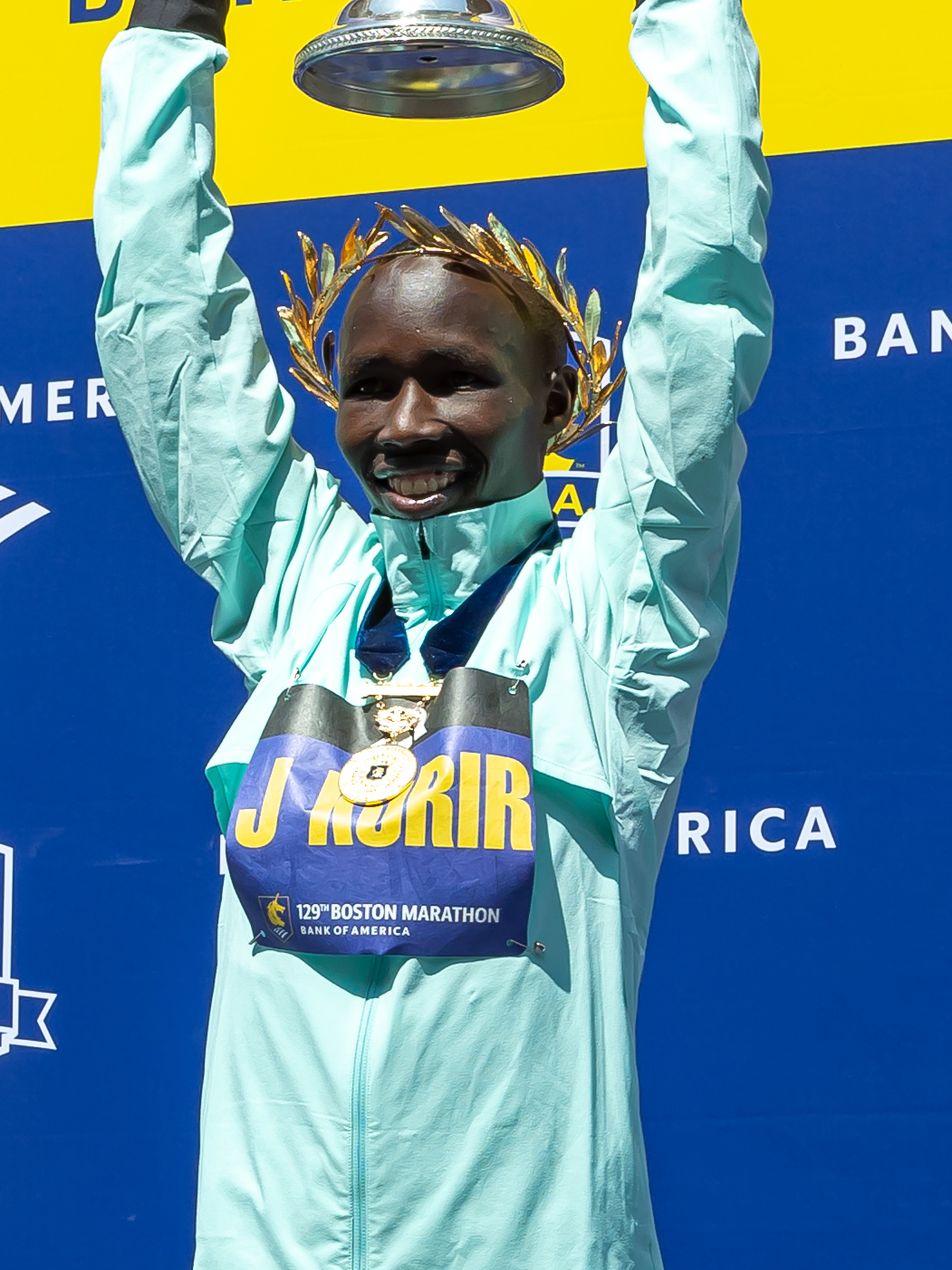
Elite marathon runners sweat heavily because they sustain enormous workloads; their cooling systems respond earlier and harder. Photograph: Margot Murphy
Image Credits: Wikimedia Commons / Margot Murphy
Sweat is your body's air conditioner. As working muscles burn fuel, most of that energy escapes as heat, and sweat glands release water onto the skin so evaporation can carry the heat away.
This article takes a closer look at whether fitter people really sweat less, including what training changes about the sweat response, why sweat rate follows workload more than fitness, and why you may still notice less sweat as you improve.
The paradox: fit people often sweat more, not less
Walk into any running club and you will notice the fastest athletes are usually the sweatiest. That observation is real, and it contradicts the gym wisdom that fitness dries you out.
The reason is simple arithmetic. A fitter runner at 70 percent of maximum effort is moving far faster than a beginner at the same relative intensity.
Faster movement means more metabolic heat produced per minute, and more heat means more sweat. Researchers who compared two groups matched for body mass but with very different aerobic fitness (VO2max of 40.3 versus 60.1 mL/kg/min) found that sweat rates depended on metabolic heat production, not on fitness itself, as reported by Sweat Science based on work from Ollie Jay's lab published in the American Journal of Physiology.
So if your fitter training partner is dripping and you are not, it is probably because they are doing more work. The question gets interesting when both of you do the same absolute work, like jogging side by side at the same pace.
What training actually changes about your sweat response
Regular aerobic training rewires the cooling system in three documented ways. First, sweating starts earlier in the workout, a proactive response that keeps core temperature stable from the first kilometer instead of playing catch-up.
Second, the maximum sweating capacity rises. Sweat glands become more responsive with training, raising the ceiling on how much sweat you can produce per hour. Third, trained athletes deliver blood to the skin more effectively, which works hand in hand with sweat evaporation to dump heat, according to the Fitness First Report's review of recent research.
A 2014 study in PLOS ONE compared 16 long-distance runners (with 7 to 12 years of training, averaging 9.2 years) against 20 sedentary controls. The runners showed shorter sweat onset times, higher sweat rates, more activated sweat glands, and greater sweat output per gland, with sweat onset time correlating to VO2max at r squared of 0.543.
In other words, training upgrades the machinery. It does not necessarily turn the tap down.
Why sweat rate follows workload more than fitness
The cleanest evidence comes from a study presented at the American College of Sports Medicine meeting by Matthew Cramer and Ollie Jay, later published in the Journal of Applied Physiology. They put 28 volunteers of widely varying fitness and body size through 60-minute cycling tests while measuring sweat rates and core temperature.
Heat production explained about 50 percent of the variation in core temperature. Adding body fat percentage, which ranged from 6.8 to 32.5 percent across subjects, explained only another 2.3 percent. For sweat rate, body fat explained just 1.3 percent of variation, and VO2max accounted for only 4 percent on its own.
A 1995 study of nine college baseball players training at a mean ambient temperature of 36.7 degrees Celsius found that VO2max was inversely correlated with body mass lost as sweat, as indexed on PubMed (PMID 7588694). At a given exercise intensity, the fitter players held their body temperature with a lower sweating rate than less fit players.
Read together, the pattern is consistent. Your sweat glands respond to how much heat you are generating right now. Fitness changes how efficiently you generate that heat and how precisely the cooling responds.
Why you may notice less sweat anyway
Several real effects create the impression that fitter people sweat less. The first is economy: trained runners convert fuel to forward motion more efficiently, producing less waste heat at any given pace. Less waste heat means less sweat needed for the same speed.
The second is evaporation efficiency. Trained athletes tend to spread sweat in thinner films that evaporate faster instead of dripping off.
Dripping sweat cools nothing, since only evaporation removes heat. More efficient evaporation means the same cooling with less total fluid loss.
The third is heat acclimation, which often arrives alongside fitness. Repeated exposure to hot workouts triggers faster sweat onset and higher sweat capacity, and some 2025 research found that even condensed heat-training protocols produce these adaptations. What looks like "fitness" may partly be heat training.
Finally, humidity and body size dominate the day-to-day picture. A bigger athlete hauls more mass and makes more heat.
A humid day strangles evaporation for everyone. Genetics, medications, and clothing matter too, which is why two equally fit runners can look very different in the same class.
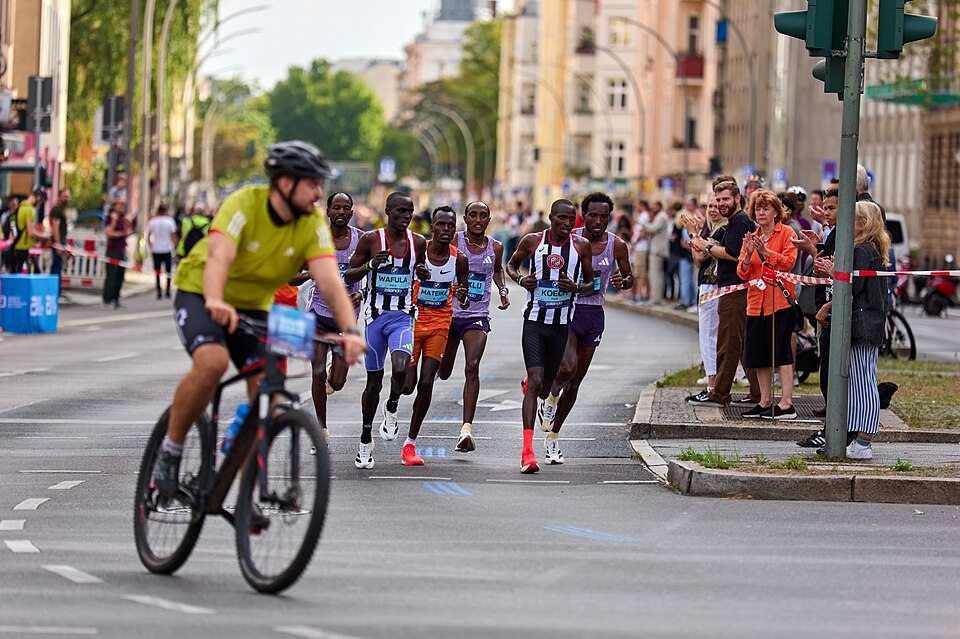
Professional runners at the Berlin Marathon. Sweat rate in a race is driven mostly by pace and heat, not by how fit each athlete is. Photograph: Leonhard Lenz
Image Credits: Wikimedia Commons / Leonhard Lenz
Frequently asked questions
Does sweating more mean I am out of shape?
No. Sweat volume mostly reflects your workload, body size, and the weather. A fit athlete running fast in humidity will out-sweat a beginner walking slowly, and that says nothing bad about either of them.
How can I measure my own sweat rate?
Weigh yourself before and after a workout without drinking in between. Each pound (about 0.45 kg) lost equals roughly 0.5 liters of sweat. Repeat a few times to find your baseline for different conditions.
Can I train my sweat response?
Heat acclimation is the most direct lever. Short, repeated sessions in heat teach the body to start sweating earlier and sustain higher rates, with research showing effects from condensed protocols in 2025.
Is it dangerous to sweat very little in the heat?
It can be a warning sign if sweating stops during extreme heat or you feel dizzy, confused, or nauseous. Those are symptoms of heat illness, so stop, cool down, and get help rather than pushing through.
The bottom line
Getting fitter does not simply turn down your sweat tap. It makes the whole cooling system faster, stronger, and more efficient: earlier onset, higher ceiling, better blood delivery to the skin.
At the same relative effort, fitter athletes often lose less sweat, because efficient muscles generate less waste heat and efficient skin evaporates it better. Watch your workload and the weather, not your fitness, when predicting how much you will sweat.
Latest in Fitness
- How your body shifts gears from a walk to a run without you noticing
- Why your car has a rev limiter, and what your body borrows from the idea
- Why music can raise goosebumps on your skin
- Why climbers tape their fingers before hard routes
Subscribe to the Rive News newsletter for one science-backed explainer like this every morning.
Related stories
How long does it really take to build noticeable muscle?
Strength gains start in week one, but visible muscle takes 8-12 weeks for most beginners. What the Oklahoma CT-scan study measured,
Why you feel dizzy after a workout: the 5 common causes
Post-workout dizziness usually comes from a blood pressure dip, dehydration, or low blood sugar. The numbers behind each cause, and when
Why Do Knees Hurt When Squatting but Not Running?
Knees hurt when squatting but not running because deep bends multiply force on the kneecap. Learn the mechanics, common causes, fixes,