
Why Do Onions Make You Cry? The Kitchen Chemistry Explained
Key takeaways
- Cutting an onion releases an enzyme that converts sulfur compounds into syn-propanethial-S-oxide, a tear-inducing gas.
- The gas irritates corneal nerves, and the eyes tear up to wash the irritant away.
- A sharp knife and a chilled onion produce less spray, which are the only two tricks the research backs.
It happens in every kitchen: three slices into an onion and your eyes sting, then stream. This is not an allergy, and it is not the onion's smell.
It is chemical warfare the onion evolved to stop animals from eating it. This article explains the enzyme chain behind the tears, what the latest high-speed-camera research found, and which cutting tricks actually reduce the spray.
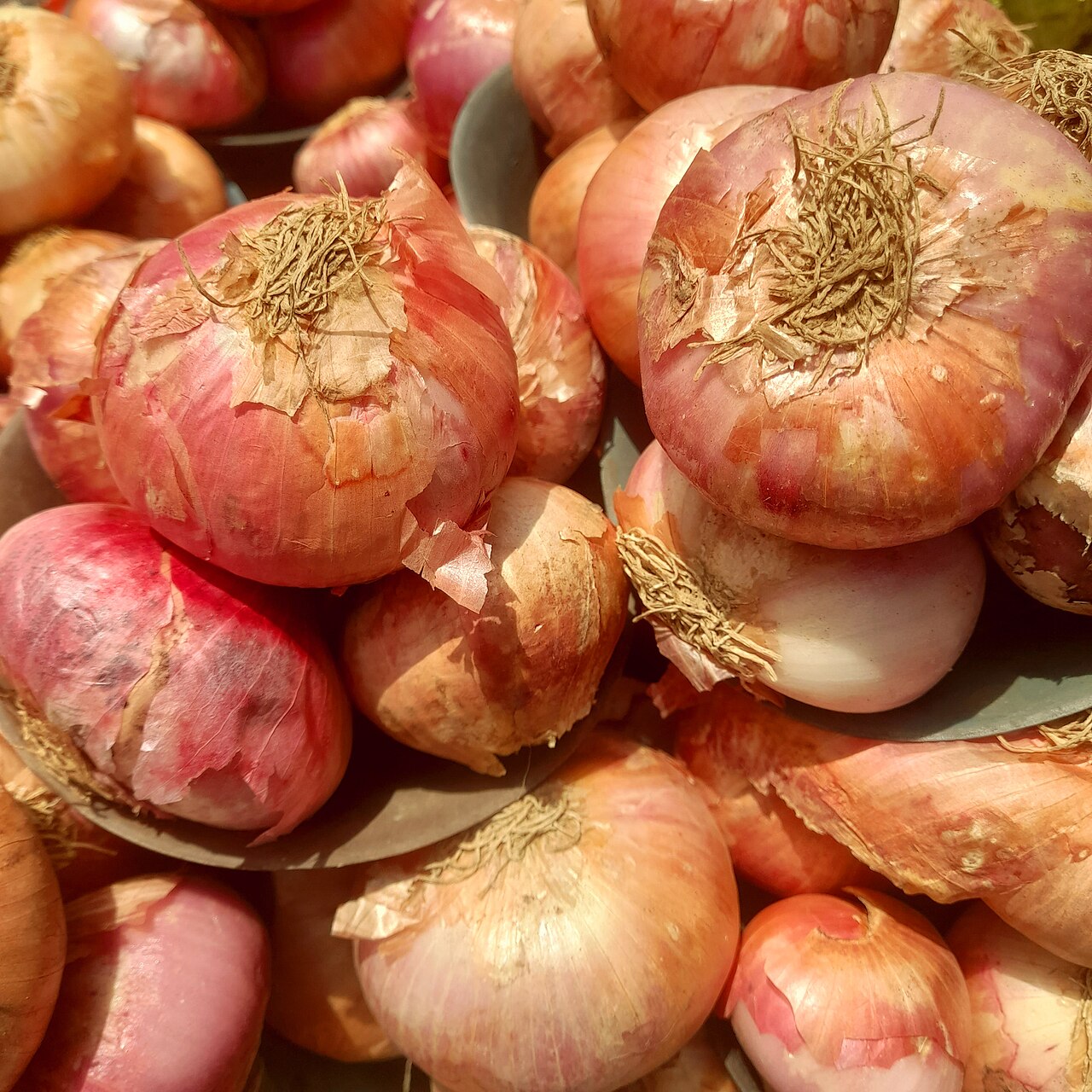
Red onions at a market. The tear gas forms only after the knife breaks the onion's cells. Photograph: Hajia Hijjah
Image Credits: Wikimedia Commons / Hajia Hijjah
Why do onions make you cry? The chemistry inside an intact onion
Inside an uncut onion, the ingredients of the tear gas sit in separate compartments. Sulfur-containing compounds, including amino acid sulfoxides, are kept apart from the enzymes that act on them. Think of each precursor stored in a different kitchen cupboard.
Your knife breaks the cell walls and mixes those ingredients. An enzyme called alliinase starts a reaction that produces unstable sulfur compounds, called sulfenic acids.
Then a second enzyme, lachrymatory-factor synthase, converts them into syn-propanethial-S-oxide. This volatile gas is the tear-triggering irritant, and its everyday scientific name is simply lachrymatory factor. The name shares its Latin roots with lacrimare, meaning to weep.
The enzyme story was settled in stages. Scientists once blamed generic allinase for the instability of the compounds in a cut onion.
A 2002 Japanese study by Imai and colleagues proved that lachrymatory-factor synthase, a previously undiscovered enzyme, is the real culprit. Back in 1979, E. Block and co-workers had already pinned down the exact structure of syn-propanethial-S-oxide, showing it has the syn, or Z, configuration, according to the American Chemical Society.
How the gas makes your eyes water
Syn-propanethial-S-oxide is a volatile sulfur compound, so it drifts off the cutting board and into the air around your face. Your cornea is packed with nerve endings that report touch, temperature, and pain. Those nerves detect the gas and signal through the trigeminal nerve to the brain.
The brain answers with a defense cascade. It stimulates the autonomic nerve fibers in the lachrymal glands, which flood the eye with tears to dilute and flush the irritant. The tears themselves are harmless, and the effect is not long term.
There is an irony in the loop. The more you cry, the more the tears spread the compound across the eye's surface, which can intensify the sting before it fades. Holding still and letting the tears do their work clears the gas faster than rubbing.
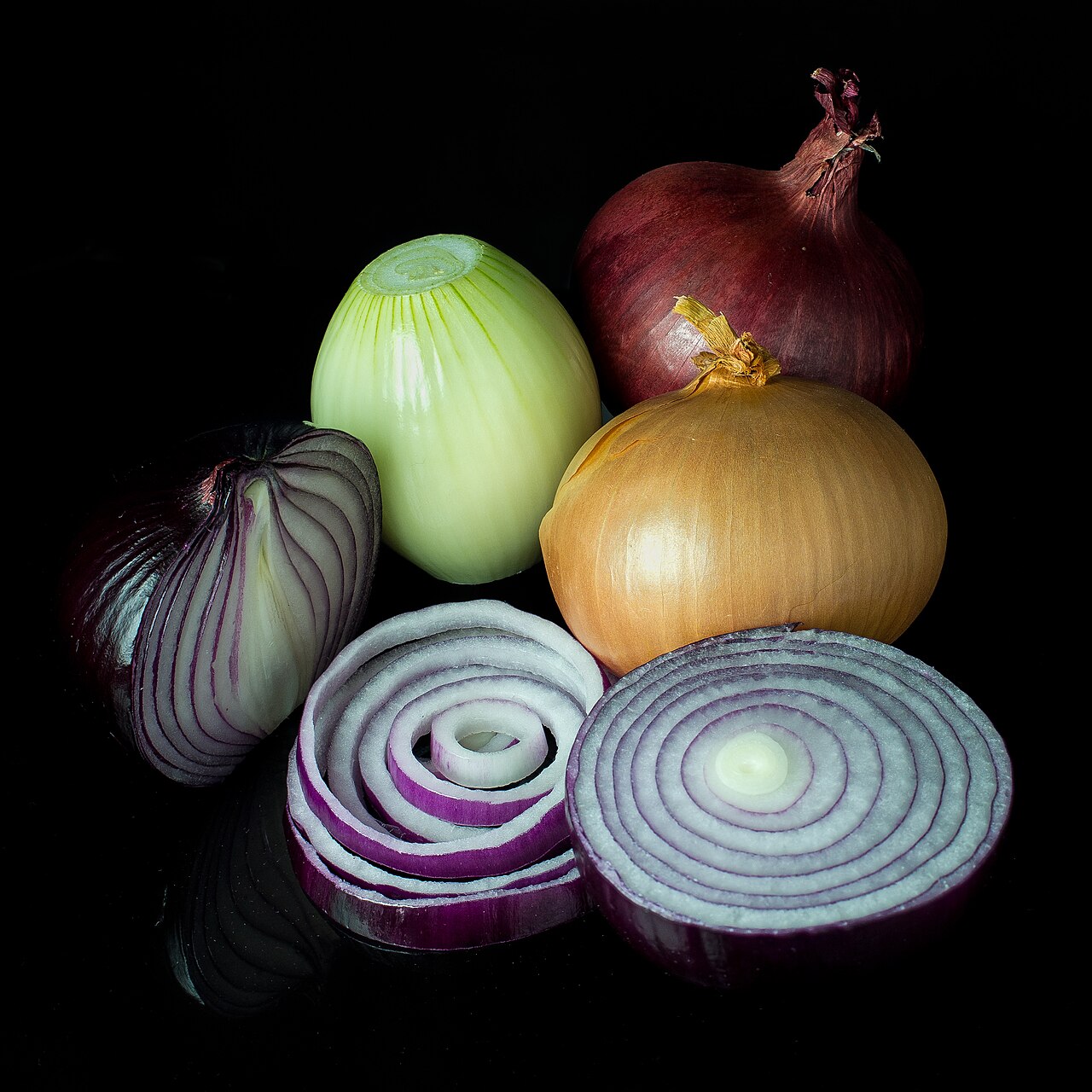
Onions ready for the cutting board. A dull knife crushes more cells and releases more irritant. Photograph: Colin
Image Credits: Wikimedia Commons / Colin
What the high-speed cameras found
A 2025 study by Zixuan Wu and colleagues at Cornell University, titled "Droplet Outbursts from Onion Cutting," filmed the cutting process with high-speed cameras at 5,000 to 20,000 frames per second. It confirmed an idea first proposed back in 1947: the irritant does not arrive only as gas. The knife's impact ejects tiny droplets loaded with the chemicals, and those droplets are a major delivery vehicle for the tears.
The researchers tested two variables that cooks can control: blade sharpness and cutting speed. A sharp knife crushes fewer cells, which means less irritant released into the air around the board. That single upgrade beats every folk remedy stacked against it.
Cutting speed matters less than the blade. The Cornell team found that a sharp, deliberate cut crushes fewer cells than a slow, sawing motion with a dull knife.
Keep your knife honed and your cuts decisive, and you release measurably less irritant with every slice. That is also why food processors and dull serrated blades tend to produce more tears than a single sharp chef's knife.
Which kitchen tricks actually work
Chilling the onion before cutting is the second research-backed move. Cold slows evaporation, so less propanethial S-oxide leaves the cut surfaces.
Thirty minutes in the fridge is enough; you are not trying to freeze it. A fridge that runs constantly is overkill for this, but steady cold storage helps the cause.
Cut the root end last. The root contains the highest concentration of the sulfur compounds, so leaving it intact while you dice the rest reduces the total spray. A small fan blowing across the board pushes vapors away from your face, which is physics, not folklore.
Other low-effort moves come from the same principle of keeping vapors away from your eyes. Peeling onions under cold water washes away some of the surface irritant before the knife even touches the board.
Setting a small fan to blow across the board pushes the gas stream away from your face. Holding your breath and cutting quickly helps a little, and if none of it works, Food Reference offers the honest last resort: have someone else cut them for you.
Some popular tricks have weaker backing. Bread on the knife tip, chewing gum, and holding your breath may distract you more than they reduce the chemistry.
Cutting under running water washes some irritant away, but it makes for slippery handling. Keep it simple: sharp knife, cold onion, root last, and if you want the technique to stick, treat it like any other oven-preheating habit you built through repetition.
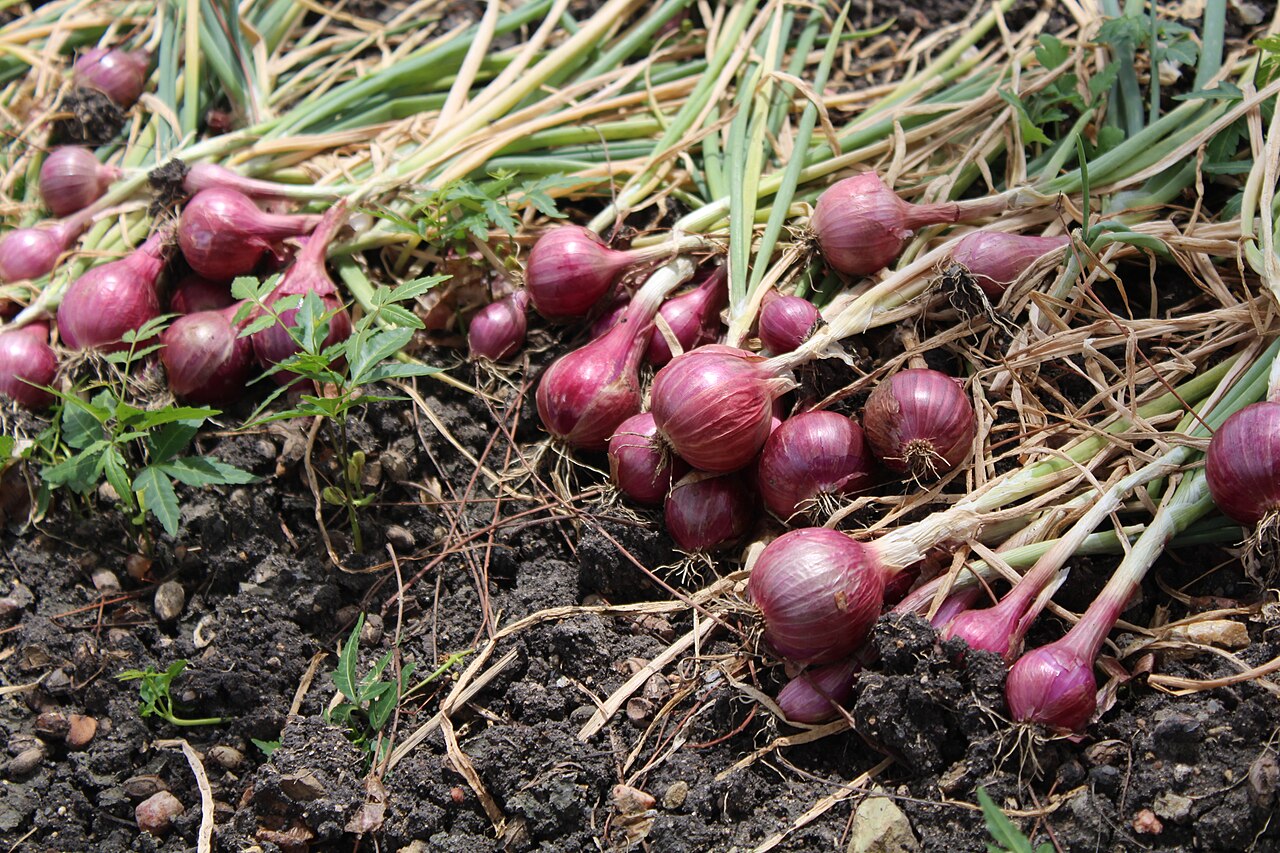
Onions growing in the field. The sulfur defense that makes you cry also deters the pests that eat the crop. Photograph: Kasyap
Image Credits: Wikimedia Commons / Kasyap
Is crying from onions bad for your eyes?
No. The tearing is a protective response, and the effect is temporary. The gas is an irritant, not a damaging agent.
Do sweet onions make you cry less?
Often, yes. Varieties with lower sulfur content produce less of the precursor compounds, so there is less material for the enzymes to convert into irritant.
Why do goggles work for cutting onions?
Because they block the delivery route. If the gas and droplets never reach the corneal nerves, the defense cascade never starts.
Can you buy onions that do not make you cry?
Researchers have produced onions with suppressed lachrymatory-factor synthase genes that contained far less syn-propanethial-S-oxide and eliminated the tearing response among sensory panelists. They are a lab result, not a grocery item, for now.
The bottom line
Onions make you cry because cutting mixes sulfur compounds with two enzymes, producing a volatile gas that your eyes flush out with tears. The science-backed fixes are a sharp knife, a chilled onion, and cutting the root last. Everything else is comfort.
Latest in Food & Cooking
Subscribe for weekly kitchen-science explainers in plain language.
Related stories
Why Does Bread Go Stale Faster in the Refrigerator?
Bread goes stale faster in the fridge because starch recrystallizes fastest near 4°C. Here is the retrogradation science and the right way
Baking soda and baking powder: what's the difference?
Baking soda is pure sodium bicarbonate; baking powder adds two dry acids for double-acting lift. Learn when to use each, plus exact

What Is the Maillard Reaction in Simple Terms?
The Maillard reaction is the browning chemistry between amino acids and sugars above 140 C that creates the crust, color, and rich flavor