
Why grass grows faster after rain than watering
By Rive News / Research desk | Rive News / Published October 28, 2026 at 9:00 AM PKT
Key takeaways
- Deep, even rain reaches roots that light sprinkling never wets.
- Wetting soil also releases nitrogen already stored in organic matter.
- Nitrogen carried in rain itself adds only a small part of the growth boost.

[A freshly mowed lawn shows even green growth across its surface. Photograph: Marek Ślusarczyk]
Image Credits: Wikimedia Commons
A lawn can look transformed a few days after a good rain, even when the sprinkler ran all the previous week. The grass grows faster, greens deeper, and seems to thicken overnight.
The difference is real, but the usual explanation is incomplete. Rain does carry a little nitrogen, yet that is the smallest part of the story.
This article explains why rain outperforms watering, including soaking depth, even coverage, nitrogen release from soil, the small nitrogen gift in rain itself, and how to water more like rain.
Depth is the biggest difference
Most garden watering is shallow. A sprinkler running for 20 minutes may wet only the top few centimetres of soil, and much of that water evaporates before it sinks further.
Grass roots in that shallow layer get a drink, but deeper roots stay dry. The plant responds by keeping its roots near the surface, which makes it more vulnerable to the next dry spell.
Rain usually arrives in larger amounts over a longer time. A steady rain of 20 millimetres soaks far deeper than a quick sprinkler pass, reaching the full root zone.
The Asian Turfgrass Center worked through one such case, starting from soil at 15 percent volumetric water content and 4 millimetres of daily water loss through evaporation and transpiration. After 20 millimetres of rain, the average soil water content over the next five days rose to 27 percent.
That deeper moisture changes growth directly. In the same calculation, clipping volume, the measure of how much grass is cut, rose from 10 millilitres per square metre per day before the rain to a predicted 22 after it.
The direct effect of extra soil water accounted for about 12 of that gain, more than any other single factor. Deep water grows deep roots, and deep roots grow more grass.
The lesson for watering is blunt. One deep soaking beats several light sprinklings, because only the deep soaking reaches the roots that matter. A lawn watered deeply once or twice a week grows stronger than one sprinkled daily, and it survives dry spells better when the sprinkler is off.
Even coverage matters more than people think
Rain falls evenly. Every blade and every patch of soil in an open lawn gets roughly the same amount, at roughly the same rate.
Sprinklers do not match that uniformity. Wind bends the spray, overlapping arcs double-water some patches, and dry corners appear near edges, trees, and buildings.
Uneven watering produces uneven growth. Well-watered patches surge while dry patches stall, and the lawn looks patchy even when the total water applied matches a rainy week.
Homeowners often respond by watering more, which over-waters the wet patches and still misses the dry ones. The result is a lawn that is both soggy and thirsty at once.
Drop size plays a part too. Rain falls as a mix of drop sizes at speed, which helps it penetrate the surface rather than sitting on it.
Sprinkler droplets are gentler and more uniform, which sounds kind but can leave water beading on dry, compacted soil.
Wet soil frees nitrogen already there
The second driver of post-rain growth is nitrogen already in the soil. Lawns hold nitrogen in organic matter: dead grass clippings, roots, and soil life.
That nitrogen is locked up and unavailable to plants until soil microbes convert it into mineral forms, a process called mineralisation. Microbes work fastest in warm, moist soil, and they slow sharply when soil dries out.
Rain restarts that microbial work. As soil rewets, microbes break down organic matter and release ammonium and nitrate, the forms grass roots can absorb.
The Asian Turfgrass Center estimated that this soil-derived nitrogen could add about 8 millilitres per square metre per day to clipping volume in the five days after a 20 millimetre rain. That is more than three times the contribution of nitrogen in the rain itself.
This explains a puzzle many gardeners notice. A lawn that received no fertiliser can still green up strongly after rain, because the fertiliser was already there, locked in the soil and waiting for water.
It also explains why rain after a dry spell produces a bigger flush than rain after a wet week. The longer the dry period, the more organic matter has built up unprocessed, and the larger the release when water returns.
Soil type changes the size of this effect. Soils rich in organic matter release more nitrogen on rewetting than sandy, poor soils. A lawn top-dressed with compost holds a larger nitrogen bank than one fed only with synthetic fertiliser, which is one reason compost improves lawns beyond its nutrient content alone.
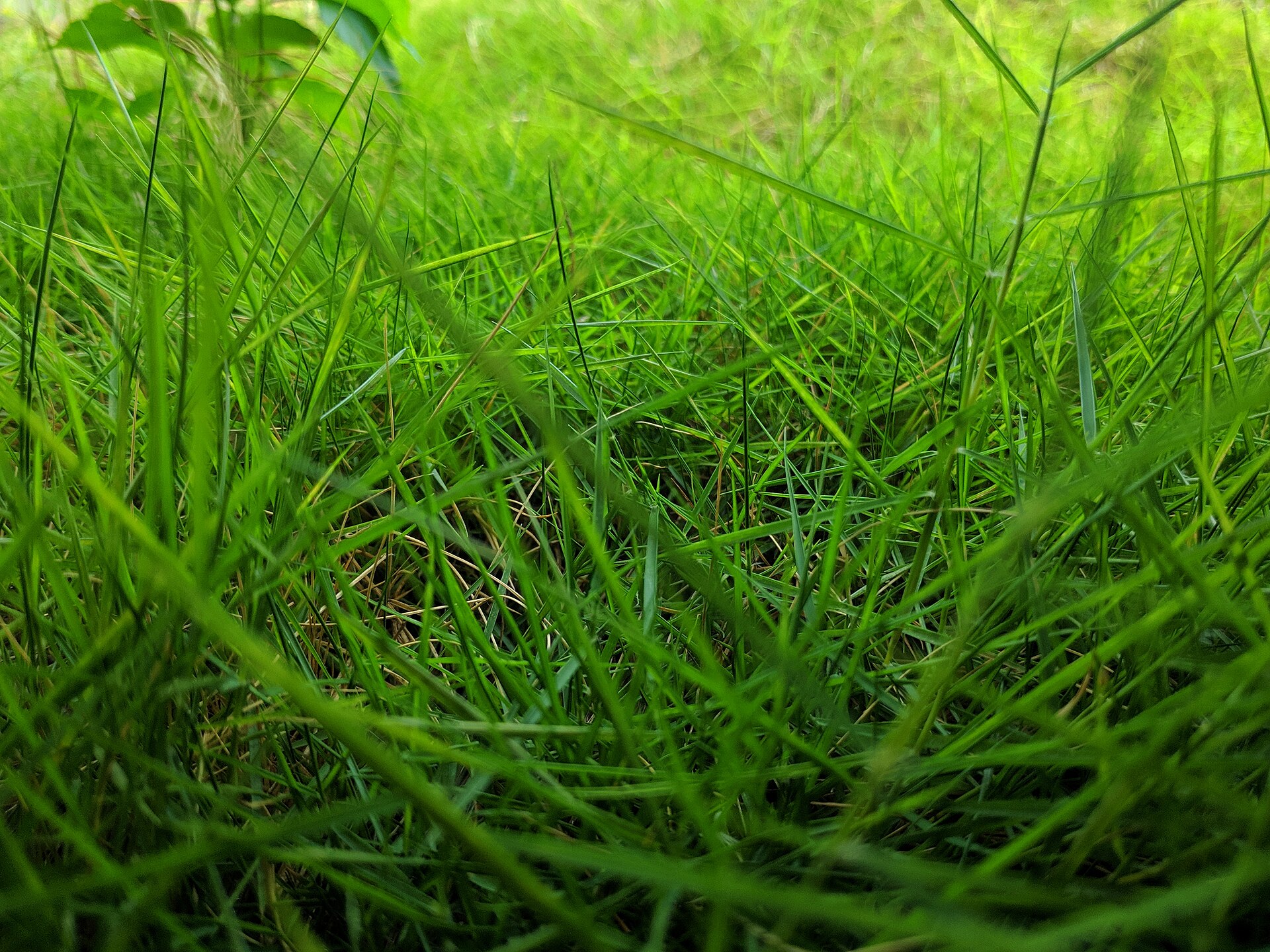
[Green grass blades fill the frame, showing the dense growth rain encourages. Photograph: Wikimedia Commons contributor]
Image Credits: Wikimedia Commons
The nitrogen in rain is real but small
Rain does carry nitrogen. Air is about 78 percent nitrogen gas, but plants cannot use that form directly.
Lightning during thunderstorms converts some atmospheric nitrogen into nitrogen oxides, which dissolve in rainwater and fall as nitrate and ammonium. Other nitrogen compounds from dust and pollution also wash out of the air in rain.
The amounts are modest. In the Asian Turfgrass Center calculation, nitrogen in the rain itself contributed about 2.5 millilitres per square metre per day to clipping volume after a 20 millimetre event, against 12 from extra soil water and 8 from soil nitrogen release. Rain nitrogen is a genuine bonus, not the main event.
That ranking corrects a popular myth. Many lawn guides claim rain greens grass because rain is full of nitrogen, as if rainwater were liquid fertiliser. The numbers say otherwise.
If rain nitrogen were the main driver, watering with nitrogen-rich fertiliser would match rain exactly, and it does not. The full rain effect needs deep water and microbial release as well.
Lightning-heavy storms may carry slightly more nitrogen than gentle rain, which could explain why a thunderstorm greens a lawn more than a drizzle of the same total water. The difference is still small beside the depth and soil effects, and no gardener can order lightning. The practical point stands: rain wins mainly because it waters deeply and evenly, not because it fertilises heavily.
Why grass looks greener, not just longer
Growth and colour are linked but not identical. Grass looks greener after rain partly because it grows, producing fresh young blades full of chlorophyll, the pigment that captures sunlight. Young blades are brighter green than old, weathered ones, so a flush of new growth changes the lawn's colour at once.
Nitrogen also deepens colour directly. Chlorophyll molecules contain nitrogen, so a plant with more available nitrogen can build more chlorophyll and look darker green.
That is why the nitrogen release from soil matters for colour as well as growth. A lawn short of nitrogen looks pale even when it grows, while a well-fed lawn looks rich green.
Water itself changes appearance. A well-hydrated blade stands upright and reflects light evenly, while a drought-stressed blade folds, wilts, and looks dull or grey-green. Part of the post-rain transformation is simply grass returning to its normal shape, like a sponge refilling.
The lawn did not change colour overnight. It recovered its form.
Brown patches need a separate check. A lawn that stays brown after good rain may have dead crowns, disease, or grub damage rather than simple drought. For help separating those causes, see why a lawn has brown patches in summer and why a lawn is patchy and how to fix bare spots.
How to water more like rain
Gardeners cannot make rain, but they can copy its strengths. Water deeply, aiming for about 25 millimetres in one session, enough to wet the root zone rather than the surface.
A simple test is to push a screwdriver into the soil after watering. If it slides in easily to 10 centimetres or more, the water went deep enough.
Water slowly enough to avoid runoff. If water pools or runs off, stop and let it soak in, then resume.
Soaker hoses and low-rate sprinklers mimic rain's steady pace better than a high-pressure jet. Watering in the early morning also helps, since less water evaporates and the grass dries before night, which discourages disease.
Keep mower height up. Cutting grass to about 7 to 8 centimetres shades the soil, slows evaporation, and lets roots grow deeper.
Short mowing forces the plant to spend energy regrowing blades instead of roots, which makes the lawn thirstier.
Feed the soil, not just the grass. Leaving clippings on the lawn returns organic matter and nitrogen to the soil bank that rain later releases. Occasional compost top-dressing builds that bank further.
The NPK figures on fertiliser bags explain the balance of the three main nutrients involved. A lawn fed this way responds to rain more strongly, because it has more stored nitrogen waiting for water to release it.
Frequently asked questions
Does rainwater contain more nitrogen than tap water?
Rainwater usually carries small amounts of nitrate and ammonium from the air, while tap water carries very little nitrogen. The difference is real but small, and it is not the main reason rain grows grass faster. Depth of soaking and nitrogen released from soil matter more.
Will watering deeply once a week match a rainy week?
It can come close for growth, provided the water reaches the root zone evenly and the soil holds organic matter. It will not match rain exactly, since sprinklers cover less evenly and do not wash the whole lawn at once. Deep, slow watering is still the best imitation available.
Why does grass grow fastest in spring after rain?
Spring combines the three ingredients: warming soil that speeds microbial nitrogen release, active grass growth, and frequent rain. The same rain in cold winter soil produces little growth, because microbes and grass are both slow. Timing matters as much as water.
Can too much rain harm a lawn?
Yes. Waterlogged soil starves roots of oxygen and invites disease, and heavy rain can wash nutrients away before roots absorb them.
A lawn that stays soggy for days needs drainage help, not more water. Short, frequent rain is ideal, while flooding is harmful.
The bottom line
Grass grows faster after rain than after watering because rain does three things at once: it soaks deep enough to reach the whole root zone, it covers the lawn evenly, and it wakes soil microbes that release stored nitrogen. Nitrogen falling in the rain adds a small bonus on top. Gardeners who water deeply, slowly, and in the morning, who mow a little higher, and who feed the soil with clippings and compost, get closer to the rain effect than any sprinkler schedule based on light, daily watering.
Tags: lawns, grass, rain, watering
The Rive News research desk covers plant science and practical gardening, summarising published research for home gardeners without claiming field trials of its own.
Related
- Why does my lawn have brown patches in summer
- Why is my lawn patchy and how to fix bare spots
- How to improve clay soil for gardening
- What does NPK on fertiliser actually mean
Subscribe for one practical gardening explainer each week.
Rive News standards: facts are checked against public sources listed above; corrections are welcomed and applied promptly.
Related stories
What Is Companion Planting and Does It Work?
Marigolds work as a nematode cover crop, but the basil flavor claim failed repeated tests. An honest evidence review of what companion
Determinate vs. indeterminate tomatoes: growth, pruning, and harvest differences
Determinate tomatoes grow to a set size and ripen all at once, while indeterminate types vine all season. That one difference shapes

How to improve clay soil for gardening
Gypsum will not fix ordinary clay soil, say extension experts. What actually works: 2 to 3 inches of compost, mulch, better drainage,