
How Does a Seed Know Which Way Is Up? Gravitropism Explained
Key takeaways
- Seeds sense gravity using dense starch grains called statoliths that settle to the bottom of specialized cells.
- The settling redirects the hormone auxin to the lower side, making shoots bend up and roots bend down.
- Charles Darwin documented this response, named gravitropism, in the 19th century, and modern mutants confirm the mechanism.
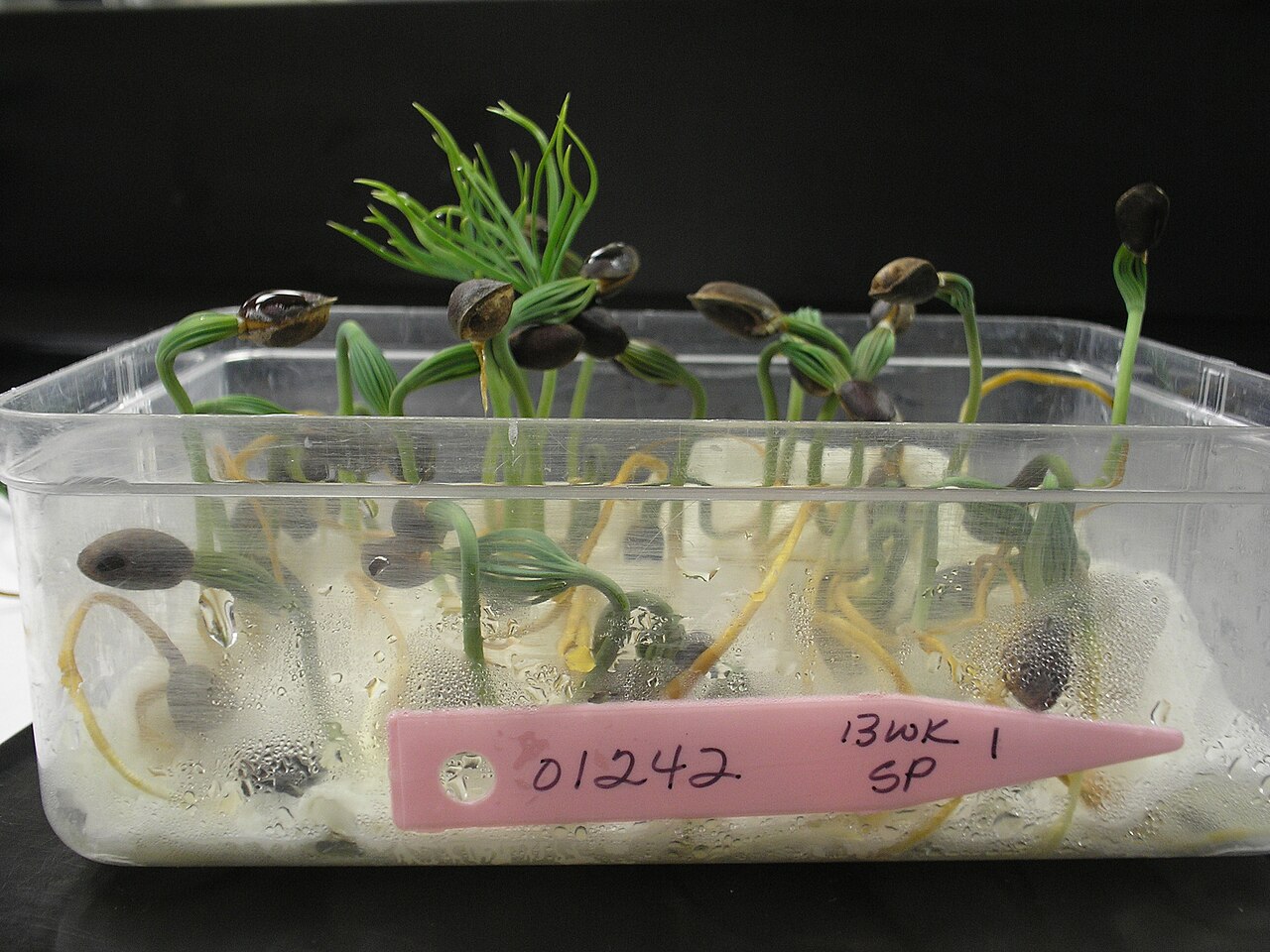
A seed germination test showing young seedlings orienting themselves. Photograph: USFS Region 5
A seed buried in soil sits in total darkness. It cannot see the sky.
Yet when it germinates, the shoot heads up and the root heads down, every time. The seed is not guessing. It is reading gravity.
This article explains how a seed knows which way is up, including the dense starch grains that act as internal weights, the hormone auxin that bends growth, and why roots and shoots respond in opposite directions.
The response has a name: gravitropism
The growth response to gravity is called gravitropism (also known as geotropism). Roots show positive gravitropism: they grow toward the pull of gravity, down into the soil. Shoots show negative gravitropism: they grow away from gravity, up toward the light.
Charles Darwin was among the first to document this scientifically, observing that roots grow downward while stems grow upward, as the Wikipedia article on gravitropism notes. The observation seems obvious now, but Darwin was recording a sensory system plants possess and animals lack: growth guided by a constant, invisible force.
The practical proof is simple to reproduce. Lay a germinating seedling on its side in the dark, and within hours the shoot curves upward and the root curves downward.
Lumen Learning's biology text notes that a plant laid on its side in darkness will send its shoots upward given enough time. No light is required. Gravity alone is the signal.
Dense starch grains act as the plant's weights
Plants do not have inner ears, but they have something functionally similar. Certain cells contain amyloplasts, specialized plastids packed with dense starch granules. Because they are heavier than the surrounding cell fluid, these grains settle to the lowest point of the cell, wherever gravity pulls them.
According to the Wikipedia article on gravitropism, these dense amyloplasts are called statoliths, and the specialized cells holding them are called statocytes. In roots, the statocytes sit in the columella at the center of the root cap.
A gardening-science guide on JardineriaOn reports that surgically removing the columella destroys the root's gravity response entirely. In shoots, sensing happens in a starch-rich cell layer near the vascular tissue.
When the plant is tilted, the statoliths drop to the new bottom wall of each cell. Lumen Learning explains that a few hours later, the shoot or root shows growth in the new vertical direction. The grains are, in effect, tiny internal plumb bobs.
How does settling translate into a signal? Wikipedia's summary of current research describes statoliths enmeshed in a web of actin filaments, where their sedimentation appears to activate mechanosensitive channels. That physical signal triggers the reorientation of auxin transport proteins, redirecting the flow of the plant's growth hormone.
Auxin turns a tilt into a bend
The hormone that carries out the order is auxin, the main growth hormone in plants. When the statoliths signal that the plant is tilted, auxin gets redistributed so it accumulates on the lower side of the organ.
Here is where the elegant part appears: auxin has opposite effects on shoots and roots. Lumen Learning lays out the mechanism clearly.
In shoots, a high auxin concentration stimulates cell elongation, so the lower side grows faster than the upper side and the shoot curves upward. In roots, a high auxin concentration inhibits cell elongation, so the lower side grows more slowly while the upper side keeps growing, bending the root downward.
The same signal, the same hormone, the same lower-side accumulation, yet the shoot bends up and the root bends down, because their tissues read auxin differently. This differential sensitivity is what explains Darwin's original observation, as Wikipedia notes.
The result for a germinating seed is automatic orientation. Whichever way the seed landed in the soil, the emerging root feels gravity, sends auxin to its lower side, slows that side's growth, and curves downward.
The shoot does the reverse and curves up. Within days the plant has righted itself.
Mutants confirm the machinery
The strongest evidence that statoliths are the real sensors comes from plants built without them. Wikipedia's gravitropism article describes mutants of the PGM1 gene in the lab plant Arabidopsis thaliana: the mutation cripples starch production, leaving the presumptive statoliths less dense. Those plants are measurably less sensitive to gravity, which supports the starch-statolith hypothesis directly.
Other gravitropic mutants affect auxin transport or auxin response, and they also show defective gravity responses. Each broken piece of the pathway confirms the model: dense grains sense, channels signal, auxin redistributes, differential growth bends.
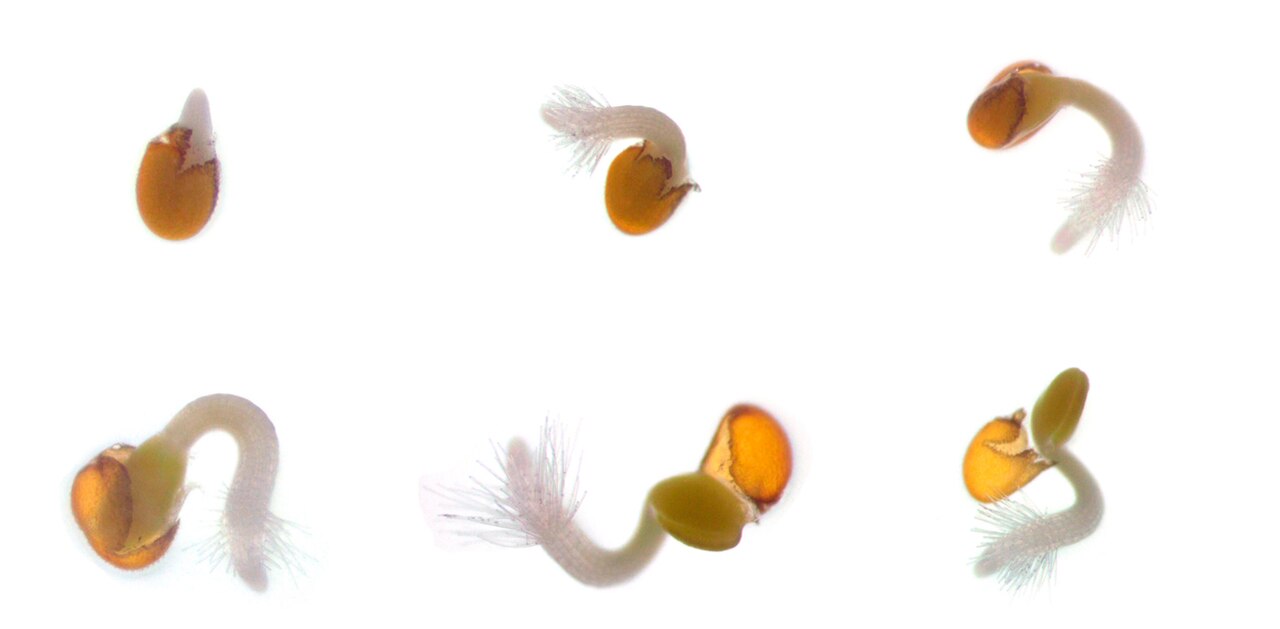
Successive stages of seed germination in Arabidopsis thaliana, the lab plant used in gravitropism research. Photograph: Alena Kravchenko
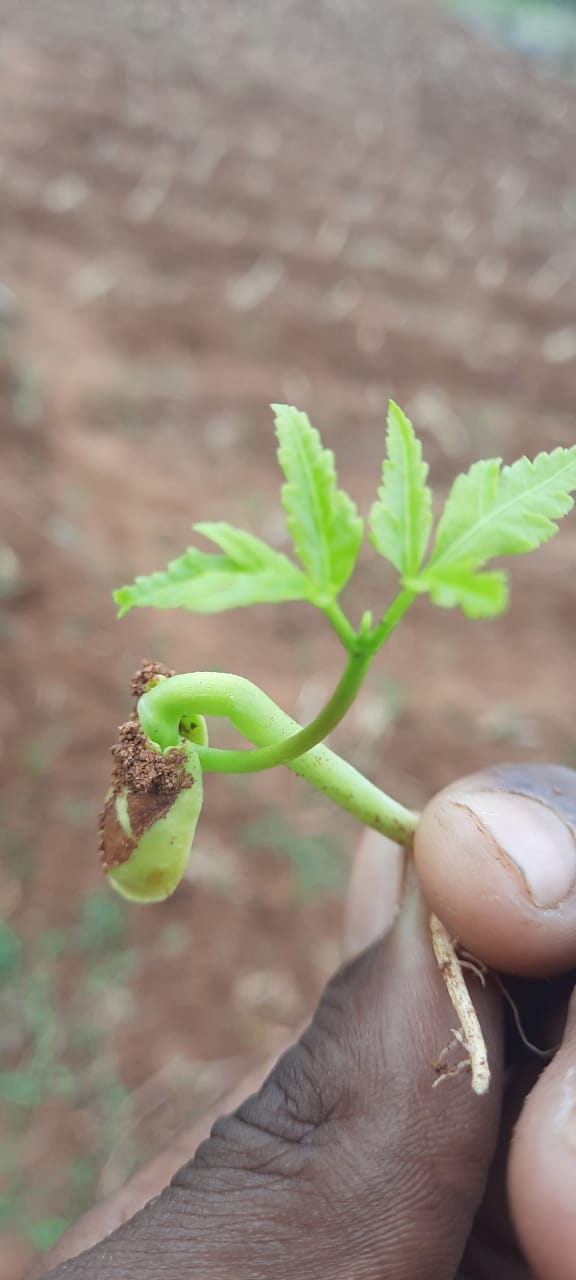
A germinating neem seed, with the root curving downward and the shoot pushing upward. Photograph: Anandha abirami Govindan
Frequently asked questions
What is gravitropism?
Gravitropism is a plant's growth response to gravity. Roots exhibit positive gravitropism (growing downward) and shoots exhibit negative gravitropism (growing upward), ensuring the plant orients itself correctly.
How do seeds sense gravity without eyes or ears?
Specialized cells contain dense starch-filled organelles called statoliths. These settle to the bottom of the cell under gravity, and their settling triggers a chemical signal that redistributes the hormone auxin.
Why do roots and shoots grow in opposite directions?
Both accumulate auxin on their lower side, but auxin stimulates cell elongation in shoots and inhibits it in roots. The lower side of a shoot grows faster (bending up); the lower side of a root grows slower (bending down).
Does light matter for a seed to find up?
No. Gravitropism works in complete darkness. Experiments show that a seedling laid on its side in the dark still sends its shoot up and its root down.
How fast does a plant respond to being tilted?
The statoliths settle within minutes, but visible bending takes a few hours as auxin redistributes and differential growth accumulates.
The bottom line
A seed knows which way is up because it carries its own gravity sensors: dense starch grains that sink to the low side of specialized cells. Their settling redirects the hormone auxin, and because shoots and roots read auxin oppositely, the shoot bends up while the root bends down. Darwin watched it happen; modern genetics confirmed how.
Latest in Gardening
- Why do sunflowers follow the sun when young but stop when old?
- Why do daffodils come back every year without replanting?
- Why does coriander bolt so quickly in summer?
- How do trees survive freezing winters without moving?
Get one garden-science explainer in your inbox every morning. Subscribe for the daily rundown.
Image Credits: Wikimedia Commons / USFS Region 5, Alena Kravchenko, Anandha abirami Govindan
Related stories

What Is Companion Planting and Does It Work?
Marigolds work as a nematode cover crop, but the basil flavor claim failed repeated tests. An honest evidence review of what companion
Determinate vs. indeterminate tomatoes: growth, pruning, and harvest differences
Determinate tomatoes grow to a set size and ripen all at once, while indeterminate types vine all season. That one difference shapes
How to improve clay soil for gardening
Gypsum will not fix ordinary clay soil, say extension experts. What actually works: 2 to 3 inches of compost, mulch, better drainage,