
Why Do Plants Lean Toward the Window? Phototropism Explained
Key takeaways
- Plants lean toward windows because of phototropism, a hormone-driven growth response to one-sided light.
- The hormone auxin shifts to the shaded side of the stem, making those cells elongate faster and bend the shoot toward light.
- Rotating the pot 90 to 180 degrees every week or so keeps growth even and prevents permanent leaning.
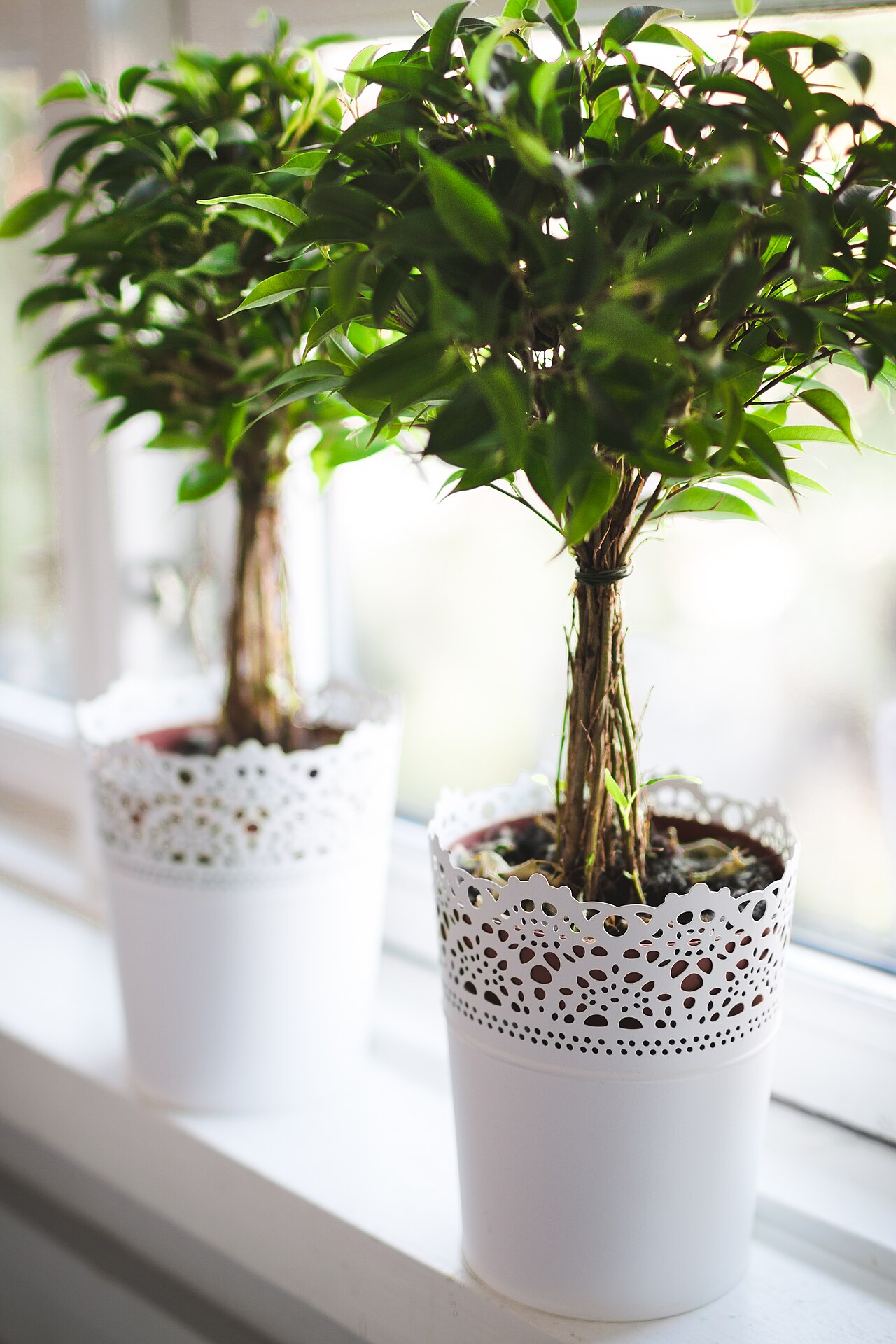
Houseplants on a windowsill receive light mostly from one direction, which triggers phototropism.
That crooked pothos on your windowsill is not broken, and it is not being dramatic. The bend toward the glass is one of the oldest and best-understood tricks in plant biology. Scientists call it phototropism: directional growth in response to a light stimulus, as described by Biology Insights.
The plant is not reaching with any intention. It is running a chemical program that moves a growth hormone from one side of its stem to the other.
Why do plants lean toward the window in the first place? Because light is food, and a plant that cannot move its body has to move its growth. This article explains phototropism in plain language, including the auxin mechanism, why indoor plants lean so hard, and how to straighten things out.
What phototropism actually is
Phototropism is a plant's way of repositioning without taking a single step. The word breaks down simply: "photo" for light and "tropism" for turning. Shoots show positive phototropism, meaning they grow toward the light source.
Roots do the opposite, showing negative phototropism by bending away from light and into the soil.
You can watch phototropism happen on almost any houseplant left near glass. The effect is strongest in fast-growing seedlings such as beans or sunflowers, which can pivot visibly within 24 to 48 hours of being placed near one-sided light, according to plant-care coverage of the phenomenon. Mature houseplants respond more slowly, but the daily small bends accumulate over weeks into the unmistakable lean every indoor gardener knows.
The reason plants evolved this behavior is efficiency. A shoot that angles itself toward the brightest available light captures more energy for photosynthesis. Outdoors, where sunlight sweeps across the sky during the day, the response stays subtle and self-correcting.
Indoors, where a window is a fixed spotlight, the response has nowhere to go but sideways.
How the auxin mechanism bends your plant
The star of this story is auxin, a plant hormone produced at the very tip of the shoot. Auxin is best known for promoting cell elongation: cells exposed to more auxin grow longer. According to LiveToPlant, the most-studied auxin involved in phototropism is indole-3-acetic acid, or IAA.
Here is the sequence when light strikes your plant from one side. Specialized blue-light receptors called phototropins sit in the cells at the shoot tip. They are sensitive to blue wavelengths around 450 to 495 nanometers, LiveToPlant reports.
Once activated, these receptors trigger a signaling cascade that redistributes auxin away from the illuminated side of the stem and onto the shaded side.
Then the growth imbalance kicks in. On the shaded side, the higher auxin concentration activates proton pumps (H+-ATPases) in cell membranes. Those pumps push hydrogen ions into the cell wall, lowering its pH.
The acidity switches on enzymes called expansins, which loosen the connections between cellulose fibers in the wall. With the wall loosened, the cell takes in more water and expands. The shaded-side cells elongate faster than their lit-side neighbors, and the stem curves toward the light.
Think of it like inflating balloons in a row: inflate the ones on the left more than the right, and the whole line bends right. That differential growth is the bend you see.
This explanation is formalized in the Cholodny-Went hypothesis, proposed independently by Frits Went and Nikolai Cholodny in the 1920s and 1930s. Their core claim, still taught today, is that unilateral light causes auxin to accumulate on the shaded side of a shoot, and that asymmetric auxin produces asymmetric growth.
Why windows make the lean so much worse
Outside, light arrives from many angles over the course of a day. The sun moves, clouds diffuse the beam, and nearby leaves bounce light around. A plant's phototropic corrections cancel each other out, and the stem stays roughly vertical.
A window is different. It delivers strong, directional light from one fixed position for hours every day, while the rest of the room stays dim. The plant's auxin machinery gets the same signal day after day: grow toward the glass.
The bending adds up.
Several household factors intensify the effect. A plant pushed right against the glass gets an extreme light gradient between its lit and shaded sides. Reflective walls behind the plant can help, but most rooms absorb the little ambient light that bounces back.
And because people rarely move their plants, the plant adapts to one permanent lean instead of correcting itself.
Mild leaning is harmless, and many gardeners find a slight tilt charming. Prolonged one-sided light, however, produces stretched stems, sparse leaves on the shaded side, and a weaker structure overall. In extreme cases the plant becomes top-heavy and unstable in its pot.
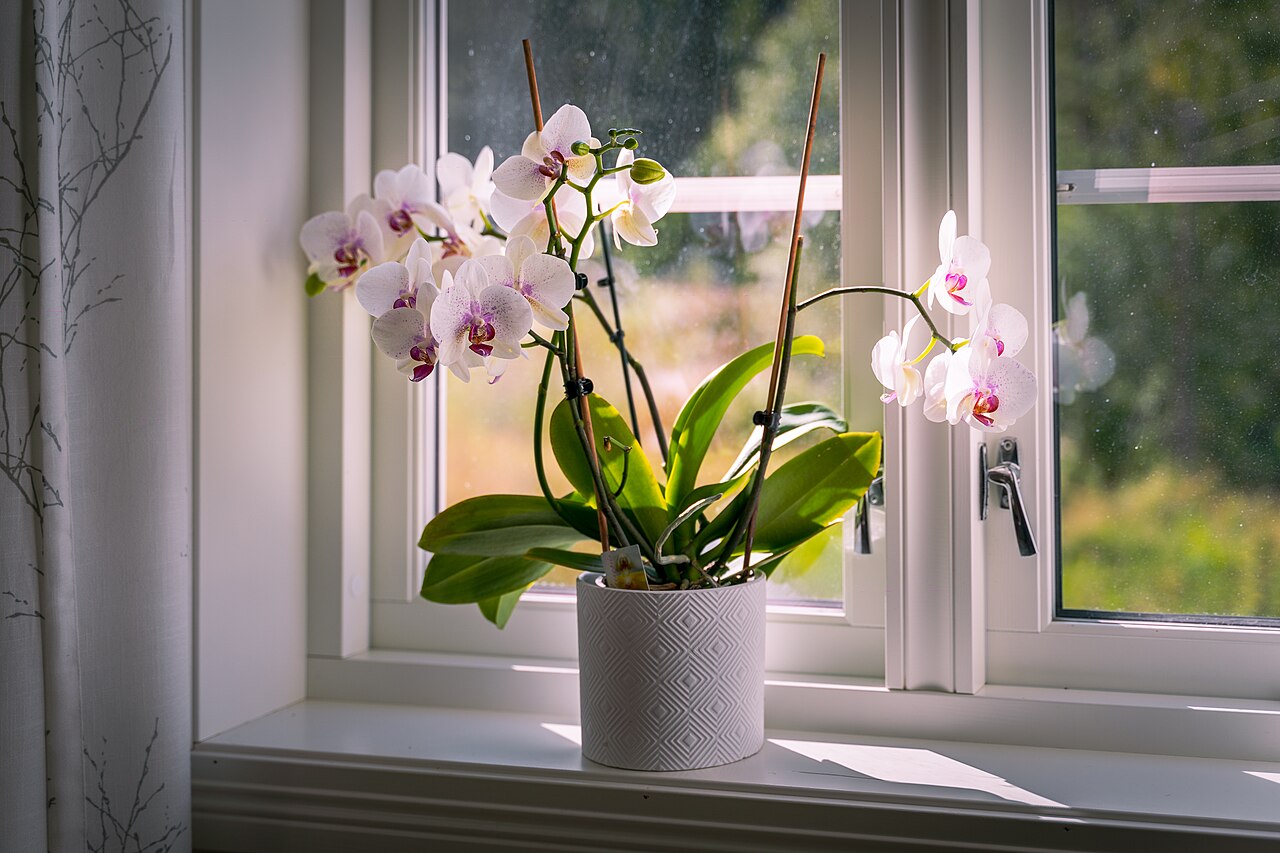
An orchid by a west-facing window: steady directional light keeps auxin pooled on the shaded side of the stem.
How to fix a leaning plant and prevent the next one
The good news: phototropism is reversible for young, flexible growth. You cannot straighten old woody stems, but you can redirect new growth and rebalance the plant over time.
Start by rotating the pot. Turn it 90 to 180 degrees every week to ten days so each side of the plant takes turns facing the window. This is the single most effective habit, and it works because it evens out the auxin distribution before any lean becomes permanent.
Next, consider the light itself. Moving the plant a little farther from the glass reduces the extreme contrast between the lit and shaded sides. A sheer curtain does the same job: it softens the beam so the whole plant gets usable light instead of one blasted side.
For plants that must sit right on the sill, like many succulents and herbs, rotation matters even more.
For a plant that already leans hard, prune strategically. Cut back the most stretched, lopsided stems to a healthy node. New growth will emerge from that point and, with regular rotation, grow straighter.
Do not try to force a bent stem straight with ties alone; the bend is grown tissue, and forcing it can snap the stem.
Finally, watch the seasons. Winter light is weaker and more directional, so phototropic leaning often gets worse in colder months. This is also the season when condensation builds up on windows, so keep foliage off the glass to avoid both cold damage and fungal problems.
If your plant is leaning because one room runs colder than the rest, check whether one room in the house is colder than the others, since temperature gradients can compound uneven growth.
Frequently asked questions
Is leaning toward the window bad for my plant?
A slight lean is normal and harmless. It becomes a problem when stems stretch, leaves thin out on the shaded side, or the plant grows unstable. Regular rotation keeps the lean cosmetic instead of structural.
Can I straighten a plant that already bent?
New growth can be redirected, but old bent stems will not straighten on their own. Rotate the pot, improve the light, and prune the worst stems back to a node so fresh growth comes in evenly.
Do all plants lean toward light?
Shoots of most green plants show positive phototropism, while roots bend away from light. The response is strongest in fast growers and seedlings, which is why a sunflower seedling can lean dramatically in a day while a slow cactus barely changes.
Will artificial grow lights cause the same lean?
Yes, if the light comes mostly from one side. Overhead grow lights positioned centrally produce much less leaning than a window. If you use a single lamp to the side, rotate the plant just as you would with a window.
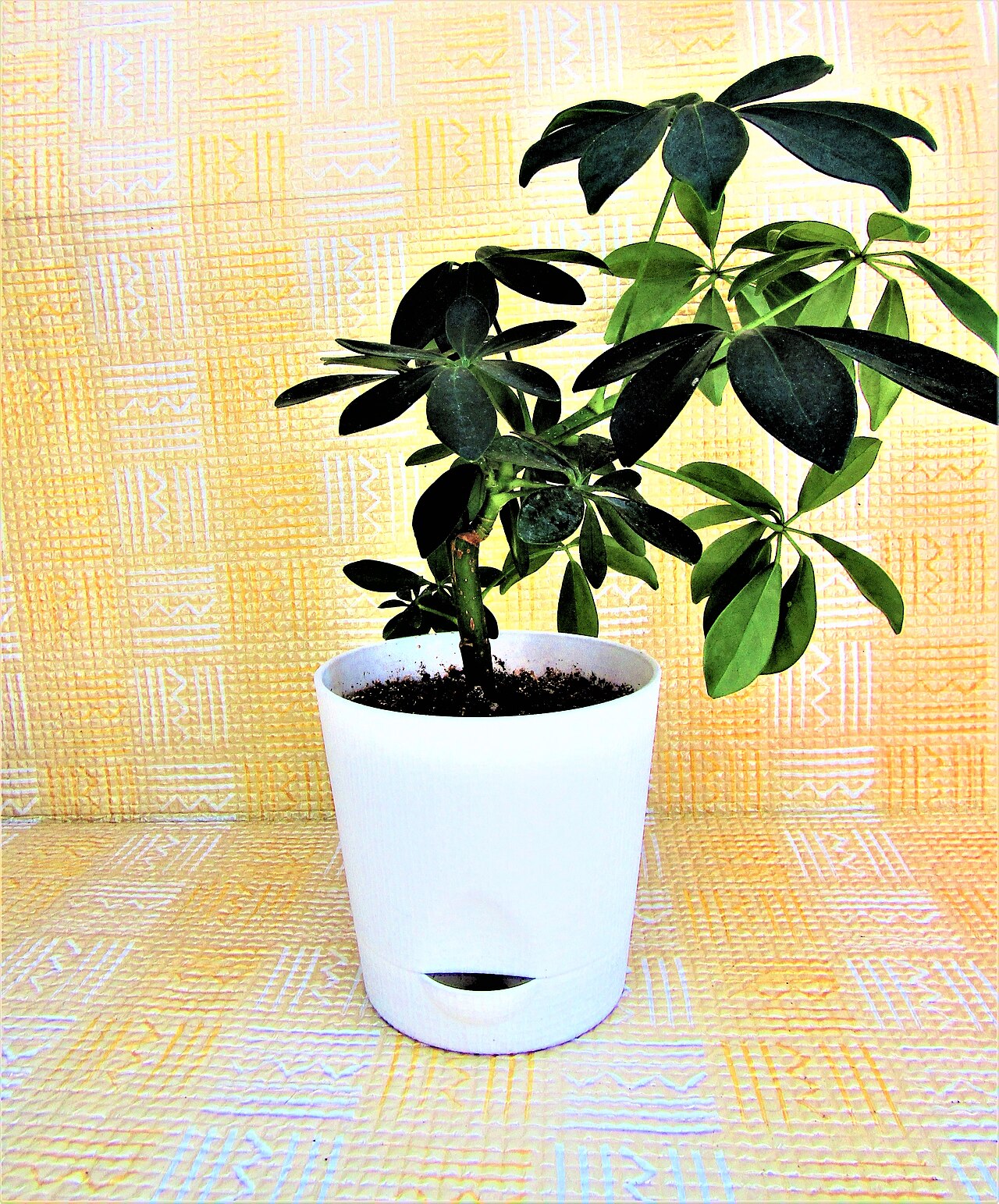
Young houseplants such as this umbrella tree show the auxin-driven lean most clearly during fast growth.
The bottom line
Your plant leans toward the window because blue-light receptors in its shoot tip shift the hormone auxin to the shaded side of the stem, making those cells stretch faster until the shoot curves into the light. It is phototropism, an ancient survival program, not a sign your plant is unhappy. Rotate the pot a quarter to a half turn every week or so, soften harsh directional light, and prune lopsided growth, and the plant will grow evenly again.
For more ideas on what to grow indoors, see our guide to growing strawberries in a hanging basket.
Image Credits: Wikimedia Commons / Lucas Alexander, Øyvind Holmstad, Dandy1022
Latest in Gardening
- Grow Strawberries in a Hanging Basket
- Stop Condensation on Windows in Winter
- Why Is One Room Colder Than the Rest of the House?
Subscribe for weekly plant-care science, explained in plain English.
Related stories

What Is Companion Planting and Does It Work?
Marigolds work as a nematode cover crop, but the basil flavor claim failed repeated tests. An honest evidence review of what companion
Determinate vs. indeterminate tomatoes: growth, pruning, and harvest differences
Determinate tomatoes grow to a set size and ripen all at once, while indeterminate types vine all season. That one difference shapes

How to improve clay soil for gardening
Gypsum will not fix ordinary clay soil, say extension experts. What actually works: 2 to 3 inches of compost, mulch, better drainage,