
Why do your roses have black spots on the leaves?
Key takeaways
- Black spots on rose leaves are black spot disease, caused by the fungus Diplocarpon rosae.
- The fungus needs wet leaves to infect, and spots appear 3 days to 2 weeks after infection, followed by yellowing and leaf drop.
- Remove and bin affected leaves, water at the base, prune for airflow, and treat early in the season for best control.
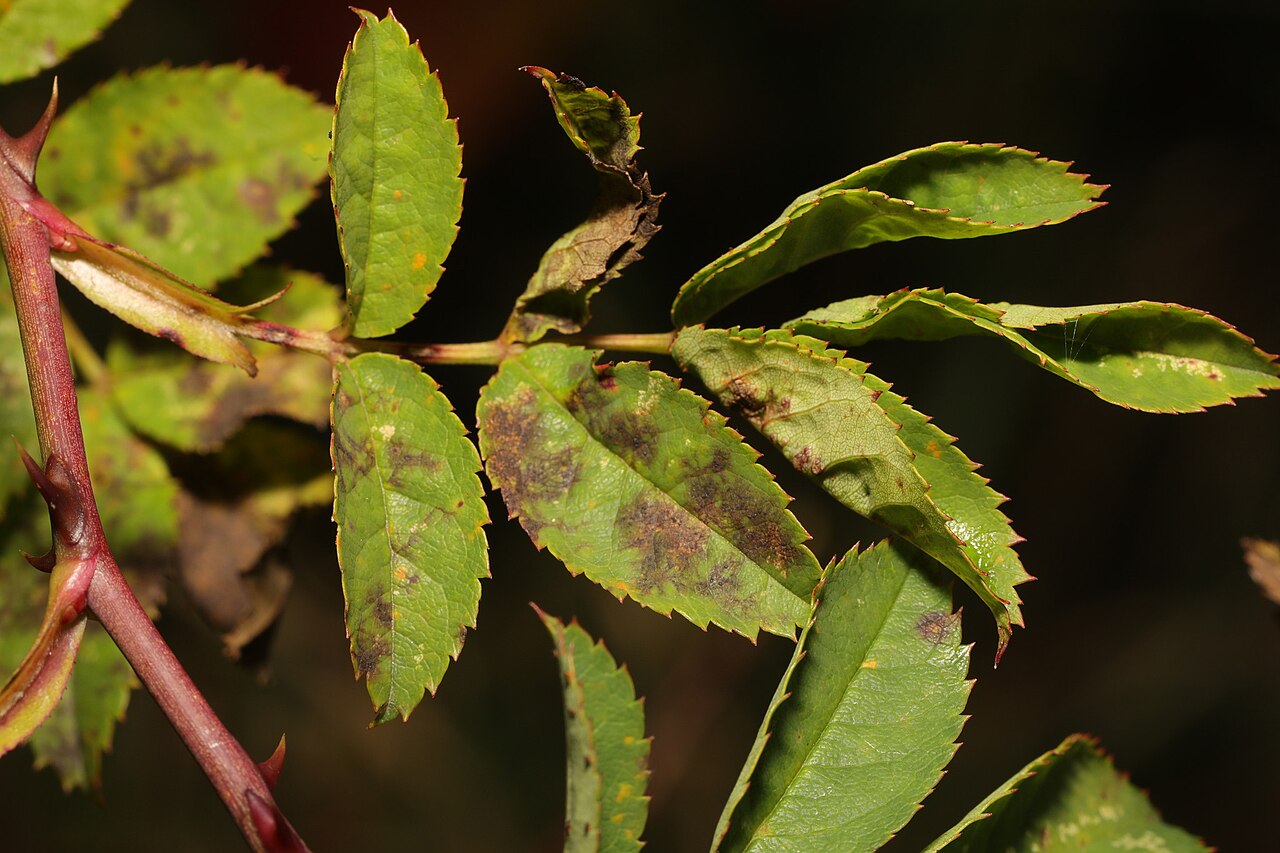
Rose leaves showing black spot disease, with dark circular lesions typical of Diplocarpon rosae infection.
Image Credits: Wikimedia Commons
Black spots on rose leaves are the calling card of black spot disease, the most common fungal disease of roses worldwide. The spots start small and dark, the leaf around them turns yellow, and badly affected leaves drop off.
A light case is mostly a cosmetic nuisance. A severe, repeated infection weakens the whole bush, reduces flowering, and can eventually kill it after several years. The good news is that the disease is very manageable once you know how it works.
This article explains why your roses have black spots on the leaves, including what black spot disease is, how it spreads, how to treat it, and how to prevent it next season.
What black spot disease is
Black spot is caused by the fungus Diplocarpon rosae. It shows up on the upper surfaces of leaves as black or dark brown circular spots with fringed or irregular edges. The spots can reach half an inch across and often merge into larger blotches.
Yellow halos form around the spots as the infection advances. Entire leaves then turn yellow and drop prematurely, sometimes leaving the lower part of the bush bare while the top still looks fine. Repeated defoliation weakens the plant because it keeps losing the leaves it needs for photosynthesis.
The disease favors warm, wet weather. According to Rutgers University's plant pathology program, infection is ideal at temperatures between 68 and 80 degrees Fahrenheit, and symptoms can appear anywhere from 3 days to two weeks after the fungus lands on a leaf.
Here is the detail that matters most for control: leaves must stay wet for at least 7 hours for infection to take hold. If the leaf surface dries within 7 hours of the spores landing, no infection develops. Temperatures above 85 degrees Fahrenheit also halt the disease, which is why black spot often eases in high summer and returns in fall.
How it spreads
The fungus overwinters on infected canes and in fallen leaves around the base of the plant. In spring, rain and watering splash the spores up onto the new foliage, and the cycle starts again.
Every new wet spell moves the disease higher up the bush. Overhead watering, sprinklers, and rain hitting bare soil all fling spore-laden droplets onto healthy leaves. Crowded bushes with poor airflow stay wet longer after rain, which gives the fungus the hours of leaf wetness it needs.
The disease rarely kills an established rose outright in a single season. Garden writer Lee Burkhill of Garden Ninja notes that roses with a touch of black spot every summer can still flower spectacularly if the underlying plant is healthy, well pruned, and well fed. But Ashridge Trees warns that a severe case, left unmanaged for three or four years of constant defoliation, can exhaust and kill a bush.
New plants are not the main victims. Unlike white spots on seedling leaves, which strike the youngest growth, black spot attacks roses of any age whenever wet weather and susceptible foliage meet.
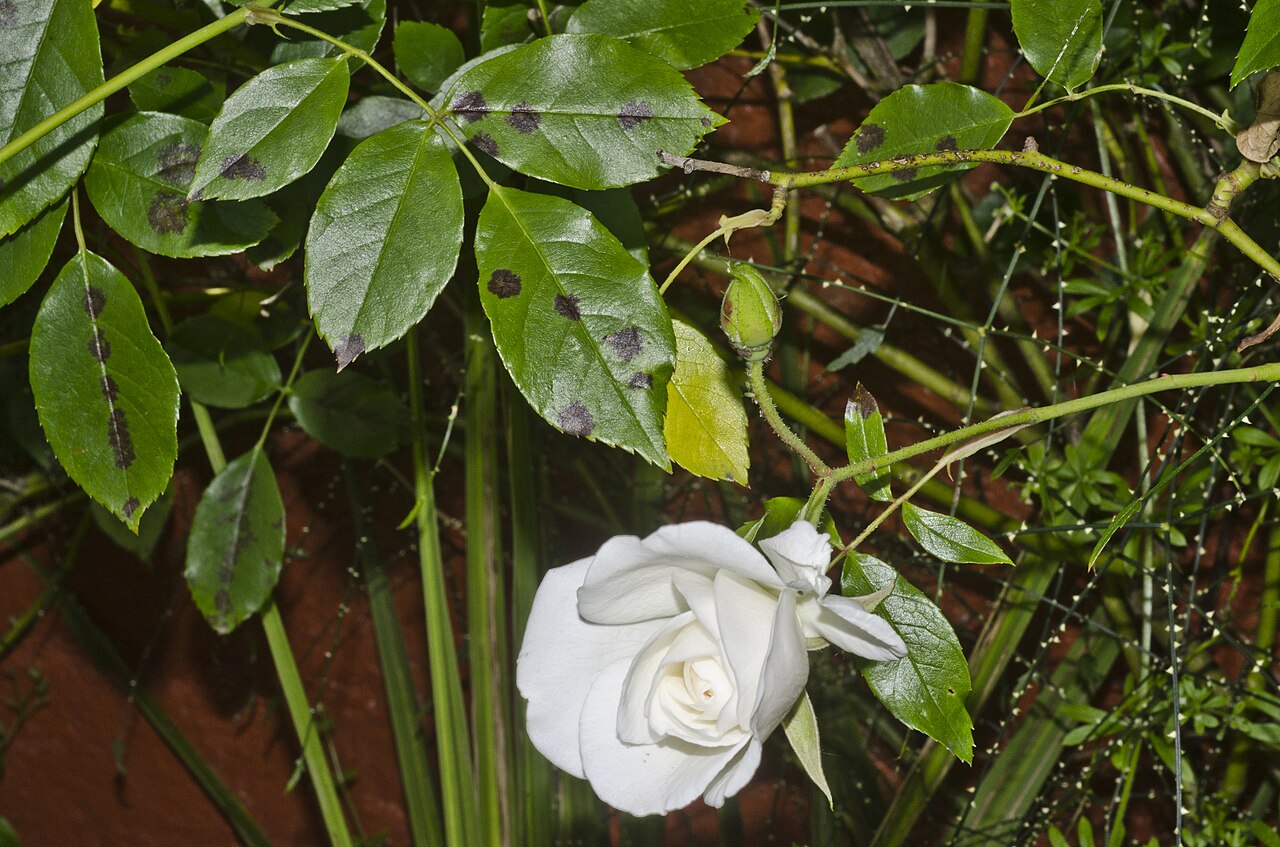
A close view of black spot lesions on rose foliage, showing the fringed edges of the fungal spots.
Image Credits: Wikimedia Commons
How to treat it
Start with sanitation, which costs nothing. Pick off spotted leaves from the plant and rake up every fallen leaf from the soil beneath it. Bin the debris or burn it; do not compost it, because home compost rarely gets hot enough to kill the spores.
Prune for an open, airy shape. Good air circulation dries leaves faster after rain, and faster drying means fewer infections. Make your cuts when the foliage is dry, and disinfect your secateurs between bushes so you do not carry spores along.
Change how you water. Water at the base of the plant, not overhead, and water in the morning so any splashed foliage dries during the day. A mulch layer in spring helps too, by covering the fallen-leaf debris where spores overwinter and reducing soil splash.
For active infections, fungicides work when used early and often. Rutgers lists contact fungicides such as chlorothalonil and mancozeb, and systemics such as propiconazole and azoxystrobin. Spray every 7 to 12 days through the growing season, shortening the interval in wet weather.
If you prefer a gentler approach, diluted neem oil is effective against black spot, and some growers spray cow's milk diluted one part milk to three parts water. Whichever product you choose, repeat applications every 7 to 10 days while conditions favor the disease, because new growth keeps emerging unprotected.
How to prevent it next season
Autumn cleanup is the foundation of prevention. Collect and bin every fallen rose leaf before winter, since that litter is where the fungus waits for spring. Do not bury the leaves under fresh mulch without removing them first.
Choose resistant varieties when you plant new roses. Shrub roses, ramblers, and wild species are largely untroubled, and among modern varieties, names like Ballerina, Buff Beauty, Lucky, and Silver Anniversary are noted for strong resistance.
Give each bush space and sun. An open site with morning sun dries dew quickly, and proper spacing keeps air moving between plants. Avoid planting roses where water pools or where sprinklers hit the foliage daily.
Feed for vigor, but do not overdo nitrogen. A healthy, well-fed rose outgrows light infections, while soft, overfed growth is more susceptible. A balanced rose fertilizer applied as directed, plus organic matter in the soil, builds the kind of steady growth that tolerates disease pressure.
Begin protective spraying early in spring, as leaf buds open, rather than waiting for the first spots. Prevention is far easier than cure with black spot, because the fungus is already cycling by the time symptoms show.
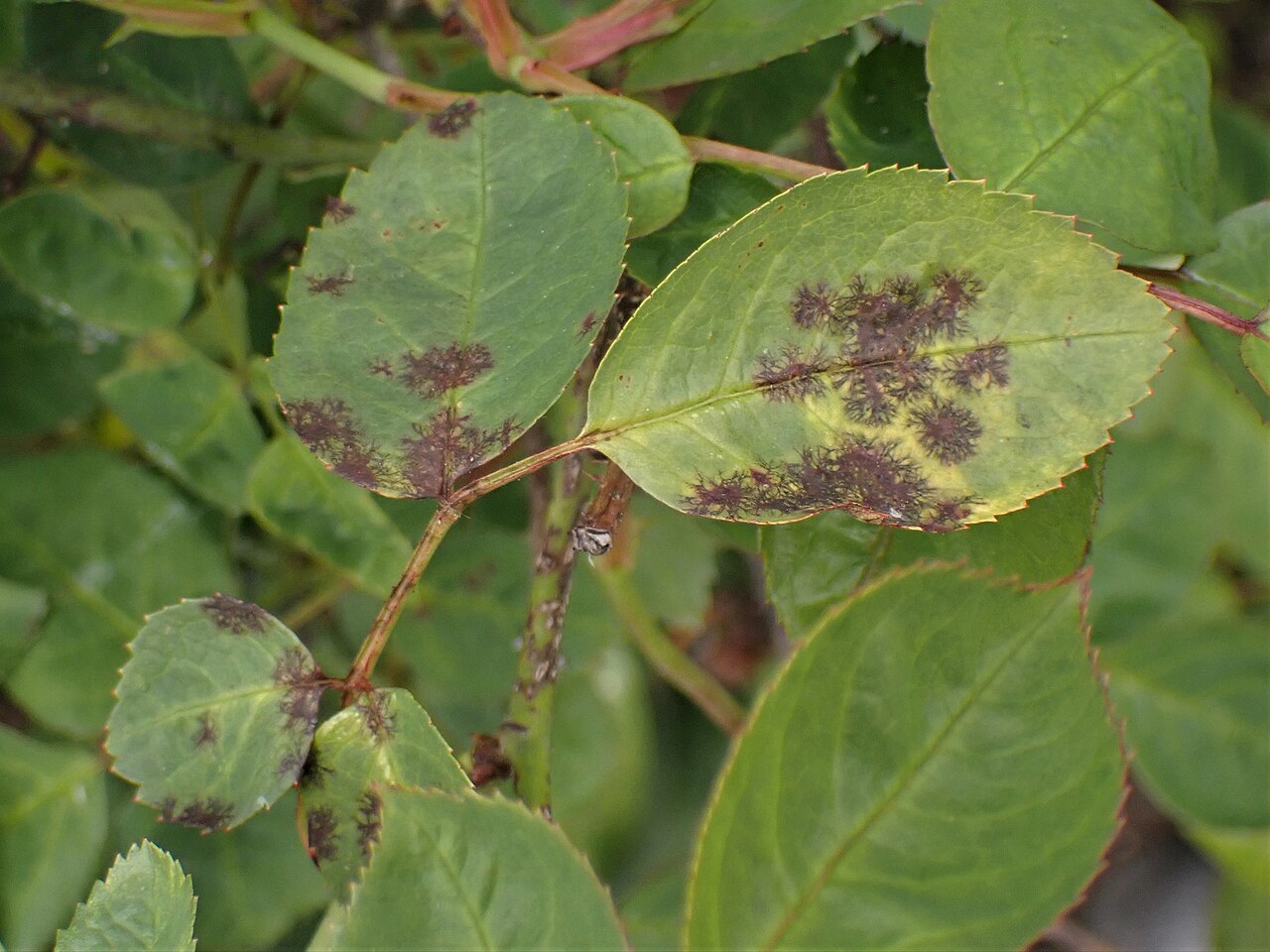
Black spot infection spreading across rose leaves, with yellowing tissue surrounding the dark lesions.
Image Credits: Wikimedia Commons
Frequently asked questions
Can roses recover from black spot?
Yes. Roses recover well with consistent treatment: remove infected material, improve growing conditions, and apply fungicide or neem oil on schedule. New healthy growth replaces the lost leaves.
Should I cut off leaves with black spots?
Yes, promptly. Removing spotted leaves from the plant and the ground slows the spread and reduces next season's spore supply. Dispose of them in the trash, not the compost.
Does black spot spread to other plants?
Black spot is specific to roses. It will not infect your other garden plants, though the wet conditions that favor it can encourage different diseases elsewhere.
Is Epsom salt a treatment for black spot?
No. Epsom salt supplies magnesium but has no fungicidal effect against Diplocarpon rosae. It will not treat or prevent black spot.
When should I start spraying for black spot?
Begin preventive spraying in early spring as new leaves emerge, before any symptoms appear. Continue every 7 to 14 days through the growing season while the weather stays warm and wet.
The bottom line
Black spots on rose leaves mean black spot fungus, and the fungus means wet leaves. Remove infected foliage, keep water off the leaves, open up the bush for airflow, and treat early in the season. Do that consistently, and black spot becomes a minor chore instead of a yearly crisis.
Tags: gardening, roses, black spot, plant disease, fungus
Rive News is a research desk that explains everyday questions with sourced, practical answers.
Latest in Gardening
- Why do seedlings fall over and die?
- Why does your lawn have bare patches?
- How to protect plants from a sudden frost
Subscribe to the Rive News newsletter for one practical explainer every morning.
© 2026 Rive News. All rights reserved.
Related stories
What Is Companion Planting and Does It Work?
Marigolds work as a nematode cover crop, but the basil flavor claim failed repeated tests. An honest evidence review of what companion
Determinate vs. indeterminate tomatoes: growth, pruning, and harvest differences
Determinate tomatoes grow to a set size and ripen all at once, while indeterminate types vine all season. That one difference shapes
How to improve clay soil for gardening
Gypsum will not fix ordinary clay soil, say extension experts. What actually works: 2 to 3 inches of compost, mulch, better drainage,