
Why Does Your Heart Race When You Get Startled?
Key takeaways
- A sudden scare fires the brain's startle reflex within milliseconds, launching the fight-or-flight alarm.
- Adrenaline from the adrenal glands makes the heart beat faster and stronger, raising blood pressure and breathing rate.
- The pounding usually fades in minutes as the parasympathetic system restores calm; persistent pounding warrants medical attention.
A sudden bang behind you. A door slamming when the house was quiet.
Your shoulders fly up, you gasp, and a half-second later your heart is hammering against your ribs. That pounding is the most noticeable part of the startle response, the body's ancient, involuntary alarm system.
Your racing heart after a scare is not a malfunction. It is doing exactly what evolution built it to do: pumping fuel and oxygen to muscles that might need to act in the next few seconds.
This article explains how the startle reflex fires, what adrenaline does to the heart, why the reaction is so fast, and when the pounding is worth paying attention to.
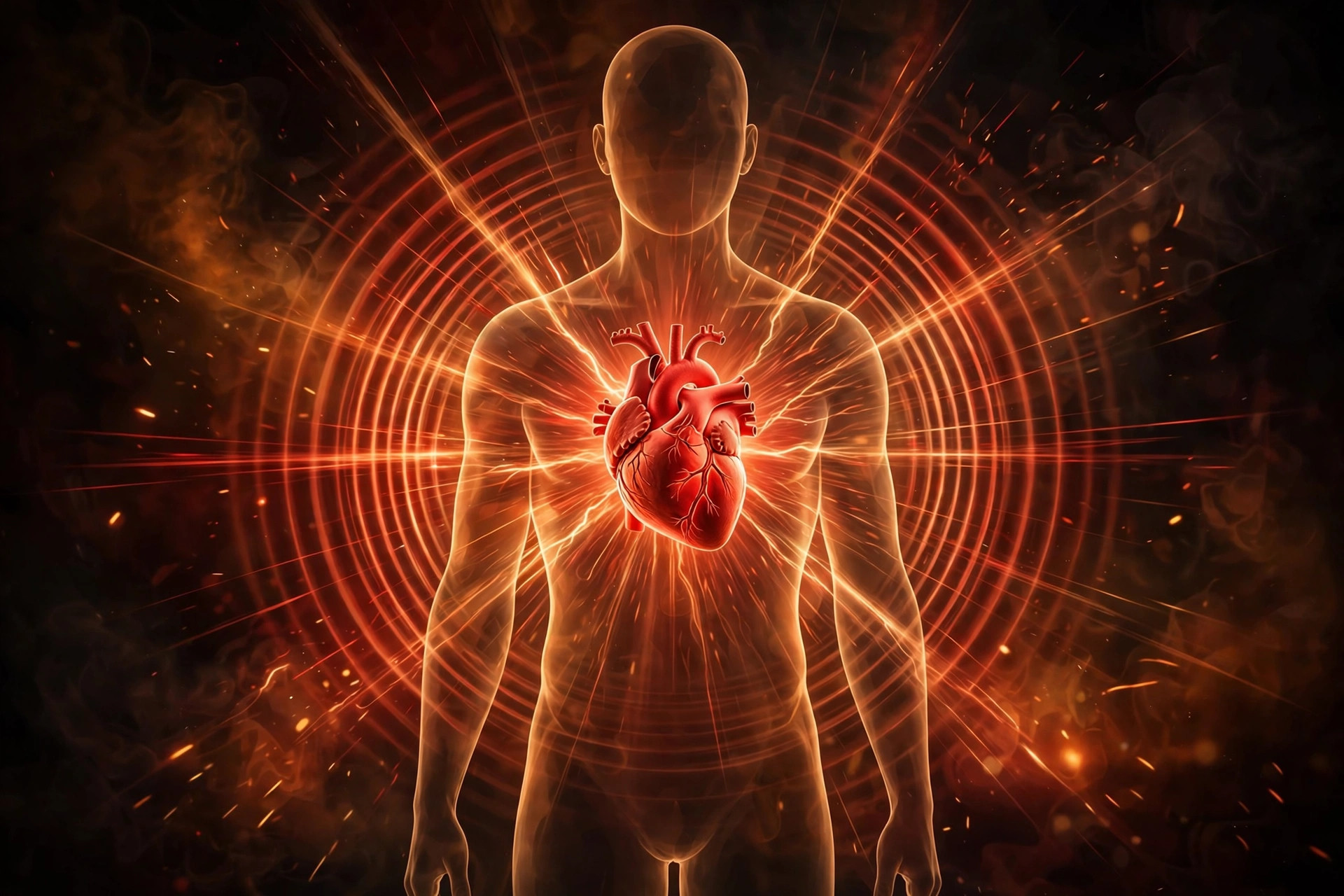
An illustration of the heart lighting up during the startle response, the moment adrenaline floods the bloodstream. Illustration: Rive News.
Image Credits: Original illustration, Rive News
How the startle reflex fires first
The startle reflex begins in the brain, long before conscious thought gets a vote. A sudden noise or movement is picked up by threat-detection circuits centered on the amygdala, and the body launches a protective response within milliseconds.
Researchers describe the startle response as defensive and neurologically primitive: a sudden flexion of muscle groups that prepares the organism for action. Robert Levenson, Paul Ekman, and Matthieu Ricard characterized it in a 2012 paper as a defensive, phylogenetically ancient reflexive response thought to protect the organism from injury.
A 2024 review by Daniel Santos-Carrasco and Luis G. De la Casa defined it as a sudden flexion of specific muscle groups in response to an intense stimulus, serving an adaptive, protective function that readies the body for defensive or escape responses. In plain terms, the brain's alarm trips, the muscles brace, and the body interrupts whatever it was doing.
The reflex can be tuned by experience. Habituation makes you jump less at a noise you have heard a dozen times, while sensitization makes each scare bigger after a run of frightening moments.
Once the alarm trips, the body launches the larger fight-or-flight program. The sympathetic nervous system, the branch of the nervous system that speeds the body up under stress, takes the lead, and a cascade of well-orchestrated physiological changes begins.
What adrenaline does to your heart
Within seconds of the alarm, the adrenal glands release adrenaline, also called epinephrine, into the bloodstream. Adrenaline is the chemical messenger that turns the heart's output up, fast.
According to Choosing Therapy's overview of the fight-or-flight response, adrenaline and noradrenaline raise heart rate, blood pressure, respiration, and perspiration. The racing heart has a specific job: pumping more oxygen and nutrients to the muscles to prepare the body to fight or flee. Blood flow increases to the large muscle groups of the arms and legs, while digestion slows because the body diverts energy to survival functions.
Adrenaline also signals the body to release stored sugar into the blood, giving muscles ready fuel. The heart beats not only faster but harder, which is why you feel it thumping in your chest, your throat, and sometimes your ears.
The whole package has a familiar name: an adrenaline rush. It helped our ancestors survive wild animal attacks and other immediate threats. Today the same chemical reaction fires for a slammed door, a jump scare in a film, or a public-speaking moment.
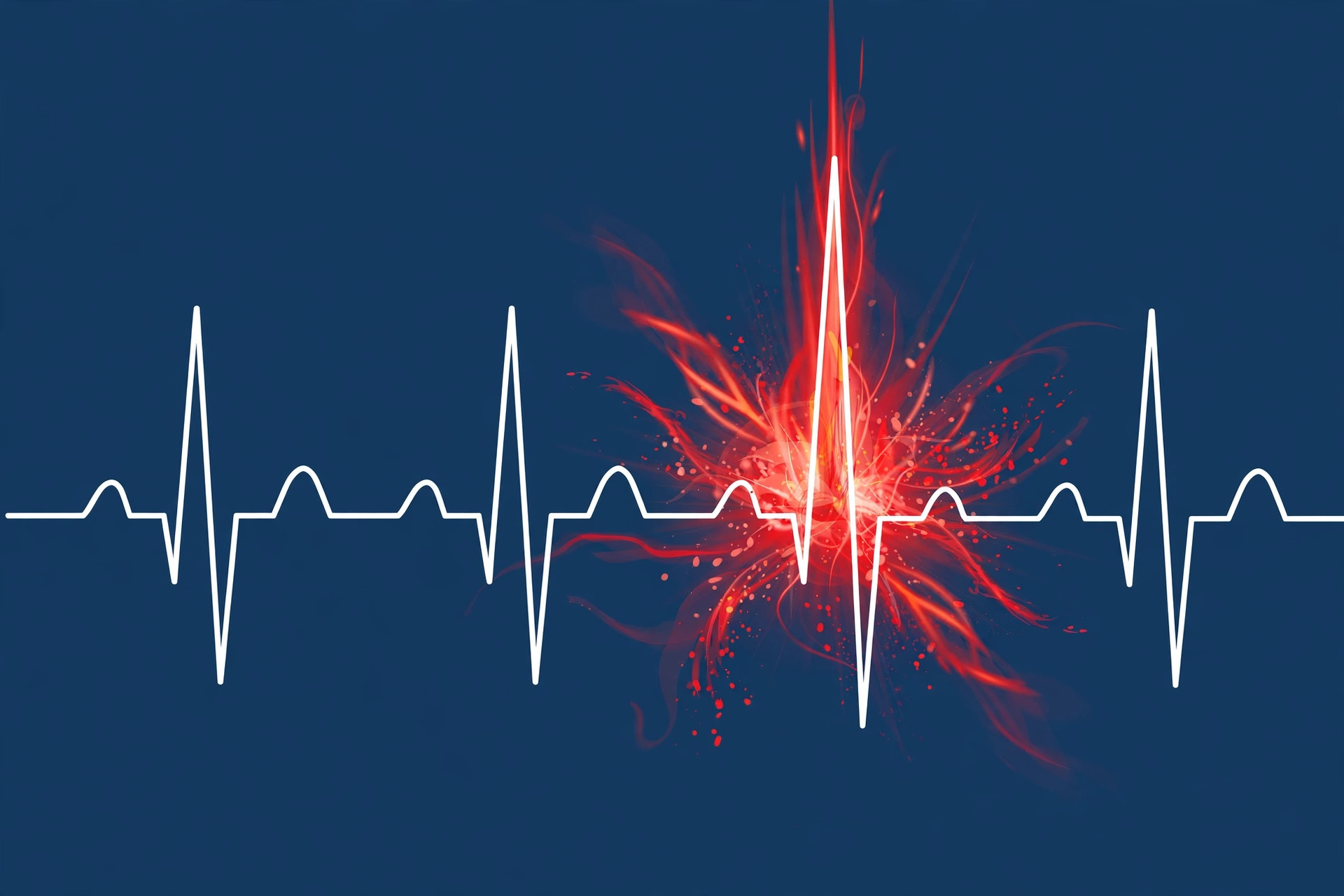
An illustration of a heart trace spiking as adrenaline hits, the classic signature of the fight-or-flight surge. Illustration: Rive News.
Image Credits: Original illustration, Rive News
Why the reaction is so fast
Speed is the entire point. The startle response is measured in milliseconds, far faster than deliberate thought, because hesitation was once lethal. The alarm stage of the stress response is the body's first and fastest answer to a threat, and it skips the slow route of conscious evaluation.
Your body also stacks the deck before you notice. Muscles tense in anticipation, breathing quickens to pull in extra oxygen, and the senses sharpen into a state of hyper-alertness. Blood is even diverted away from the skin's surface and from fingers and toes, which is why people can feel pale or get tingling and "cold feet" during a scare.
That mismatch explains the most familiar part of being startled: the scare lasts a second, but the pounding lasts minutes. Your conscious mind has already identified the "threat" as a falling book, but the machinery is still running at full power. The hormones need time to clear.
How your body calms back down
Once the brain confirms there is no real danger, the parasympathetic nervous system takes over and reverses the changes. Heart rate eases, breathing deepens, and muscles release. Most people return to baseline within a few minutes.
Controlled breathing speeds the reset because it signals safety to the nervous system. Slow exhales are especially effective, since they engage the vagal pathways that slow the heart. People who practice this, from first responders to stage performers, can shorten the tail of a startle response noticeably.
Relaxation responses work on the same wiring that produces other odd body sensations, from night leg cramps to a cough that worsens when lying down.
Repeated, exaggerated startle responses can also be learned. Bodies conditioned by chronic stress or trauma sometimes fire the alarm at smaller and smaller triggers. That is one reason relaxation training and, where needed, professional therapy can help dial the system back down.
Therapists who work with chronic stress describe many clients whose startle responses became exaggerated over time, even when no real danger is present.
Frequently asked questions
Is it normal for my heart to pound after a scare?
Yes. A pounding heart is the expected result of the fight-or-flight program: adrenaline raises heart rate, blood pressure, and breathing so the body is ready to act. The feeling typically fades within a few minutes as stress hormones clear.
Can being startled damage my heart?
A normal startle is harmless for a healthy heart. Extremely intense fright has, in rare cases, triggered stress-related cardiac events in people with existing heart disease, which is why sudden severe symptoms deserve medical attention rather than dismissal.
Why do I jump at small noises on some days?
The startle response is tuned by your current state. Poor sleep, caffeine, anxiety, or a run of recent scares can sensitize the alarm, so the same noise that barely registers on a calm day makes you leap on a tense one.
How can I calm down quickly after a scare?
Slow your exhale: breathe in for four counts, out for six. Long exhales activate the parasympathetic system that slows the heart. Reminding yourself, in plain words, that the threat has passed helps the conscious mind call off the alarm.
Outlook
For most people, a racing heart after a startle is a sign of a healthy, working alarm system. The pounding is the body's way of making sure you are ready, just in case. It is a good idea to see a clinician if the racing comes with chest pain, fainting, or severe shortness of breath, or if episodes of a pounding heartbeat arrive without any trigger at all.
This explainer describes how the body works and is not medical advice. If symptoms worry you, talk to a qualified clinician.
Latest in Health
- Why leg cramps strike at night and how to get relief
- Why you cough more lying down with a cold
- Why skin itches after a hot shower
Subscribe for one clear health explainer a week: science without the jargon.
Related stories
ADHD linked to fourfold dementia risk in Pitt study of 187,000 adults
Adults with ADHD face four times the risk of dementia, a University of Pittsburgh study of 187,000 adults published in JAMA Psychiatry
Why Do Athletes Get Cramps Despite Drinking Water?
Muscle cramps strike even well-hydrated athletes because sweat drains electrolytes that plain water cannot replace. Here is why water alone

Do bananas actually prevent muscle cramps?
A medium banana has 422 mg of potassium, but the evidence says it cannot stop cramps. Here is what the research shows, and what actually