
How to Teach Kids About Money With Pocket Money
Key takeaways
- Start pocket money around age 5 to 7, when children grasp numbers and begin asking about buying things.
- A common guideline is $1 per year of age each week, adjusted to your budget and what the money must cover.
- Split each payment into save, spend, and give so every coin teaches a choice.

Pocket money is a teaching tool disguised as a treat. Handled well, it gives children a safe place to make money mistakes while the stakes are small.
This article explains how to teach kids about money with pocket money, including when to start, how much to give, whether to tie it to chores, and how the system grows as children grow.
When to start
Most parenting and financial guides put the starting point around age 5 to 7. At that age, children are beginning to understand numbers, developing simple math skills, and asking questions about money, according to WiseDime.
Ameriprise Financial gives a similar window, suggesting an allowance once children reach age 6 or 7. Younger children can still learn with coins and a piggy bank, but the lessons land better once a child can count change and wait for something.
Watch for signs rather than a birthday. A child who asks what things cost, who saves a birthday coin, or who trades toys with a sense of value is ready. A child who still thinks a card machine makes money for free needs a few more months of watching you pay.
Start small. A tiny, regular amount teaches the same lessons as a large one, and consistency beats generosity every time, according to HabitHero.
How much pocket money to give
There is no hard rule, but a widely used guideline is $1 per year of age each week. A 7-year-old gets $7 per week. A 10-year-old gets $10 per week.
WiseDime lists this as the common starting point, and it scales naturally as children grow.
HabitHero publishes a similar table of weekly ranges by age. Children aged 4 to 5 get $1 to $3, ages 6 to 8 get $3 to $7, ages 9 to 11 get $7 to $12, ages 12 to 14 get $12 to $20, and ages 15 and up get $20 to $40 or more.
The amount should match what the money must cover. If pocket money pays only for treats, keep it small. If it must cover outings, gifts, apps, or clothing extras, raise it and say so plainly.
A child who must buy birthday gifts for friends from a $3 allowance learns frustration, not budgeting.
Set the amount you can sustain every week. A steady $5 beats a promised $15 that stops after a month. If money is tight, say so in simple terms: "We have $5 a week for your money lessons.
" Children handle honest limits better than broken promises.
Should pocket money be tied to chores?
Families split on this question, and all three common approaches can work. WiseDime lists them as fixed allowance, earned allowance, and a hybrid.
A fixed allowance arrives every week no matter what. It teaches budgeting, because the child must manage a set amount. Household chores stay separate, as part of belonging to the family rather than paid work.
An earned allowance arrives when the child completes tasks. It teaches a work ethic and links money to effort. The risk is that a child may refuse a chore and forfeit the pay, which leaves the chore undone.
A hybrid gives a small base allowance plus bonuses for extra tasks. This mix keeps budgeting lessons steady while rewarding extra effort. Many families find it the easiest to sustain.
Pick one approach and explain it in one sentence. "Your pocket money comes every Friday. Extra jobs earn extra money.
" Clarity matters more than the choice itself, because children test rules they do not understand.
The save, spend, and give split
Ameriprise Financial suggests splitting money into three buckets: spending, saving, and donating. The same idea appears in many family money guides, often with jars or envelopes labeled Save, Spend, and Give.
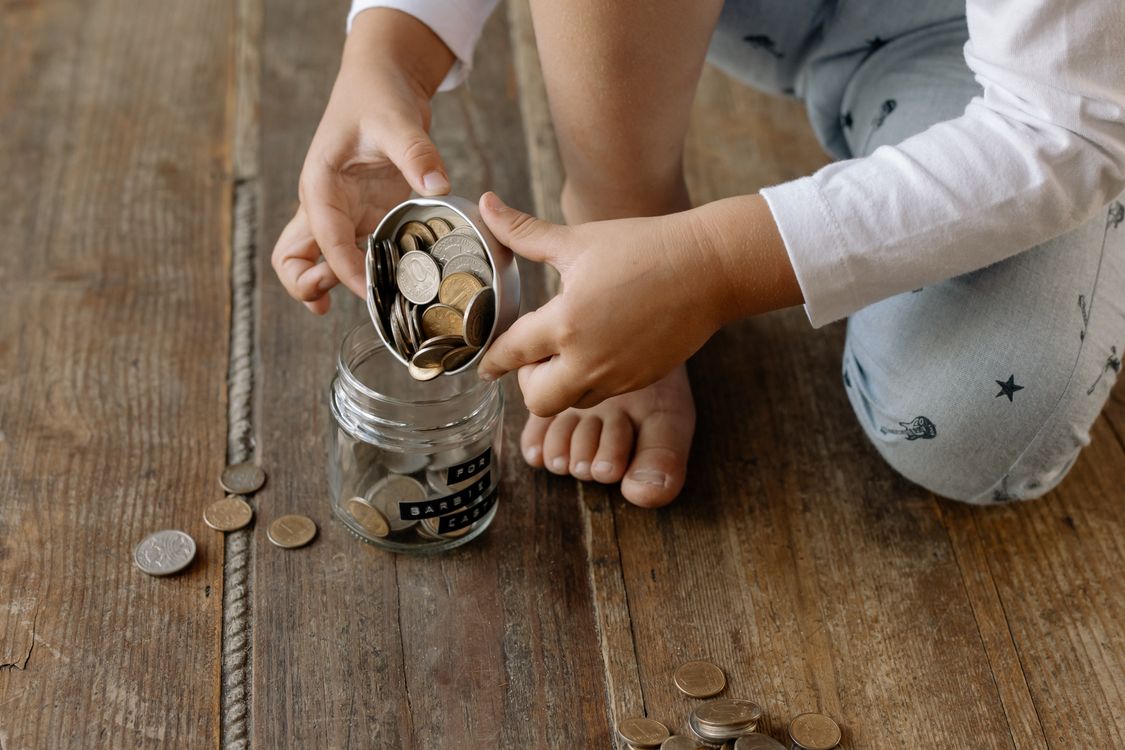
Use real containers a young child can see. Three clear jars work better than an app for a 6-year-old, because coins are visible and countable. Each payday, the child divides the money between jars.
A simple split is half for spending, most of the rest for saving, and a small share for giving.
Saving needs a goal. "Save for a toy" is vague. "Save $24 for the dinosaur set" is a plan.
Help the child count progress and mark it on a chart. Waiting for a goal is the hardest money lesson, and the most useful one.
Giving needs a choice. Let the child pick the cause: a school collection, a food bank, a gift for a grandparent. Like adults, children give more willingly to causes they connect with, as Ameriprise notes.
A small regular gift teaches that money is for sharing, not only for spending.

Let them make small mistakes
The hardest part of pocket money is watching a child waste it. A child who spends the whole week on sweets will feel the loss by Thursday. That feeling is the lesson.
Resist the bailout. If you top up the money every time it runs out, the child learns that money is unlimited. If you hold the line, the child learns that choices have costs.
A week without treats is a cheap education.
Talk about the mistake without scolding. Ask what the child would do differently next week. Help them plan the next payment: "If you want the comic book on Saturday, keep $4 in the spend jar until then.
" Advice lands better after a mistake than before one.
Protect the saving jar. If the child raids savings for sweets, the goal slips and the saving habit dies. Agree together that savings stay saved unless the goal changes by discussion, not by impulse.
Teach prices, not lectures
Children learn money by handling it. Take them shopping with their own money and let them pay. Counting coins at a till teaches more than any worksheet.
Compare prices out loud. "This pack costs $6, and that one costs $4. What is the difference?" Show them how a larger pack can cost less per item.
Let them choose between two treats at different prices and live with the choice.
Talk about wants and needs in plain language. Food, clothes, and a home are needs. A third toy car is a want.
Wants are fine, but they wait their turn. This distinction, taught with pocket money, becomes the core of adult budgeting.
Avoid money secrecy. Children who never hear about bills grow up thinking money appears on demand. You do not need to share account balances.
A simple "we plan our money too" is enough.
How the system grows with the child
Pocket money should grow with responsibility. HabitHero describes the shift well: for little kids, allowance is a hands-on lesson that money is finite. For teens, it is training wheels for adult budgeting, with more responsibility handed over while the stakes stay low.
Ages 6 to 8 work with coins, three jars, and one savings goal. Talk about goals and let them feel the wait for bigger purchases.
Ages 9 to 11 can handle earn-more jobs and longer waits. Add outings, collectibles, and gifts for friends to their budget. Let them plan a small outing with a set amount.
Ages 12 to 14 can move to fortnightly pay and simple budgeting. Add apps, clothing extras, social outings, and phone top-ups. Let them track spending in a notebook or a simple app.
Ages 15 and up can take a monthly budget for defined categories. Give them clothing money for the month and let them decide when to buy. Ameriprise suggests that by the preteen and teen years, it can make sense to give children money to cover routine expenses such as school lunches and clothing costs.
Each step hands over one more decision. The parent steps back one pace at a time, and the child practices adult budgeting with guardrails.
What not to do
Do not use pocket money as a punishment tool. Withholding a week of money for bad behavior turns a teaching system into a threat, and it breaks the consistency the lessons depend on. Discipline belongs elsewhere.
Do not pay for every chore. If every dish earns a coin, children learn that family work is optional labor for hire. Keep basic chores unpaid and reserve pay for extra jobs beyond the usual routine.
Do not compare siblings. One child may save for months while another spends at once. Both are learning.
Praise the saver for patience and the spender for honesty about choices, and let each child move at their own pace.
Do not lend against future payments. "Borrow from next week" teaches debt before saving. If the money runs out, the week is over.
Next Friday brings a fresh start.
Frequently asked questions
At what age should pocket money start?
Around age 5 to 7, when a child can count, understands that money buys things, and can wait a short time for a goal. Start with coins and a tiny weekly amount.
How much pocket money is enough?
A common guide is $1 per year of age each week, adjusted to your budget and what the money must cover. Consistency matters more than the exact amount.
Should I tie pocket money to chores?
You can, but you do not have to. Fixed, earned, and hybrid systems all work. Pick one, explain it in one sentence, and stay consistent.
What if my child spends everything at once?
Let it happen, and hold the line. The empty jar teaches more than a lecture. Help the child plan the next week so the same mistake is less likely.
When should teens get a monthly budget?
Around age 15, move to a monthly payment for defined categories such as clothing, transport, and eating out. Step back and let them manage it, with a review at month end.
The bottom line
Pocket money works when it is small, regular, and tied to real choices. Start around age 5 to 7, use a simple amount rule, split each payment into save, spend, and give, and let children make small mistakes while the stakes are low. Grow the system with the child, and by the teen years the allowance becomes a genuine budget.
The goal is not a child who never wastes money. It is a child who knows what wasting money feels like, and what to do next time.
This article is for general information, not financial advice.
Tags: parenting, kids, money, allowance
Latest in Parenting
- Why Do Kids Ask Questions All the Time?
- How to Handle Sibling Rivalry Without Taking Sides
- How to Talk to Children About Fear of the Dark
Subscribe to the Rive News newsletter for one useful explainer each week.
Related stories

Why babies cry more in the evening: the witching hour explained
The witching hour is the fussy evening stretch most newborns hit daily. Why overtiredness, cluster feeding, and overstimulation stack up

When Do Babies Start Sleeping Through the Night by Month?
Most babies sleep through the night between 3 and 6 months, with regressions at 4 and 8 to 10 months. See the month-by-month table

Why Your Baby Wakes Up the Second You Put Them Down
Newborns wake when put down as the startle reflex, light sleep, and lost warmth hit at once. It is normal and peaks early, fading