
Why Do Cats Drink by Curling Their Tongue Backward
Key takeaways
- Cats touch only the tongue's top surface to water, then yank it up to pull a liquid column.
- A 2010 Science study measured lapping at about 4 laps per second, balanced on a Froude number near 1.
- The backward curl is what defeats gravity: inertia pulls water up before it can fall.
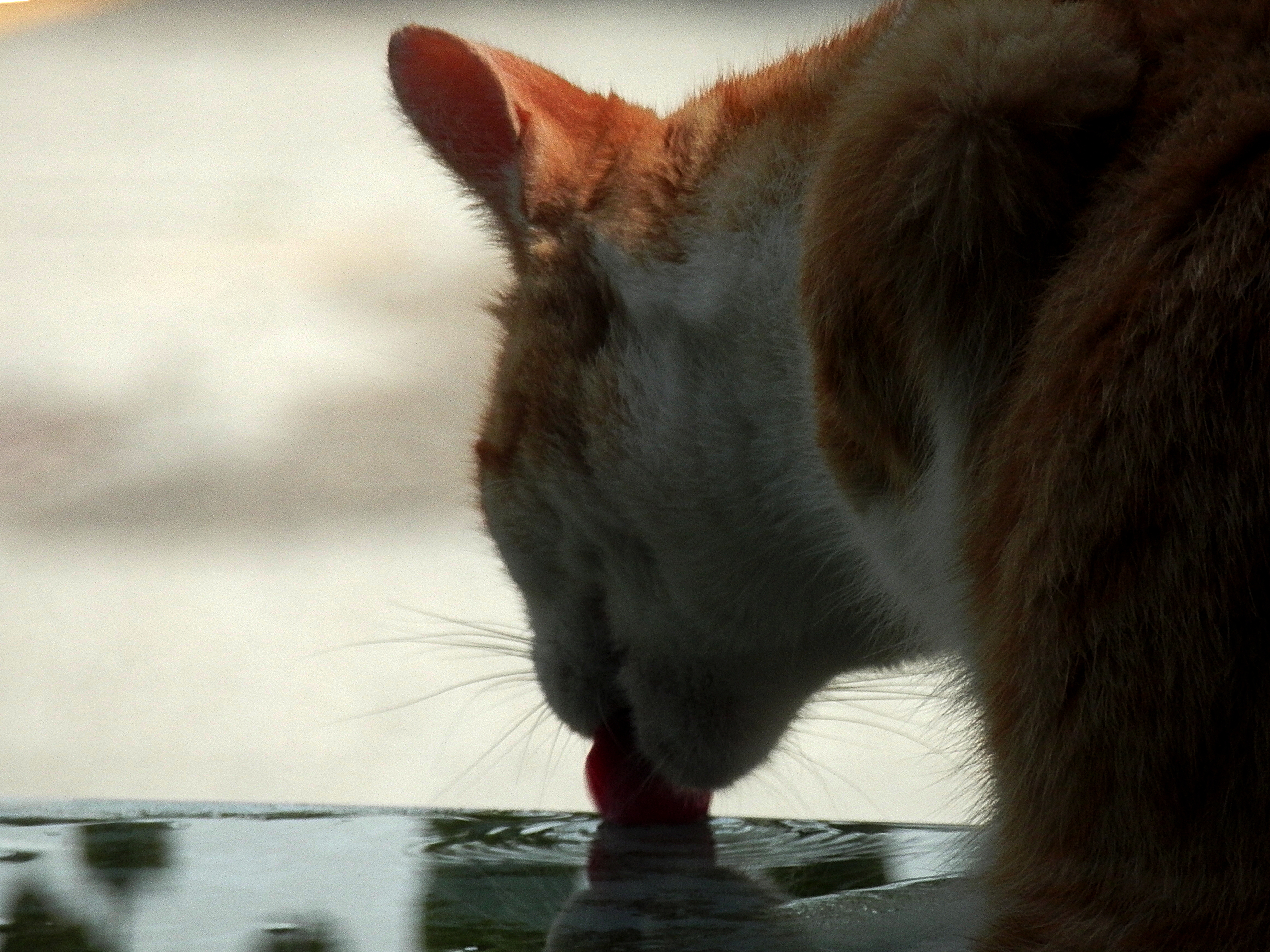
Watch a cat drink and it looks like scooping. It is not.
Slow-motion footage revealed in 2010 that cats curl the tip of the tongue sharply backward, barely brush the water's surface, and then exploit inertia to pull a column of liquid into the mouth. The motion is too fast for the naked eye, and casual observation got the mechanism exactly backwards for decades.
The finding came from engineers at MIT, Virginia Tech, and Princeton who filmed the process with high-speed cameras and published it in the journal Science. This article explains what they found, why the backward curl matters, and how dogs drink completely differently.
What looks like scooping is really a backward curl
When a cat drinks, it extends its tongue downward with the tip curled backward like a capital J, so that the top surface of the tongue touches the liquid first. That was the long-standing description, and it is roughly right about the shape. Where observers went wrong was assuming the curled tip acted as a ladle.
High-speed videos made by the research team showed the truth. The smooth tip of the tongue barely brushes the surface of the liquid before the cat rapidly draws its tongue back up.
As it does, a column of liquid forms between the moving tongue and the liquid's surface. The cat then closes its mouth, pinching off the top of the column for a drink, while keeping its chin dry.
Roman Stocker, an MIT civil and environmental engineering professor who led the study, had wondered about the mechanism after watching his own cat, Cutta Cutta, drink. Stocker, Pedro Reis of MIT, Sunghwan Jung of Virginia Tech, and Jeffrey Aristoff of Princeton published their results as "How cats lap: Water uptake by Felis catus" in the November 11, 2010 issue of Science.
Inertia versus gravity, measured to four laps a second
The team's key insight is a competition between two forces. Water sticks to the tongue's dorsal surface through adhesion.
When the cat lifts its tongue fast, the liquid's inertia carries it upward in a column. Gravity immediately starts pulling that column back down.
The cat must close its jaws at exactly the right instant to capture the water before gravity wins.
The researchers built a mathematical model around the Froude number, a dimensionless ratio of inertia to gravity. For cats of all sizes, that number came out to almost exactly one, indicating a near-perfect balance between the two forces. As Newswise reported, the team concluded that the cat chooses its lapping speed to maximise the volume of liquid ingested per lap.
And the speed is startling. A domestic cat manages about four laps a second, with the tongue moving roughly a metre per second.
Larger cats lap more slowly: the team analysed videos of tigers, lions, and jaguars from Boston-area zoos, working with Zoo New England's mammal curator John Piazza and assistant curator Pearl Yusuf. The same Froude mechanism held across felines of all sizes, which is why the follow-up paper called the mechanism conserved among felines.
Why the curl has to point backward
The backward curl is not decorative. It is the geometry that makes the whole trick work.
If the cat dipped its tongue like a dog, it would disturb the surface and get a mouthful of splashes. Instead, the dorsal side of the tip rests on the liquid surface without piercing it.
Only on the upward stroke does the liquid adhere to that upper surface and get drawn into a column.
Virginia Tech's report on the study puts the sequence plainly: the lowest point of the tongue rests on the liquid's surface, and when the tongue is lifted back into the mouth, liquid adhering to the upper side of the tip is drawn upwards, forming a column as it enters the body. The column is captured when the jaw closes.
This precision explains several quirks of cat drinking. Cats that lap too fast break the column and get less water per lap.
Cats drinking from fountains often prefer the falling stream, which presents a cleaner surface to work with. And the whole apparatus depends on a smooth tongue tip, one reason grooming and tongue anatomy matter more to a cat than owners realise.
How dogs drink completely differently
Dogs do the opposite. A dog's tongue curls forward and plunges into the liquid, scooping water up in a ladle shape.
It is messier, splashier, and far less efficient per lap. Cats cannot afford the dog's approach for a simple reason: getting the chin and chest wet with every drink would be a liability for a stealth predator.
The researchers noted that vertebrates with incomplete cheeks must use their tongues to drink, and cats and dogs are the most common examples. But the two animals arrived at opposite solutions.
The dog relies on volume and speed. The cat relies on timing and fluid dynamics.
This also explains why cats sometimes seem fussy about water bowls. A deep, narrow bowl forces an awkward tongue angle that breaks the delicate surface contact. Wide, shallow bowls let the tongue work at its designed angle, which is the same reason experienced owners keep the water away from the food, where introducing a new cat to a resident cat is stressful enough without competition at the water bowl.
The study also advanced robot design
The team said the work had implications beyond the water bowl. Understanding how a tongue pulls a precise liquid column upward with inertia could inform ways to robotically move liquids, the researchers told Reuters. They even built a robotic cat tongue, a disk moving up and down over a dish of water, to systematically explore the lapping mechanism.
Stocker noted in a statement that the work was done without dedicated funding, without graduate students, and partly from YouTube videos of big cats. It remains a favourite example of how a mundane observation, a cat drinking milk, can expose an elegant physics problem hiding in plain sight.
FAQ
Why does my cat dip its paw in the water before drinking?
Paw-dipping is a separate behaviour, often about testing the water level or playing. True drinking uses the backward-curled tongue and the inertia trick, not the paws.
Is it normal for cats to make a mess when drinking?
A little splashing is normal. Excessive mess can mean the cat is lapping too fast for its column timing, or the bowl shape is forcing a bad tongue angle. Try a wider, shallower bowl.
Do big cats drink the same way as house cats?
Yes. The 2010 study confirmed the same Froude-number balance in tigers, lions, and jaguars, with lapping frequency scaling to body mass. The mechanism is conserved across felines.
Why won't my cat drink from a deep bowl?
Deep bowls push the tongue into a steep angle that disrupts the surface contact the technique needs. Shallow, wide bowls match the physics of the lap, which is also why cats prefer drinking from faucets and fountains with clean, moving surfaces.
The bottom line
Cats curl their tongues backward because the dorsal surface, lightly brushed across the water, can pull a liquid column upward on inertia alone. The 2010 Science study timed it at about four laps per second and showed the Froude number sitting at almost exactly one across all felines. It is a gravity-defying trick executed with a precision the naked eye cannot follow, and it works precisely because the tongue never scoops.
Latest in Pets
- Why do cats stare without blinking?
- How to introduce a new cat to a resident cat
- Why do guinea pigs freeze when picked up?
- Which human foods are dangerous for dogs and cats?
Subscribe for weekly pet science explainers in plain English.
Image Credits: Wikimedia Commons
Related stories
Why Does My Dog Eat Grass and Vomit?
A UC Davis study of 1,571 owners found grass eating is normal dog behavior, not self-medication: only 10% were ill first. What the science
Why Does My Dog Stare at Me While I Eat?
Dogs stare at you while you eat because it has worked before, and mutual gaze raises bonding hormones. Learn the reinforcement science
Foods toxic to dogs: the list, with reasons
Chocolate, xylitol, grapes, onions: common foods can harm dogs. Learn what makes each one toxic, the warning signs, and what to do if your