
Why Do Dogs Twitch and Paddle Their Paws While Dreaming
Key takeaways
- Dogs twitch and paddle their paws during REM sleep, when the brain is highly active and likely dreaming.
- The brainstem's pons normally switches muscles off during dreams; leaks in that switch cause twitching.
- Twitching is most common in puppies and senior dogs, and brief loose paddling is normal, not a seizure.
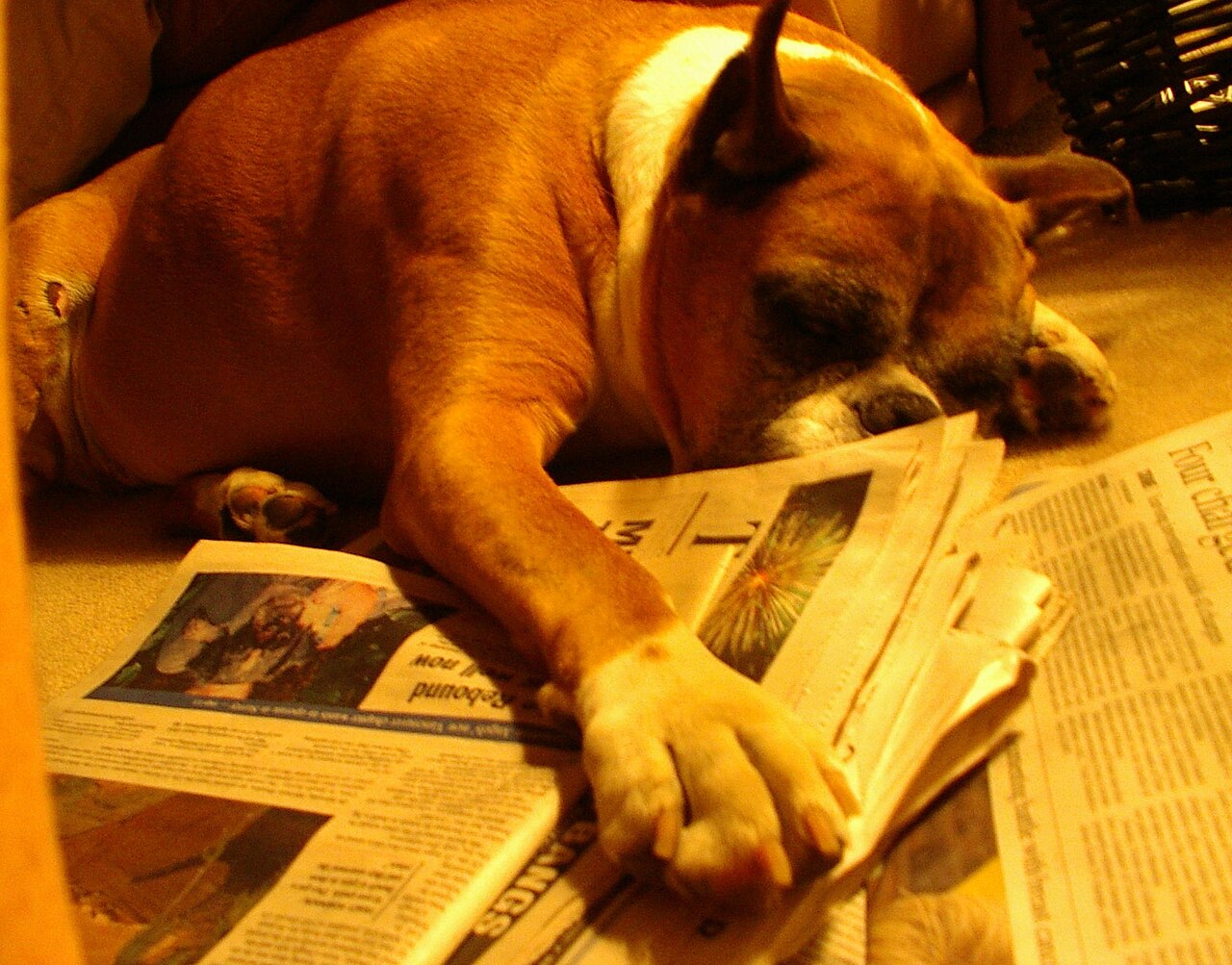
An 8-year-old Boxer asleep on its side, the classic position for visible dream twitches. Photograph: Paul Kucharczyk
Image Credits: Wikimedia Commons / Paul Kucharczyk
Most dog owners have watched it happen: the family dog is asleep on the rug when its paws start paddling as if it is sprinting after something invisible. The whiskers flick, a soft whimper escapes, and for a moment the dog looks like it is running a race in another world. Then, seconds later, everything goes still.
That twitching and paddling is one of the most misread behaviors in pet ownership. Many owners worry it is a seizure, while others assume the dog is chasing squirrels in its dreams.
The science points to something precise: these movements are motor signals leaking through during REM sleep, and they tell us that dogs dream in ways remarkably close to the way humans do. This article explains what the sleep cycle looks like in dogs, why the paws paddle, why puppies and old dogs twitch most, and how to tell normal dreaming from something that needs a vet.
How a dog's sleep cycle actually works
Dogs sleep far more than humans do. PetMD reports that dogs sleep an average of 12 to 14 hours each day, and that sleep is not one uniform state.
Like humans, dogs cycle through stages of sleep, including non-REM sleep and rapid eye movement (REM) sleep. REM is the stage when dreaming happens: the brain becomes highly active, the eyes move beneath closed lids, breathing turns irregular, and the heart rate speeds up.
Psychologist Stanley Coren of the University of British Columbia measured canine sleep architecture and found a pattern that mirrors humans. His data showed dogs spending about 44 percent of their time alert, 21 percent drowsy, 23 percent in non-REM slow-wave sleep, and 12 percent in REM sleep.
The cycles run fast: a full dog sleep cycle lasts roughly 45 minutes, compared with about 90 minutes in humans. Coren's research also found that an average-size dog enters REM and begins dreaming about every 20 minutes, with each dream lasting around a minute.
That short cycle explains why an observant owner sees twitching so often. Dogs dip into and out of dream sleep all day and night, and each brief REM window is an opportunity for paws to paddle. Smaller dogs dream more often but for shorter stretches; larger dogs dream less frequently but for longer, according to Coren's findings.
Why the paws paddle: the pons and its off switches
The paddling has a specific neurological explanation, and it starts in the pons, a structure in the brainstem. During REM sleep, the pons normally suppresses motor signals so the body stays still while the brain is active.
Coren describes this system as having two "off switches" that regulate movement during the sleep cycle. When the switches work, the dog lies motionless while its brain runs a vivid dream. When they are incomplete, motor signals leak through, and the paws paddle, the whiskers twitch, and soft barks escape.
"If either or both of these 'off' switches is not fully developed or has grown weak due to the aging process, then the muscles are not completely turned off and during dreaming, the animal will start to move," Coren told PetMD. "How much movement occurs depends upon how effective or ineffective these 'off' switches are."
That explains the age pattern owners notice. Puppies twitch more because their pons is still developing; senior dogs twitch more because the mechanism has weakened with age.
PetMD reports that sleep twitching occurs most commonly in younger and older dogs and less often in adults. Puppies also spend more time in dream sleep than adults because their developing brains need to process more information, which adds even more twitching.
The paddling itself is probably memory replay in action. MIT cognitive scientist Matthew Wilson and researcher Kenway Louie showed in 2001 that animals replay the neural patterns of waking experiences during REM sleep.
When a dog spends the afternoon running, fetching, or chasing, the brain consolidates those experiences during sleep by replaying the neural patterns behind them. The legs paddle because the dream narrative the brain is rehearsing is often a physical one: running, swimming, playing.
Dreaming or seizure? How to tell the difference
The most useful thing a dog owner can learn is the difference between normal dream twitching and a seizure, because the two look similar to an untrained eye and the stakes are very different.
Jerry Klein, the chief veterinary officer of the American Kennel Club, gave a clear rule of thumb on the AKC website.
"Some [dogs] manifest dreaming with twitching, paddling, or kicks of the legs. These movements are often brief (less than 30 seconds) and intermittent," Klein said.
"Seizing dogs' limbs, on the other hand, tend to be rigid and stiffer, with more violent movement."
Several other signs separate the two. Dream twitches are loose and drifting: the paws paddle softly, the movements come and go, and they usually pass within seconds.
A dreaming dog is floppy. A seizing dog's limbs go stiff and paddle hard, the episode lasts longer, the dog cannot be roused, and afterward the dog may drool, lose bladder control, or seem dazed and disoriented.
Dr. Chryle Bonk, a veterinarian who spoke to Rover about sleep twitching, noted that twitching in short five to 10-second intervals is normal and often means the dog is dreaming or has simply been startled by a noise.
The safest response to twitching is usually no response at all. The AKC warns that a dog woken abruptly from a bad dream might bite before it realizes the distress was not real. Calling the dog's name softly from a distance is enough if you are worried; if the dog wakes and acts normally, it was a dream.
When twitching deserves a vet visit
Normal dream twitching needs no treatment, but a few patterns should prompt a call to the veterinarian. A sudden increase in twitching in a mature adult dog deserves attention, because adult dogs twitch less than puppies and seniors, and a change can signal that something has shifted. Any episode with rigid limbs, rhythmic hard paddling, drooling, loss of bladder control, or confusion afterward should be evaluated, since those match seizure patterns rather than dreaming.
Context matters too. Dogs that are exhausted after a long day of play or training often enter deeper REM cycles and show more intense dream behavior that evening.
Cold can cause shivering that looks like twitching but has a different origin, and certain medications that alter the nervous system can increase twitch frequency. Keeping a short log of when the twitching happens, how long it lasts, and whether the dog wakes up normally gives the vet useful information.
Good sleep habits help. Consistent sleep routines and adequate daily exercise help dogs cycle through sleep stages more predictably, according to the veterinary sources above.
A calm wind-down period before bed, rather than overexertion late at night, can reduce intense REM episodes driven by an overstimulated brain. Puppies commonly twitch more as their nervous systems mature, and most owners notice the movements decrease as the dog grows.
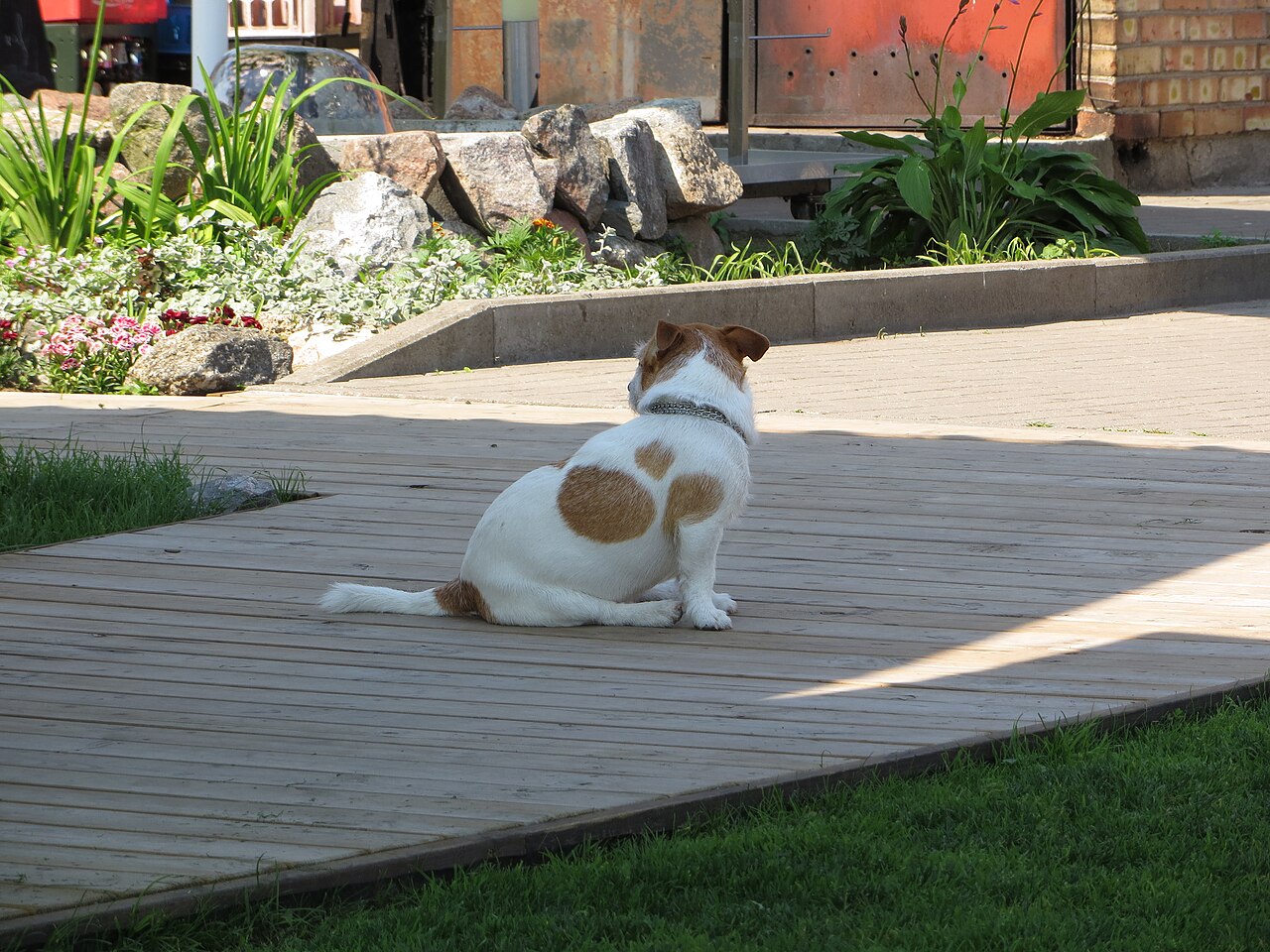
A young dog taking a rest in the shade. Dogs that rest well cycle through sleep stages more predictably. Photograph: Bernt Rostad
Image Credits: Wikimedia Commons / Bernt Rostad
FAQ
Do dogs really dream?
Research strongly indicates they do. Stanley Coren's brain-wave studies found that dog brain waves during sleep show the same patterns and stages as humans, including REM and non-REM sleep.
MIT research by Matthew Wilson and Kenway Louie showed animals replaying the day's experiences during REM. What we've basically found, in the words of researchers who study canine sleep, is that dogs dream doggy things: the activities of their daily lives.
Why does my puppy twitch so much more than my adult dog?
Two reasons. First, puppies spend more time in REM sleep than adults because their brains are processing more new information.
Second, the pons off-switches that suppress movement during dreams are still developing in young dogs, so more motor signals leak through. The twitching usually decreases as the nervous system matures.
Should I wake my dog if it seems to be having a bad dream?
No. The American Kennel Club advises against waking a dog abruptly from a nightmare, because the dog might bite before it realizes it is not really in distress. If the twitching worries you, say the dog's name softly from a distance and let it wake on its own.
Can dogs have nightmares?
Dogs go through the same sleep phases humans do, including the REM stage when dreams occur. Veterinary behaviorists suggest dogs process familiar activities like playing or chasing in their dreams, and a dreaming dog may whimper or twitch more intensely during some episodes.
There is no way to know exactly what a dog experiences, but the sleep architecture is the same. Read more about why some dogs dream vividly at night.
Is it normal for dogs to bark or whimper in their sleep?
Yes. Soft barks, whimpers, and yips are common during REM sleep and come from the same motor leakage that makes the paws paddle. Brief vocalizations during sleep are normal as long as the dog wakes up normally and the movements are loose and short.
The bottom line
A dog paddling its paws in sleep is almost always doing something ordinary: dreaming during REM sleep while its pons lets a few motor signals slip through. The behavior is most common in puppies and seniors, usually lasts seconds, and needs no intervention.
Learn the contrast with seizures, which are rigid, prolonged, and disorienting, and you will know exactly when to relax and when to call the vet. Good sleep routines and calm evenings keep the dreams, and the twitching, at healthy levels.
Latest in Pets
- Why dogs bury their bones and toys
- Do dogs dream, and do they have nightmares?
- Human foods that are dangerous for dogs and cats
- Why babies smile in their sleep
Subscribe for weekly explainers on the science behind everyday mysteries.
Related stories
Why Does My Dog Eat Grass and Vomit?
A UC Davis study of 1,571 owners found grass eating is normal dog behavior, not self-medication: only 10% were ill first. What the science
Why Does My Dog Stare at Me While I Eat?
Dogs stare at you while you eat because it has worked before, and mutual gaze raises bonding hormones. Learn the reinforcement science
Foods toxic to dogs: the list, with reasons
Chocolate, xylitol, grapes, onions: common foods can harm dogs. Learn what makes each one toxic, the warning signs, and what to do if your