
Why Do Dogs Tilt Their Heads When You Talk?
Key takeaways
- No single proven explanation exists. Scientists have published essentially one focused study on canine head tilting, and the rest is informed theory.
- The strongest evidence links the tilt to concentration: gifted word-learner dogs tilt 43 percent of the time versus 2 percent for typical dogs, always in the same direction.
- Older theories about sound localization and getting a better view remain plausible but unproven, so treat them as theories, not facts.

The classic canine head tilt: partway through your sentence, the ears shift and the whole head cocks sideways. Photograph: Reid Campbell/Wikimedia Commons
Image Credits: Wikimedia Commons
Ask your dog if it wants to go to the park and you may get the look: head tipping sideways, ears shifting, eyes locked on your face. It is one of the most beloved behaviors in the animal kingdom, and scientists are still arguing about what it means.
That is worth saying plainly. As Scientific American reported, researchers have published just one study focused specifically on possible reasons for head tilting in dogs.
Everything else is theory. This article explains why dogs tilt their heads when you talk. It covers the sound-localization theory, the better-view theory, what the Gifted Word Learner study found, and what the tilt does not mean.
What the head tilt looks like
The behavior is easy to recognize and oddly specific. The dog turns its head partway to one side, usually while a person is speaking, and holds it there for a beat or two. Many dogs tilt the same direction every time, like a consistent personal habit.
It tends to show up at moments of engagement: a familiar word, an unusual sound, a question the dog half understands. That timing is the clue researchers keep coming back to. Whatever the tilt is for, it appears when the dog is paying attention.
Theory 1: sound localization
The oldest explanation is about hearing. Tilting the head changes the angle of the ears, which changes the tiny time difference between a sound reaching one ear versus the other. The brain uses that difference to work out where a sound is coming from.
Julia Meyers-Manor, an animal cognition researcher at Ripon College who was not involved in the head-tilt study, put it simply in Scientific American: "Humans do it; birds do it; dogs do it. Lots of different species will do this head tilt because that changes the angle that your ears are at, and now the sound is reaching one ear faster than the other."
Dogs' outer ears, the pinnae, are mobile and vary wildly by breed, from pricked to floppy. Psychologist Alexandra Horowitz has hypothesized that dogs tilt to adjust those pinnae and get a better fix on a sound's location, as reported by Labroots.
It is a neat mechanical story, but it remains unproven in dogs specifically.
Theory 2: getting a better view
The second theory is about seeing, not hearing. A dog's muzzle can block part of its view of a human face, especially in long-snouted breeds. Tilting the head shifts the muzzle out of the line of sight.
Psychologist Stanley Coren tested this idea with a pilot survey of more than 500 dog owners, Labroots reported. Owners of brachycephalic dogs, the flat-faced breeds like pugs, said their dogs tilted about 52 percent of the time when spoken to. Owners of longer-muzzled breeds like beagles and greyhounds reported about 71 percent.
That gap is suggestive: dogs whose muzzles block more of their view tilt more. But it is a survey of owner impressions, not a controlled experiment. And 52 percent is still a lot of tilting from dogs with almost no muzzle to work around. Treat it as a clue, not a verdict.
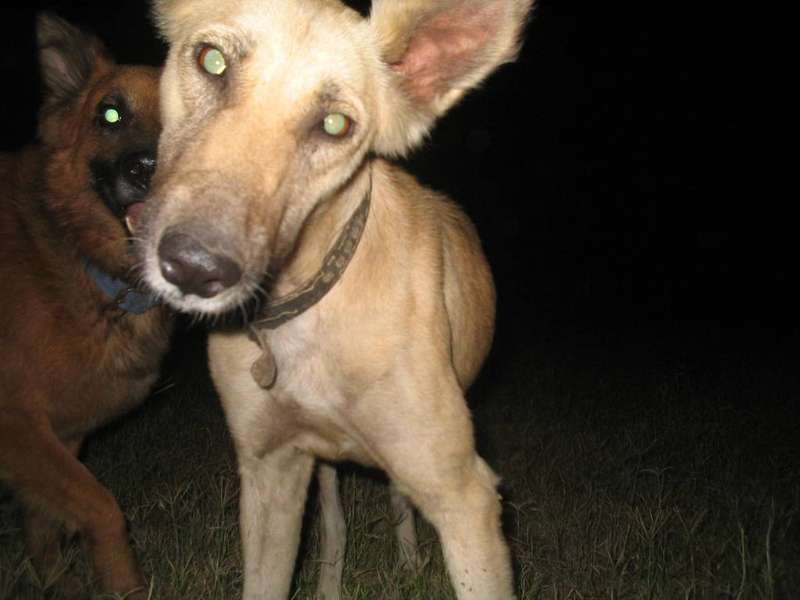
Dogs tilt at unfamiliar sounds as well as familiar voices, which keeps the sound-localization theory in the running. Photograph: Wikimedia Commons contributor/Wikimedia Commons
Image Credits: Wikimedia Commons
Theory 3: concentration and word memory
The strongest evidence points inward, at thinking rather than sensing. In 2021, researchers at Eotvos Lorand University in Hungary published the first research-based evidence connecting head tilting to cognitive processing. It appeared in the journal Animal Cognition.
The team, led by animal cognition researcher Andrea Sommese, studied "Gifted Word Learner" dogs: rare dogs able to learn and correctly retrieve many toys by name. When an owner said a toy's name, the gifted dogs tilted their heads about 43 percent of the time. Typical dogs did it about 2 percent of the time.
The detail that matters most is direction. The gifted dogs tilted in the same direction no matter where the owner was standing, Scientific American reported.
If the tilt were about pinpointing sound, the direction should change with the sound's location. It did not. That suggests the behavior is about processing the word and matching it to a mental image of the object.
Sommese drew the human parallel directly: "In humans, when you remember a story or something, you tilt your head to the side, and you have this mental image of something in your mind. Probably it's the same for dogs."
A 2025 study added a social layer. Researchers had 103 dog owners film their pets under four conditions: resting, silent eye contact, neutral unfamiliar speech, and familiar words delivered with warmth.
The head tilt appeared far more often in that last condition than any other, Popular Science reported. The dogs were not just reacting to noise. They were responding to the sense that someone was talking to them.
Direction may carry meaning too. Most dogs in the 2025 study leaned right.
Since the brain processes sensory input contralaterally, a rightward tilt may engage the left hemisphere, where familiar-word processing happens in dogs as well as humans. MRI work from the same research group showed dogs activating the left hemisphere for familiar words regardless of tone, though the researchers stress this is still hypothesis, not proof.
What the head tilt doesn't mean
The tilt is not a trick your dog performs for treats, though dogs absolutely learn that tilting gets a reaction. It is not a sign of confusion in the human sense, and it is certainly not evidence that your dog understands sentences.
What it seems to signal is attention plus effort: the dog has registered something meaningful and is working on it. The gifted-dog results suggest the harder the mental work of matching a word to a memory, the more likely the tilt. Your average dog may simply be doing a lighter version of the same thing when you ask about the park.
One honest caveat: a sudden, constant, or one-sided head tilt that is new for your dog is a different matter from the conversational tilt described here. Anything persistent or paired with other symptoms is worth a vet visit. The cute tilt is occasional and social. A medical tilt does not switch off.
Frequently asked questions
Do all dogs tilt their heads?
Most do at least sometimes, but frequency varies. Coren's owner survey found longer-muzzled breeds tilt more often than flat-faced breeds. The gifted-dog study found dramatic individual differences tied to word-learning ability.
Does the direction of the tilt mean anything?
Possibly. Individual dogs tend to tilt the same direction consistently, and most dogs in the 2025 study leaned right. That may reflect left-hemisphere engagement for processing familiar words. Researchers call this a hypothesis, not a conclusion.
Does head tilting mean my dog understands what I'm saying?
Not sentences, but likely familiar words. The gifted-dog research links tilting to matching heard words with stored memories of objects. Brain imaging shows dogs process familiar words in the left hemisphere. Attention and partial understanding, yes. Comprehension of grammar, no.
Why does my dog tilt its head at sounds that aren't my voice?
Unfamiliar or interesting sounds trigger the same behavior. That is why the sound-localization theory survives alongside the concentration theory. A novel noise is exactly the kind of thing worth locating and thinking about.
The bottom line
The head tilt is probably your dog thinking out loud, or as close as dogs get. The best evidence says the tilt accompanies concentration: matching a familiar word to a memory, with the ears' angle possibly helping the sound arrive cleanly at the same time.
Science has one focused study and several good theories, so hold the localization and better-view explanations lightly. What is not in doubt is the moment itself: your dog heard something that mattered, and for a second or two, gave it their full attention.
Tags: dogs, dog behavior, animal cognition, pets
Rive News is the research desk behind Rive News's explainers, covering travel, food, fitness, parenting and pets with sourced, plain-English guides.
Latest in Pets
- What Size Backpack Fits Under an Airplane Seat?
- Why Does Bread Go Hard but Crackers Go Soft When Stale?
- Why Does Going Downstairs Hurt Knees More Than Going Up?
- What Is the 4-Month Sleep Regression, and Why Does It Happen?
Subscribe for one practical explainer in your inbox every morning.
Corrections: spotted an error? Email the desk and we will fix it promptly and note the change.
Copyright 2026 Rive News. All rights reserved. Content is for general information only and is not professional advice.
Related stories

Why Does My Dog Eat Grass and Vomit?
A UC Davis study of 1,571 owners found grass eating is normal dog behavior, not self-medication: only 10% were ill first. What the science

Why Does My Dog Stare at Me While I Eat?
Dogs stare at you while you eat because it has worked before, and mutual gaze raises bonding hormones. Learn the reinforcement science

Foods toxic to dogs: the list, with reasons
Chocolate, xylitol, grapes, onions: common foods can harm dogs. Learn what makes each one toxic, the warning signs, and what to do if your