
Why Does Bread Go Hard but Crackers Go Soft When Stale?
Key takeaways
- Bread is roughly 40 percent water and crackers only 3 to 5 percent. The same kitchen air dries one out and dampens the other as moisture moves toward balance.
- Bread's real staling engine is starch retrogradation: its baked starch slowly re-crystallizes and stiffens the crumb. That is why even sealed bread firms up.
- Crackers go limp because their sugars pull water from the air. Bread goes hard because it is wet enough to lose water to it.
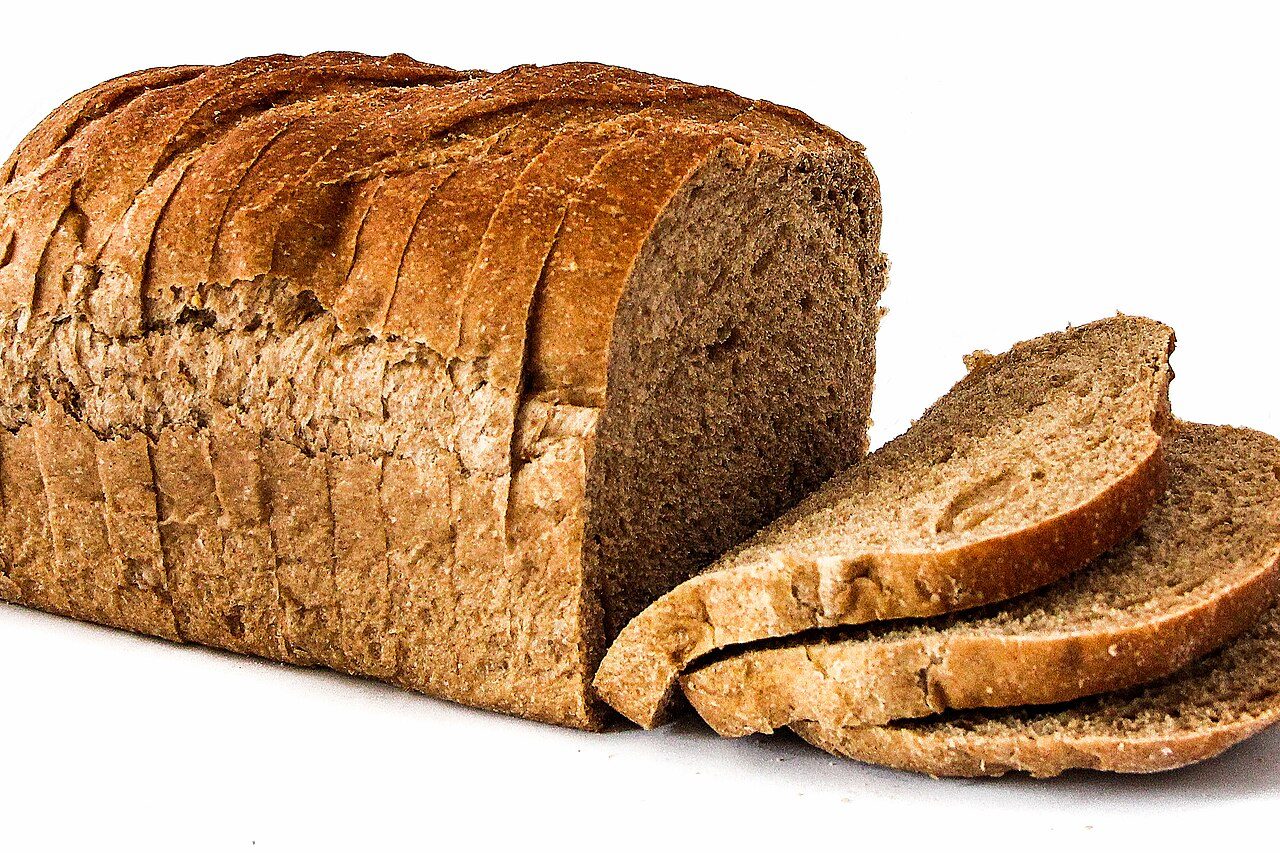
A fresh loaf is soft because its starch is swollen with water; within a day or two that starch begins to re-crystallize. Photograph: FranHogan/Wikimedia Commons
Image Credits: Wikimedia Commons
Bread left on the counter turns into a brick. Crackers left in the same air turn into a soggy mess. It feels like the two foods are breaking the same rule in opposite directions.
They are not. Both follow one rule about water, plus a second rule about starch that only bread has to obey. This article explains why bread goes hard and crackers go soft as they stale. It covers how water moves toward balance, the starch process behind hard bread, why dry snacks absorb moisture, and how to store each one.
What staleness really means
Staleness is not one process. Food scientists split it into "crust staling" and "crumb staling," as Popular Science laid out in a 2015 report on the science of staleness.
Crust staling is the outside of a loaf going from crisp to soft. Crumb staling is the inside going hard.
Chips and crackers are, in that framework, all crust. A potato chip left out absorbs moisture from the air and completely softens, because there is no moist interior to harden. Bread does both at once: its crust softens by stealing moisture from its own crumb, while the crumb firms up underneath.
That split explains why a stale baguette feels doubly wrong. The crackly exterior has gone leathery and the interior has gone dense. Both changes come from the same water moving around inside the loaf.
Water moves toward balance
Here is the one rule that governs everything in this story: water moves from wetter to drier until it reaches balance with its surroundings. Bread and crackers start on opposite sides of that balance, so they move in opposite directions.
Fresh bread is roughly 40 percent water. Crackers sit near 3 to 5 percent, according to a science explainer's breakdown of the food-science literature. Your kitchen air sits somewhere between those two extremes.
So bread, being wetter than the air, loses moisture to it. Crackers, being drier than the air, drink moisture in.
This is also why packaging works the way it does. A Moment of Science, the Indiana Public Media program, notes that bread comes sealed in a plastic bag specifically to trap its moisture inside. Crunchy cookies come sealed to keep outside moisture out. Each package is fighting the opposite battle.
Why bread turns hard: starch retrogradation
Drying out is only half the bread story. The bigger half is a process called starch retrogradation. It is why a sealed loaf still goes firm.
Starch is made of two molecules, amylose and amylopectin. During baking, once the dough passes about 150 degrees Fahrenheit, the starch granules gelatinize. They swell with water and the crumb turns soft and fluffy, as Tasting Table describes in its breakdown of the chemistry.
Then the loaf cools, and the starch wants to return to its tidy crystalline structure. "Starch granules exude amylose during baking," Bill Atwell, professor of grain science at the University of Minnesota, told Popular Science.
Those released amylose molecules form spiderweb-like strands that attach to the gluten network. As the crumb sheds moisture, the webs stiffen and the bread firms up.
That is why retrogradation, not drying, is considered the main staling mechanism. Biology Insights defines retrogradation as cooked starch molecules gradually reassembling into tightly packed crystalline structures as they cool and sit. It is the same process that firms up day-old rice and leftover potatoes.
The retrogradation story also explains two kitchen facts. Refrigerator temperatures around 4 degrees Celsius speed retrogradation up. That is why bread goes stale faster in the fridge. And gentle reheating temporarily reverses the process. That is why toast or a warmed slice tastes closer to fresh: the heat breaks the crystals apart again, at least until they re-form.
Ingredient choices matter too. Tasting Table notes that enriched breads with extra sugar, eggs, and fat stay soft longer. The fat and sugar help the loaf retain moisture and interfere with the hardening starch.
Why crackers turn soft: moisture absorption
Crackers have no starch-retrogradation drama. They are baked nearly dry, so their problem is the opposite: they sit below the moisture balance of the room and they want to catch up.
Sugar is the accomplice. A Moment of Science explains that hard cookies and crackers typically carry a high concentration of sugar, and sugar is hygroscopic, meaning it attracts water out of its surroundings. The dense texture of the cookie then holds on to whatever moisture arrives.
Bread, by contrast, has less sugar and a more open crumb structure, so it is not very hygroscopic at all. Its water is free to leave by evaporation. Two foods, two moisture budgets, two opposite fates.
Freshness can even be a trick of perception. In a 2004 study, Oxford University researchers had people eat Pringles in a soundproof booth while wearing headphones that amplified their crunching. Subjects rated the chips as fresher when the crunch sounded louder, Popular Science reported. Crispness lives partly in the ears.
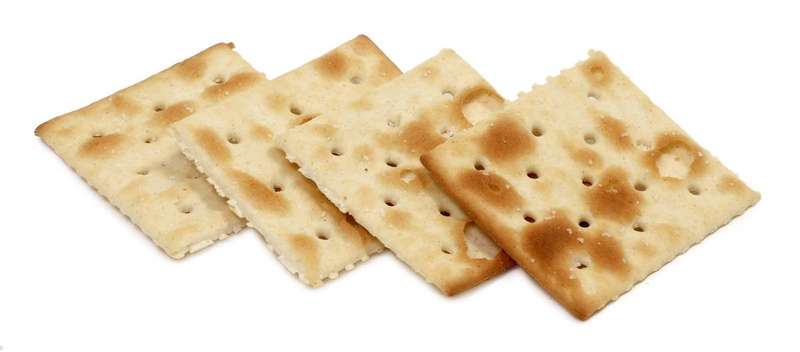
Saltine crackers are baked almost dry, so in humid air their sugars pull moisture in and the snap disappears. Photograph: Evan-Amos/Wikimedia Commons
Image Credits: Wikimedia Commons
How to store bread and crackers
Store each one against its own enemy. Bread's enemies are time and the fridge. Keep bread at room temperature in a sealed bag or bread box for the one to two days it takes to eat it. Freeze anything you will not finish, since freezing nearly stops retrogradation.
Crackers' enemy is humid air. Keep them in their sealed package, squeeze the air out of an opened sleeve, or move them to an airtight jar. A box of crackers that has gone limp is not ruined, either. A few minutes in a hot oven drives the absorbed moisture back out and restores the snap.
Frequently asked questions
Can stale bread be made soft again?
Temporarily, yes. Reheating breaks apart the re-crystallized starch and lets it reabsorb some moisture. That is why toast tastes fresher than a cold stale slice. The effect fades as the starch re-crystallizes again.
Why does bread go stale faster in the fridge?
Fridge temperatures near 4 degrees Celsius accelerate starch retrogradation, the re-crystallization that firms the crumb. Cold storage slows mold but speeds staling. So the fridge is the worst of both worlds for bread you plan to eat soon.
Do sealed crackers still go soft?
Eventually, if the seal is imperfect or the package is opened. An unopened factory seal keeps outside moisture out, which is the whole point of the packaging. Once opened, airtight storage keeps the snap.
Is stale food still safe to eat?
Staleness is a texture change, not spoilage. Hard bread and limp crackers are safe if they show no mold, off smells, or other spoilage signs. When in doubt, throw it out.
The bottom line
Bread goes hard because it starts wet: it loses water to the air and its starch re-crystallizes into a firm structure. Crackers go soft because they start dry: their sugars pull water out of the air until the snap is gone.
Store them accordingly. Keep bread sealed at room temperature and freeze the surplus. Keep crackers sealed against humidity and re-crisp them in a hot oven. Same kitchen, opposite strategies.
Tags: food science, bread, snacks, kitchen tips, storage
Rive News is the research desk behind Rive News's explainers, covering travel, food, fitness, parenting and pets with sourced, plain-English guides.
Latest in Food
- What Size Backpack Fits Under an Airplane Seat?
- Why Does Going Downstairs Hurt Knees More Than Going Up?
- What Is the 4-Month Sleep Regression, and Why Does It Happen?
- Why Do Dogs Tilt Their Heads When You Talk?
Subscribe for one practical explainer in your inbox every morning.
Corrections: spotted an error? Email the desk and we will fix it promptly and note the change.
Copyright 2026 Rive News. All rights reserved. Content is for general information only and is not professional advice.
Related stories

Why Does Bread Go Stale Faster in the Refrigerator?
Bread goes stale faster in the fridge because starch recrystallizes fastest near 4°C. Here is the retrogradation science and the right way

Baking soda and baking powder: what's the difference?
Baking soda is pure sodium bicarbonate; baking powder adds two dry acids for double-acting lift. Learn when to use each, plus exact

What Is the Maillard Reaction in Simple Terms?
The Maillard reaction is the browning chemistry between amino acids and sugars above 140 C that creates the crust, color, and rich flavor