
What Causes the Northern Lights to Appear in the Sky
Key takeaways
- The northern lights start at the Sun, when charged particles travel to Earth and funnel toward the poles.
- Those particles hit oxygen and nitrogen high in the atmosphere, and the gases release the energy as coloured light.
- Strong solar storms push the lights farther from the poles, which is why mid-latitude sightings happen.
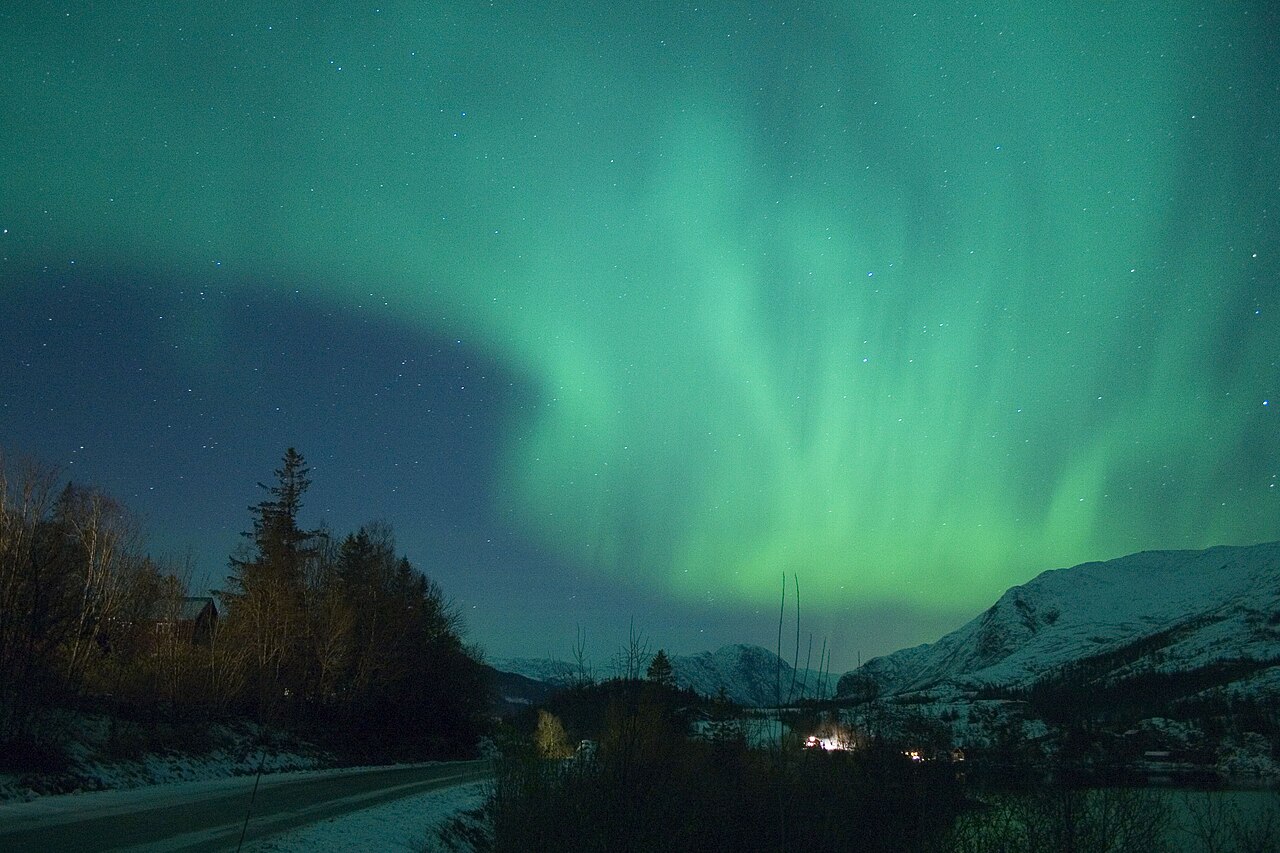
What causes the northern lights to appear? The short answer is the Sun. Charged particles stream away from the Sun, reach Earth, and slide down our magnetic field toward the poles.
There they collide with gases high in the atmosphere. The gases soak up the energy and release it as light, painting curtains of green, red, blue, and purple across the night sky.
The longer answer is a chain of events that starts 150 million kilometers away. This article follows that chain, including the solar wind, coronal mass ejections, Earth's magnetic shield, the colours of the aurora, and the storm scale that tells watchers where the lights may show.
It starts at the Sun
The Sun sends us more than heat and light. It also sends a steady stream of charged particles called the solar wind. These particles race outward in all directions at hundreds of kilometers per second.
Earth sits in their path.
Most of the time the solar wind is a breeze. During solar storms it becomes a gale. The strongest storms involve coronal mass ejections, known as CMEs.
NOAA's NESDIS describes a CME in plain words: "During one kind of solar storm called a coronal mass ejection, the sun burps out a huge bubble of electrified gas that can travel through space at high speeds."
A CME can carry billions of tons of charged gas. When one heads toward Earth, it takes roughly one to three days to arrive. Forecasters at NOAA's Space Weather Prediction Center track these clouds and issue watches when a strong one is on its way.
The Sun also has coronal holes, darker regions where fast solar wind streams out freely. These streams can trigger auroras too, even without a CME. NOAA's National Centers for Environmental Information notes that auroras can be set off by far less energetic events, such as fast solar wind streams from coronal holes.
The Sun runs on an 11-year activity cycle. Near solar maximum, sunspots, flares, and CMEs are more common, and auroras appear more often and farther from the poles. Near solar minimum, the show quiets down.
Earth's magnetic shield funnels the particles
Earth has a magnetic field, generated deep inside the planet. The field stretches into space and forms a bubble called the magnetosphere. It shields us from most of the solar wind, deflecting the particles around Earth like a rock splits a stream.
The shield has weak points near the magnetic poles. Field lines there dive down into the atmosphere instead of running parallel to the surface. Some incoming particles follow those lines down into the upper atmosphere.
That is why auroras ring the polar regions instead of appearing everywhere.
The auroral oval is the ring around each magnetic pole where auroras happen most often. In the north, it passes over northern Canada, Alaska, Greenland, Iceland, northern Scandinavia, and Siberia. In the south, it rings Antarctica and the southern ocean.
When a strong storm arrives, the oval swells and shifts toward the equator. A display that normally sits over northern Canada can then stretch down over the northern United States and mid-latitude Europe. That is how rare sightings from places like California or the Mediterranean happen.
The same process runs at both poles at once. The southern twin of the northern lights is the aurora australis, or southern lights. NOAA notes that any planet with an atmosphere and a magnetic field probably has auroras, and astronomers have seen them on Jupiter and Saturn.
Collisions that make light
High in the atmosphere, 80 to 600 kilometers up, the incoming particles meet thin gases. The main gases are oxygen and nitrogen. The collisions transfer energy to the gas atoms.
When the atoms release that energy, they glow.
NOAA's Space Weather Prediction Center compares the process to a neon light. In a neon tube, electrons flow through gas and collide with neon atoms, which then glow in colour. In the sky, electrons from space flow down Earth's magnetic field and collide with atoms of the upper atmosphere, which then glow in colour.
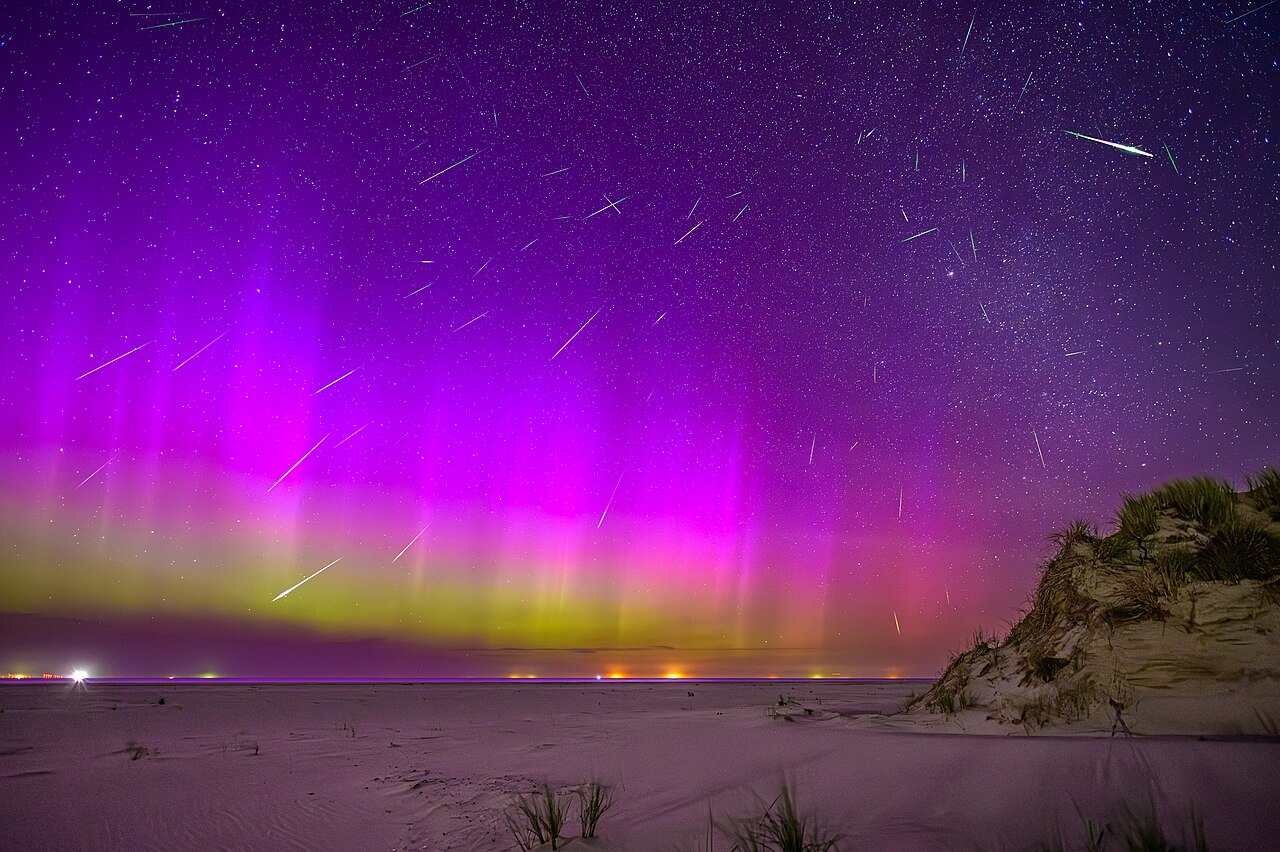
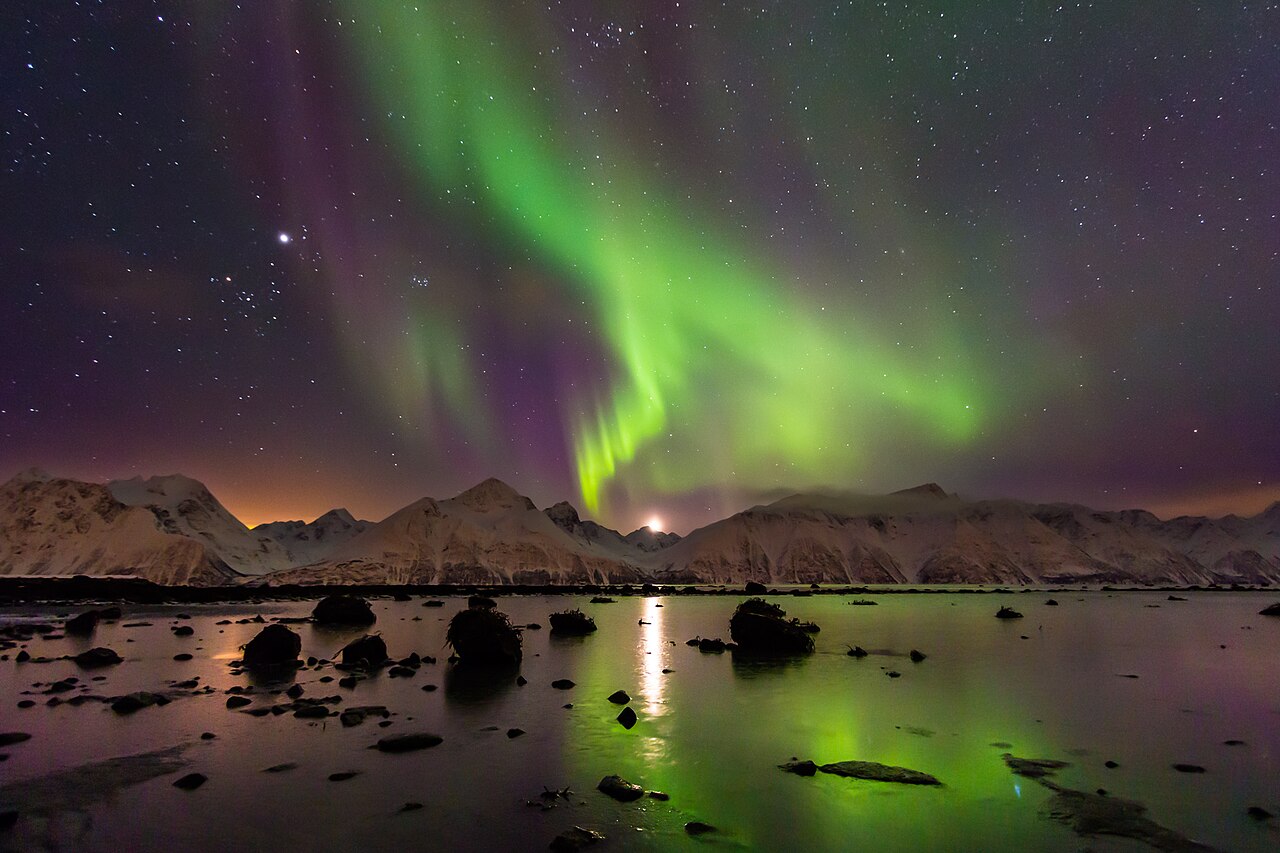
The colour tells you which gas is glowing and how high it sits. Oxygen gives off green light most often, and red light at higher altitudes. Nitrogen glows blue and purple.
A display with green curtains and purple edges shows oxygen and nitrogen glowing at different heights.
The shapes are just as varied as the colours. Auroras can look like quiet arcs, rippling curtains, rays, or spirals. They can pulse, flicker, or sweep across the sky in waves.
The shapes trace the magnetic field lines along which the particles travel.
Auroras are silent. The air up there is too thin to carry sound, and the display happens far overhead. People sometimes report crackling sounds during strong displays, but scientists have not confirmed a direct link.
The storm scale
Not every aurora night is equal. NOAA ranks geomagnetic storms from G1 (minor) to G5 (extreme). Each level brings brighter auroras and a wider viewing area, along with a higher risk of effects on satellites, radio, and power grids.
A G1 storm can brighten the auroral oval and push the lights a little farther from the poles. A G3 storm, classed as strong, can bring visible auroras to mid-latitudes. A G5 storm is rare and can push the lights deep into the tropics.
The Halloween Solar Storms of 2003 gave a vivid example. That G5 event produced aurora sightings from California to Texas to Florida, according to NOAA. People in Australia, central Europe, and even the Mediterranean reported the display.
It remains the benchmark for a modern extreme event.
Storms also carry real risks. NOAA notes that energy from solar storms can damage electrical grids, communications systems, and satellites in Earth orbit. Astronauts on the International Space Station avoid space walks during strong storms.
The GOES-R series of weather satellites watches the Sun for incoming storms and warns of danger.
For watchers, the practical lesson is simple. A G1 or G2 forecast means a good chance near the usual auroral zone. A G3 or stronger forecast means people farther south should check the sky on a clear night.
Why the lights come and go
Auroras are fickle. A display can blaze for an hour, fade to nothing, then return in a fresh wave. Three things decide what you see: solar activity, darkness, and clear skies.
Solar activity sets the ceiling. Without incoming particles, there is no show. Forecasters use the Kp index, a 0 to 9 scale of geomagnetic activity, to describe conditions.
A Kp of 5 or higher usually means storm conditions and wider visibility.
Darkness matters as much as activity. Auroras happen in daylight too, but sunlight washes them out. The best viewing hours run from late evening to early morning, roughly 10 PM to 2 AM local time, when the sky is darkest.
Clear skies decide the rest. Clouds sit far below the aurora, and a single cloud layer hides the whole show. Moonlight also hurts.
A bright full Moon washes out faint auroras, so the darkest nights near new Moon give the best contrast.
The best seats are under the auroral oval in the far north. Alaska, northern Canada, Iceland, northern Norway, Sweden, Finland, and Siberia all offer frequent displays in winter. The long winter nights there give watchers many hours of darkness.
Light pollution is the final enemy. City glow can hide all but the strongest displays. Drive an hour away from town, let your eyes adjust for 20 minutes, and face north.
A camera often catches colours that eyes miss, because a long exposure gathers more light than the eye can.
Names and old stories
The word aurora comes from Latin, and it is the name of the goddess of dawn. Galileo first used the word for the polar lights. Borealis comes from the Latin word for northern.
Australis means southern.
Long before the science, people under the lights told stories about them. Some northern peoples saw spirits, swans, or reflections of distant fires. In parts of Scandinavia, folk tales said the lights were swans or geese.
In some traditions, they were warnings of war or omens of change.
Science replaced the myths without dimming the wonder. The lights are solar particles, magnetic fields, and glowing gases. Knowing the mechanism makes the sight richer, not poorer, because the viewer knows the light left the Sun days earlier and crossed 150 million kilometers to reach the sky overhead.
You can read how another kind of sky physics works in how planes stay in the air and what gravity is in simple words.
Frequently asked questions
Can you see the northern lights from the United States?
Yes, during strong storms. The northern tier of states, from Maine to Washington, sees auroras most often. During G3 or stronger storms, the lights can reach much farther south.
Clear, dark skies away from city lights give the best chance.
What time of night is best for auroras?
Late evening to early morning, roughly 10 PM to 2 AM local time. That window holds the darkest skies. Displays can start earlier or run later, so check forecasts and stay out as long as you can.
Do the northern lights make noise?
Scientists have not confirmed auroral sounds. The display happens in very thin air, 80 kilometers up or more, far too high for sound to reach the ground. Reports of crackling during strong displays remain unverified.
Are auroras dangerous to people on the ground?
No. The particles that make auroras never reach the ground. Earth's magnetic field and atmosphere absorb them high overhead.
The risk falls on power grids, satellites, and radio systems, not on people watching the sky.
What is the difference between the northern and southern lights?
Only the hemisphere. The northern lights are aurora borealis. The southern lights are aurora australis.
The same process creates both, and they often appear at the same time around opposite poles.
The bottom line
The northern lights appear when the Sun's charged particles reach Earth, funnel toward the poles, and strike gases high in the atmosphere. Oxygen glows green and red. Nitrogen glows blue and purple.
Check the storm forecast, find dark skies, face north, and give your eyes time to adjust.
Tags: northern lights, aurora, space weather, astronomy
Latest in Science
- What is gravity in simple words
- How do planes stay in the air
- How trees talk to each other underground
Subscribe for one clear science explainer each week.
Related stories

Why diamond is hard and graphite is soft when both are carbon
Diamond and graphite are both pure carbon, yet diamond is 10 on the Mohs scale and graphite is 1 to 2. The difference is not the atoms;

Why Hot Water Can Freeze Faster Than Cold: The Mpemba Effect Explained
Hot water can freeze faster than cold under specific conditions. The Mpemba effect, named for a 1963 schoolboy experiment, still divides

How Magnets Work at the Atomic Level: Spins, Domains, and Iron
Magnetism comes from electrons: their spin and orbits make each atom a tiny magnet. In iron, quantum forces align these atomic magnets into