
What causes tides to go in and out? The moon's pull explained
By Rive News / Research desk | Rive News / Published October 24, 2026 at 9:00 AM PKT
Key takeaways
- The moon's gravity forms two ocean bulges: one facing it, one on the far side. As Earth spins through both, most coasts get two high and two low tides daily.
- A lunar day lasts 24 hours and 50 minutes, so high tides arrive about 12 hours and 25 minutes apart and shift roughly 50 minutes later each day.
- The sun's pull is less than half the moon's. At new and full moons they combine into higher spring tides; at quarter moons they oppose, making smaller neap tides.
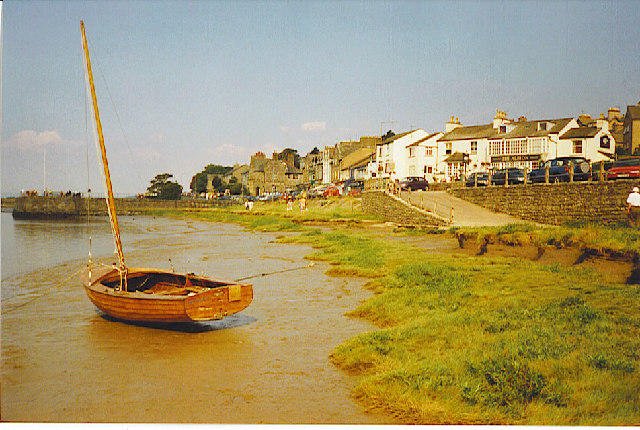
[The shoreline at Arnside beach just after high tide, with wet sand showing how far the water reached.] Photograph: Colin Smith
Image Credits: Wikimedia Commons
Tides are the slow rise and fall of the ocean's surface along a coast. Over a few hours, the water creeps up the beach and covers the rocks, then pulls back again. It happens twice a day in most parts of the world.
That rhythm is not weather, and it is not ordinary waves. Wind makes surface waves and storms push water around, but the steady twice-a-day rise and fall is something else: the largest wave system on Earth, stretching across entire ocean basins. According to NOAA's National Ocean Service, tides are very long waves that move across the oceans, and it is the crest of that wave arriving at a coast that we call high tide, and its trough that we call low tide.
This article explains what causes tides to go in and out, including how the moon's gravity creates the tidal force, why a second bulge forms on the far side of the Earth, how the planet's rotation turns those bulges into a 24-hour-50-minute schedule, and how the sun shifts tides into springs and neaps.
How the moon's gravity stretches the ocean
The short version comes from NOAA's education site SciJinks:
""High and low tides are caused by the moon. The moon's gravitational pull generates something called the tidal force.
The tidal force causes Earth-and its water-to bulge out on the side closest to the moon and the side farthest from the moon. These bulges of water are high tides.""
The tidal force is not plain gravity. It is the difference in the moon's gravity from one side of the Earth to the other.
Gravity weakens with distance, so the moon pulls harder on the near side of the Earth than on the planet's center, and weaker still on the far side. That uneven pull stretches the planet slightly toward the moon.
You can picture it as simple arithmetic. Take the moon's pull on the near side and subtract the pull it exerts on the Earth's center; you are left with a small force pointing toward the moon.
Do the same on the far side and you are left with a small force pointing away from the moon. Those two leftover forces are the two bulges, as NOAA's Jetstream ocean guide explains.
The moon is only about one-hundredth of the Earth's mass, yet it rules the tides. Distance beats mass here.
The moon is close enough that its difference in pull across the Earth outweighs the far heavier but far more distant sun. According to NOAA's Jetstream ocean guide, the moon's tidal pull is over twice as strong as the sun's.
Why a second bulge forms on the far side
The near-side bulge is easy to picture: water pulled toward the moon. The far-side bulge is the part most explanations skip, and it is the key to why tides come twice a day rather than once.
On the far side, the moon's gravity is weakest, and inertia takes over. The water there keeps moving with the swing of the Earth-moon system, which turns around a center of mass offset from the Earth's center toward the moon.
That water resists being pulled back in the opposite direction, and it piles outward into a second bulge. NOAA's National Ocean Service puts it plainly: the bulge on the far side of the Earth is caused by inertia, because the ocean water moving away from the moon resists the gravitational forces that attempt to pull it in the opposite direction.
The result is an ocean shaped, as NOAA describes it, like a football pointing at the moon, with a bulge at each pointed end. The flat sides between the bulges are the zones where the water sits lower. Because the two bulges are nearly equal in size, consecutive high tides at a coast usually reach about the same height, whether the moon is overhead or on the far side of the planet.
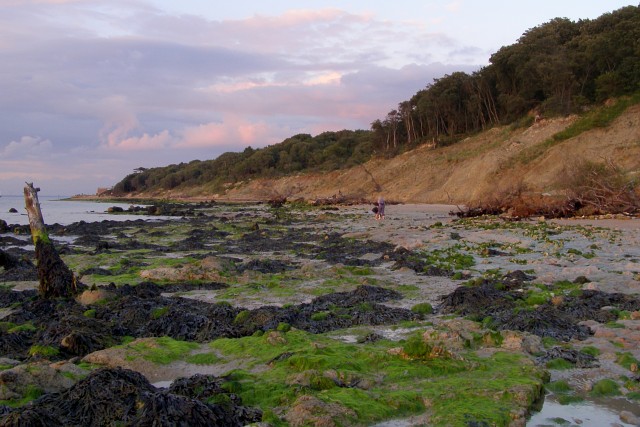
[Exposed beach and tidal flats with the sea withdrawn far from shore at low tide.] Photograph: Jim Champion
Image Credits: Wikimedia Commons
How the spinning Earth turns the bulges into a schedule
The bulges stay roughly lined up with the moon. The Earth turns beneath them. As the planet rotates, your beach moves through one bulge, out the other side into the flat zone, into the second bulge, and out again: two high tides and two low tides per cycle.
That cycle is not 24 hours. The moon orbits the Earth in the same direction the Earth spins, so each day the moon has moved a little ahead along its orbit.
The Earth must spin an extra 50 minutes to catch back up. NOAA's National Ocean Service calls this the lunar day: 24 hours and 50 minutes, the time it takes a point on Earth to return to the same position under the moon.
The numbers that come out of it are exact enough to plan by. Because the Earth rotates through two bulges every lunar day, coastal areas experience two high and two low tides every 24 hours and 50 minutes, with high tides 12 hours and 25 minutes apart. The run from high tide to low tide takes six hours and 12.5 minutes, according to NOAA.
That extra 50 minutes is also why tide times slide later each day. If high tide is at 8:00 in the morning today, expect it around 8:50 tomorrow.
Tide scientists call this lag lunar retardation. It gets more precise: NOAA's Tides & Currents guide notes the moon sweeps about 12.2 degrees along its orbit each day, so a point on the Earth must rotate 372.2 degrees, not just 360, to face the moon again. That extra rotation alone accounts for roughly 48.8 minutes of the daily lag.
A few places break the twice-a-day pattern. Some coasts get one high and one low tide per day, called diurnal tides, and others get mixed tides, where successive highs and lows differ noticeably in height. Coastline shape and seafloor depth change how the bulges move water around, which is why tide tables look different from one harbor to the next, according to NOAA.
The sun's part, and the rhythm of spring and neap tides
The sun pulls on the oceans too, but it is the junior partner. Its tidal pull is less than half the moon's, so the moon still sets the schedule. What the sun changes is the size of the tides, and it does that on a two-week beat.
At new moon and full moon, the sun and moon line up with the Earth, pulling along the same line from the same side or from opposite sides. Their tidal forces add together, and the result is spring tides: higher high tides and lower low tides, with the biggest range between them. These arrive about every 14 days, and the name has nothing to do with the season.
A week later, at first or last quarter, the sun and moon pull at right angles to each other. The moon's high tide lands where the sun's pull is making low water, and the two forces partly cancel out.
The result is neap tides, with a much smaller gap between high and low water. Then the cycle repeats with the next new or full moon.
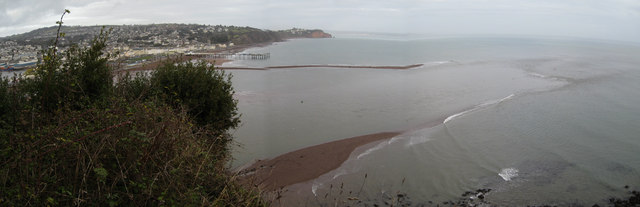
[Teignmouth Harbour entrance at spring low tide, with the harbour channel far emptier than at high water.] Photograph: Colin Vosper
Image Credits: Wikimedia Commons
Frequently asked questions
Why are there two high tides a day instead of one?
Because there are two bulges of water, not one. The moon's gravity raises the bulge on the near side, and inertia raises a second bulge on the far side. The spinning Earth carries your coast through both bulges each lunar day, so you get two high tides, according to NOAA's National Ocean Service.
Why does high tide happen later each day?
The moon moves along its orbit in the same direction the Earth spins, so the Earth needs about 50 extra minutes to catch up to it. That makes the lunar day 24 hours and 50 minutes long, and every tide in the cycle, high or low, shifts about 50 minutes later each day.
Does the sun affect tides too?
Yes, but it is the smaller player. NOAA's Jetstream ocean guide says the moon's tidal pull is over twice the sun's. The sun mostly changes how big tides get: boosting them into spring tides at new and full moons, and damping them into neap tides at the quarter moons.
Do lakes have tides?
Not in any way you could notice. The tidal pull acts everywhere, but it only builds into something visible across an ocean basin, where water can pile into the bulges as the Earth rotates. On a lake, the effect is too small to matter.
Are tides the same everywhere in the world?
No. Most coasts see two nearly equal high and low tides a day, but some places get one tide cycle a day, and others get mixed tides where the two highs or two lows differ in height. Coastline shape and seafloor depth change how the bulges move water, according to NOAA.
The bottom line
The moon's uneven gravity stretches the oceans into two bulges, one raised by pull and one by inertia, while the Earth spins through both on a 24-hour-50-minute clock. The sun's smaller pull then tweaks how tall each tide grows. To see it in action, check the tide predictions for your nearest coast from NOAA Tides & Currents and watch the water arrive about 50 minutes later each day.
Tags: tides, moon, ocean, gravity
Written by the Rive News research desk, which publishes plain-language science explainers checked against primary sources such as NOAA.
Related
- What Is Gravity in Simple Words: A Plain Guide
- Why does the earth have seasons? The 23.5-degree tilt
- Why Does a Balloon Shrink in Cold Air? Charles's Law Explained
Subscribe for one clear, jargon-free science explainer every week.
Rive News standard: every key claim traces to a named source, and nothing is published that cannot be checked.
Related stories
Why diamond is hard and graphite is soft when both are carbon
Diamond and graphite are both pure carbon, yet diamond is 10 on the Mohs scale and graphite is 1 to 2. The difference is not the atoms;

Why Hot Water Can Freeze Faster Than Cold: The Mpemba Effect Explained
Hot water can freeze faster than cold under specific conditions. The Mpemba effect, named for a 1963 schoolboy experiment, still divides
How Magnets Work at the Atomic Level: Spins, Domains, and Iron
Magnetism comes from electrons: their spin and orbits make each atom a tiny magnet. In iron, quantum forces align these atomic magnets into