
Why does the earth have seasons? The 23.5-degree tilt
By Rive News / Research desk | Rive News / Published October 20, 2026 at 9:00 AM PKT
Key takeaways
- Earth has seasons because its rotation axis tilts about 23.5 degrees, so each hemisphere leans toward the sun for half the year and away for the other half.
- Distance from the sun does not cause seasons: Earth is closest to the sun in early January, during the Northern Hemisphere's winter.
- Solstices mark the longest and shortest days, while equinoxes bring nearly equal day and night worldwide.
The seasons feel like they should come from distance. Summer must mean Earth is closer to the sun, and winter must mean it drifted farther away. It is the most natural guess in the world, and it is wrong.
Earth has seasons because the planet spins on a tilted axis while it orbits the sun. That tilt, about 23.5 degrees, aims each hemisphere toward the sun for half the year and away from it for the other half. Everything else about the seasons follows from that single lean.
This article explains why the earth has seasons, including the role of axial tilt, how solstices and equinoxes work, why distance from the sun is not the cause, and what the seasons look like from space.
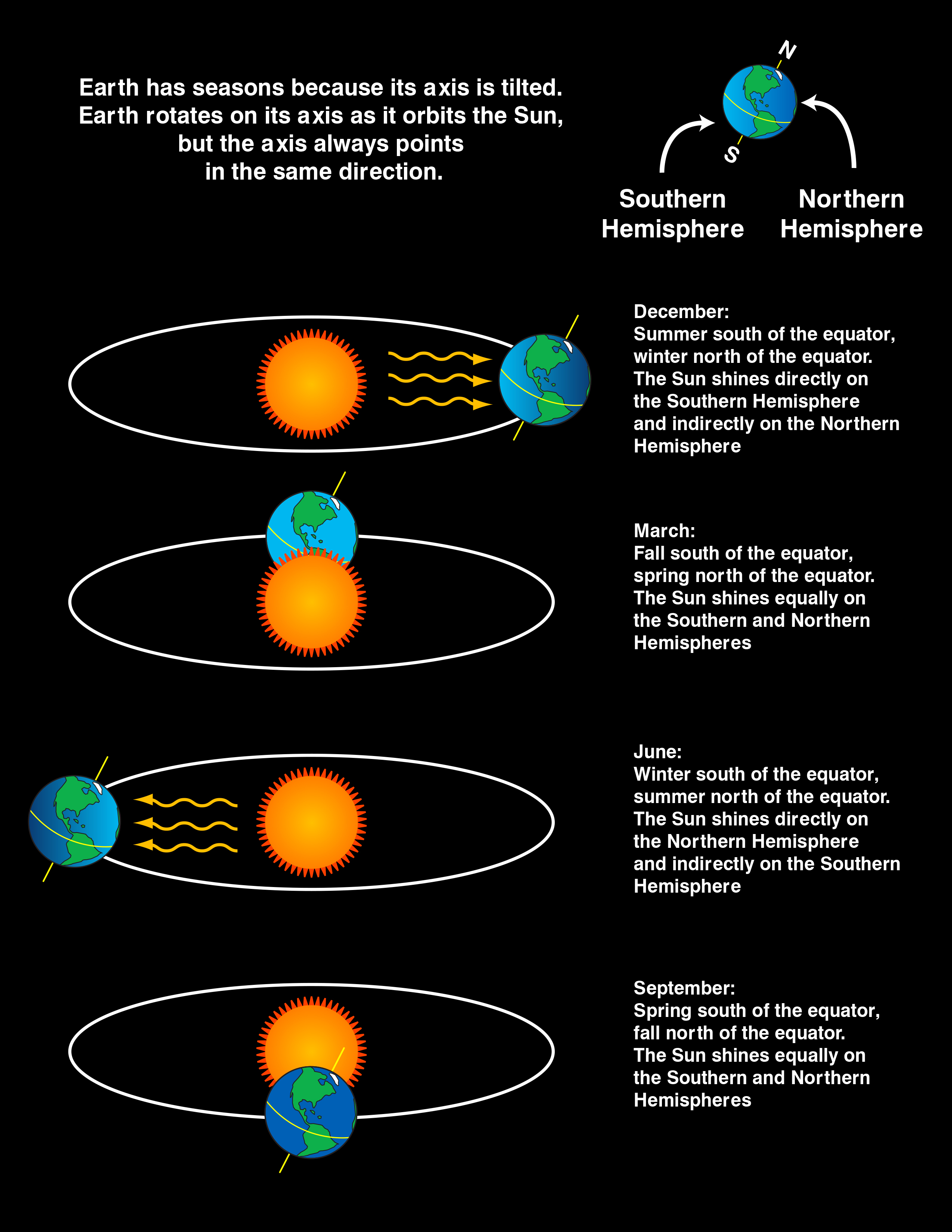
A diagram of Earth's orbit shows how the tilted axis points each hemisphere toward or away from the sun through the year.
Image Credits: Wikimedia Commons
The 23.5-degree tilt drives the seasons
Picture Earth as a spinning top that leans to one side. The lean never straightens and never changes direction as the planet travels around the sun. That fixed lean is the whole story.
Around the June solstice, the Northern Hemisphere leans toward the sun. Sunlight strikes it more directly and the days grow longer, which brings summer and warm weather, according to NASA Science.
Around the December solstice, the Southern Hemisphere gets the same treatment. June means summer north of the equator and winter south of it, and December flips the arrangement.
Two things change with the tilt. First, the angle of sunlight: direct rays concentrate energy on a smaller area and heat it more intensely, while slanted rays spread the same energy thin. Second, day length: the tilted hemisphere gets longer days, so it also gets more total hours of heating.
Where did the tilt come from? NASA Science reports that the 23.5-degree lean is thought to be the scar of an ancient collision.
About 4.5 billion years ago, a Mars-sized body called Theia smashed into the young Earth, knocking the planet sideways in the same cataclysm that formed the moon. Earth never stood back up.
The tilt is not perfectly frozen either. Over a roughly 41,000-year cycle, gravitational tugs from the sun and Jupiter shift the lean between 22.1 and 24.5 degrees.
When the tilt grows, summers get hotter and winters colder; when it shrinks, seasons grow milder. These slow wobbles, called Milankovitch cycles, helped push Earth into and out of past ice ages.
How solstices and equinoxes work
The year's four turning points are just four snapshots of the same tilted orbit.
The June solstice, around June 21, is the Northern Hemisphere's longest day and the Southern Hemisphere's shortest. The December solstice, around December 21, reverses them. Solstice literally means the sun appears to stand still: for a few days it rises and sets at nearly the same points on the horizon before reversing direction.
The equinoxes, around March 21 and September 23, are the midpoints. On those days the boundary between Earth's sunlit and dark halves, called the terminator, runs directly through both poles, according to NASA Science. Both hemispheres receive almost the same sunlight, and day and night are nearly equal in length everywhere.
Equinox also has a neat observable detail: the sun rises due east and sets due west on those two days. The rest of the year, sunrise and sunset drift north or south of those points.
If Earth had no tilt at all, none of this would happen. Every latitude would receive the same solar angle all year, and there would be no seasons, only a permanent gradient from hot equator to cold poles.
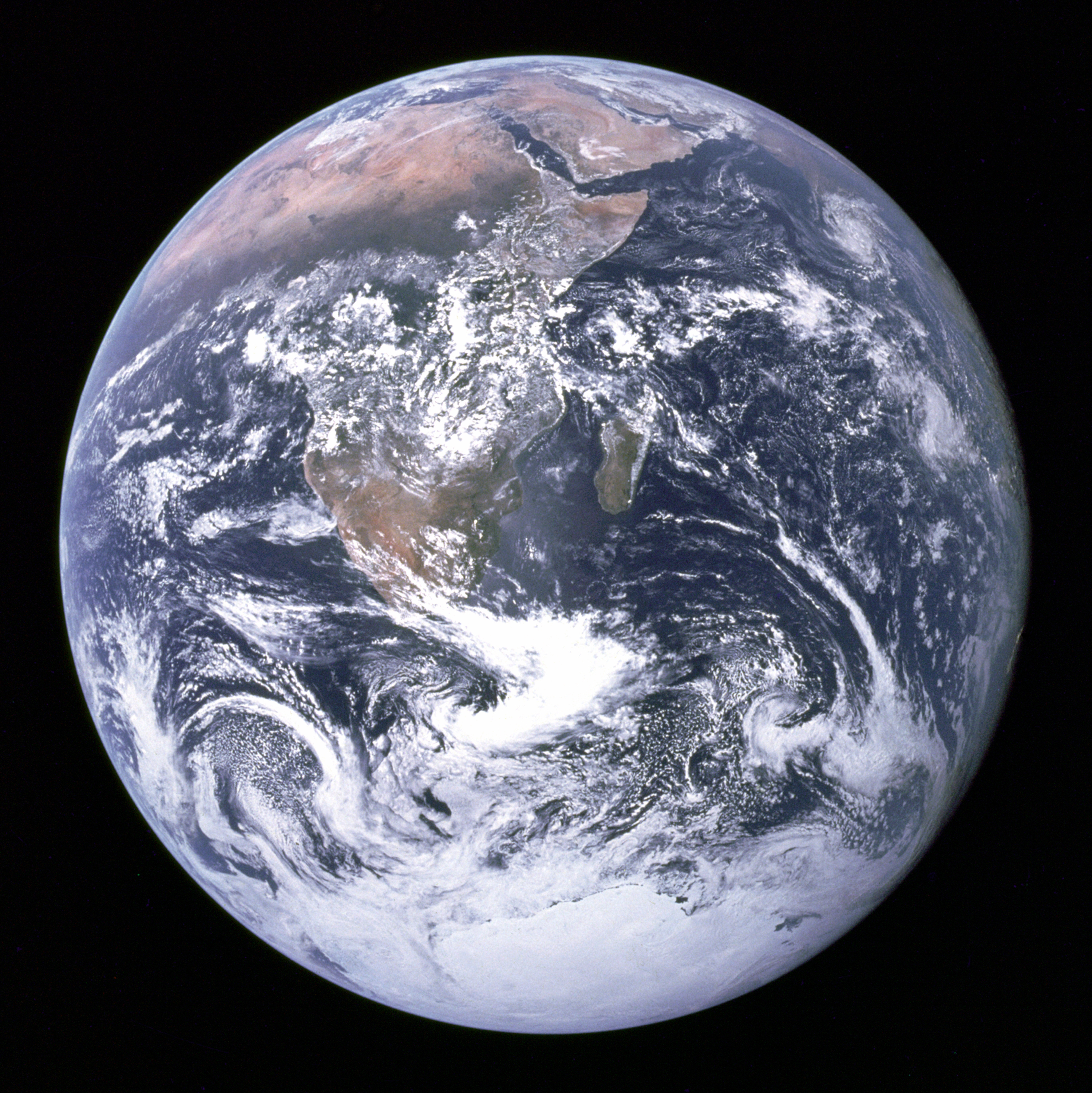
Earth photographed from space, the planet whose 23.5-degree axial tilt produces the seasons.
Image Credits: Wikimedia Commons
Why distance from the sun is not the cause
Here is the fact that breaks the distance theory for good. Earth is actually closest to the sun in early January, in the middle of the Northern Hemisphere's winter, and farthest from the sun in early July, during northern summer.
The orbit is slightly elliptical, so the distance does vary. But the variation is small, and it points the wrong way: if distance drove the seasons, January would be the hottest month in the north. It obviously is not.
The distance idea also cannot explain why the hemispheres have opposite seasons at the same time. When it is July in London, it is winter in Sydney.
Both cities sit at nearly the same distance from the sun on the same day. Only the tilt explains that split: one hemisphere leans sunward while the other leans away.
Distance does matter on much longer timescales. Combined with the wobbling tilt and the slowly changing shape of the orbit, it paces the ice ages. But for the seasons you feel each year, the tilt does the work.
What the seasons look like from space
From far enough away, you can watch the seasons happen. NASA's EPIC camera, aboard the DSCOVR spacecraft, sits about 1.6 million kilometers from Earth, holding position between the sun and our planet. From there it photographs the full sunlit face of Earth every few hours.
Stitched across a year, those images show the apparent position of the continents shifting with the seasons. The shift is an illusion created by the tilt: as each hemisphere leans toward or away from the sun, the lit portion of the globe slides north or south.
The September 2026 NASA Earth Observatory feature used these images to show all four seasonal extremes side by side. In the June frame the Arctic basks in light while Antarctica hides in dark; in December the poles trade places. It is the tilt, visible from a million miles out.
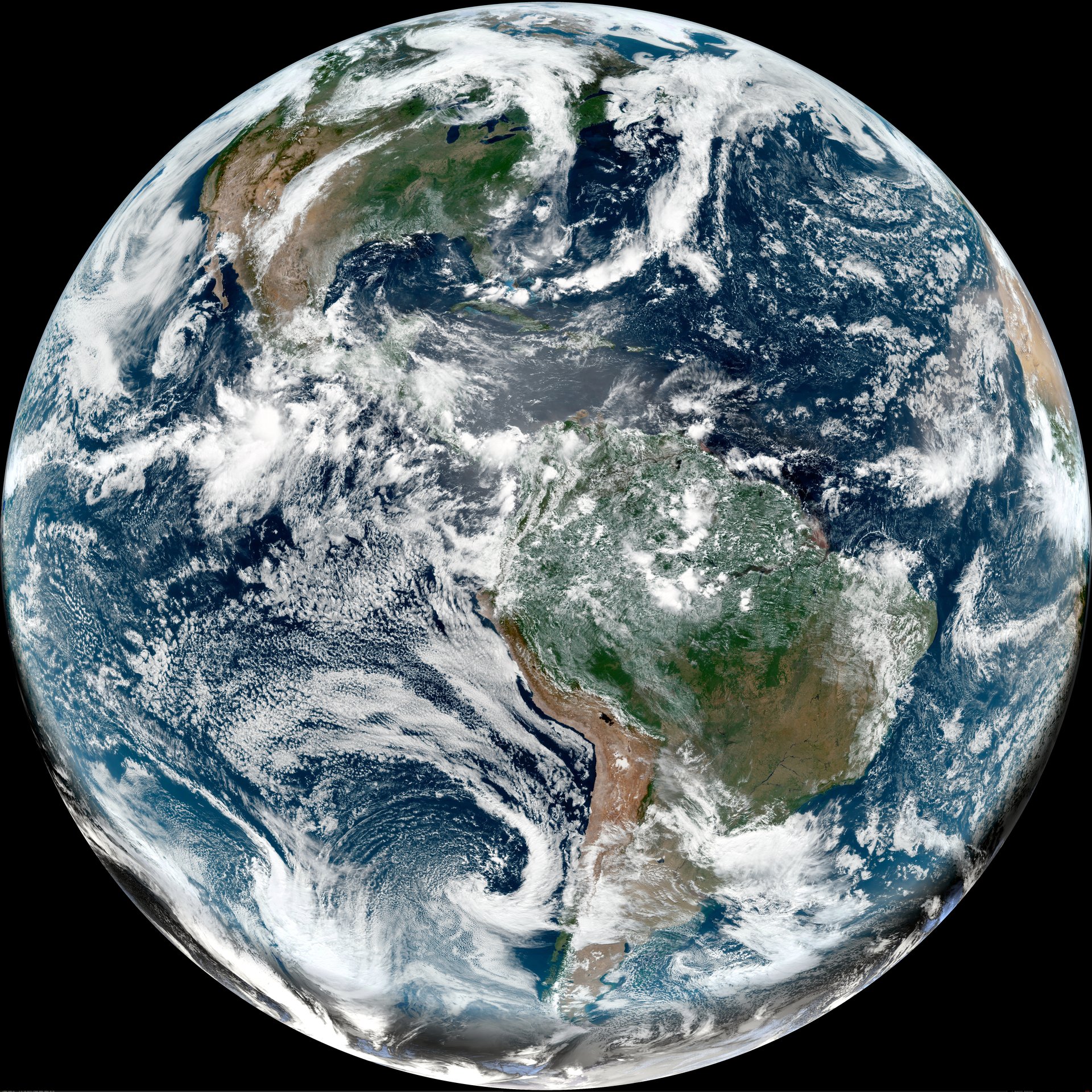
A satellite view near the June solstice shows the Northern Hemisphere tilted toward the sun, the geometry behind northern summer.
Image Credits: Wikimedia Commons
The same geometry explains familiar sky sights. Because the tilt aims the Northern Hemisphere away from the sun in December, the sun rides low and the days shrink, which is also why winter sunsets glow orange low on the horizon. Astronomy and weather turn out to be the same story told at different scales.
Frequently asked questions
If the tilt causes seasons, why is it hot at the equator year-round?
The equator sits in the middle of the lean, so sunlight strikes it nearly head-on all year. The tilt changes the sun's angle dramatically at high latitudes but barely at all near the equator. That is why tropical regions get wet and dry seasons instead of hot and cold ones.
Do other planets have seasons?
Yes, when they are tilted. Mars leans about 25 degrees and has seasons much like Earth's, though each lasts nearly twice as long because the Martian year is longer. Uranus is tipped on its side at 98 degrees, so its seasons are extreme: each pole gets decades of sunlight followed by decades of dark.
Why are the seasons opposite in Australia?
Australia sits in the Southern Hemisphere. In December the south leans toward the sun while the north leans away, so Australians get summer during northern winter. The hemispheres always take turns.
What would happen if Earth had no tilt?
Seasons would vanish. Every latitude would keep the same climate all year, with a permanent hot equator and frozen poles. Day length would stay near 12 hours everywhere, every day.
The bottom line
Seasons come from Earth's 23.5-degree tilt, not its distance from the sun. The lean aims each hemisphere sunward for half the year, changing both the angle of sunlight and the length of days. Next time someone says summer means Earth is closer to the sun, you can tell them January is actually the closest point, and watch the idea click.
Tags: earth science, astronomy, seasons, solar system
Rive News is the research desk behind this publication, covering everyday science and practical explainers with sourced, verifiable facts.
Latest in Science
- Why the sky looks orange at sunset
- Why we see lightning before we hear thunder
- Why the sea is salty but rivers are not
- When the Orionid meteor shower peaks in 2026
Get one practical explainer in your inbox every morning. Subscribe to the Rive News newsletter.
Published by Rive News. Information is for general purposes only.
Related stories

Why diamond is hard and graphite is soft when both are carbon
Diamond and graphite are both pure carbon, yet diamond is 10 on the Mohs scale and graphite is 1 to 2. The difference is not the atoms;

Why Hot Water Can Freeze Faster Than Cold: The Mpemba Effect Explained
Hot water can freeze faster than cold under specific conditions. The Mpemba effect, named for a 1963 schoolboy experiment, still divides
How Magnets Work at the Atomic Level: Spins, Domains, and Iron
Magnetism comes from electrons: their spin and orbits make each atom a tiny magnet. In iron, quantum forces align these atomic magnets into