
Why does the sky look orange at sunset? Rayleigh scattering
By Rive News / Research desk | Rive News / Published October 20, 2026 at 9:00 AM PKT
Key takeaways
- Sunsets look orange because low sunlight travels through much more air, and air molecules scatter the short blue wavelengths out of the beam.
- The effect is called Rayleigh scattering: scattering strength falls with the fourth power of wavelength, so blue scatters far more than red.
- Dust, smoke, and pollution intensify sunset colors, while volcanic eruptions can paint red skies for months.
The sun does not change color at sunset. What changes is the amount of air its light must cross to reach your eyes, and what that air does to the light along the way.
At noon, sunlight drops through the atmosphere on a short, nearly vertical path. At sunset, it skims in sideways through a far thicker slice of air. That longer journey strips the blue out of the beam and leaves the orange behind.
This article explains why the sky looks orange at sunset, including what Rayleigh scattering is, why the daytime sky is blue, how the longer sunset light path changes colors, and what dust and pollution add.
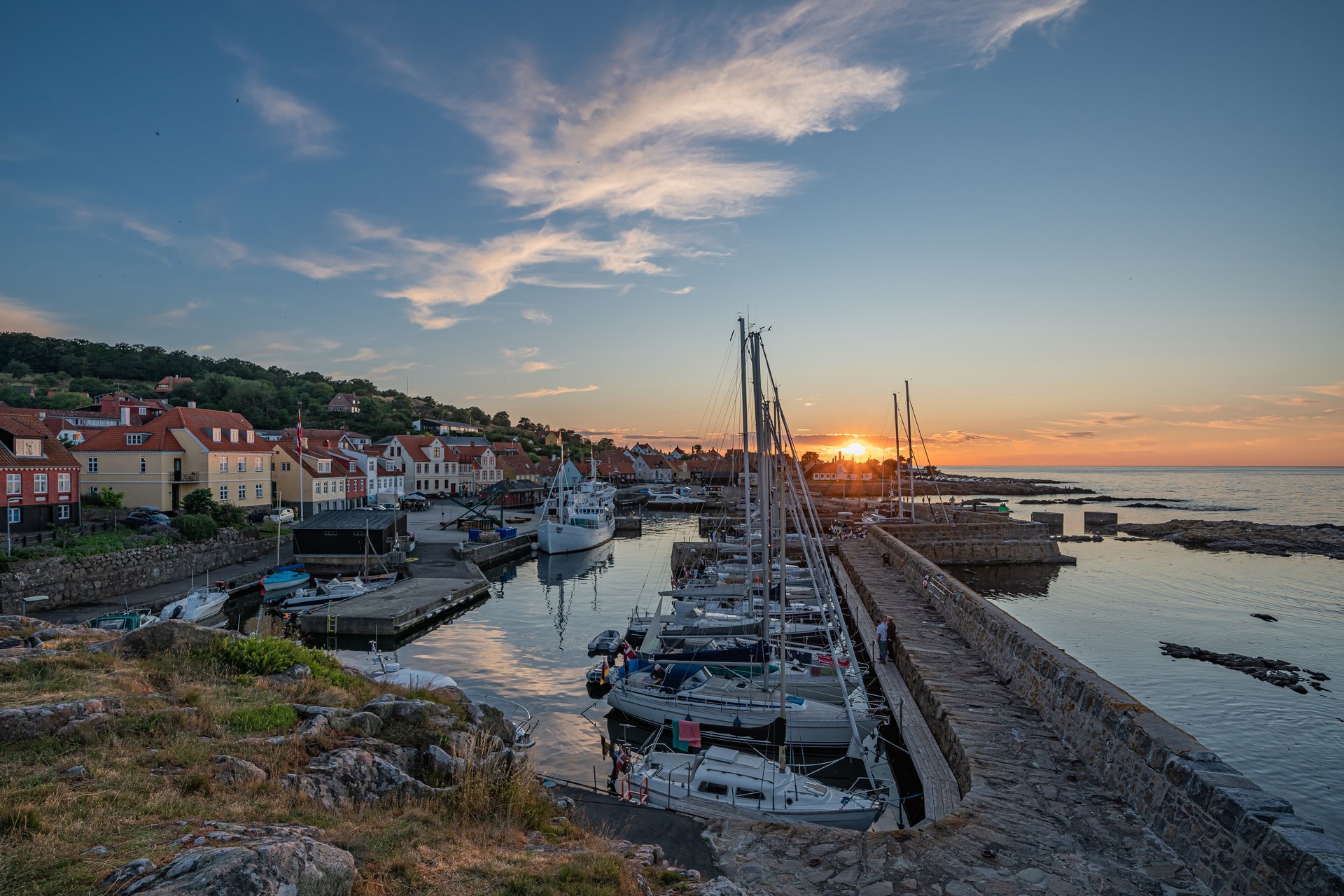
An orange sunset over water, with the sun low enough that its light crosses a long path through the atmosphere.
Image Credits: Wikimedia Commons
What Rayleigh scattering actually is
Sunlight looks white, but it is a mix of colors, each with its own wavelength. When that light meets air molecules, which are far smaller than the wavelengths of visible light, the molecules deflect some of it in all directions. That deflection is Rayleigh scattering.
The key detail is how strongly the scattering depends on color. The amount of scattering is inversely proportional to the fourth power of the wavelength, which means short wavelengths scatter enormously more than long ones. Blue light, around 450 nanometers, scatters more than four times as strongly as red light at 650 nanometers.
The effect is named after the 19th-century British physicist Lord Rayleigh, born John William Strutt, who worked out the mathematics of how small particles scatter light. His name also lives on in optics, acoustics, and statistics.
One clarification helps: the light is not absorbed and lost. It is redirected.
The blue photons still exist; they are just bounced out of the direct beam and scattered across the sky. Where they go decides what color you see.
Why the daytime sky looks blue
At midday the sun sits high and its light takes the shortest possible path through the atmosphere. Along that short trip, air molecules scatter the blue portion of sunlight in every direction.
Your eyes receive that scattered blue light from all over the sky, not just from the direction of the sun. The sky itself becomes a glowing blue dome. Look directly at the sun and you still see white, because the direct beam retains its full mix of colors.
The daytime sky is blue for the same reason sunsets are orange. It is one mechanism seen from two angles: scattered light versus remaining light. This is also why the explanation for why we see lightning before we hear thunder comes down to a similar idea of different travel behavior, though with speed rather than color.
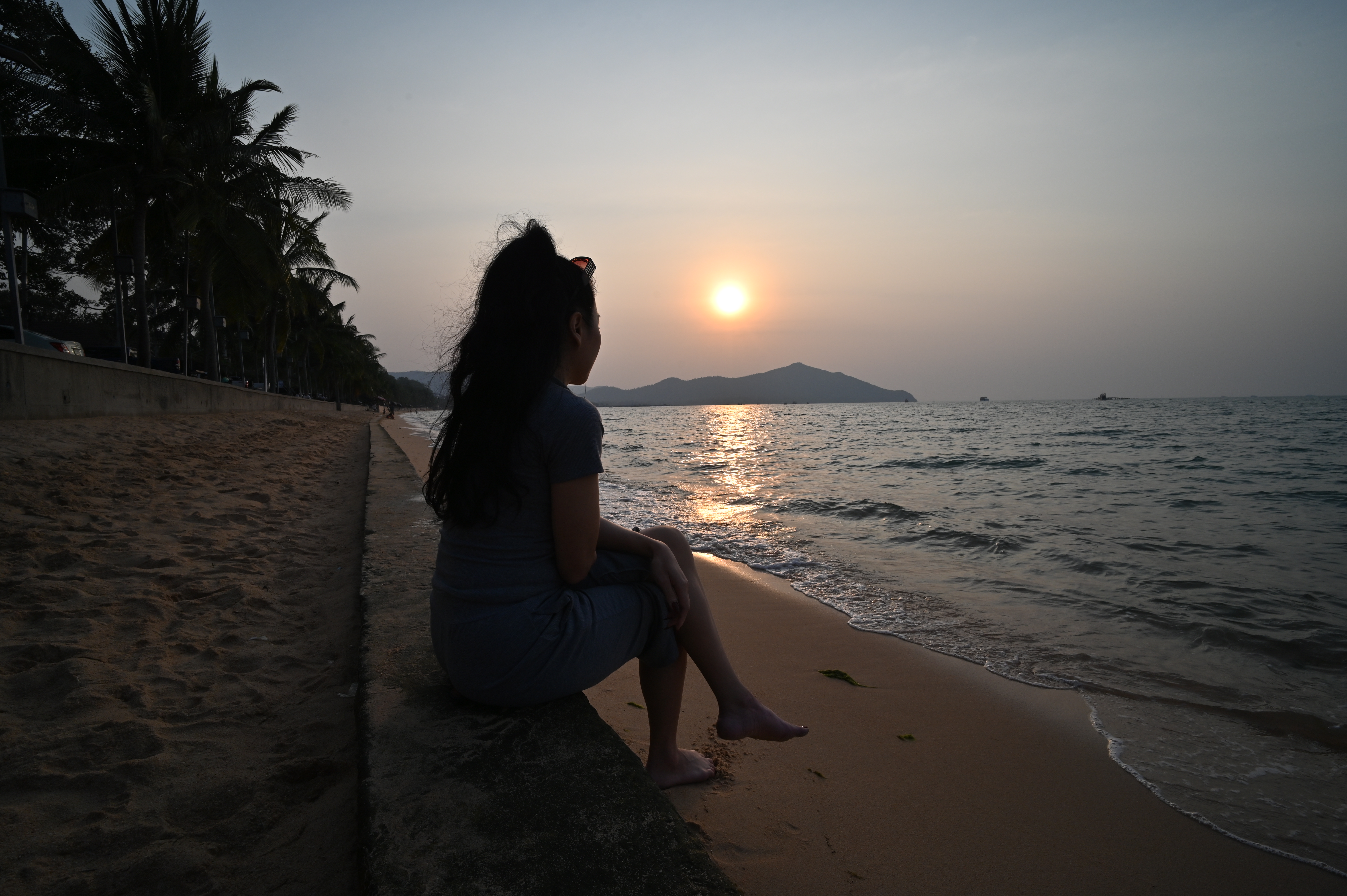
A beachgoer watches the sun sink, when the lengthening light path through the air filters the colors.
Image Credits: Wikimedia Commons
How the long sunset path turns light orange
As the sun sinks, its light must cross far more atmosphere than at noon. Picture the difference between dropping straight through a thin blanket and sliding sideways through the whole mattress.
Along that extended path, the short blue and green wavelengths get scattered out of the direct beam again and again. By the time the light reaches you, most of the blue is gone, bounced away across the sky. What remains in the straight-line beam is dominated by the long wavelengths that scatter least: orange and red.
The exact shade depends on how much scattering happened. On very clear days the sun may look yellow or soft orange near the horizon. With more air in the path and more particles to scatter, the colors deepen into intense red and crimson that can fill large parts of the sky, according to Science Times.
Altitude changes the show. From a mountaintop, with less air above you, sunsets can look sharper and the blue overhead darker. At sea level the thicker air column gives the colors more room to develop.
What dust, pollution, and volcanoes add
Pure air gives beautiful sunsets on its own, but particles supercharge them. Fine aerosols from industry, traffic, and wildfire smoke add more scattering targets, stripping out the short wavelengths even faster and leaving strongly red or orange light behind. Regions with more haze often see the most vivid colors, though with less clarity overall.
Volcanoes are the extreme case. Major eruptions inject huge amounts of fine sulfate particles into the upper atmosphere, where they linger and scatter light across wide areas. Science Times notes these particles can produce spectacular red sunsets for months after an eruption.
Clouds play a different role. Their water droplets are comparable in size to light's wavelength, so they scatter all colors roughly equally, a regime called Mie scattering.
That is why clouds look white at noon. At sunset, those same white clouds sit in the path of the reddened light and reflect it, which is why they blush pink and orange.
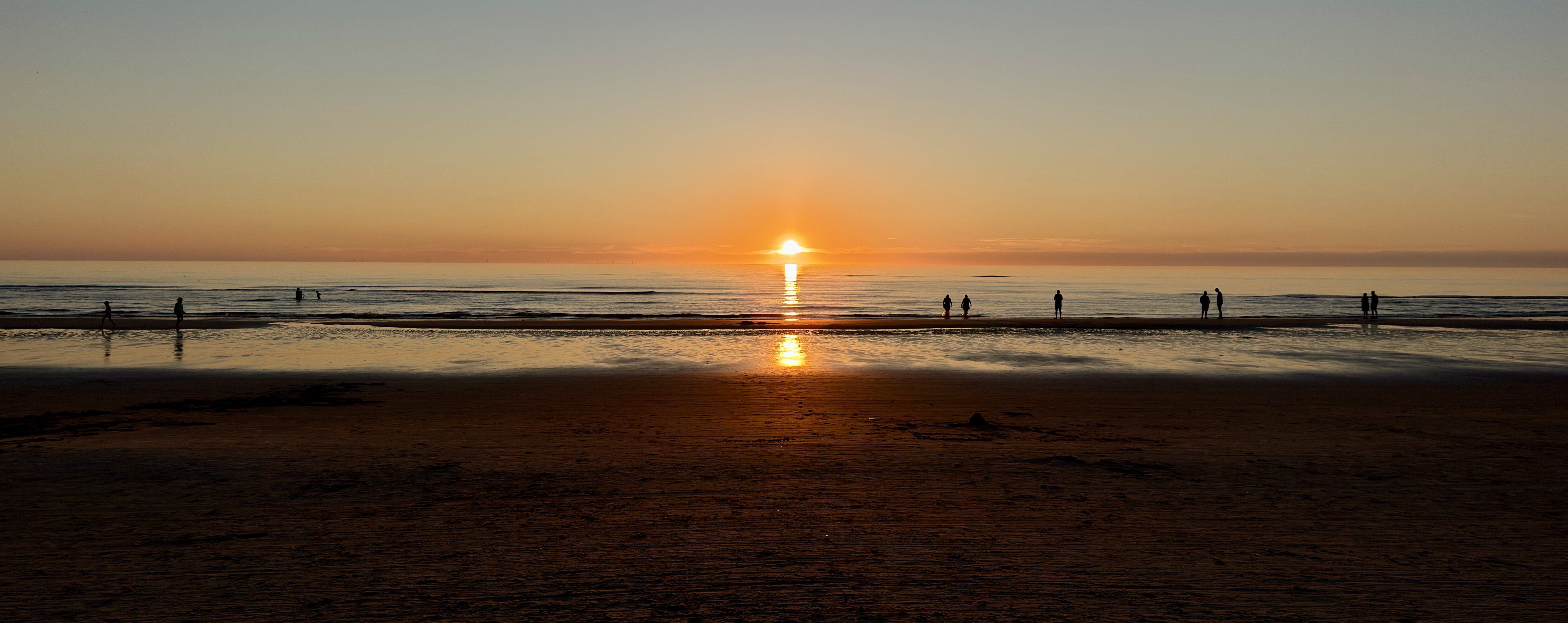
Clouds catch the reddened sunset light over the North Sea, glowing pink and orange against the darkening sky.
Image Credits: Wikimedia Commons
There is a subtle morning-versus-evening difference worth knowing. The physics of sunrise and sunset is identical, but the atmosphere is often more stable in the morning after a cool night, with fewer airborne particles. Sunsets, with a full day of dust and activity kicked up, tend to run more fiery and diffused.
Frequently asked questions
Why is the sky blue during the day?
Air molecules scatter short blue wavelengths in all directions, and your eyes collect that scattered light from across the whole sky. The direct beam from the sun still looks white, since it keeps its full color mix.
Why are some sunsets more colorful than others?
Vibrancy comes down to what is in the air. Clean air gives pure, sharp colors; a little fine haze or high cloud deepens the reds; heavy pollution can mute everything. High-altitude clouds catching the low sun often produce the most dramatic displays.
Is a sunrise scientifically different from a sunset?
No. Rayleigh scattering works the same at both ends of the day. Any difference in appearance comes from atmospheric conditions: mornings tend to be calmer and clearer, while evenings carry more of the day's dust.
Why do clouds turn pink at sunset?
Cloud droplets scatter all wavelengths equally, so they act like white screens. At sunset they are lit by light that has already been reddened by its long atmospheric path, and they reflect those warm colors back to you.
The bottom line
Sunsets are orange because the low sun's light crosses a long stretch of air, and Rayleigh scattering strips the blue wavelengths out of the beam before it reaches you. The leftover reds and oranges are what remain, deepened by dust, smoke, and clouds. Tonight at sunset, look for the gradient: orange at the horizon fading to blue overhead is the scattering gradient made visible.
Tags: atmospheric science, physics, sunsets, earth science
Rive News is the research desk behind this publication, covering everyday science and practical explainers with sourced, verifiable facts.
Latest in Science
- Why the earth has seasons
- Why we see lightning before we hear thunder
- Why the sea is salty but rivers are not
- When the Orionid meteor shower peaks in 2026
Get one practical explainer in your inbox every morning. Subscribe to the Rive News newsletter.
Published by Rive News. Information is for general purposes only.
Related stories
Why diamond is hard and graphite is soft when both are carbon
Diamond and graphite are both pure carbon, yet diamond is 10 on the Mohs scale and graphite is 1 to 2. The difference is not the atoms;

Why Hot Water Can Freeze Faster Than Cold: The Mpemba Effect Explained
Hot water can freeze faster than cold under specific conditions. The Mpemba effect, named for a 1963 schoolboy experiment, still divides

How Magnets Work at the Atomic Level: Spins, Domains, and Iron
Magnetism comes from electrons: their spin and orbits make each atom a tiny magnet. In iron, quantum forces align these atomic magnets into