
China's secret space plane caught on camera: clearest photo yet
Web StoryWatch this story in 15 seconds →Key takeaways
- The US Defense Intelligence Agency published the clearest public photo of China's secret reusable space plane on October 26, 2026.
- A commercial Maxar satellite took the photo in 2024. It shows the Shenlong craft from below, with solar panels out and an open payload bay.
- China has flown the uncrewed space plane on four orbital missions since 2020. The latest began in February 2026 and is still in space.
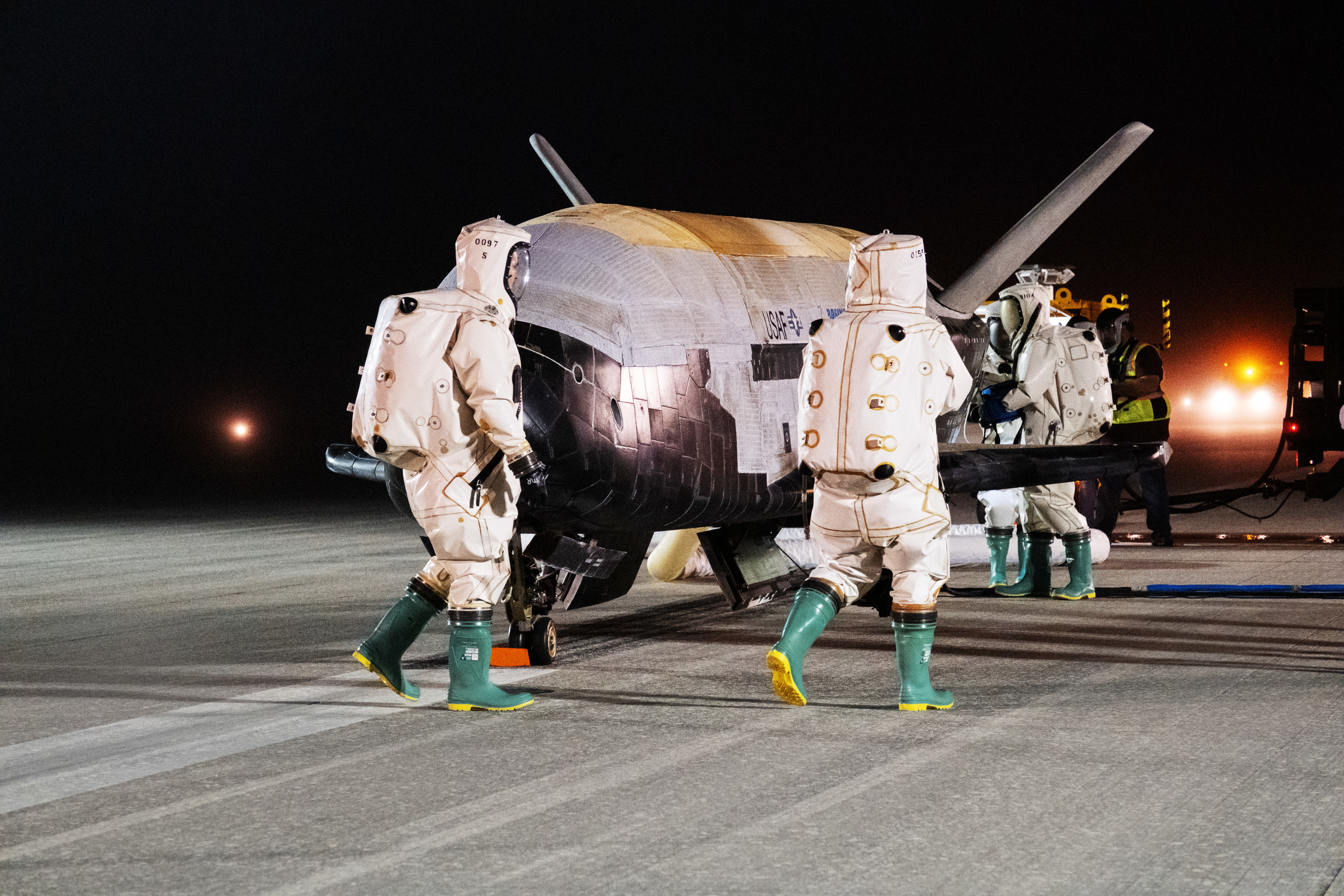
The United States has published the clearest public photo of China's secret space plane. The Defense Intelligence Agency released it on October 26, 2026. A commercial Maxar satellite took the photo in 2024.
What happened
The photo sits on page 53 of the DIA report. The report is called "Challenges to Security in Space 2026". This is its third edition, after versions in 2019 and 2022. It covers what the US knows through July 2026.
The image shows the underside of a small winged spacecraft in orbit. A service module is attached to its rear. Solar panels spread out from that module, and the payload bay doors hang open.
The report's caption is dry. It calls the object an unnamed Chinese "spaceplane". Analysts say it is almost certainly Shenlong, China's reusable test craft.
The DIA itself lists two Chinese models, Shenlong and Tengyun. It does not say which one the photo shows.
This is not the first time the photo has surfaced. A blurrier version appeared in 2024. US Space Force Colonel John Patrick showed it at a space forum in South Korea. At the time nobody confirmed what the object was.
The DIA has now settled it. The agency calls the craft a "PRC Spaceplane". It offered a plain-language reason for its interest.
> "A key capability for reusable space activities are spaceplanes like this PRC Spaceplane captured by Maxar. Spaceplanes can launch into orbit to place objects in space or even test them and return to earth," the report says.
The craft in the photo
The vehicle looks like a small shuttle. It has short wings and twin vertical tails. Analysts note its wings are longer than those on the US X-37B.
Two bumps on its belly look like covers for landing gear wheels. The solar panels stand out most.
Most spacecraft mount panels on top. This one deploys them from the rear service module instead.
The module gives power and thrust in orbit. It breaks away before the plane returns to Earth. The photo likely dates to the craft's third mission.
That flight launched in December 2023 and ended in September 2024. The camera caught it sometime in between. The exact date has not been shared.
Before this release, the public had little to go on. Observers relied on grainy telescope photos and computer drawings. That is a big gap for a program that began flying in 2020.
Four missions so far
China has flown the reusable craft four times. Every flight used a Long March 2F rocket from Jiuquan in the Gobi Desert.
The first flight lasted only two days in September 2020. The second began in August 2022 and stayed up for 276 days. During that flight it moved close to a companion satellite.
At one point the two objects sat within 100 meters of each other. The DIA says the plane appeared to "maneuver with a companion satellite and conduct station-keeping at around 1 km separation."
The third flight ran from December 14, 2023 to September 6, 2024. That is 268 days. The DIA says the craft "released and interacted with an object" again.
The fourth mission began on February 7, 2026. The vehicle is still in orbit. Tracker Jonathan McDowell studied its path and found fresh moves.
The craft released an object, caught up with it in September, and recaptured it. China keeps its official line simple. State media calls the vehicle an experimental reusable spacecraft.
It says the tests support the "peaceful use of outer space". Past missions have landed at a military airfield near Lop Nur in Xinjiang. The runway there runs about 16,400 feet.
Why it matters
A space plane is more than a satellite with wings. It can place objects in orbit, test them up close, and bring them home.
That makes it useful for repairs, inspections, and research. The same moves look different to rival militaries. Flying within 100 meters of another satellite takes real skill.
It can serve peaceful jobs like servicing. It can also serve jamming or interference.
Nothing in the photo proves weapons. The DIA report offers no evidence of offensive payloads.
The release lands amid a wider race. America flies its own secret space plane, the Boeing X-37B. It has flown eight missions since 2010.
Its current flight is the eighth, which launched on August 22, 2025. The plane is over 29 feet long, with a 15-foot wingspan. It travels at about 17,426 miles per hour in orbit.
The DIA report also tracks China's wider growth. It says China's spy-satellite fleet has passed 510 satellites. That number has more than tripled since 2018.
The agency lists Chinese tools for jamming, cyber attacks, and weapons that can act near other spacecraft. Close approaches in orbit are becoming normal.
A Russian satellite approaches a US satellite story earlier this month showed the same pattern. Space is crowded, and everyone is watching everyone else.
What happens next
The fourth mission is still flying. Trackers will watch for its return. Past flights ended at the Lop Nur airfield.
Its appearance on that runway will confirm the mission's end. More declassified images may follow. The DIA report is unclassified and public.
Each edition tends to reveal a little more than the last. Even routine space traffic now shares orbit with military hardware.
SpaceX cargo launches to the space station fly through the same crowded zone. That mix of science, commerce, and defense is the new normal.
Expect more countries to publish photos like this one. In orbit, secrecy has an expiration date.
Related stories

Why diamond is hard and graphite is soft when both are carbon
Diamond and graphite are both pure carbon, yet diamond is 10 on the Mohs scale and graphite is 1 to 2. The difference is not the atoms;

Why Hot Water Can Freeze Faster Than Cold: The Mpemba Effect Explained
Hot water can freeze faster than cold under specific conditions. The Mpemba effect, named for a 1963 schoolboy experiment, still divides
How Magnets Work at the Atomic Level: Spins, Domains, and Iron
Magnetism comes from electrons: their spin and orbits make each atom a tiny magnet. In iron, quantum forces align these atomic magnets into