
Why Does Helium Make Your Voice Squeaky? Formants Explained
Key takeaways
- Helium shifts your vocal tract's resonant frequencies upward because sound travels about three times faster in helium than in air.
- Your vocal cords vibrate at nearly the same pitch; the squeak comes from changed timbre, not a higher note.
- A heavy gas like sulfur hexafluoride reverses the effect, while inhaling gas from pressurized tanks risks lung injury or oxygen loss.

Inhale helium from a party balloon and your voice turns thin and squeaky, like a cartoon chipmunk. The party trick is famous, and the explanation is more subtle than most people expect. Helium does not tighten your vocal cords or raise your actual pitch.
Instead, it changes the resonant frequencies of the tube of air in your throat and mouth, the part of speech scientists call the vocal tract. This article explains why helium changes your voice, including how vocal formants work, why the underlying pitch barely changes, the sulfur hexafluoride mirror effect, and the safety risks worth knowing.
How vocal formants shape your voice
Your voice is really two things working together. Your vocal folds, two small flaps of tissue in your larynx, vibrate to produce a raw buzzing tone. That vibration sets the fundamental frequency, which is what musicians call pitch.
The sound then travels through your vocal tract: the throat, mouth, and nasal cavities. These hollow spaces resonate, amplifying some frequencies and damping others.
The boosted frequencies are called formants, and they are what make an "ah" sound different from an "ee. ".
Formants depend on the shape and size of the resonant cavity and on the speed of sound in the gas filling it. Change the gas, and you change the resonances, even though your vocal folds are doing exactly the same work. Scientists describe this as the source-filter model of speech production, a framework laid out in foundational work on acoustic phonetics.
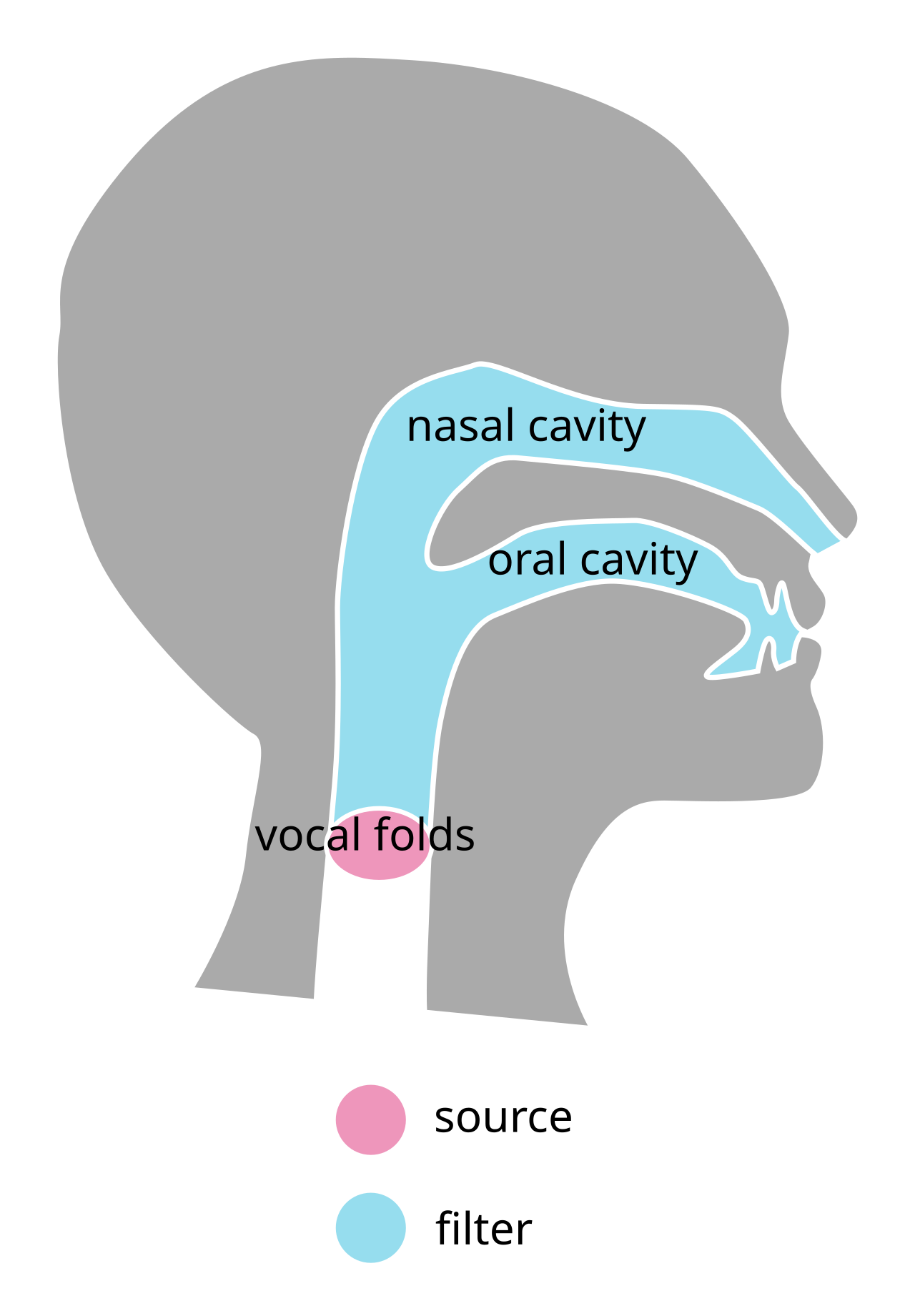
The speed of sound is the key variable here. In ordinary air it is about 343 meters per second at room temperature. In helium it jumps to roughly 965 to 972 meters per second, nearly three times faster, because helium atoms are far lighter than the nitrogen and oxygen molecules they replace.
Physics references such as the UNSW physicists who maintain the well-known "Physics in Speech" resource put it this way: resonant frequencies run several times higher in a helium-filled vocal tract than in one filled with air. As Live Science's Natalie Wolchover summarized their explanation, "There is less power at low frequencies so the sound is thin and squeaky." The high-frequency components of your voice get amplified relative to the low ones, and the overall timbre shifts toward something our ears read as squeaky.
Why the pitch itself barely changes
This is the part almost everyone gets wrong. Helium does not make your vocal folds vibrate faster.
If you sing a specific note on normal air and then sing it again after inhaling helium, it is still the same note, or very close to it. The melody survives; only the tone color changes.
The reason is that pitch comes from the source, and the source is mechanical. Your vocal folds open and close hundreds of times per second, and that rate is set by their tension, mass, and the airflow from your lungs, not by the gas around them. Helium is too light to meaningfully alter that mechanism during a single breath.
What changes is the filter. Because sound races through helium, the wavelengths that fit neatly inside your throat and mouth shift toward higher frequencies.
Your tract starts emphasizing higher harmonics and suppressing lower ones. Our hearing system is tuned to associate that brighter, thinner spectrum with a higher voice, which is why the illusion feels so convincing.
You can hear the truth of this underneath the squeak if you listen carefully. The rhythm of speech stays identical. Intonation patterns stay identical.
Even the base note is still there, just buried under a new set of amplified overtones. Singers and voice coaches sometimes use this fact as a demonstration: the instrument is unchanged, only the room it plays in has been retuned.
A related demonstration makes the point in reverse. If the gas made the vocal cords themselves vibrate faster, every aspect of the voice would shift uniformly.
Instead, vowels change far more than consonants, because vowels depend most on formant structure. The selective change is the fingerprint of a resonance effect, not a pitch effect.
The sulfur hexafluoride mirror effect
If light gases push formants up, heavy gases should push them down. That is exactly what sulfur hexafluoride does. SF6 is roughly five to six times denser than air, and sound creeps through it at only about 134 meters per second.
Breathe a small amount of sulfur hexafluoride and a normal speaking voice drops into a deep, booming growl. The mechanism is identical to the helium case, just running in the opposite direction. The formants slide downward, the low frequencies gain emphasis, and the timbre darkens.

Science communicators have demonstrated the pair side by side for years, often using the same volunteer to show the symmetry. The helium clip gives the chipmunk; the SF6 clip gives something closer to a movie-trailer narrator. The same mouth, the same vocal folds, two different gases, two opposite effects.
Xenon, a noble gas, can produce a similar deepening effect, but it is rare and expensive, so sulfur hexafluoride remains the standard demonstration gas. The comparison matters because it rules out alternative explanations.
If helium somehow irritated the throat into a higher voice, a different gas would not produce the exact mirror image. The clean symmetry is strong evidence that gas density and sound speed are doing all the work.
Safety risks of the balloon trick
Helium feels harmless because it is chemically inert, and a single sip from a party balloon is low risk for most people. The danger is not poisoning.
It is displacement. Every breath of helium is a breath without oxygen, and enough of it can cause dizziness, lightheadedness, or loss of consciousness from oxygen deprivation.
Never inhale helium directly from a pressurized tank. Tank gas is released at high pressure and at very low temperature, and the combination can rupture lung tissue or force gas into the bloodstream. ScienceABC's safety writeup on the phenomenon warns that a concentrated mass of gas entering the blood can lodge in the brain and cause stroke, seizure, or death.
Sulfur hexafluoride carries its own risk. Because it is heavy, it settles in the bottom of the lungs instead of floating out like helium.
A large lungful can sit there blocking oxygen exchange. The same caution applies: small amounts, never from a pressurized source, and stop immediately if you feel lightheaded.
Children deserve extra supervision around this trick. Balloons themselves are a choking hazard, and kids are more likely to take repeated deep breaths from them. A quick demonstration for a curious child is fine; a contest to see who can do the funniest voice the longest is not.
FAQ
Does helium damage your vocal cords?
There is no good evidence that a small amount of helium harms the vocal folds themselves. The documented risks are oxygen deprivation and, with pressurized sources, barotrauma to the lungs. That said, repeated deep inhalations are asking for trouble, and medical sources advise keeping any demonstration brief.
Why do I sound like Donald Duck specifically?
The comparison is apt in an odd way. According to the UNSW physics team, a real duck would have resonances at much higher frequencies than a human even in normal air, simply because its vocal tract is far shorter. Helium makes your longer human tract behave acoustically like a shorter one, pushing your formants toward duck territory.
How long does the squeaky voice last?
Only until the helium leaves your airways, usually well under a minute of normal breathing. Helium is lighter than air and rises out of the lungs on its own. Trying to talk through it does nothing to clear it faster.
Can other light gases do the same thing?
In principle, yes. Any gas lighter than air will raise the speed of sound in the vocal tract and shift formants upward.
In practice, most light gases are flammable, like hydrogen, or toxic, which is why helium dominates the demonstrations. Neon is safe but expensive and harder to obtain in balloons.
The bottom line
Helium makes your voice squeaky by speeding up sound inside your vocal tract, which pushes its resonant frequencies higher and thins out the tone. Your vocal cords keep vibrating at the same pitch underneath the effect. Sulfur hexafluoride shows the same physics in reverse, and both gases deserve respect as asphyxiation hazards when used carelessly.
Tags: physics, acoustics, helium, human voice, science explainer
Latest in Science
- How scientists pinned down the age of the Earth
- Why salt melts the ice on winter roads
- Why we see shimmering mirages on hot roads
- How touchscreens detect your finger
Get one clear science explainer in your inbox every morning. Subscribe for free.
Related stories

Why diamond is hard and graphite is soft when both are carbon
Diamond and graphite are both pure carbon, yet diamond is 10 on the Mohs scale and graphite is 1 to 2. The difference is not the atoms;

Why Hot Water Can Freeze Faster Than Cold: The Mpemba Effect Explained
Hot water can freeze faster than cold under specific conditions. The Mpemba effect, named for a 1963 schoolboy experiment, still divides

How Magnets Work at the Atomic Level: Spins, Domains, and Iron
Magnetism comes from electrons: their spin and orbits make each atom a tiny magnet. In iron, quantum forces align these atomic magnets into