
How plants turn sunlight into sugar, step by step
Key takeaways
- Photosynthesis converts sunlight, water, and carbon dioxide into glucose and oxygen, following the equation 6CO2 + 6H2O + light energy → C6H12O6 + 6O2.
- The work happens in two stages inside chloroplasts: light reactions that capture energy, then the Calvin cycle that builds sugar.
- Chlorophyll absorbs mainly blue and red light and reflects green, which is why plants look green.
A plant cannot walk to a store or order dinner. It makes its own food instead, using nothing but sunlight, air, and water. This process is called photosynthesis, and it is the quiet engine behind almost all life on Earth.
In plain English, photosynthesis is how a plant turns light energy into chemical energy. That chemical energy is stored in sugar, which the plant uses to live and grow.
This article explains how plants turn sunlight into sugar, covering what happens inside the leaf, the two stages of photosynthesis, and why it matters for everything else.
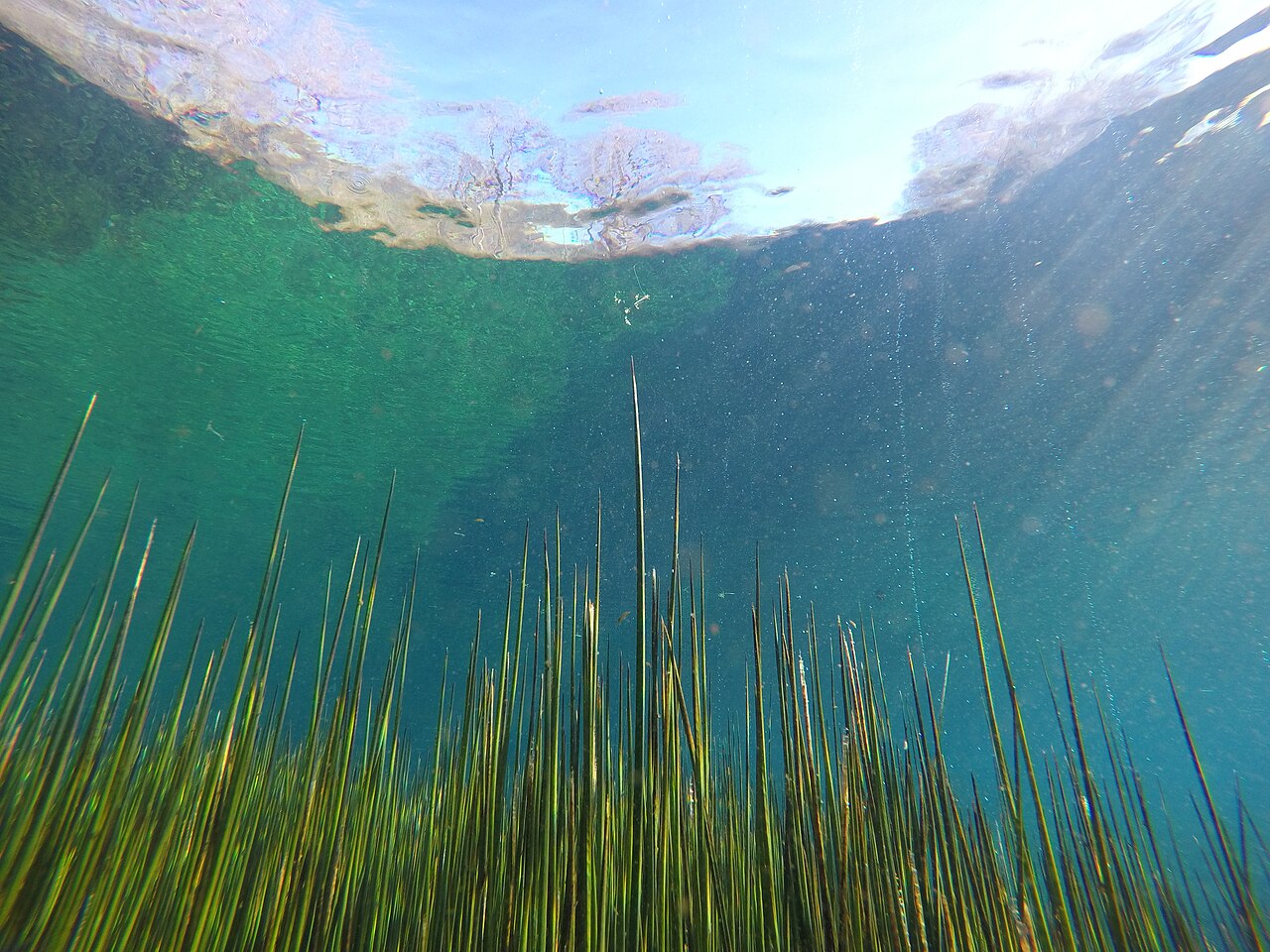
Oxygen bubbles stream from seaweed while photosynthesis runs in still water. Photograph: Rcaravit/Wikimedia Commons
Image Credits: Wikimedia Commons / Rcaravit, KarlGaff, ELaurent
What happens inside the leaf
Everything starts in the leaf, which works like a solar-powered kitchen. Each leaf is packed with microscopic green structures called chloroplasts, and those are the rooms where photosynthesis happens, according to Britannica.
Inside each chloroplast sits a pigment called chlorophyll. Chlorophyll is the actual light-catcher. When sunlight lands on a leaf, chlorophyll molecules absorb its energy the way a solar panel absorbs light.
Chlorophyll is picky about which light it uses. Britannica reports that plants absorb light between about 400 and 700 nanometers, leaning hard on blue light near 450 nanometers and red light between 650 and 700 nanometers. Green light mostly bounces off, which is exactly why leaves look green to our eyes.
The leaf also needs raw ingredients. Tiny pores on the leaf surface, called stomata, open to let carbon dioxide in from the air, according to Biology LibreTexts.
Water arrives from the roots through the plant's internal plumbing. Both ingredients are cheap and abundant, which is part of why the system works so well.
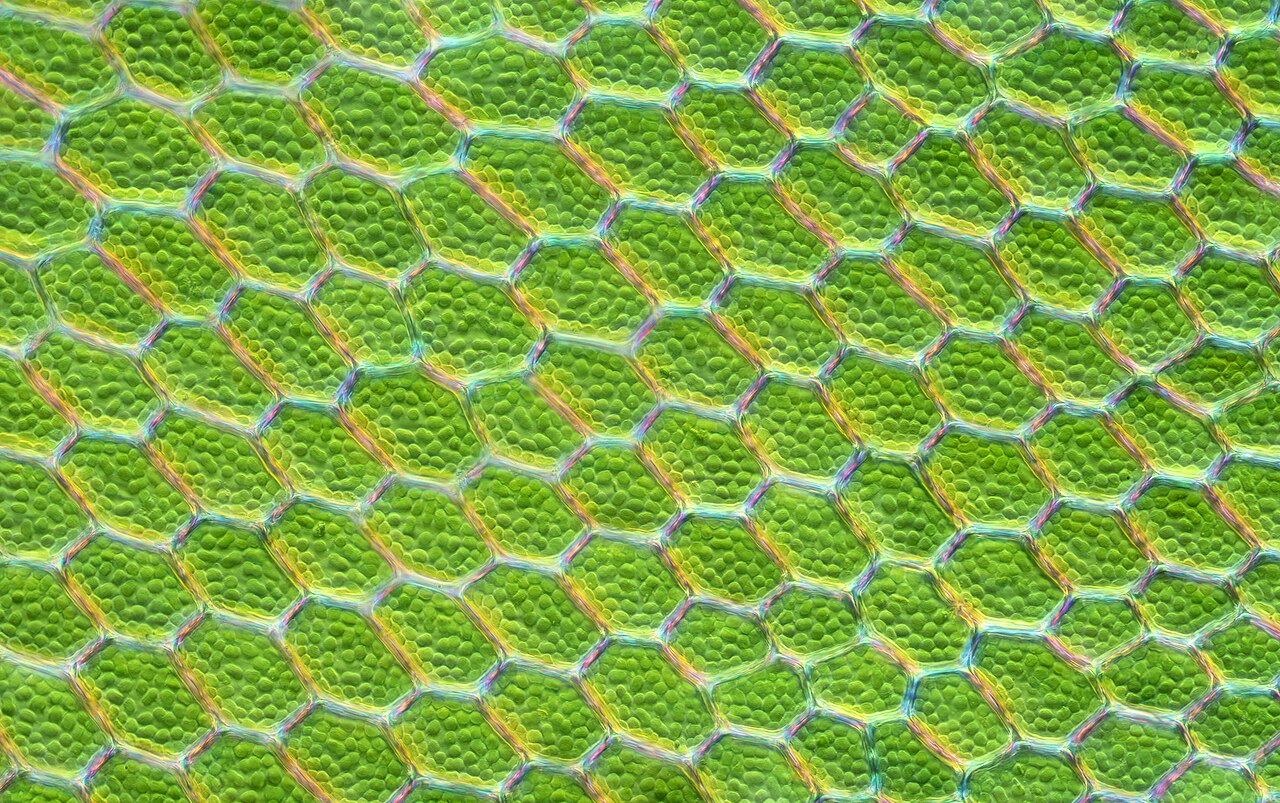
Moss leaf cells seen under a microscope, packed with green chloroplasts. Photograph: KarlGaff/Wikimedia Commons
The two stages of photosynthesis
Photosynthesis is really two jobs done in sequence. First comes the light-catching stage, then the sugar-building stage. Both happen inside the chloroplast, but in different rooms.
The light-dependent reactions run on folded membranes called thylakoids. Two clusters of chlorophyll, named photosystem II and photosystem I, absorb photons of light and split water molecules apart. The split releases oxygen into the air and stores the captured energy in two carrier molecules, ATP and NADPH, according to Britannica.
The whole process can be summarized in one equation:
6CO2 + 6H2O + light energy → C6H12O6 + 6O2
Six molecules of carbon dioxide plus six molecules of water, with sunlight added, become one molecule of glucose and six molecules of oxygen. The water-splitting step is also what freed oxygen into the atmosphere in the first place.
The second stage, the Calvin cycle, runs in the fluid around the thylakoids, called the stroma. It does not use light directly. Instead it spends the ATP and NADPH from the first stage to grab carbon dioxide from the air and build it into sugar, molecule by molecule.
The heavy lifting is done by an enzyme called RuBisCO, which attaches CO2 to a five-carbon molecule called RuBP. The cycle then works through three steps, carbon fixation, reduction, and regeneration, turning the captured carbon into three-carbon sugars that eventually become glucose, according to Biology LibreTexts.
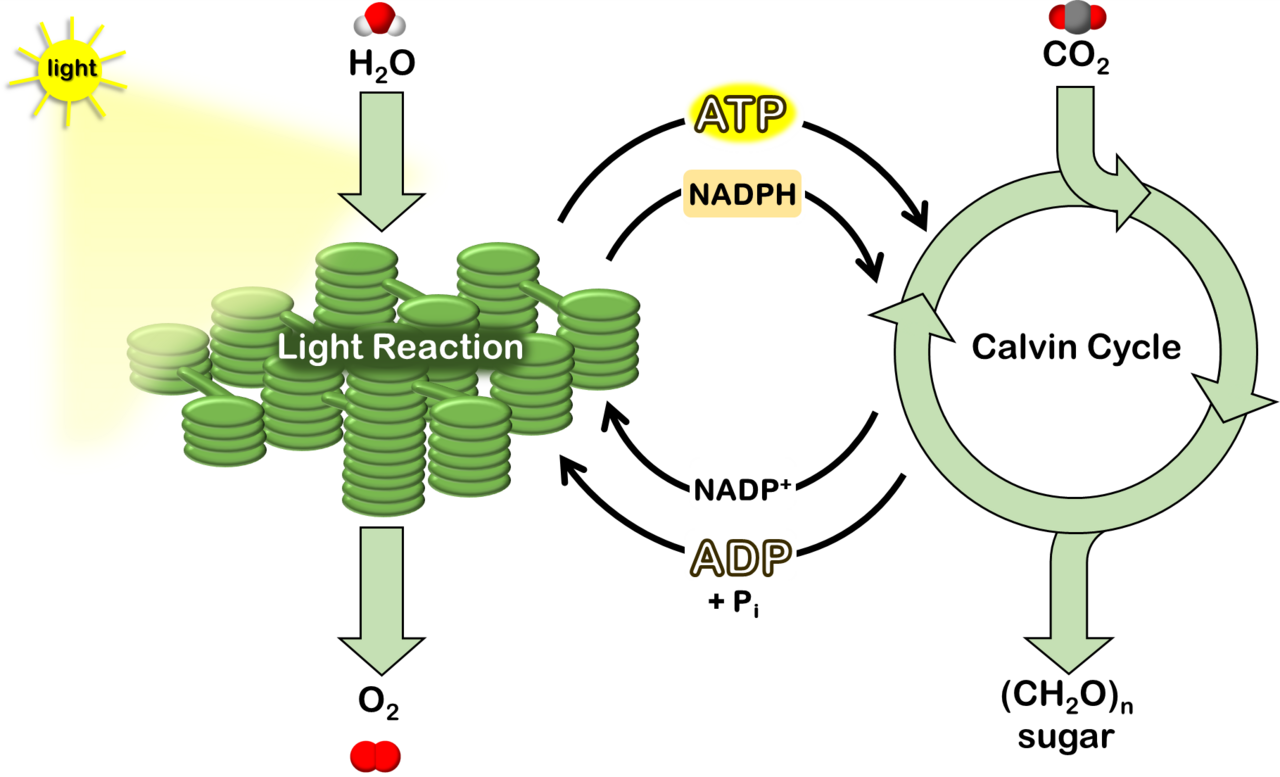
A summary diagram showing how the light reactions feed the Calvin cycle. Illustration: ELaurent/Wikimedia Commons
Why it matters for everything else
Sugar is the plant's lunch, but the leftovers feed the world. Every animal, fungus, and person alive either eats plants or eats something that eats plants. All of that food energy traces back to a leaf catching sunlight.
The oxygen is just as important. Nearly all the oxygen in the air started as a byproduct of photosynthesis, released when water was split during the light reactions. Every breath you take is photosynthesis paying you back.
Plants also pull carbon dioxide out of the atmosphere and lock its carbon into sugar, wood, and leaves. When that material breaks down or burns, the carbon returns to the air. That cycle is why forests and oceans sit at the center of every serious climate conversation.
Even the energy in fossil fuels began as photosynthesis. Coal and oil are ancient plants and plankton, whose captured sunlight was buried and compressed over millions of years. We are still, in a roundabout way, running civilization on old sunlight.
How fast does a plant actually make sugar?
Very fast, and constantly. As long as light, water, and carbon dioxide are available, the light reactions run and the Calvin cycle keeps building. On a sunny day, a leaf is manufacturing sugar nonstop, second by second.
Do plants only make sugar in sunlight?
The light-catching stage needs light, but the Calvin cycle does not use light directly. It can keep running in the dark for a while on the ATP and NADPH stored up during the day, until those reserves run out.
Is oxygen the main product of photosynthesis?
No. Sugar is the main product and the plant's actual goal.
Oxygen is a byproduct released when water is split during the light reactions. It turned out to be the most consequential byproduct in Earth's history, but the plant treats it as waste.
Can plants use artificial light?
Yes. Plants respond to the wavelength of light, not the source. Grow lights are designed to emit the blue and red wavelengths that chlorophyll absorbs best, which is why indoor plants can thrive under them.
Why do leaves turn yellow or red in autumn?
The plant breaks down its chlorophyll and pulls the nutrients back into the stem before winter. With the green pigment gone, yellow and orange pigments that were there all along finally become visible.
The bottom line
Plants turn sunlight into sugar by catching light with chlorophyll, using that energy to split water, and then spending the stored energy to assemble carbon dioxide and water into glucose. Two stages, one leaf, zero moving parts.
Next time you pass a green leaf, remember it is doing chemistry that feeds you and fills your lungs. Not bad for something that just stands there.
Latest in Science
- Why the sky is blue but space is black
- Why ice floats while most solids sink
- Why diamond is hard but graphite is soft
- How magnets work at the atomic level
Subscribe to the Rive News newsletter for a new plain-English science explainer every week.
Related stories

Why diamond is hard and graphite is soft when both are carbon
Diamond and graphite are both pure carbon, yet diamond is 10 on the Mohs scale and graphite is 1 to 2. The difference is not the atoms;

Why Hot Water Can Freeze Faster Than Cold: The Mpemba Effect Explained
Hot water can freeze faster than cold under specific conditions. The Mpemba effect, named for a 1963 schoolboy experiment, still divides

How Magnets Work at the Atomic Level: Spins, Domains, and Iron
Magnetism comes from electrons: their spin and orbits make each atom a tiny magnet. In iron, quantum forces align these atomic magnets into