
Why Is the Sky Blue but Space Black? Both Answers Side by Side
Key takeaways
- The sky is blue because air molecules scatter short blue wavelengths of sunlight in every direction.
- Space is black because it is nearly empty: with nothing to scatter sunlight, there is no glow to see.
- Sunsets turn red for the same reason the sky is blue: the blue light gets scattered away on a longer path.
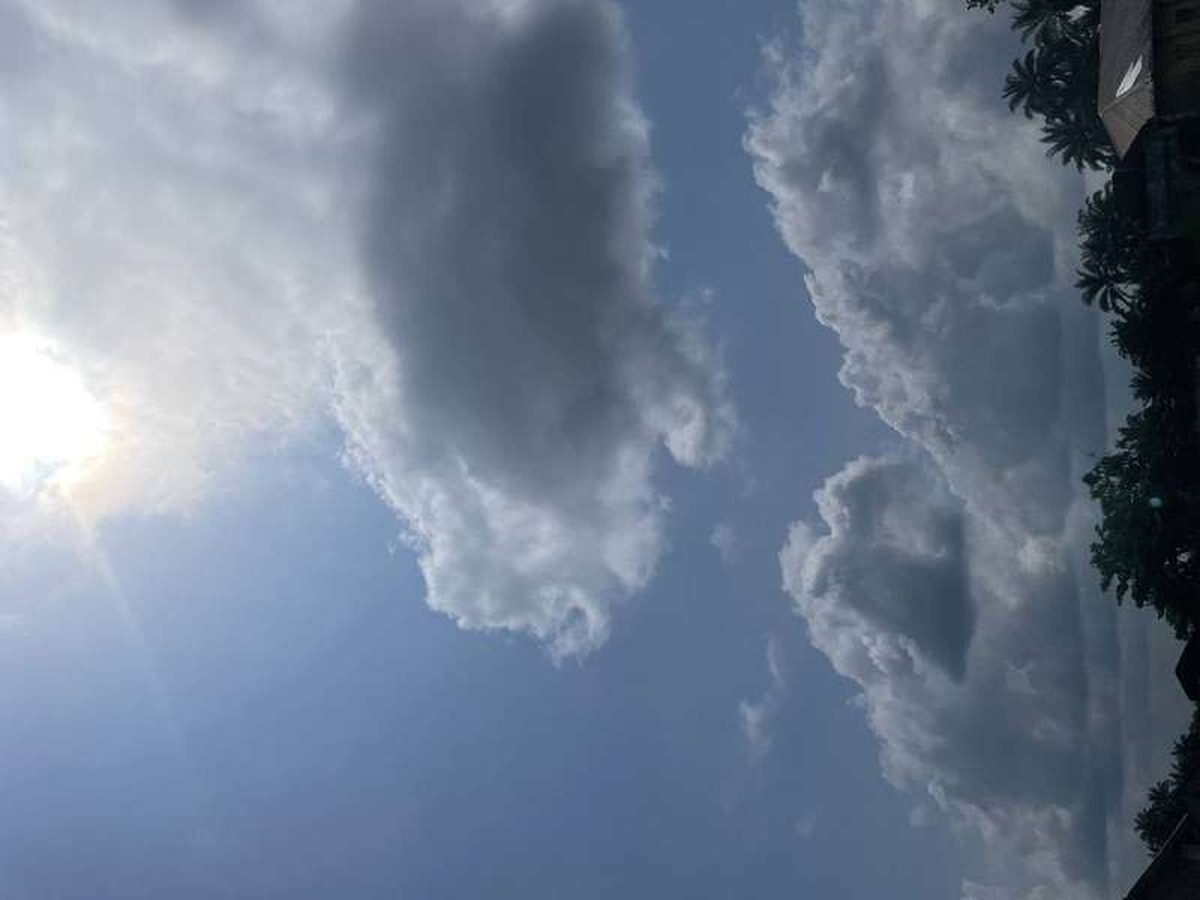
Image Credits: Wikimedia Commons
Sunlight looks white, but it is a blend of every color of the rainbow. What you see when you look up depends on what the light bumps into on its way to your eyes.
Above your head it bumps into air, and the result is blue. Beyond the air it bumps into almost nothing, and the result is black.
This article explains both halves of the puzzle, including why the sky is blue, why space is black, how the two answers mirror each other, and what sunsets prove about the whole thing.
Why the sky is blue
The key effect is called Rayleigh scattering. When sunlight enters the atmosphere, it collides with gas molecules, mostly nitrogen and oxygen, that are much smaller than the wavelength of visible light.
Small particles do not scatter all colors equally. Shorter wavelengths get deflected far more strongly than longer ones, and the strength of the effect grows with the inverse fourth power of the wavelength (the shorter the wavelength, the far stronger the scattering). Blue light, with its short wavelength, is scattered in every direction while the longer red and orange wavelengths mostly continue straight.
So when you look at the sky away from the sun, you are seeing blue light that was heading toward the sun's original direction, got bounced by air molecules, and ended up heading toward your eyes. The atmosphere is not blue. The scattered sunlight is blue.
One detail people often ask about: violet light has an even shorter wavelength than blue and scatters even more. The sky still looks blue for two reasons. Human eyes are much more sensitive to blue than to violet, and the upper atmosphere absorbs a portion of the incoming violet light before it can scatter.
Why space is black
Now remove the air. Space is a near-vacuum: the space between stars holds only about 5 to 10 hydrogen atoms per cubic centimeter. Sunlight traveling through it meets essentially nothing.
With no molecules to bounce off, light travels in straight lines until it hits something solid, like a planet, a moon, or your retina. Look away from the sun and the stars, and there is no scattered glow arriving from any direction. Your eyes report the absence of light as black.
This is why the sky would be black even at noon if Earth had no atmosphere. The moon has no meaningful atmosphere, and its daytime sky is pitch black with the sun blazing in it. Mercury is the same.
The blackness is not a property of space itself; it is the result of nothing being there to redirect light toward you.
The two answers, side by side
The two effects are mirror images of each other, which is why the question pairs them so naturally.
The sky is blue because the atmosphere is a scattering medium. Sunlight enters, blue wavelengths get redirected in all directions, and some of that redirected light reaches your eyes no matter where you look. The glow fills the whole dome of the sky.
Space is black because there is no scattering medium. Sunlight passes through undisturbed, and unless your eyes sit directly in the beam or on a lit object, no light arrives. The darkness fills everything between the light sources.
The common thread is that color in the sky is not about the light source. The sun is the same white-yellow disc in both cases. The difference is entirely about what sits between the sun and your eyes.
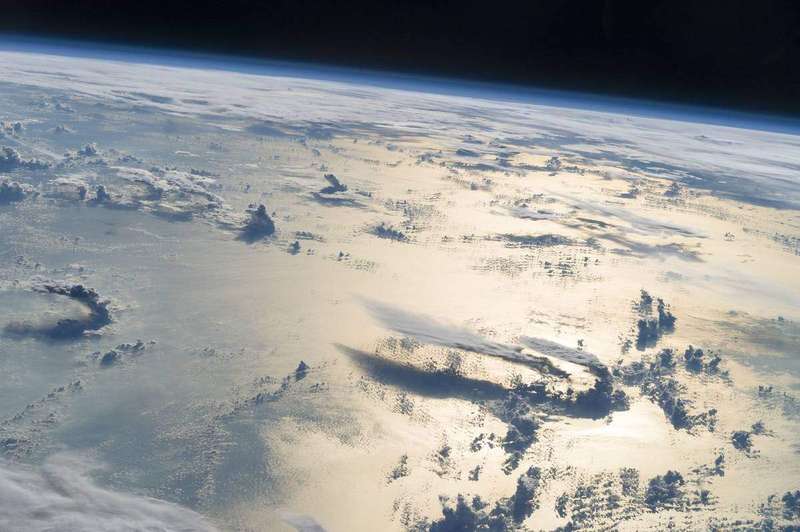
Image Credits: Wikimedia Commons
Sunsets: the bonus proof
Sunsets are the same physics with a longer path. When the sun sits low on the horizon, its light must travel through much more atmosphere to reach you than at midday.
On that long journey, nearly all the blue and violet light gets scattered away before it arrives. What survives the trip is the long-wavelength end: reds, oranges, and yellows. The sunset colors are the leftover light after the sky has finished stealing the blue.
Clouds, dust, and pollution adjust the effect. Water droplets in clouds are larger than air molecules, so they scatter all wavelengths roughly equally, which is why clouds look white or gray. Fine dust and smoke can deepen reds, which is why wildfire sunsets look so dramatic.

Image Credits: Wikimedia Commons
Frequently asked questions
If space is black, why can we see the stars?
The stars are light sources, like distant light bulbs. You see them because their light travels straight to your eyes. The blackness is everything else: the directions where no light source sits.
Why is the sky not violet, since violet scatters most?
Two filters stand between violet light and your perception. Your eyes respond weakly to violet compared with blue, and ozone and other gases in the upper atmosphere absorb some violet before it scatters. What is left over reads as blue.
Would the sky be a different color on another planet?
Yes, if the atmosphere differs. Mars has a thin atmosphere full of fine dust, and its daytime sky looks butterscotch or pinkish. The scattering particles there are larger than air molecules, so the color rules change.
Is the blue of the ocean related to the blue of the sky?
Barely. The ocean looks blue mostly because water itself absorbs red light slightly and because it reflects the sky. On a gray day the sea looks gray, which tells you how much of its color is borrowed.
The bottom line
The sky is blue because air scatters sunlight, favoring the short blue wavelengths. Space is black because there is no air to do the scattering, so light travels straight past you into the dark.
One medium, two outcomes: put air in the way and you get a blue dome; take it away and you get blackness studded with stars. Watch a sunset tonight and you will see the same scattering at work, running in reverse.
Rive News's research desk writes plain-English explainers on science, verified against public sources.
Latest in Science
- Why does ice float but most solids sink?
- Why is the ocean salty but lakes are not?
- How Vaccines Train the Immune System: Antibodies and Memory Cells
Subscribe for one practical science explainer every morning.
Corrections: spotted an error? We fix verified mistakes promptly and note the update.
Related stories

Why diamond is hard and graphite is soft when both are carbon
Diamond and graphite are both pure carbon, yet diamond is 10 on the Mohs scale and graphite is 1 to 2. The difference is not the atoms;

Why Hot Water Can Freeze Faster Than Cold: The Mpemba Effect Explained
Hot water can freeze faster than cold under specific conditions. The Mpemba effect, named for a 1963 schoolboy experiment, still divides

How Magnets Work at the Atomic Level: Spins, Domains, and Iron
Magnetism comes from electrons: their spin and orbits make each atom a tiny magnet. In iron, quantum forces align these atomic magnets into