
How Vaccines Train the Immune System: Antibodies and Memory Cells
Key takeaways
- A vaccine gives the immune system a safe practice run against a germ's identifying markers, without causing the disease itself.
- The first response produces antibodies; the lasting protection comes from memory B cells and memory T cells that persist for years.
- If the real germ arrives later, those memory cells launch a faster, stronger response that can stop the infection before it causes serious illness.

A nurse prepares a vaccination in a clinic. The injection itself takes seconds; the immune training it triggers unfolds over the following days and weeks. Photograph: Shixart1985/Wikimedia Commons
Image Credits: Wikimedia Commons
Your immune system learns by encounter. The first time it meets a new germ, it has to figure out the threat from scratch, and that takes time. A vaccine is a way to give it that first encounter safely, so the learning happens without the illness.
The "training" metaphor is more literal than it sounds. Vaccination walks the immune system through the opening steps of a real infection, detection, identification, and response, using parts that cannot cause the disease. What remains afterward is a standing memory of the germ.
This article explains what a vaccine contains, including how the immune system responds the first time, the roles of antibodies and memory cells, and why boosters exist.
What a vaccine actually contains
Every vaccine centers on the same idea: show the immune system the germ's identifying markers, called antigens, without the danger of the germ itself.
Different vaccine types do this differently. Live-attenuated vaccines (weakened live germs), such as the one for measles, mumps, and rubella (MMR), use a weakened form of the virus that mimics a natural infection but cannot cause serious disease.
Inactivated vaccines, such as those for polio or hepatitis A, use a killed version of the whole germ. Other designs use only fragments of the germ, like a single protein, which is enough for the immune system to learn the signature.
St. Jude Children's Research Hospital describes the purpose plainly: a vaccine initiates the priming step needed to establish immune memory, a kind of training exercise for the immune system. The dose is small, the components are non-harmful, and their job is to alert and train the body's defenses against future infections with the same agent.
One clarification worth making early: a vaccine is not a physical shield that prevents exposure. As St. Jude puts it, vaccines work with the immune system to reduce or eliminate harm after exposure.
The germ can still arrive. The difference is what happens next.
The first encounter: how the immune system responds
When vaccine antigens enter the body, the innate immune system (the body's fast, general defense) reacts first. Scavenger cells such as macrophages and dendritic cells engulf the foreign material, break it down, and carry the identifying fragments to the lymph nodes. There, they present those fragments to the adaptive immune system's specialists: B cells and T cells.
This presentation step is the heart of the training. B cells that recognize the antigen begin to multiply and change, and many become plasma cells, factories that produce antibodies. According to the Centers for Disease Control and Prevention, cited by Live Science, a healthy person can produce millions of antibodies a day once this machinery is running.
Antibodies are Y-shaped proteins custom-built to latch onto the specific antigen. Once attached, they can neutralize the germ directly, tag it for destruction by other immune cells, or block it from attaching to the body's own cells. Humans make five main classes of antibodies, IgG, IgM, IgA, IgE, and IgD, each with specialized protective roles.
Meanwhile, T cells join the effort. Helper T cells coordinate the response, directing B cells and other defenders, while killer T cells learn to recognize and destroy the body's own cells if they become infected.
Here is the catch that makes vaccines necessary: this whole first response is slow. The body needs several days to ramp up antibody production against a germ it has never seen.
For aggressive germs like the measles virus, a few days is too long. The infection can spread and overwhelm the person before the defenses are ready. That gap between exposure and readiness is exactly what vaccination closes in advance.
If you feel mildly unwell after a vaccination, a sore arm, fatigue, a low fever, that is usually the immune response itself at work, not an infection. St. Jude notes that post-vaccine symptoms are normal and a sign the immune system has recognized the vaccine and is responding.
Antibodies and memory cells: the two kinds of protection
After the practice run winds down, most of the antibody-producing plasma cells die off, and circulating antibody levels gradually decline. This is normal and expected. It does not mean protection has vanished.
What remains is the second, longer-lasting layer of defense: memory cells. Some of the activated B cells and T cells transform into memory B cells and memory T cells, long-lived sentinels that persist in the body for years.
St. Jude offers a vivid image for what they carry: vaccines act like an immunologic wanted poster, informing T and B cells who the bad guys are.
The two layers do different jobs. Antibodies are the rapid-response force, already circulating and able to engage a germ right away.
Memory cells are the reserve: if the real germ arrives, memory B cells can restart antibody production far faster than the first encounter allowed, and memory T cells reactivate the coordinated cellular defense. Together they turn a slow first response into a fast, high-powered second response.
This is why vaccinated people who do get infected often have milder symptoms, shorter illness, or fewer complications. The immune system is not starting from zero. It is executing a plan it has already rehearsed.
The record of that rehearsal at population scale is striking. St. Jude cites the measles example: in the 20th century, average annual measles cases in the United States was 530,217; by 2021 it was 9, a 99 percent decrease attributed to vaccination.
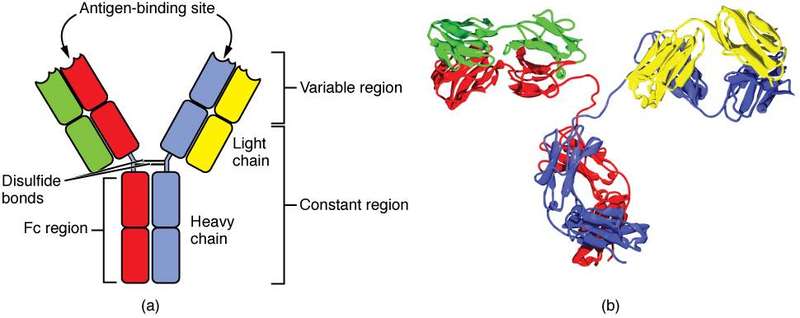
A diagram of an IgG antibody's four-chain structure. Antibodies are Y-shaped proteins built to latch onto one specific germ marker. Photograph: CFCF/Wikimedia Commons
Image Credits: Wikimedia Commons
Why boosters exist
Protection is not always permanent, for two reasons. First, immune memory can fade. Antibody levels decline over time, and for some diseases the memory-cell population thins enough that the response slows.
Second, germs change. When a germ evolves enough that its markers look different, the old wanted poster no longer matches.
Booster doses address both problems. A booster re-exposes the immune system to the antigen, which reminds the memory cells and strengthens the response, renewing protection.
For evolving germs, updated vaccine formulas teach the immune system the new markers. Acibadem Hospitals Group describes boosters as renewing or improving protection when immunity declines or germs evolve.
This is also why different vaccines have different schedules. Some, like MMR, establish durable protection with the initial series. Others need periodic refreshing because the disease, the immune memory, or both behave differently over time.
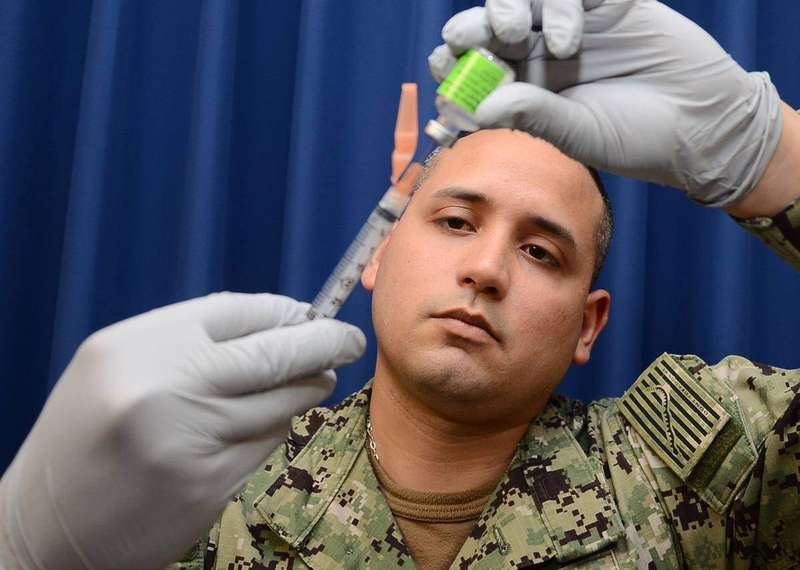
A medical specialist prepares a syringe with influenza vaccine. Flu shots are a familiar example of a vaccine that is updated and repeated as the virus evolves. Photograph: Tm/Wikimedia Commons
Image Credits: Wikimedia Commons
The bottom line
Vaccines train the immune system by staging a safe first encounter. Antigens trigger the full response, antibodies are produced, and when the drill ends, memory B and T cells keep the lesson on file. The next meeting with the real germ starts not from zero but from a rehearsed plan, which is the difference between a slow scramble and a rapid defense.
It is a good idea to discuss any questions about vaccination with your own doctor or a qualified health professional, who can advise based on your individual situation.
Frequently asked questions
How long does it take for a vaccine to train the immune system?
The full response unfolds over days to weeks after the dose. Antibody production ramps up over several days, and the memory-cell population establishes itself as the initial response winds down.
Do antibody levels dropping mean the vaccine stopped working?
Not necessarily. Antibody levels naturally decline after vaccination, but memory B and T cells remain and can restart the response quickly on re-exposure. Declining antibodies alone do not equal lost protection.
Why do some vaccines need boosters and others do not?
It depends on how long immune memory lasts for that disease and whether the germ evolves. Boosters renew fading memory or teach the immune system updated germ markers.
Is feeling sick after a vaccine a bad sign?
Usually not. Mild symptoms like a sore arm, tiredness, or low fever are typically the immune response itself at work, and health authorities describe them as a normal sign the body has recognized the vaccine.
---
Rive News is the research desk behind these explainers. We verify every claim against public sources before publishing.
Related stories
- Why Pregnant Women Get Leg Cramps in the Third Trimester
- Jet Lag: The Best Way to Recover Flying East vs. West
- Why Paying Only the Minimum Keeps You in Debt
Get one practical explainer in your inbox every morning. Subscribe to the Rive News newsletter.
Rive News follows a public corrections policy. If you spot an error, tell us and we will fix it visibly.
Related stories

Why diamond is hard and graphite is soft when both are carbon
Diamond and graphite are both pure carbon, yet diamond is 10 on the Mohs scale and graphite is 1 to 2. The difference is not the atoms;

Why Hot Water Can Freeze Faster Than Cold: The Mpemba Effect Explained
Hot water can freeze faster than cold under specific conditions. The Mpemba effect, named for a 1963 schoolboy experiment, still divides

How Magnets Work at the Atomic Level: Spins, Domains, and Iron
Magnetism comes from electrons: their spin and orbits make each atom a tiny magnet. In iron, quantum forces align these atomic magnets into