
Why do rainbows always arc and never form straight lines?
Key takeaways
- Rainbows arc because they are circles: sunlight leaving raindrops at a 42-degree angle traces a ring around the antisolar point, directly opposite the sun.
- The ground blocks the lower half of that circle, which is why you usually see only an arc, and full circles appear from airplanes.
- Each color sits at its own angle (red at 42 degrees, violet at 40), so the bow is layered like nested rings rather than painted as one band.
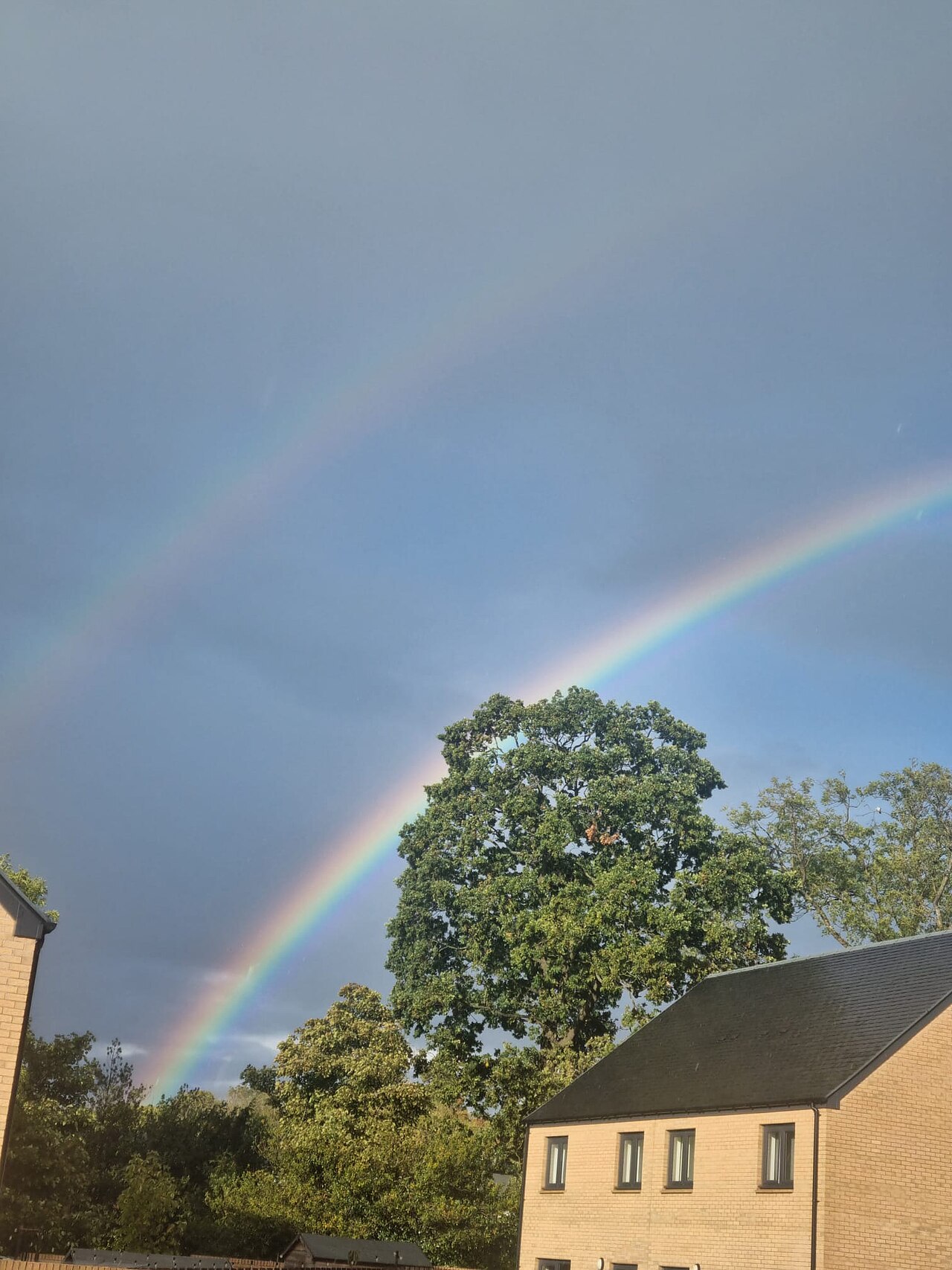
Why do rainbows always arc and never form straight lines? Because a rainbow is not a line drawn across the sky. It is a circle, centered on a point directly opposite the sun, and you are standing at the tip of the cone that creates it.
This article explains the observer geometry behind the arc: the 42-degree angle, the antisolar point, and why the ground steals the bottom half of every rainbow you see.
Sunlight makes a fixed turn inside every raindrop
The curved shape starts inside a single drop of water. A ray of sunlight enters one side of the drop, refracts as it slows down, reflects once off the back inner surface, then refracts again as it exits. That path was described by Robert Greenler of the University of Wisconsin-Milwaukee in a classic Scientific American explanation.
If you trace thousands of parallel sun rays striking a drop at different points, most scatter in all directions. But a concentration of rays emerges at one specific angle: 42 degrees from the direction the light entered. The rainbow is the pileup of light at that angle.
Dispersion paints the colors. Water bends short wavelengths more than long ones, so each color piles up at a slightly different angle.
The University of St Andrews optics notes give the minimum-deviation angles as 137.6 degrees for red light and 139.4 degrees for blue light inside the drop. From the observer's side, that works out to red at 42 degrees from the antisolar point and violet at about 40 degrees.
Your eye is the center of the geometry
Here is the crucial step most explanations rush past. You do not see a rainbow in the raindrops. You see only the light that raindrops send toward your eyes.
Define one direction in space: the antisolar point, exactly opposite the sun. During daytime it sits below the horizon, marked by the shadow of your head. To see returning rainbow light, look 42 degrees away from that point.
The region 42 degrees away from a point is not one direction but a whole collection of directions that form a circle around it. The University of Washington's atmospheric science notes put it precisely: the raindrops producing the red light you see are the collection of all drops lying 42 degrees away from an imaginary sunbeam passing through the back of your head. Those drops lie along the surface of a cone whose tip coincides with your eye, and so the red light appears to form a circular arc.
A straight line could never satisfy this geometry. A straight band would require the light to return at a single fixed direction, but the fixed quantity is the angle from the antisolar point, and that constraint always traces a circle.

Why you usually see an arc, not a full circle
The rainbow circle is complete in the sky. The ground simply gets in the way.
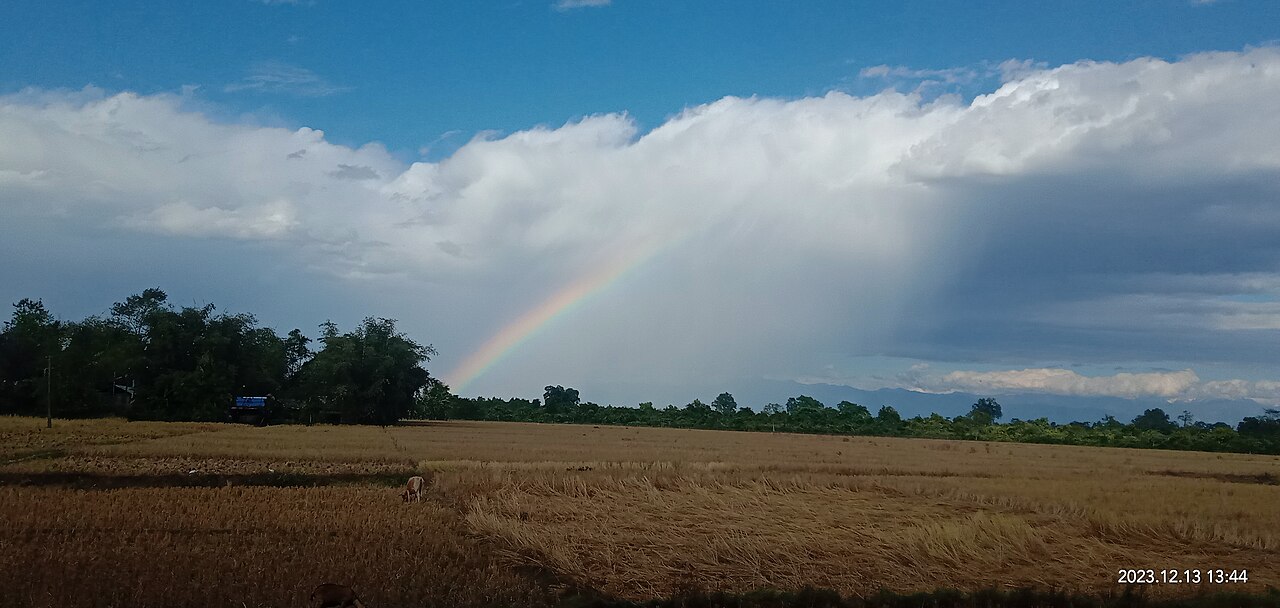
From ground level, the antisolar point sits below the horizon, so the lower half of the circle lies under the earth. You see only the upper portion: an arc. The higher the sun climbs, the smaller the visible arc becomes, because the circle's center sinks further below the horizon.
Rainbows are also most vivid when the sun sits low, below 42 degrees above the horizon. That is why rainbows favor morning and late afternoon, when the sun is behind you and low enough that a large slice of the circle clears the ground.
Full-circle rainbows do happen. Passengers and pilots on airplanes regularly photograph complete rings around the antisolar point, because at altitude nothing blocks the lower half. Without the ground in the way, the geometry shows itself for what it always was: a circle.
The double rainbow follows the same rule, twice
Some sunlight reflects twice inside a raindrop before exiting. Those doubly reflected rays pile up at a wider angle: 51 degrees from the antisolar point.
That produces the secondary rainbow, a fainter bow sitting outside the primary one. It is fainter because each internal reflection lets some light leak through the drop's surface, so less light survives to make the second bow.
The color order reverses in the secondary rainbow. Because the double-reflection path inverts the geometry, red appears on the inner edge and violet on the outer edge, the mirror image of the primary bow. Both bows are centered on the same antisolar point, which is why double rainbows look like perfectly nested arcs.
Frequently asked questions
Can a rainbow ever appear as a straight line?
No. The 42-degree constraint always traces a circle around the antisolar point. Optical effects that look like straight bands, such as sun dogs or light pillars, come from ice crystals or atmospheric layers, not from the raindrop reflection-refraction path.
Why is red always on the outside of the rainbow?
Red light piles up at 42 degrees from the antisolar point while violet piles up at 40 degrees. The larger angle means a larger ring, so red forms the outer edge and violet the inner edge of the primary bow.
Why do rainbows appear mostly after rain, not during it?
You need rain in the sky ahead of you and clear sun behind you at the same time. Heavy clouds overhead block the sunlight the geometry requires. The classic rainbow moment is a receding shower with the sun breaking through behind the observer.
Why does everyone's rainbow look slightly different?
Each observer has a personal antisolar point defined by their own eye and the sun. The raindrops sending light to your eyes are not the same drops sending light to someone standing next to you, so every person sees their own private rainbow.
The bottom line
Rainbows arc because a fixed angle from a single point in space always describes a circle, not a line. The ground hides the bottom of that circle, leaving the familiar arc. Next time you spot one, remember: the full ring is still there, waiting for an airplane window.
Latest in Science
- Why the sky is blue but space is black
- Why clouds are white when the sky is blue
- Why the sky turns orange at sunrise and sunset
Subscribe to the Rive News newsletter for one clear science explainer every week.
Related stories
Why diamond is hard and graphite is soft when both are carbon
Diamond and graphite are both pure carbon, yet diamond is 10 on the Mohs scale and graphite is 1 to 2. The difference is not the atoms;

Why Hot Water Can Freeze Faster Than Cold: The Mpemba Effect Explained
Hot water can freeze faster than cold under specific conditions. The Mpemba effect, named for a 1963 schoolboy experiment, still divides

How Magnets Work at the Atomic Level: Spins, Domains, and Iron
Magnetism comes from electrons: their spin and orbits make each atom a tiny magnet. In iron, quantum forces align these atomic magnets into