
Why Are Clouds White When the Sky Is Blue?
Key takeaways
- Tiny air molecules scatter short blue wavelengths far more than long red ones, which is why a clear sky looks blue.
- Cloud droplets are thousands of times larger than air molecules, so they scatter every color equally and stay white.
- The same physics explains red sunsets, hazy white skies, and why the sky is black on the Moon.
Look up on a clear afternoon and you get a puzzle for free. The sky is blue. The clouds floating in it are white.
Both are lit by the same Sun, shining through the same air. So why the different colors?
This article explains why clouds are white when the sky is blue, including Rayleigh scattering in the clear sky, Mie scattering inside clouds, and the special cases of sunsets, haze, and gray storm clouds.
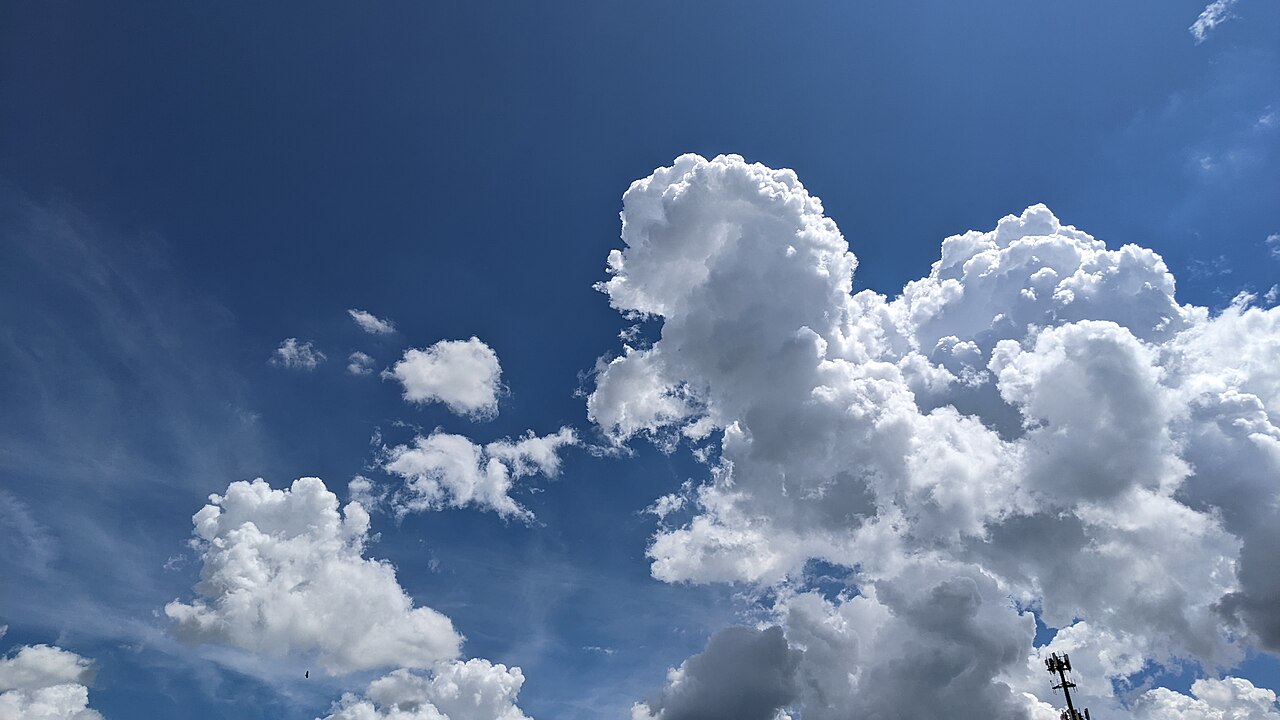
White cumulus clouds drift across a blue sky. The air between the clouds scatters blue light; the droplets inside them scatter all colors equally. Photograph: Lance Vanlewen
Image Credits: Wikimedia Commons / Lance Vanlewen
Why the sky looks blue: Rayleigh scattering
Sunlight looks white, but it is a mix of every color. As it travels through the atmosphere, it collides with nitrogen and oxygen molecules. These molecules are tiny, far smaller than the wavelength of visible light, which runs from about 400 to 700 nanometers.
When light hits a particle much smaller than its wavelength, a process called Rayleigh scattering takes over. The oscillating electric field of the light shakes electrons in the molecule, and those electrons re-emit light in all directions. The key detail is that scattering strength scales with the inverse fourth power of the wavelength.
Halve the wavelength and scattering jumps sixteen-fold.
Short wavelengths therefore scatter far more than long ones. Blue light, around 450 to 495 nanometers, scatters dramatically more than red. Your eye receives blue light arriving from every direction in the sky, not just from the Sun, and the sky reads as blue.
The University of Hawaii's Geography 101 course puts it plainly: because of this wavelength-selective scattering, more blue light diffuses throughout the atmosphere than other colors, producing the familiar blue sky.
A natural follow-up: violet scatters even more than blue, so why isn't the sky violet? Two reasons. Some violet gets absorbed in the upper atmosphere, and the human eye is simply more sensitive to blue than violet.
The physics delivers violet; your eyes report blue.
Why clouds stay white: Mie scattering
Clouds are not empty sky. They are dense collections of water droplets and ice crystals, each one roughly 10 microns across, thousands of times larger than an air molecule. At that size, the light encounters a particle comparable to its own wavelength, and a different regime called Mie scattering applies.
Under Mie scattering, all wavelengths scatter roughly equally. There is no preference for blue over red. Sunlight enters the cloud white, bounces from droplet to droplet in every direction, and leaves the cloud white.
As the LibreTexts atmospheric optics chapter states, when Mie scattering holds, all wavelengths of visible light are scattered roughly equally, so the color illuminating the cloud is the color you see reflected back.
The theory behind Mie scattering was worked out by Gustav Mie in 1908. It also explains why a sky heavy with dust, pollen, or smoke looks white and hazy instead of blue. Once the air fills with particles large enough for Mie scattering, wavelength-selective color gives way to uniform whiteness. A deep blue sky tells you the air is relatively free of such particles; a milky one tells you it is not.
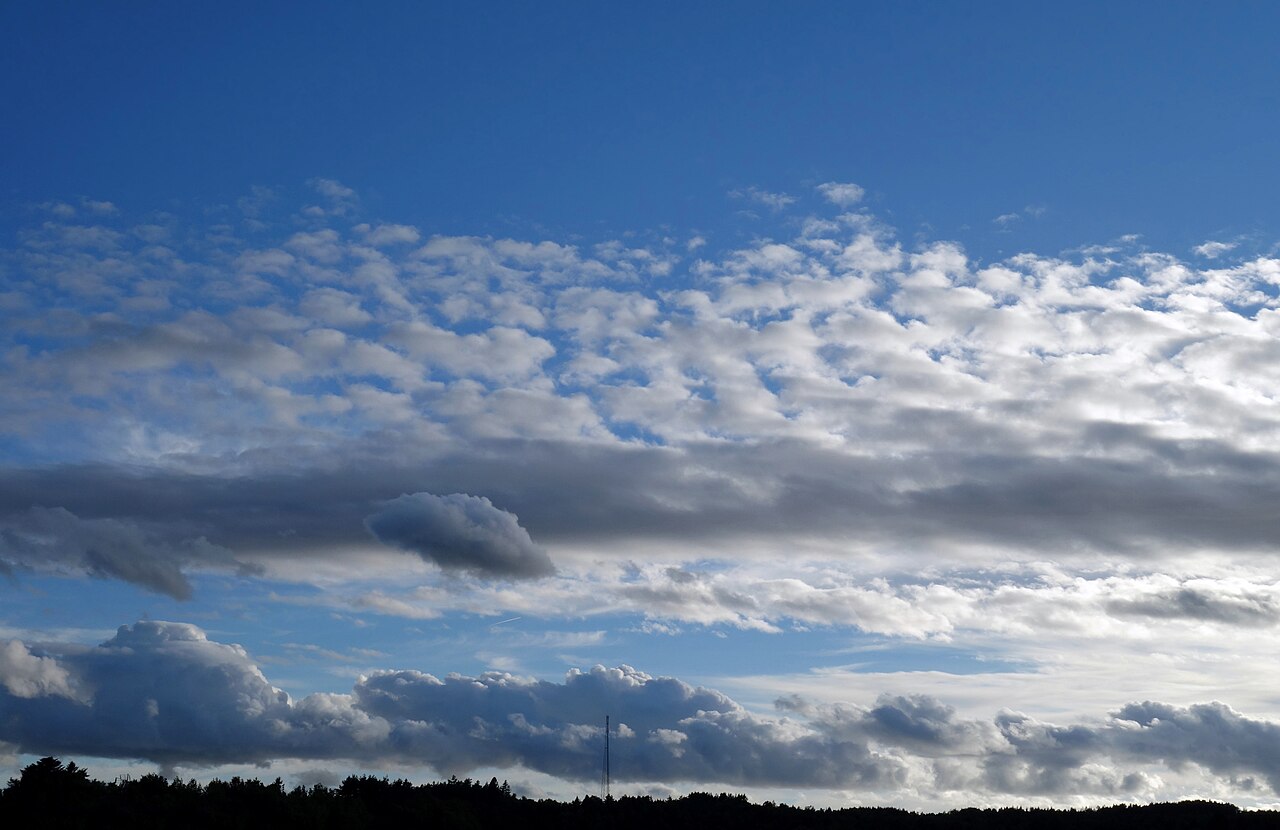
Altocumulus and cumulus clouds over the Swedish coast. Different cloud types all look white for the same reason: their droplets scatter every wavelength of sunlight equally. Photograph: W.carter
Image Credits: Wikimedia Commons / W.carter
What changes the color of clouds
If Mie scattering always returns white light, why do storm clouds look gray and sunsets turn clouds pink? Both are explained without breaking the rule.
Thick storm clouds look dark gray because of depth, not a different scattering. Sunlight entering the top of a towering cloud gets scattered and absorbed over a long path. By the time light reaches the bottom and bounces back to your eye, most of it is gone.
The cloud's underside is genuinely receiving less light, so it looks gray. The droplets still scatter all wavelengths equally; there is simply less light to work with.
Sunset colors come from the path length through air. When the Sun sits low, its light travels a long, slanted path through the atmosphere. Rayleigh scattering strips out the blue and green along the way, leaving mostly red and orange to reach the clouds.
A cloud at sunset is still scattering all colors equally; the light arriving at it is already red. That is why the most colorful sunsets happen when red light reflects off clouds or dust in the sky.
Haze is the third case. On polluted or humid days, fine aerosols load the air between you and the blue sky. Mie scattering off those particles washes the whole sky toward white, the same mechanism that whitens clouds, just spread thin across the sky.
The same physics, off Earth
The Rayleigh explanation comes with a clean test: remove the atmosphere and the blue disappears. Without molecular scattering, the sky would be pitch black except for the brilliant disc of the Sun, exactly the view astronauts report from the Moon. That prediction falls straight out of the theory and confirms it better than any equation.
There is also a forward-scattering quirk worth knowing. Rayleigh scattering sends light close to uniformly in all directions, while Mie scattering favors the forward direction, which is why clouds and haze glow brightest near the Sun. Crepuscular rays, the visible sunbeams slanting through cloud gaps at dusk, are Mie scattering made visible at low sun angles.
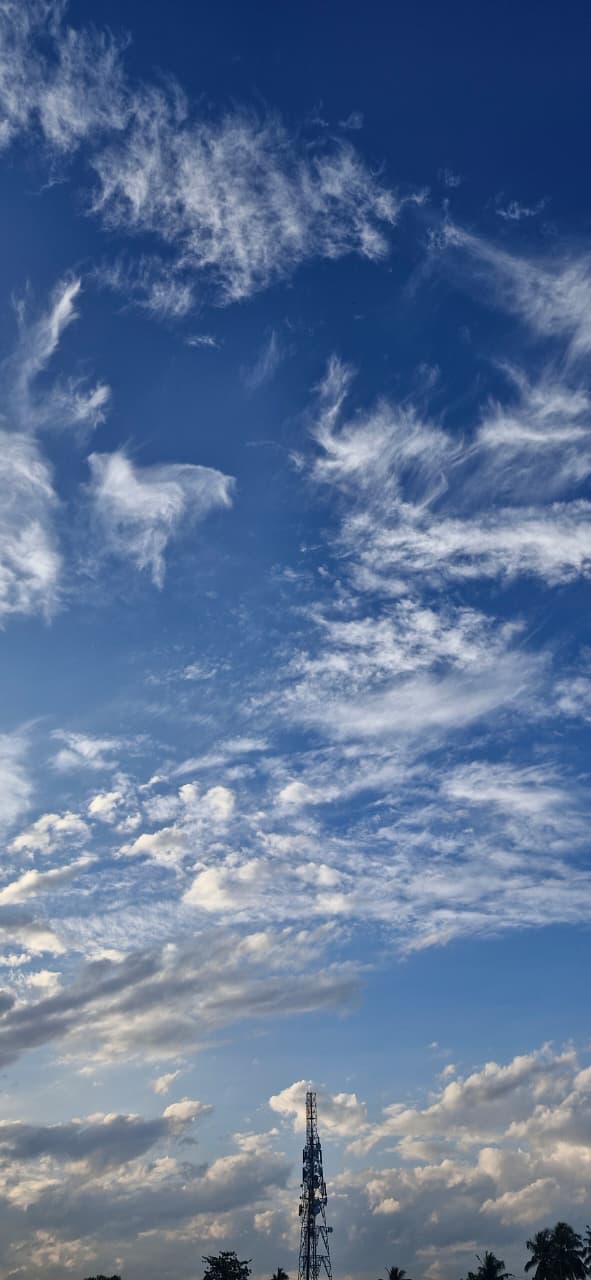
Scattered cumulus clouds in blue sky. Each droplet is about 10 microns wide, far larger than an air molecule and squarely in the Mie scattering regime. Photograph: Ani Vincent
Image Credits: Wikimedia Commons / Ani Vincent
Why is the sky blue but space is black?
Earth's sky is blue because air molecules scatter blue sunlight toward your eyes from every direction. Space has almost no molecules to scatter anything, so looking away from the Sun you see darkness. The Moon's sky is black for the same reason.
Why do some clouds look pink at sunrise?
At sunrise the Sun's light crosses a long atmospheric path, losing blue to Rayleigh scattering before it reaches the cloud. The cloud scatters the remaining red and orange equally, so it glows pink or red.
Why do clouds look gray before it rains?
A thick rain cloud's base receives little sunlight after the light is scattered and absorbed through kilometers of droplets. Less light reaching your eye means gray. The droplets still scatter all colors equally.
Can clouds ever look green?
Rarely, yes, and it is still Mie scattering at work. Severe thunderstorm clouds can look greenish when red sunset light mixes with blue light scattered by deep water-laden clouds. Meteorologists treat green skies as a hail and tornado warning sign, not an optical illusion.
The bottom line
The sky is blue because air molecules are tiny and scatter short blue wavelengths best. Clouds are white because water droplets are large and scatter every wavelength the same. One Sun, one atmosphere, two particle sizes, two colors.
The next time a sunset paints clouds orange or a storm turns them slate gray, you are watching the same two scattering rules run on different inputs.
Related reading: why the sky is orange at sunrise and sunset and how scientists measure the age of the universe.
Latest in Science
- Why is the sky blue but space black?
- Why the sky turns orange at sunrise and sunset
- Why does ice float when most solids sink?
- Why hot water can freeze faster than cold: the Mpemba effect
Get one clear science explainer like this in your inbox every week. Subscribe to the Rive News newsletter.
Image Credits: Wikimedia Commons / Lance Vanlewen, W.carter, Ani Vincent
Related stories
Why diamond is hard and graphite is soft when both are carbon
Diamond and graphite are both pure carbon, yet diamond is 10 on the Mohs scale and graphite is 1 to 2. The difference is not the atoms;

Why Hot Water Can Freeze Faster Than Cold: The Mpemba Effect Explained
Hot water can freeze faster than cold under specific conditions. The Mpemba effect, named for a 1963 schoolboy experiment, still divides

How Magnets Work at the Atomic Level: Spins, Domains, and Iron
Magnetism comes from electrons: their spin and orbits make each atom a tiny magnet. In iron, quantum forces align these atomic magnets into