
What Is Happening Inside a Microwave With Uneven Heating?
Key takeaways
- A magnetron fires 2.45 GHz waves into the oven, and they reflect off the metal walls into a fixed pattern of hot and cold spots.
- The waves penetrate only about 1 to 1.5 inches, so the center of thick food heats slowly by conduction.
- Rotating, stirring, and standing time smooth out the unevenness; a food thermometer is the final check.
One corner of the casserole is scalding. The middle is barely warm.
Every microwave owner has met this puzzle, and it feels like a broken appliance. It is not. It is the expected behavior of radio waves bouncing around inside a metal box.
This article takes a closer look at what is happening inside a microwave when food heats unevenly, including how the magnetron heats food, why standing waves create hot and cold spots, why thick food lags in the center, and what fixes the problem.
How a microwave heats food in the first place
Inside every microwave oven sits a component called the magnetron, an electron tube that converts household electrical power into short radio waves at about 2450 MHz, according to USDA Food Safety and Inspection Service guidance. Those waves are absorbed by water, fats, and sugars in the food, whose molecules vibrate and generate heat.
The mechanism is called dielectric heating. Water molecules are polar: the oxygen end carries a slight negative charge and the hydrogen ends a slight positive charge. The electric field of the wave reverses direction 2.45 billion times per second, and the molecules spin frantically to keep up, colliding with their neighbors and dumping energy as heat.
EngineerFix notes the specific numbers. The waves run at 2.45 GHz, and the wavelength is approximately 12.2 centimeters. That wavelength matters, because it sets the size of the hot and cold zones inside the oven cavity.
Note the myth it busts: a microwave does not cook "from the inside out." The waves penetrate only about 1 to 1.5 inches into food. Thicker food cooks toward the center the old-fashioned way, by conduction from the hot outer layer.
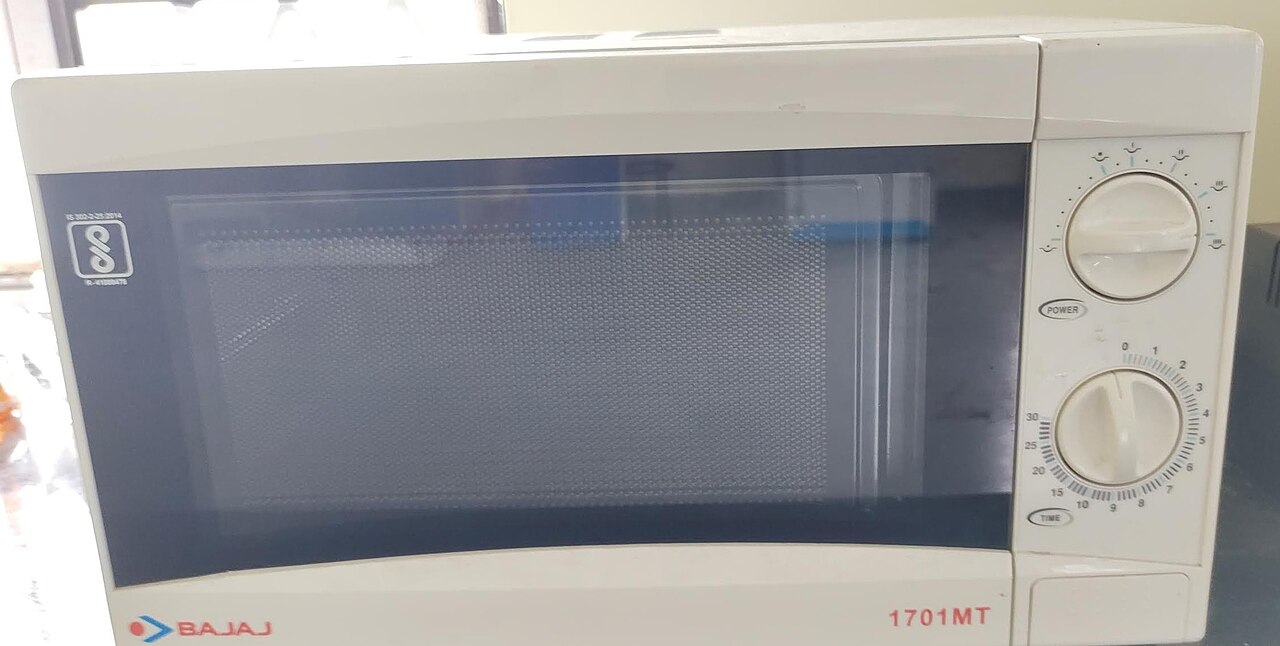
A countertop microwave oven. Photograph: Srini297/Wikimedia Commons
How standing waves make hot and cold spots
The oven cavity is a metal box, and metal reflects microwaves. When the waves from the magnetron bounce off the walls, the incoming and reflected waves overlap and interfere with each other. That interference forms a standing wave pattern: fixed zones where wave peaks line up and amplify each other, and zones where peaks meet troughs and cancel out.
EngineerFix describes the two zones precisely. Where the electric field is maximized, the antinodes, food absorbs far more energy and becomes a hot spot.
Where the field is minimized, the nodes, food absorbs little and stays a cold spot. The pattern is fixed in space, which is why the same dish develops the same hot and cold patches on repeated runs.
Tasting Table explains the practical consequence. Standing waves can cancel when they run into each other, leaving cold spots, while the energy absorption of the food itself also varies. A sugary sauce and a starchy base absorb energy at different rates, so even the dish's recipe adds unevenness.
This is a physics problem, not a repair problem. The USDA FSIS states plainly that microwave ovens can cook unevenly and leave cold spots where harmful bacteria can survive. The fix is technique, not a new appliance.
Why the middle of thick food lags behind
Penetration depth is the second half of the story. The 2.45 GHz waves only reach 1 to 2.5 centimeters into most foods, according to EngineerFix. That energy is deposited volumetrically within that shallow layer, so the exterior heats fast while the core waits.
The core heats by thermal conduction, a slow process. Heat creeps inward from the hot shell while the magnetron keeps blasting the outside. In dense foods like a thick casserole or a chicken breast, the result is scorched edges and a cool center.
Frozen food is the extreme case. NotTLDR points out that ice absorbs microwaves far less efficiently than liquid water.
When a frozen meal starts thawing, the already-liquid portions heat rapidly while the frozen sections resist. The dish then has two kinds of cold spot: frozen ones and standing-wave ones.
Salt and fat distribution adds another layer. Since microwaves target polar molecules, pockets of fat or salty sauce heat faster than plain starch. One corner of a lasagna can scald while the middle stays cool enough for bacteria, as the USDA guidance warns.
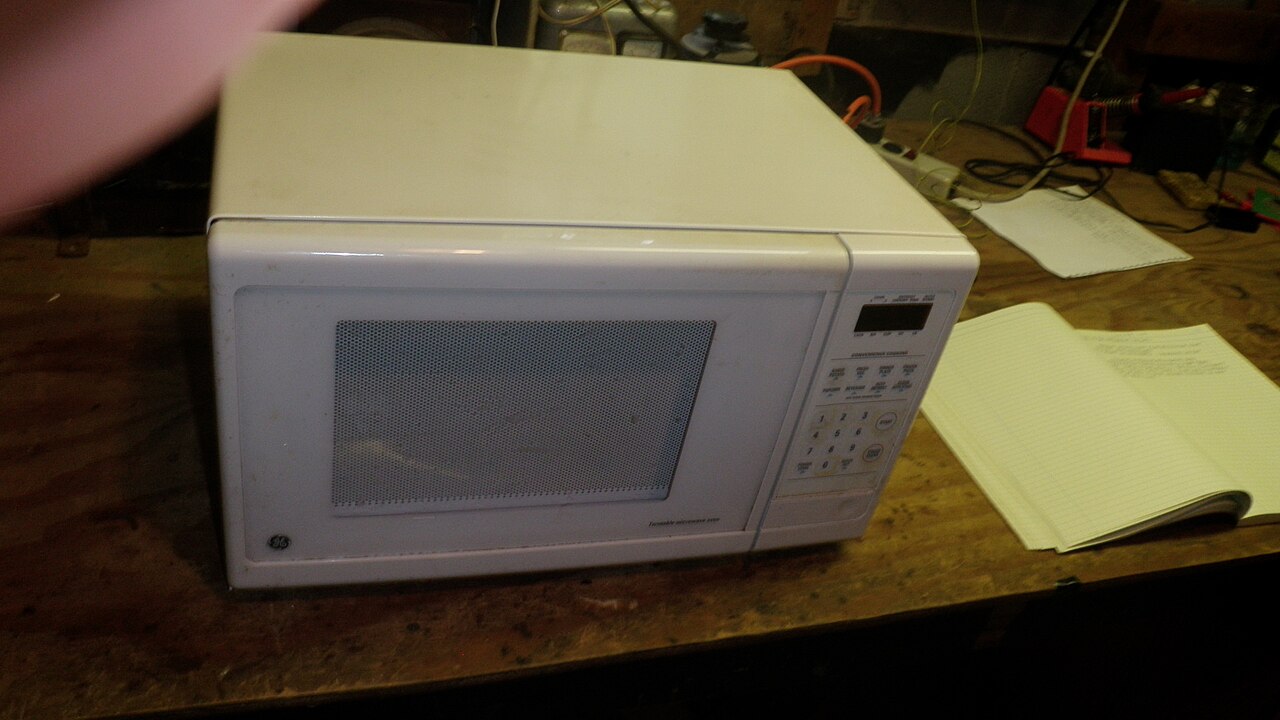
Microwave oven front with viewing window. Photograph: Jstapko/Wikimedia Commons
How turntables, stirring, and standing time fix it
Engineers attacked the fixed wave pattern with motion. The turntable rotates the food continuously so every part of the dish passes through both high and low energy zones, averaging the exposure over time. Tasting Table adds a useful trick: place food on the edge of the rotating plate rather than the center, so it sweeps through more of the oven's energy zones during rotation.
But the turntable does not eliminate the interference pattern. It only averages it. Three habits do the rest, and they match the USDA's own advice exactly.
First, stir and rotate midway. Rearranging the food moves hot portions into cold zones and breaks up the standing-wave map.
Second, arrange food evenly and cover it. A lid traps steam and evens out the surface temperature.
Third, use standing time. After the oven stops, the molecules keep transferring heat for several minutes, and dense foods can rise several degrees. The USDA emphasizes checking the temperature after standing, not the second the beep sounds.
Power levels matter too. Below High, most ovens do not lower the wave intensity.
They cycle the magnetron on and off. That is why dense foods do better on medium power with more time: the pauses give heat a chance to migrate inward without nuking the edges.
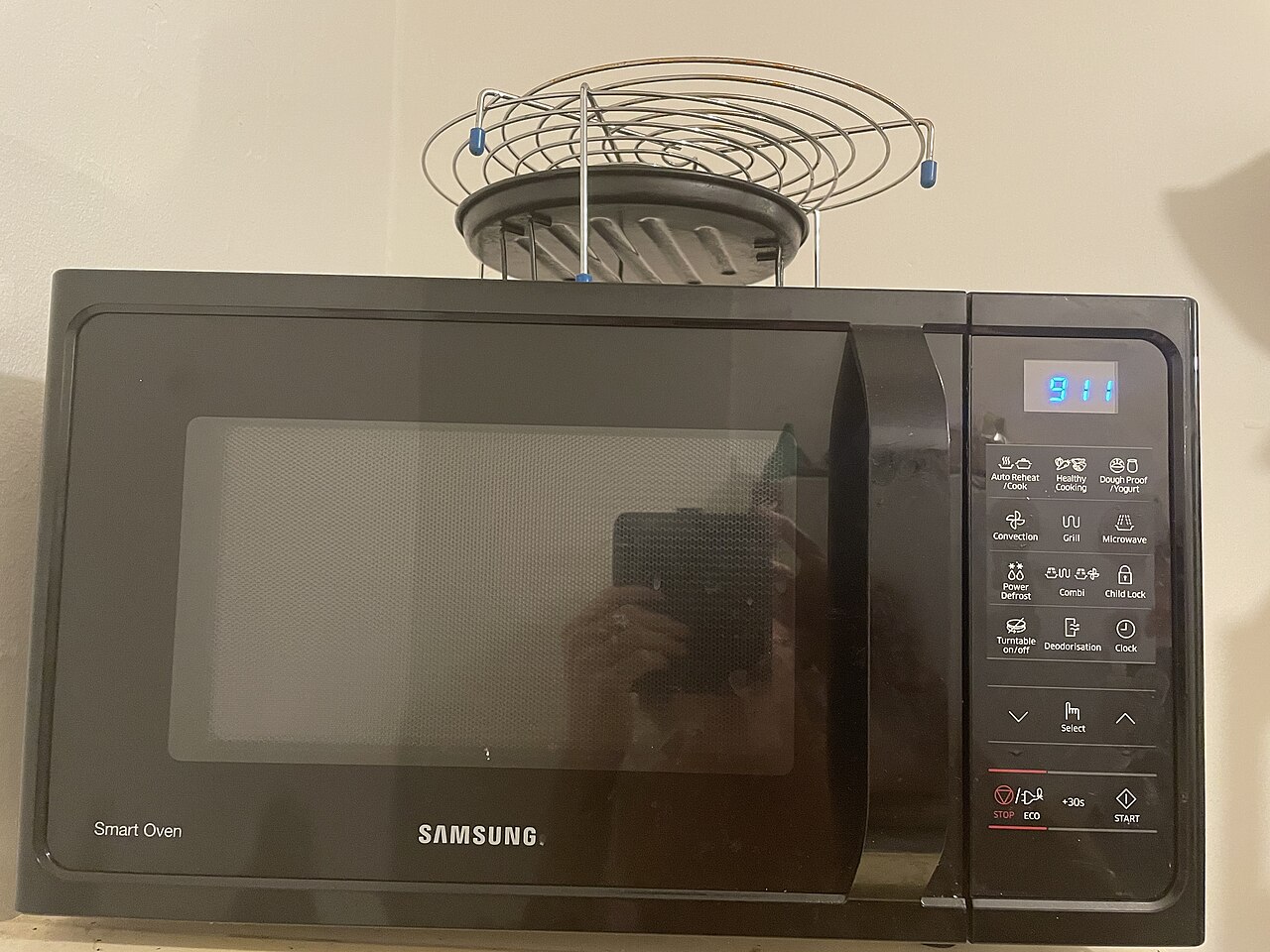
A combination microwave oven. Photograph: Klaas van Buiten/Wikimedia Commons
The final check is a food thermometer. Stir the food, let it stand, then measure in several spots.
Color and steam are not reliable guides. For safe reheating, leftovers should reach 165 degrees Fahrenheit throughout, per USDA guidance.
For a related look at how your home handles physics on a bigger scale, see why doors stick more in summer.
Frequently asked questions
Why does my microwave heat the edges but leave the middle cold?
Two reasons. The microwaves penetrate only 1 to 1.5 inches, so the center of thick food heats by slow conduction, and the standing-wave pattern inside the cavity places some fixed zones at low intensity. Stirring, covering, and standing time even it out.
Is uneven microwave heating dangerous?
It can be. The USDA FSIS warns that cold spots can let harmful bacteria survive. Stirring, rotating, standing time, and checking with a food thermometer are the recommended defenses, not a repair visit.
Does the turntable really help?
Yes, but it does not cure the problem. The turntable moves food through high and low energy zones so exposure averages out.
Placing the dish on the edge of the plate improves the effect. Standing waves still exist; motion just smooths their impact.
Why do frozen meals heat so unevenly?
Ice absorbs microwaves much less efficiently than liquid water. As the meal thaws, the liquid parts grab energy quickly while frozen sections lag. That is why a frozen dinner can be lava-hot in one corner and icy in another.
The bottom line
Inside a microwave, 2.45 GHz waves reflect off the metal walls and settle into a standing-wave pattern of hot antinodes and cold nodes, while the shallow 1 to 1.5 inch penetration leaves thick centers to conduction. Turntables, stirring, covering, and standing time average out the physics, and a thermometer confirms the job.
The cold middle is not a malfunction; it is a wave pattern you can outsmart. To explore more everyday science, read about how trees survive freezing winters and why outdoor lights attract spiders at night.
Latest in Science
- How do trees survive freezing winters without moving?
- Why do doors stick more in summer?
- Why do outdoor lights attract spiders at night?
Subscribe for one clear explainer every morning.
Image Credits: Wikimedia Commons / Srini297, Jstapko, Klaas van Buiten
Related stories
Why diamond is hard and graphite is soft when both are carbon
Diamond and graphite are both pure carbon, yet diamond is 10 on the Mohs scale and graphite is 1 to 2. The difference is not the atoms;
Why Hot Water Can Freeze Faster Than Cold: The Mpemba Effect Explained
Hot water can freeze faster than cold under specific conditions. The Mpemba effect, named for a 1963 schoolboy experiment, still divides
How Magnets Work at the Atomic Level: Spins, Domains, and Iron
Magnetism comes from electrons: their spin and orbits make each atom a tiny magnet. In iron, quantum forces align these atomic magnets into