
Why do we say the sun rises when the Earth is the one moving?
Key takeaways
- The sun doesn't travel across the sky. Earth spins eastward on its axis, sweeping your horizon past the sun.
- At the equator, Earth's surface moves at about 1,670 km/h (1,040 mph), yet we feel nothing because the motion is constant.
- We keep saying "sunrise" because the wording predates heliocentrism by millennia, and it still describes exactly what we see.

Image Credits: Wikimedia Commons
Every morning the sun climbs over the eastern horizon, and every evening it sinks in the west. For most of human history, the obvious conclusion was that the sun travels around us.
It doesn't. Earth spins eastward on its axis, and that spin sweeps your horizon past the sun, making it look like the sun is the one moving, as NASA's StarChild astronomy site explains. You are standing on a rotating platform, watching a stationary lamp.
This article explains the phrase. It covers what "sunrise" really describes, how Earth's spin creates the illusion, why we don't feel the motion, and why the old wording stuck around.
What "sunrise" actually describes
Sunrise is the moment your patch of Earth rotates into the sunlight. The sun hasn't moved to meet you. You have moved into its light.
Picture it this way. The sun sits roughly still, flooding space with light in all directions.
Earth turns like a slow rotisserie, and each spot on its surface takes a daily ride from darkness into light and back again. "Sunrise" names the moment the ride carries you over the edge into the lit half.
The same spin produces sunset, when your location rotates out of the light, and the wheeling of the stars at night. One motion explains all three.
How Earth's spin creates the illusion
Earth rotates from west to east, which looks counterclockwise when viewed from above the North Pole. Because the planet carries you eastward as it turns, whatever lies beyond the eastern horizon eventually comes up over it, in NASA StarChild's neat phrasing. That is why the sun, moon, planets, and stars all rise in the east and set in the west.
The speeds involved are startling. People at Earth's equator move at about 1,600 kilometers an hour, roughly a thousand miles an hour, thanks to rotation, according to StarChild.
A more precise figure from Science News Today puts it at 1,670 kilometers (1,040 miles) per hour. The speed falls off toward the poles: about 1,400 kilometers an hour in Texas, and only about a thousand kilometers an hour in southern Canada.
There is also a subtle timing detail. Earth completes one full turn relative to the distant stars in 23 hours, 56 minutes, and 4 seconds, a period astronomers call the sidereal day. But because Earth is also traveling around the sun, it takes about 24 hours for the sun to return to the same spot in our sky, which gives us the solar day we live by.
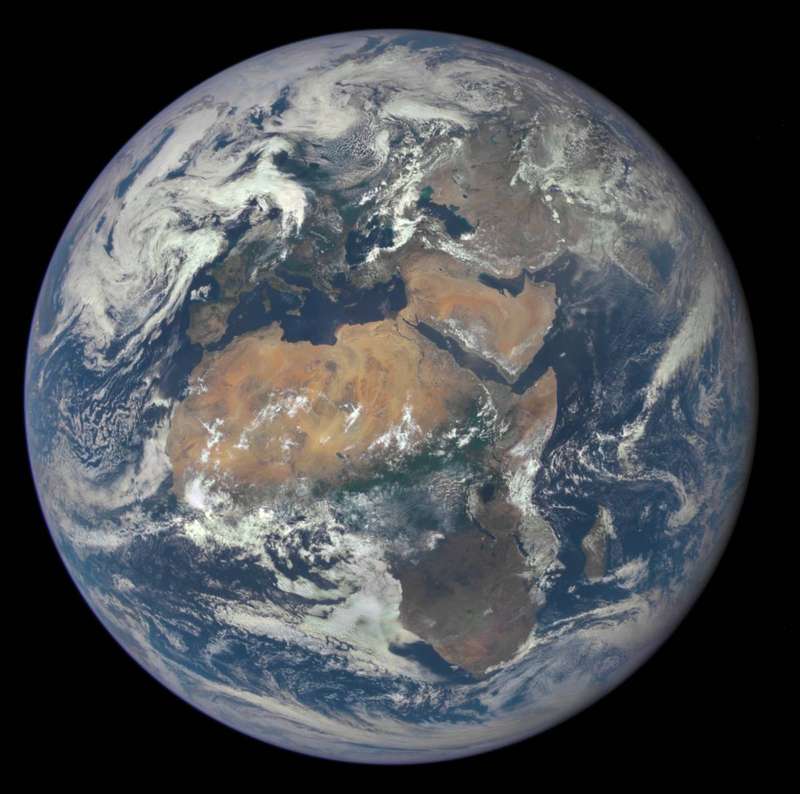
Image Credits: Wikimedia Commons
Why we don't feel the motion
A thousand miles an hour with no sensation of speed feels impossible, but it follows from how perception works. As StarChild explains, human beings have no "speed organs" that sense absolute speed. We can only tell how fast we are going relative to something else, and we sense changes in velocity when we speed up or slow down.
Earth's rotation is constant, so there is no change to feel. The atmosphere rotates with the planet too, which is why there is no thousand-mile-an-hour wind in our faces.
StarChild offers a car analogy: with the speedometer removed, you couldn't tell your speed on a smooth highway except by watching the world go by outside. Our "outside" is the sky, and what we see going by is the sun.
It took centuries of accumulated observations and clever experiments before scientists could prove the spin was real rather than simply asserting it, as the Biology Insights science site notes. Feeling nothing made the wrong answer feel right.
Why the old wording never went away
Geocentric language is older than the correction. Nicolaus Copernicus published his sun-centered model in "De revolutionibus orbium coelestium" in 1543, placing Earth as one planet among several orbiting the sun, according to the Wikipedia account of Copernican heliocentrism. People had been saying the equivalent of "sunrise" for thousands of years before that.
Language keeps what works. "Sunrise" is short, vivid, and describes exactly what an observer sees, which is what language is for.
Even professional astronomers say sunrise and sunset. The words now function as observer's terms, like "the horizon," rather than claims about who orbits whom.
There is also a deeper honesty available. On the largest scales, the question of "which one moves" depends on your frame of reference. The sun itself races around the center of the Milky Way at roughly 220 kilometers per second, as Biology Insights notes.
Everything in the universe is moving relative to something else. But the daily arc of sunlight across your sky is Earth's spin, full stop.
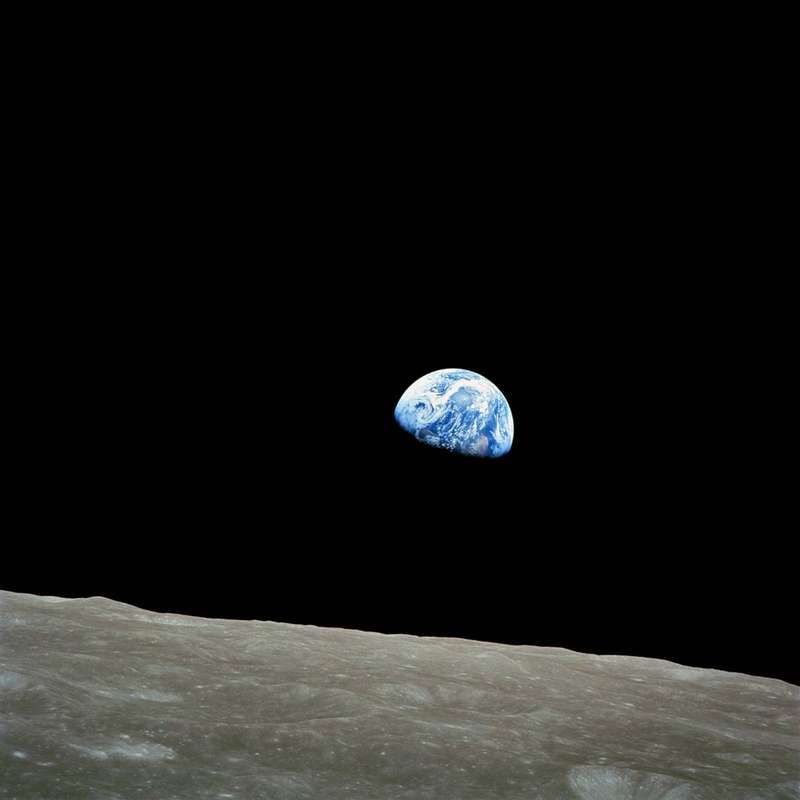
Image Credits: Wikimedia Commons
FAQ
Does the sun move at all?
Yes, just not in a way that causes day and night. The sun orbits the center of the Milky Way at roughly 220 kilometers per second, and Earth orbits the sun once a year. But the daily sunrise-to-sunset arc is produced entirely by Earth's spin.
What would happen if Earth stopped spinning?
The sun would sit nearly motionless in the sky for months at a time, shifting only as Earth continued its much slower yearly orbit around it, according to Biology Insights. Days would last half a year and nights the other half.
Why does the sun rise in the east specifically?
Because Earth spins from west to east. Your location rotates toward the sun on the eastern side first, so the sun appears over the eastern horizon, crosses the sky, and sets in the west.
Do other planets have sunrises?
Any rotating planet with a nearby star gets the same effect. Venus and Uranus are the odd ones out: they spin east to west, opposite to Earth, so a sunrise there would appear in the west.
The bottom line
We say the sun rises because our language was written before we knew better, and because the phrase still describes exactly what we see.
The physics underneath is simple: Earth spins eastward at up to 1,670 km/h, carrying each of us into the sunlight every morning. The sun never moved. We did.
Rive News is the research desk behind the Rive News publication, covering the science behind everyday questions.
Related stories
- What is the difference between APR and effective annual rate?
- What is the ideal indoor humidity level, and why does it matter?
- How to pack a backpack for 2 weeks in one bag
- Can you revive stale bread, and how does the trick work?
Subscribe to the Rive News newsletter for one practical explainer in your inbox every morning.
Related stories

Why diamond is hard and graphite is soft when both are carbon
Diamond and graphite are both pure carbon, yet diamond is 10 on the Mohs scale and graphite is 1 to 2. The difference is not the atoms;

Why Hot Water Can Freeze Faster Than Cold: The Mpemba Effect Explained
Hot water can freeze faster than cold under specific conditions. The Mpemba effect, named for a 1963 schoolboy experiment, still divides

How Magnets Work at the Atomic Level: Spins, Domains, and Iron
Magnetism comes from electrons: their spin and orbits make each atom a tiny magnet. In iron, quantum forces align these atomic magnets into