
Why airports sometimes board planes from the back door
By Rive News / Research desk | Rive News / Published October 28, 2026 at 9:00 AM PKT
Key takeaways
- Back boarding means two different things: back-to-front zones through one door, and rear-door boarding through two doors.
- Back-to-front zones feel orderly, but research and a MythBusters test found them slower than window-first methods.
- Rear-door boarding at remote stands splits passengers in two, which can roughly halve boarding and deplaning time.
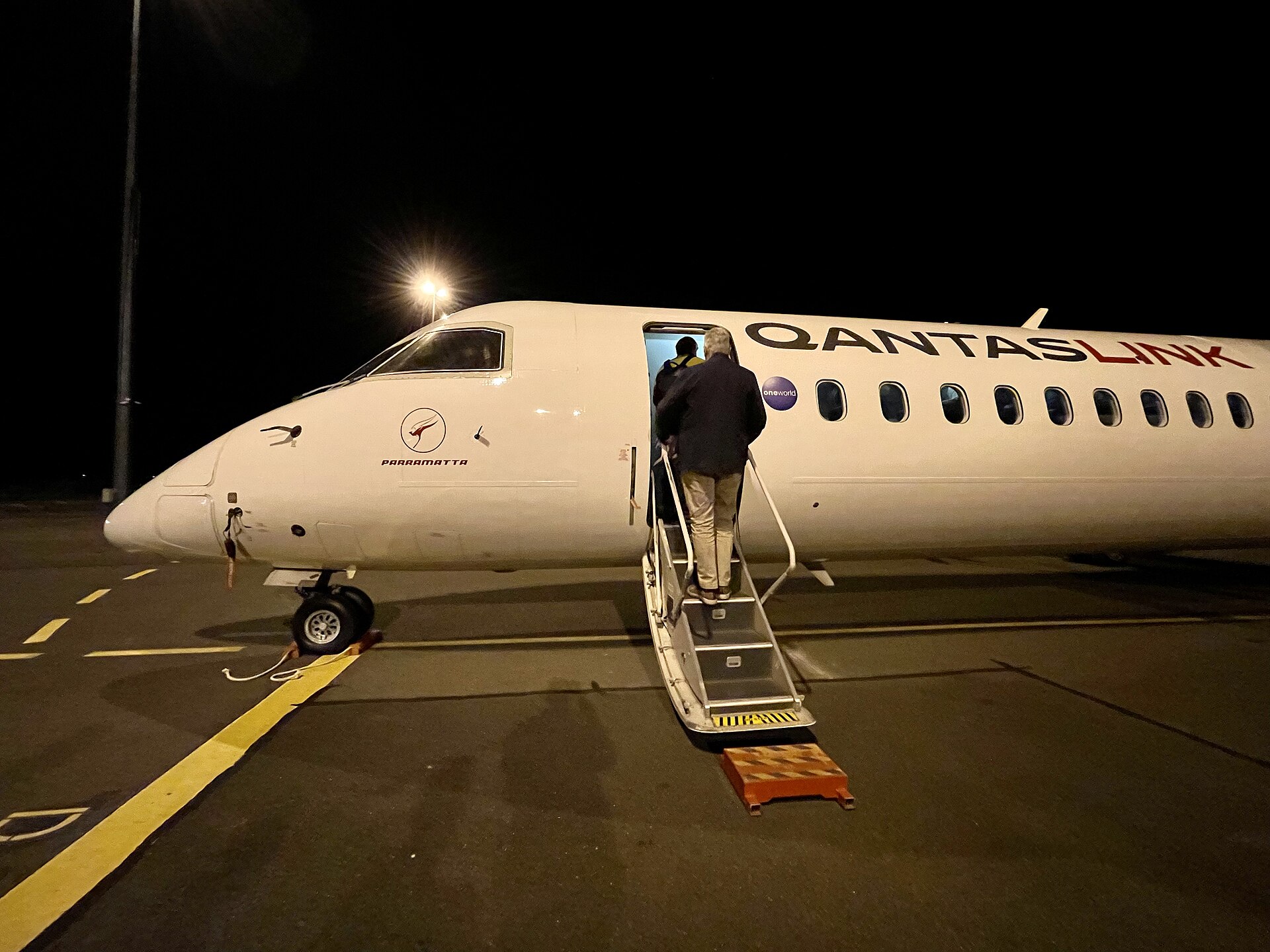
[Passengers boarding a QantasLink aircraft at Roma Airport in 2021.] Photograph: passengers boarding an aircraft
Image Credits: Wikimedia Commons
If you have ever been sent to the back of the plane first, or walked up rear stairs on the tarmac while others used the front door, you have seen back boarding in one of its two forms. The phrase covers two different practices, and they exist for different reasons. One is about the order passengers walk down the aisle, and the other is about which door they use.
This article explains both, why airlines keep using the slower one, what faster methods look like, and what back boarding means for your seat choice.
Back-to-front zones: the orderly method
The most common form of back boarding is back-to-front zone boarding through a single front door. Wikibooks' boarding summary describes the usual pattern: passengers are divided into groups, with the last rows boarding first, then the middle rows, then the front rows. The logic feels obvious.
People heading for the back walk past empty front seats, sit down, and clear the aisle before the next group arrives. Nobody should have to climb over seated passengers to reach the rear.
That logic has one large flaw, which is the aisle itself. When a whole group boards at once, everyone queues in the same narrow aisle, and each person who stops to stow a bag blocks everyone behind them. Wikibooks notes that research over the last 15 years has repeatedly shown back-to-front is not the most efficient method, and that a better method could cut turnaround time, the gap between arrival and departure, by up to 20 minutes.
The orderly feeling comes from the gate area, where groups wait neatly, not from the aisle, where the queue forms.
A famous television test made the point vividly. Grunge reports that the MythBusters team timed back-to-front boarding at 24 minutes and 29 seconds from announcement to last passenger seated, the slowest method they tested. Boarding window-seat passengers first, then middle seats, then aisle seats, took about 15 minutes, nearly half the time.
The back-to-front method also left several passengers unable to fit hand luggage in the overhead lockers near their seats. Order at the gate turned into congestion in the cabin.
Why airlines keep it anyway
If back-to-front is slower, airlines must have reasons beyond raw speed, and they do. The first is simplicity. Passengers understand row zones instantly, and gate staff can call them without explaining a complicated sequence.
A method that confuses passengers will fail in practice no matter how fast it looks on paper, because confused passengers ask questions, block the gate, and board in the wrong order anyway.
The second reason is commercial. Airlines sell priority boarding, and priority passengers usually sit at the front, in premium cabins or extra-legroom rows. Grunge notes that premium cabins are filled first under front-to-back priority systems, which frees the aisle for later passengers and rewards the passengers who paid most.
A pure speed-first system would board window passengers from all cabins together, which would erase the visible perk that premium passengers bought. Airlines protect that perk because it earns money.
The third reason is operational habit. Crews, gate systems, and airport announcements are all built around zone boarding, and changing them across hundreds of airports is a large project. A method that saves ten minutes per flight is attractive, but only if it works reliably at every station, with every passenger mix, including families, elderly travelers, and passengers needing assistance.
Airlines weigh that reliability against the theoretical saving and often keep the familiar system.
Rear-door boarding: the two-door method
The second form of back boarding is genuinely different, because it uses the rear door as well as the front one. This happens mainly at remote stands, where passengers reach the plane by bus or by walking across the tarmac instead of through a jet bridge. Ground crews place stairs at both doors, and passengers split into two streams, front-seat passengers through the front door and rear-seat passengers through the rear door.
Each stream has a shorter aisle walk and a shorter queue.
The time saving here is real, because two doors truly double the entry points. A Substack analysis of remote-stand operations argues that using both doors can cut boarding and deplaning times roughly in half compared with a single jet bridge. European low-cost carriers exploit this heavily, and the same analysis names Ryanair as an airline that boards through both ends whenever possible.
Flying Smarter reports a typical Ryanair configuration: front-door boarding through built-in stairs and rear-door boarding through movable airstairs at the same time, which speeds up both boarding and deplaning.
Rear stairs are not limited to remote stands. Cranky Flier notes that JetBlue often uses airstairs at the rear even when a jet bridge is attached at the front, and that Southwest experimented with dual jet bridges at Albany. United later tried an automated second bridge at Denver that could navigate over the wing to the rear door.
These experiments show the same idea in jet-bridge form: two doors beat one, but the equipment to serve a rear door through a bridge is expensive and fiddly. Stairs on the tarmac are cheaper, which is why rear-door boarding is most common where planes park away from the terminal.
What the faster methods actually are
Researchers have tested several methods that beat back-to-front, and they share one principle: keep people who will block each other apart. The window-middle-aisle method, sometimes called Wilma, boards all window passengers first, then middle seats, then aisle seats. Nobody has to climb over a seated neighbor, so the aisle stays clearer and bags go up faster.
The MythBusters result of about 15 minutes against 24 minutes and 29 seconds for back-to-front shows how large the gap can be.
The Steffen method, developed by University of Nevada, Las Vegas physicist Jason Steffen, goes further. Passengers board in a sequence arranged so that neighboring passengers in the queue never need the same part of the plane at the same time. It is mathematically the fastest of the common methods in simulations, but it is hard to run at a real gate, because it requires passengers to line up in an exact order that has nothing to do with their row.
Airlines have therefore borrowed pieces of these ideas, such as boarding window seats early within each zone, rather than adopting them wholesale.
Random boarding, where passengers board in no particular order, also beats back-to-front in studies, because it spreads interference evenly instead of concentrating it. That result surprises most travelers, but the logic is sound: when boarding is random, the people blocking each other are scattered, so no single long queue forms. Airlines rarely use pure random boarding, because passengers dislike the apparent unfairness and because it removes the priority perk.
The lesson is not that airlines should abandon order, but that the most orderly-looking method is not the fastest one.
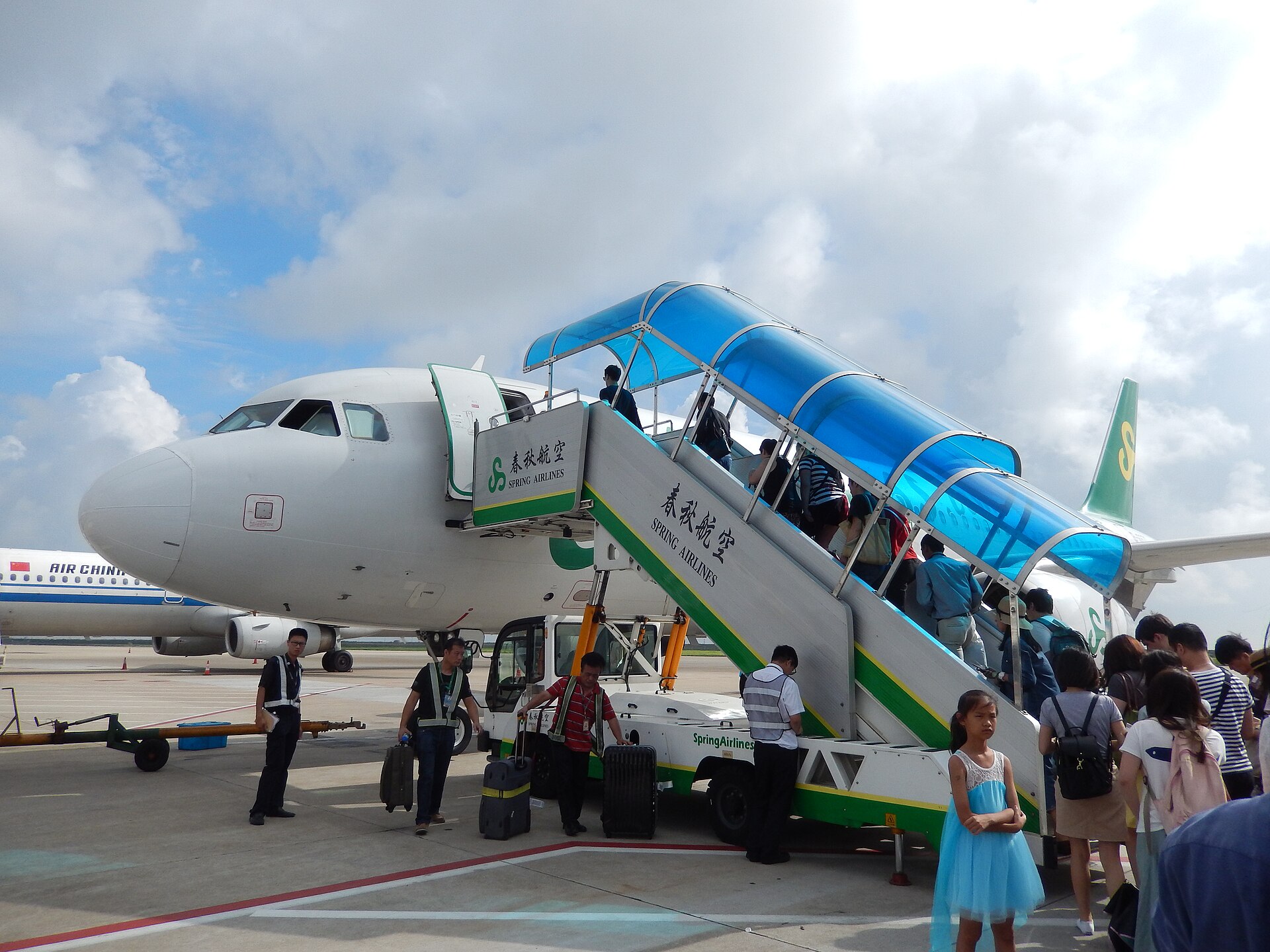
[A Spring Airlines aircraft with passenger boarding stairs at Shanghai Pudong.] Photograph: an aircraft with boarding stairs
Image Credits: Wikimedia Commons
Should I choose a rear seat for faster boarding?
A rear seat helps if your flight boards back-to-front, since you will be called early, but it can hurt at arrival, since you will deplane last through a single front door. The calculation flips at a remote stand with rear-door boarding, where rear seats deplane first through the rear door. Check how your airport boards before choosing a seat for speed.
At a jet-bridge gate, front seats usually exit fastest, while at a remote stand, rear seats can win.
Why do some flights board through both doors and others do not?
It depends on where the plane parks and what equipment the airport provides. Remote stands make two-door boarding easy, because stairs can be placed at both doors cheaply. Jet-bridge gates normally serve only the front door, because a second bridge must cross the wing and costs far more.
Low-cost carriers favor remote stands partly for this reason, while full-service carriers at major hubs usually accept the single-door limit.
Does back boarding delay the flight?
Back-to-front boarding is slower than the fastest alternatives, but airlines build that time into their schedules, so it rarely causes a delay by itself. The delay risk comes when boarding runs long for other reasons, such as late passengers or full overhead lockers. Rear-door boarding at remote stands usually shortens the process, which is one reason low-cost carriers favor it for tight turnarounds.
What should I do when my zone is called last?
Wait for your zone rather than crowding the gate, since early crowding slows everyone, including you. Keep your boarding pass and identification ready, and stow your bag quickly once you reach your row. If you sit at the back and board early, use the overhead locker near your seat promptly, because late boarders often find nearby lockers already full.
The bottom line
Airports board planes from the back for two distinct reasons, and they point in opposite directions. Back-to-front zones feel orderly but test slower than window-first methods, and airlines keep them for simplicity, premium perks, and reliability. Rear-door boarding, by contrast, genuinely speeds things up by splitting passengers across two doors, which is why it thrives at remote stands.
Knowing which kind of back boarding your flight uses tells you more about your journey than the boarding announcement alone. If you see stairs at both ends of the plane, you are in for a quick boarding. If you hear rear zones called first through one door, settle in and expect a queue.
Tags: airports, boarding, airlines, travel tips
Rive News's research desk writes plain-language explainers from public sources, with every key claim tied to a named document or institution.
Related
- Why do boarding groups exist and do they actually work
- Why do airlines dim cabin lights
- How airport security scanners see inside bags
- Why airplane windows have rounded corners on airliners
Subscribe for one plain-language travel explainer in your inbox each morning.
Rive News publishes explainers from public sources; corrections are welcomed and noted on the article.
Related stories
The 3-1-1 liquids rule for planes: what each number means
TSA's 3-1-1 rule limits carry-on liquids to 3.4-ounce containers in one quart bag. Where the 2006 rule came from, what counts, and how
Why Is Airplane Food So Bland at Altitude?
A 2010 Fraunhofer study found altitude cuts sweet and salty perception by up to 30 percent. Low humidity, cabin pressure, and noise all
Carry-on size limits: why airlines each set their own
Airlines set their own carry-on limits because the FAA only requires each carrier to have a policy, not one global size. Why 22 x 14 x