
What happens to your luggage after you check it in
By Rive News / Research desk | Rive News / Published October 27, 2026 at 9:00 AM PKT
Key takeaways
- After check-in, a bag is tagged, screened, sorted, and loaded, usually in a few minutes of system time.
- Screening comes before sorting, and a flagged bag is pulled aside for a manual check while the rest keep moving.
- Missed bags usually come from tight connections, unreadable tags, or late check-in, not from bags being lost in a maze.
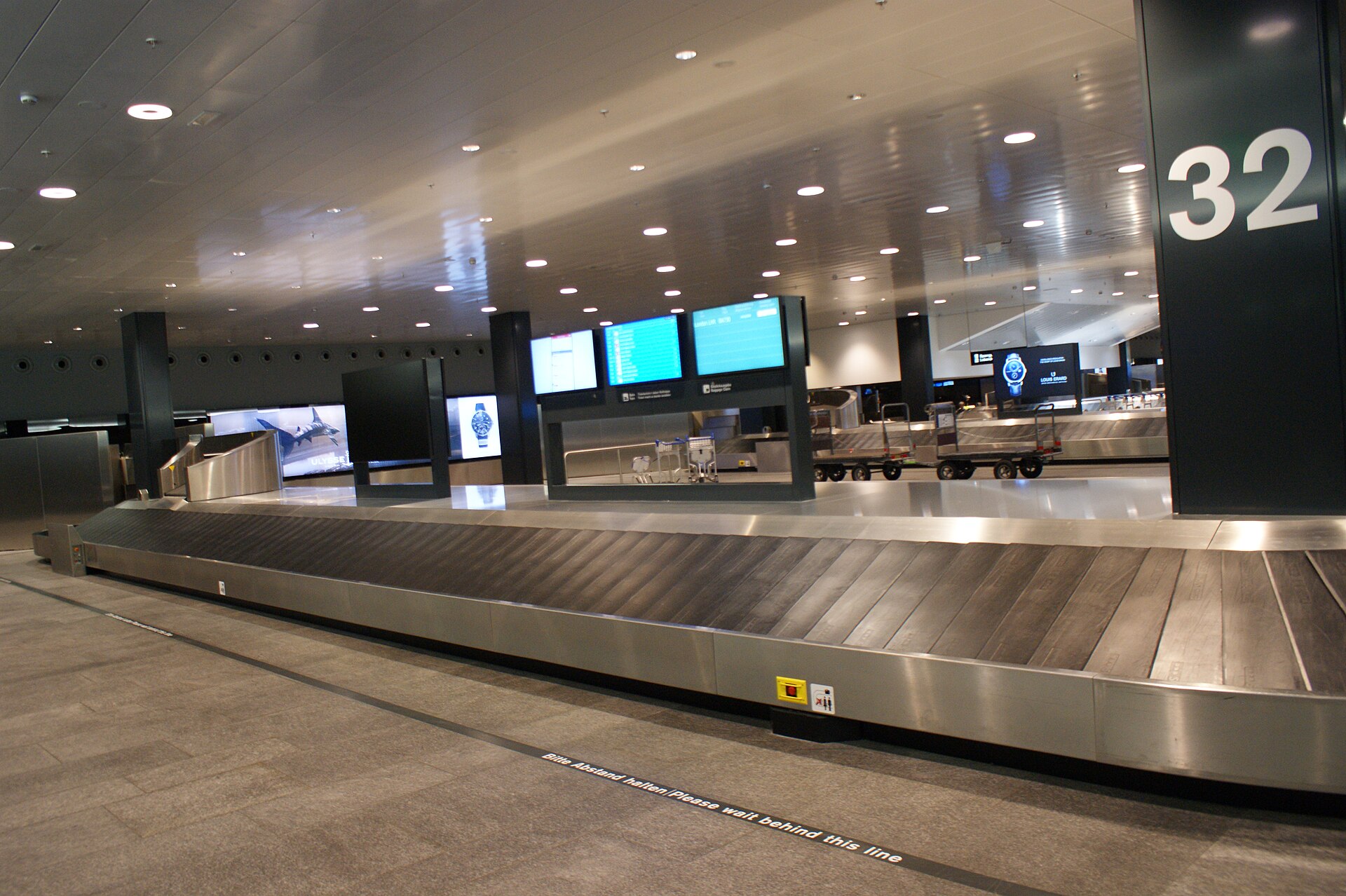
[A baggage conveyor belt at an airport terminal.] Photograph: airport photo
Image Credits: Wikimedia Commons
What happens to your luggage after you check it in is a short, busy journey through a hidden part of the airport. The bag drops out of sight at the counter, rides belts and sorters through screening and sorting, and ends up in the hold of the aircraft, ideally before the passengers board. The whole system is designed to be fast and boring, and most of the time it is.
This article explains what happens to your luggage after you check it in, including tagging, security screening, sorting, loading, and arrival. It also covers why bags sometimes miss flights, and what travellers can do to cut the odds.
The tag is the bag's identity
Everything starts with the tag printed at check-in. The tag carries the passenger's name, the flight number, the destination, and a barcode that machines can read at every stage. Some airports add radio-frequency identification, or RFID, tags, which scanners can read by radio waves without a clear line of sight to a barcode.
Cathay Pacific's account of Hong Kong International Airport explains that each bag is directed by its tag, which scanners and sorters read to send it to the right sorting area and flight bay. If the tag is damaged, missing, or unreadable, the bag cannot be routed automatically, and a handler must intervene. That is one reason old tags and stickers should be removed before a trip: a stale barcode can confuse a reader.
At check-in, the bag is also weighed, and the passenger receives a claim stub or a digital record. That stub matters at arrival, because it is the proof that a particular bag belongs to a particular passenger. Keeping it until the bag is in hand is a small habit that saves trouble if a bag goes astray.
Screening comes first
Before sorting, every checked bag goes through security screening. In the United States, the Transportation Security Administration screens checked bags for explosives and other prohibited items, and the agency reports conducting about 1.3 million checked-bag screenings each day. Most bags pass through X-ray or CT scanners without any human opening them.
Cathay Pacific notes that checked bags at Hong Kong International Airport go through up to four levels of screening before loading. The first levels are automated, and only bags that raise a question move to deeper checks. A bag that fails an early level is diverted for closer inspection, while cleared bags continue on their route.
If a bag is opened for a manual check, the passenger usually finds out at arrival. In the United States, the TSA places a notice of inspection inside any bag it opens, so the traveller knows the bag was examined.
Prohibited items found in that check may be confiscated, and the airline may need to discuss consequences with the passenger. Packing lithium batteries and valuables in hand luggage, as airlines advise, avoids the most common version of this problem.
Sorting: the hidden maze
After screening, the bag enters the sorting system, a network of conveyors, scanners, and diverters hidden below or behind the terminal. Barcode readers and photo sensors track the bag's progress and push it left, right, up, or down toward its flight's sorting area. Humans monitor the system on cameras and computers, and step in when a bag falls off a belt or a reader cannot read a tag.
The scale of these systems surprises most travellers. Toronto Pearson Airport reports 30 kilometres of conveyor belts, which carried more than 100,000 bags every day in 2019. At Hong Kong International Airport, check-in sits on level seven and baggage handling on level two, so each bag travels down five storeys as part of its journey. Cathay Pacific puts that system's success rate at 99.9 per cent for getting bags to the right place on time, even during peak festive periods.
At San Jose International Airport, Popular Science reports, the behind-the-scenes make-up area uses an automatic tag reader followed by more than 800 photo sensors that track each bag. The whole process, from the make-up area to the sorted flight bay, takes an average of three and a half minutes when nothing goes wrong. That figure is system time, not the traveller's wait, since the bag may sit in the sorting area until loading begins.
Bags for flights that depart hours later are not kept circling forever. They are set aside in a secure holding area and brought forward when loading starts, which is why checking in early rarely means a bag boards early. The bag waits, sorted and tracked, until the ground crew calls for it.
Loading: weight, balance, and the hold
Loading is where the bag leaves the building. Ground crew move sorted bags to the aircraft on carts or in containers called unit load devices, which are used on larger aircraft. At the aircraft, handlers load bags into the hold in an order that helps balance the plane, not simply in the order bags arrived.
Weight and balance matter because an aircraft's centre of gravity affects how it flies. Heavier bags are typically loaded first and lower, while the load is spread so no section is overloaded. Once loading is complete, the cargo doors close, and the bag is officially travelling with the flight.
This stage is also where tight connections fail. A bag arriving on a late inbound flight must be unloaded, carried across the airport, re-screened if required, and loaded onto the next aircraft, all within the connection time. A passenger can sprint through a terminal in minutes, but a bag cannot, which is why short connections are the biggest cause of delayed bags.
Arrival: from hold to carousel
At the destination, the process runs in reverse. Handlers meet the aircraft at the gate, unload the hold onto trailers, and drive the bags to the terminal's baggage area. Ground crew then load bags onto the carousel lane for the flight, and each bag slides down a chute onto the moving belt where passengers wait.
Toronto Pearson describes that final step plainly: handlers unload the aircraft, drive bags to the carousels, and load them onto the belt, and the journey ends when the passenger picks the bag up. If a bag does not appear, the first step is the airline's baggage desk in the arrivals area, with the claim stub and a description of the bag. Most "lost" bags are delayed, not lost, and turn up on a later flight to the same airport.
Transfer bags that miss a connection follow a different path: they are re-tagged for the next available flight and sent through the system again. That is why a delayed bag often arrives hours later, sometimes delivered to the traveller's hotel or home, rather than vanishing entirely.
Why bags actually go missing
The common image of a bag lost in a maze is mostly wrong. The usual causes are simpler: a tag torn off by a belt, a bag checked in too late to make sorting, a connection too short for the transfer, or a bag loaded onto the wrong flight during a busy turnaround. Each of those is a failure at a handoff, not a bag wandering forever in tunnels.
Removing old tags, using a sturdy tag holder, and keeping the claim stub all reduce the odds. So does avoiding very short connections, especially at large hub airports where the transfer distance is long. A distinctive bag, or a bright strap, helps at the carousel and at the baggage desk, since a plain black case is hard to describe and easy to confuse.
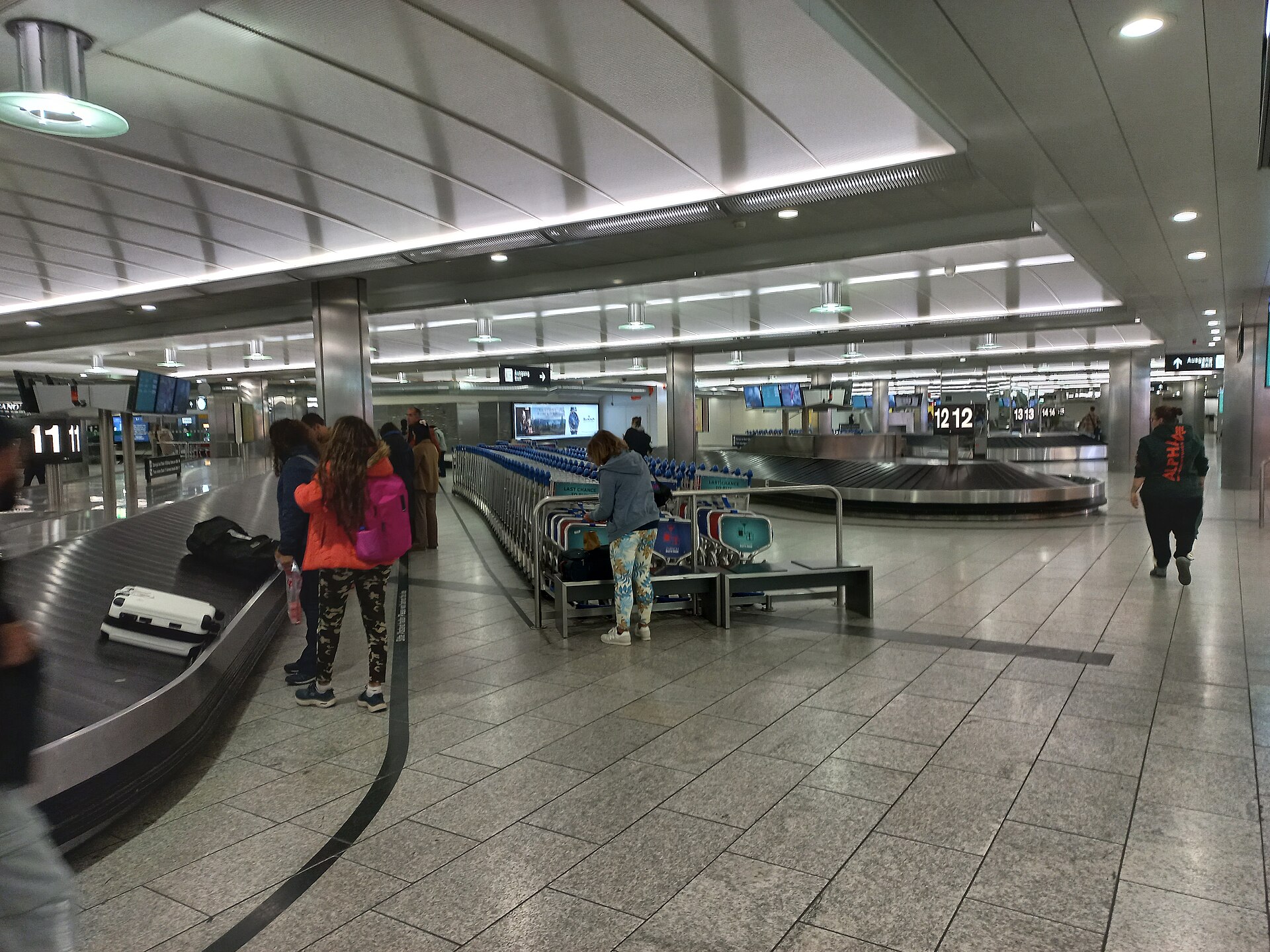
[A baggage handling system with belts and sorting equipment inside an airport.] Photograph: airport photo
Image Credits: Wikimedia Commons
Frequently asked questions
How long does checked baggage take to reach the plane?
The system time is short, with San Jose's make-up area averaging about three and a half minutes per bag when nothing goes wrong. The total time from check-in to loading is longer, since bags wait in sorting areas until loading begins. Checking in early does not make a bag board early.
Do all checked bags get X-rayed?
Yes, in practice, since checked bags pass through automated screening before loading, with deeper levels for flagged bags. The TSA reports about 1.3 million checked-bag screenings a day in the United States. A manual opening is the exception, and it leaves a notice inside the bag.
What happens if my bag misses my flight?
The airline re-tags it for the next available flight and sends it through the system again, then usually delivers it to the traveller. Report the missing bag at the arrivals baggage desk with the claim stub and a description. Most delayed bags arrive within a day, though the airline's tracking page is the best source for a specific case.
Can I track my checked bag myself?
Many airlines show bag status in their apps, from check-in through loading to arrival, using the tag scans. RFID-tagged bags at equipped airports give more frequent updates. An independent tracker in the bag can add location data, but airline systems remain the authority for delivery.
The bottom line
A checked bag's journey is a chain of handoffs, each tracked by a tag: check-in, screening, sorting, loading, and carousel. The systems behind it are large, fast, and mostly reliable, with success rates near 99.9 per cent at major airports, yet they depend on a readable tag and enough connection time. Remove old tags, keep the claim stub, and allow generous connections, and the bag will usually beat the traveller to the carousel in spirit, if not in fact.
Tags: airports, travel, luggage
The Rive News research desk writes plain-language explainers from published sources, with no invented experts or first-hand claims.
Related
- How do airport security scanners see inside your bags?
- Why do airlines overbook flights and how does bumping work?
- How to deal with lost luggage and get compensation
- Why is airplane food so bland at altitude?
Subscribe for one plain-language explainer a day, drawn from published sources.
Rive News publishes explainers from public sources; corrections are noted on the article when a sourced fact changes.
Related stories
The 3-1-1 liquids rule for planes: what each number means
TSA's 3-1-1 rule limits carry-on liquids to 3.4-ounce containers in one quart bag. Where the 2006 rule came from, what counts, and how
Why Is Airplane Food So Bland at Altitude?
A 2010 Fraunhofer study found altitude cuts sweet and salty perception by up to 30 percent. Low humidity, cabin pressure, and noise all
Carry-on size limits: why airlines each set their own
Airlines set their own carry-on limits because the FAA only requires each carrier to have a policy, not one global size. Why 22 x 14 x