
Why planes board from the back sometimes and the front other times
By Rive News / Research desk | Rive News / Published October 29, 2026 at 9:00 AM PKT
Key takeaways
- No single boarding order wins on every measure, so airlines mix zone, class, and seat-type rules.
- Tests show strict back-to-front boarding is among the slowest methods, because bag-stowing passengers jam the same aisle.
- The fastest tested method boards window seats first, in spaced rows, but it is hard to run at a real gate.
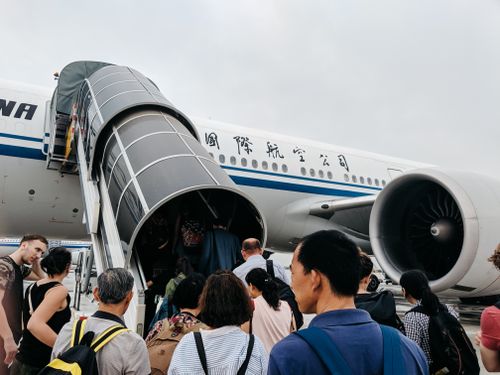
[A group of people boards an airplane via a jet bridge at Beijing Airport, the orderly queue that boarding methods try to speed up.] Photograph: Passengers boarding via a jet bridge
Image Credits: Pexels
Boarding order looks inconsistent because it is. On one flight you walk to the back first, on the next the front rows fill first, and on another the gate agent calls window seats before aisle seats. Each version is solving a different problem, and none of them solves all of them at once.
This article explains why planes board from the back sometimes and the front other times, including the aisle jam that slows back-to-front boarding, the seat-type trick that beats it, the premium and weight reasons for front-first boarding, and the pandemic change that brought back-to-front back.
The aisle is the bottleneck
Boarding feels slow because one narrow aisle serves every passenger. Only one person can stow a bag at a time in a given stretch of aisle, and everyone behind that person waits. A boarding method wins or loses on how many of these waits it creates, not on how orderly the queue looks at the gate.
Two kinds of interference cause the waits. Aisle interference happens when a passenger standing in the aisle blocks everyone behind them. Seat interference happens when a seated passenger must stand up so a window-seat neighbour can climb in.
Researchers who model boarding count both, because cutting one without cutting the other leaves the queue just as slow.
That is why intuition misleads here. Filling the back first sounds tidy, since rear passengers never walk past seated people. In practice, rear passengers board in one clump, stop in the same few rows to stow bags, and create a single long jam.
The tidy idea concentrates the very waits it was meant to spread out.
Back-to-front is slower than it looks
Astrophysicist Jason Steffen tested boarding methods on a mock 757 with 72 volunteers carrying roller bags, and the results were published in the Journal of Air Transport Management. Boarding back-to-front took 6 minutes and 11 seconds. Boarding by sections took 6 minutes and 54 seconds.
Those two familiar methods were the slowest of the five tested.
Boarding window seats, then middle seats, then aisle seats took just over 4 minutes. Boarding at random took about 5 minutes. Steffen's own staggered method, which spaces passengers across rows and seat types, took 3 minutes and 36 seconds.
The gap between the slowest and fastest methods was nearly half the boarding time.
A separate MythBusters-style test with 173 passengers reached a similar verdict, finding back-to-front the slowest method at 24 minutes and 29 seconds, against about 15 minutes for window-first boarding. The two tests used different aircraft and passenger counts, but they agreed on the ranking. Back-to-front feels logical and performs badly.
Why random boarding beats tidy rows
Random boarding works because strangers rarely sit together. When passengers board in random order, neighbours in the queue usually head for different rows, so several people can stow bags at once in different parts of the cabin. The aisle gets used in parallel instead of in a single queue.
Steffen himself noted that random boarding would beat the methods airlines use today, for exactly this reason. Passengers who line up at random are unlikely to be assigned adjacent seats, so they are less likely to jostle for the same overhead bin or the same stretch of aisle. Disorder, in this case, is a feature.
Airlines rarely use pure random boarding, though. It feels unfair to passengers who paid for priority, and it gives gate agents nothing to announce. Instead, airlines use zones and groups that approximate randomness while still letting them sell early boarding.
The window-first trick and the Steffen method
The window-first method, known as Wilma, boards window seats first, then middle seats, then aisle seats. It eliminates seat interference, because nobody climbs over a seated neighbour. A window passenger sits down while the middle and aisle seats beside them are still empty.
Steffen's method adds one more idea: spacing. Passengers board in every other row, from the back forward, on one side first, then the other, and the sequence repeats for middle and aisle seats. A 30-row aircraft would start with seats 30A, 28A, and 26A, so that people stowing bags are never standing next to each other.
The method spreads passengers across the cabin so the aisle can be used in several places at once.
The catch is complexity. A gate agent would need to call passengers in a precise, unusual order, and families travelling together would be split across groups. Airlines have shown little interest in running it, despite the test results.
Speed matters, but it competes with simplicity, customer satisfaction, and the sale of priority boarding.
Why the front boards first on many flights
Premium cabins sit at the front, and their passengers paid for early boarding. Letting first and business class board first is a product promise, not an efficiency choice. It also clears the front of the cabin early, so later passengers can walk through without squeezing past premium travellers still settling in.
Weight distribution is sometimes cited as a second reason. Aircraft are heavier at the back, where the engines sit, so filling the front first is said to balance the load during boarding.
Front-first boarding also suits flights that board through a single front door at a jet bridge. Passengers for the front rows step straight into their seats, while everyone else walks past them. The flow is simple to announce and easy to follow, even though it is not the fastest method available.
Simplicity wins many gate decisions.
When both doors open, the rules change
Some airports board through both the front and rear doors, often using stairs on the tarmac. In that case, front rows use the front door and rear rows use the rear door, and the two streams meet in the middle. This is the fastest common setup in practice, because it splits the aisle into two shorter queues.
Low-cost carriers use this method often, since they turn aircraft around quickly and many of their stands lack jet bridges.
Rear-door boarding also explains some back-first announcements. When only the rear door is in use, or when a flight boards from the back of a jet bridge arrangement, rear passengers naturally go first. The door, not a theory of efficiency, decides the order on those flights.
Why back-to-front came back during COVID-19
During the pandemic, several airlines switched to back-to-front boarding to reduce the number of passengers walking past seated travellers. The idea was to limit close contact in the cabin. It sounded safer, and it was easy to explain to worried passengers.
Modelling told a different story. A 2020 study by Islam and colleagues simulated the new processes and found that back-to-front boarding roughly doubled infection exposure compared with random boarding. It also raised exposure by about 50 percent compared with the typical pre-pandemic process.
The reason was clustering: rear passengers bunched in the aisle while stowing bags, spending longer close to each other and to seated neighbours.
The study's authors suggested airlines either return to their earlier process or adopt random boarding. Most airlines did, in effect, drift back to zone and group boarding once pandemic rules eased. Back-to-front boarding remains in use in some places, but its pandemic rationale did not survive the evidence.
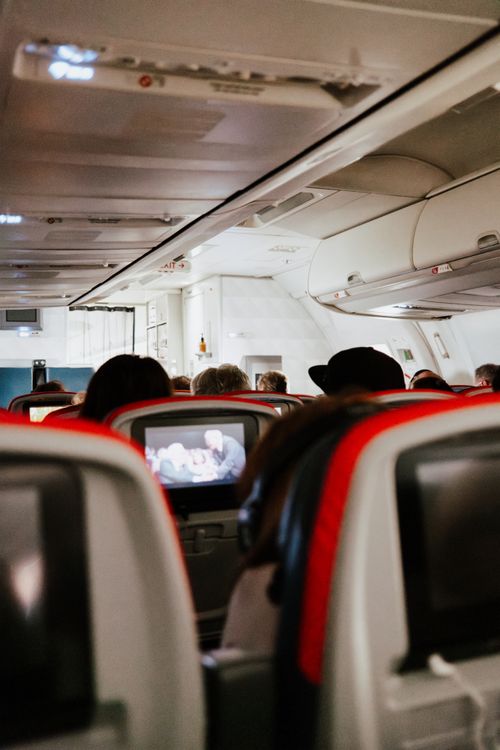
[Passengers seated in an airplane cabin, where seat type decides boarding order under window-first methods.] Photograph: Airplane cabin with seated passengers
Image Credits: Pexels
What your boarding group actually means
Most airlines today board in a sequence that mixes several rules. Passengers who need assistance and families with small children usually go first, since they take longer to settle. Premium cabins and top-tier frequent flyers follow, as part of the fare they bought.
Then come zones, which usually run from the back of economy toward the front, sometimes split by seat type.
Your group number therefore reflects your fare and status more than your row. A rear-row passenger with a basic fare may board after a front-row passenger with priority status. That mixing is deliberate: it protects the premium product and keeps the gate process simple, even at the cost of a few extra minutes.
If you want a smoother boarding experience, the seat-type research points one way: a window seat means you sit down once and nobody climbs over you. An aisle seat means you will stand up for neighbours, but you can also slip out quickly. Neither choice changes the airline's system, but it changes how much of the jam you feel.
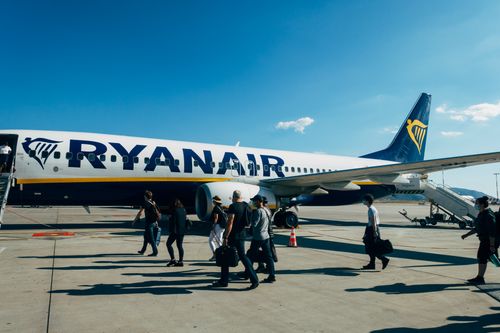
[Travellers board a Ryanair airplane under a clear blue sky, walking toward the aircraft door in boarding order.] Photograph: Travellers boarding a Ryanair airplane
Image Credits: Pexels
Frequently asked questions
Is back-to-front boarding faster?
No, according to the tests. Steffen's mock-757 test put back-to-front at 6 minutes and 11 seconds, against about 5 minutes for random boarding and 3 minutes and 36 seconds for his staggered method. Back-to-front concentrates bag-stowing passengers in the same rows, which jams the aisle.
What is the fastest way to board a plane?
The fastest tested method is Steffen's staggered order: window seats first, in every other row from the back, then middle seats, then aisle seats in the same pattern. It took 3 minutes and 36 seconds in the mock-757 test. Airlines rarely use it because it is complex to announce and splits travelling groups.
Why do airlines board first class first if it is slower?
Because early boarding is part of the premium fare. Passengers who pay more expect to settle first and to find overhead bin space. Airlines also value a simple, predictable gate process.
Speed is one goal among several, and it does not always outrank customer satisfaction or revenue.
Why did airlines use back-to-front boarding during COVID-19?
They aimed to reduce passengers walking past seated travellers. Modelling later showed the change raised infection exposure, because rear passengers clustered in the aisle while stowing bags. Most airlines returned to zone and group boarding once pandemic rules eased.
The bottom line
Boarding order changes because airlines are balancing speed, premium fares, gate simplicity, and, for a time, infection spacing. Back-to-front looks tidy but tests as slow, front-first protects the premium cabin, and window-first methods are fastest but hardest to run. The next time your group is called late, the order is probably not a mistake.
It is a compromise, and the research suggests the compromise could still be better.
Tags: airplane boarding, air travel, airlines, boarding groups
Rive News's research desk covers everyday questions about travel, science, and how familiar systems work, using published sources and official records.
Related
- Why boarding groups exist and do they actually work
- Why airports sometimes board planes from the back door
- Why airplane seats are getting smaller over time
Subscribe to Rive News for one clear explainer each day on the systems behind everyday travel.
Rive News follows a published-standards policy: claims are checked against public sources, corrections are noted on the article, and no invented quotes or statistics are used.
Related stories
The 3-1-1 liquids rule for planes: what each number means
TSA's 3-1-1 rule limits carry-on liquids to 3.4-ounce containers in one quart bag. Where the 2006 rule came from, what counts, and how
Why Is Airplane Food So Bland at Altitude?
A 2010 Fraunhofer study found altitude cuts sweet and salty perception by up to 30 percent. Low humidity, cabin pressure, and noise all
Carry-on size limits: why airlines each set their own
Airlines set their own carry-on limits because the FAA only requires each carrier to have a policy, not one global size. Why 22 x 14 x