
Why trains have gaps between rails at all
By Rive News / Research desk | Rive News / Published October 29, 2026 at 9:00 AM PKT
Key takeaways
- Steel rails expand in heat and contract in cold, so jointed track leaves a small gap at each rail end.
- On older British track, 60-foot rail lengths carried gaps of about 5 millimetres at moderate temperatures.
- Modern continuous welded rail removes most gaps and handles expansion with fixings, ballast, and special joints.
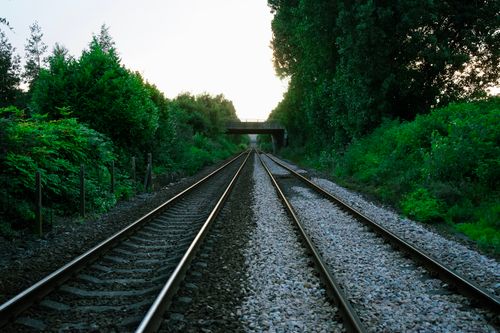
[Railway tracks in rural UK run under a bridge at sunset, the kind of older line where rail joints and gaps are still visible.] Photograph: Railway tracks in rural UK
Image Credits: Pexels
Look closely at an older railway line and you will see a small break where one rail ends and the next begins. That break is deliberate. Steel grows longer when it warms and shorter when it cools, and a railway line runs for miles through sun, frost, and shade.
Without room to move, the rails would push against each other until something gave way.
This article explains why trains have gaps between rails, including how much steel actually moves, what a fishplate joint does, why the gaps made the famous clickety-clack sound, and why most modern track has no gaps at all.
Steel moves more than it looks
Heat makes the atoms in steel vibrate more strongly, and that vibration pushes them slightly further apart. The effect on a short bar is tiny, but a rail is long, and the tiny changes add up along its length. A standard structural steel expands by about 1.2 hundred-thousandths of its length per degree Celsius, a figure engineers use when sizing rail gaps.
A worked example shows the scale. A 20-metre rail segment that warms by 30 degrees Celsius grows by nearly 7 millimetres. That is less than the width of a pencil, but it is enough to matter when hundreds of segments sit end to end.
If none of them had room to grow, the total expansion would have to go somewhere, and the track would buckle sideways or break its fixings.
Rail temperature also runs hotter than air temperature. Dark steel in direct sun absorbs radiant heat, and rail temperatures on a summer afternoon can sit well above the air temperature. Engineers therefore design gaps for rail temperature, not for the number on a weather forecast.
A mild-looking day can still leave rails hot enough to close their gaps.
The gap is a joint, not a crack
The gap sits at a rail joint, where two rail lengths meet. Two steel bars called fishplates, also known as joint bars, bolt to either side of the rails and hold them in alignment while still allowing lengthwise movement. The bolts pass through holes drilled slightly larger than the bolt, so the rail can slide a little as it expands or contracts.
On jointed track in Britain, rails came in 60-foot lengths, about 18.3 metres, joined by fishplates with gaps of about 5 millimetres at moderate temperatures. That spacing left room for summer growth while keeping the gap small enough for wheels to cross smoothly. When temperatures fell, the gap widened as the rails shrank.
When temperatures rose, it narrowed.
The joint also explains a maintenance burden. A mile of jointed track needed 176 fishplates inspected and maintained, according to Rail Engineer's account of heat-related track problems. Every joint was a point of wear, a source of impact load as wheels crossed it, and a place where bolts could loosen.
The gap solved one problem and created a long list of smaller ones.
What happens without a gap
Early railway builders learned this lesson the hard way. Some first lines butted rails tightly together for a smooth ride, and the results were predictable. In winter, tiny gaps opened as the rails shrank.
In summer, the rails deformed and buckled, raising the risk of derailment. The track had nowhere to send its extra length, so it pushed itself out of shape.
The failure has a name: a sun kink, where a length of track buckles sideways under compressive force. A sun kink can lift or shift the rails enough to derail a train, and it can also damage fasteners, sleepers, and the rails themselves. Heat accounted for 646,000 delay minutes on Britain's network in 2022-23, according to Network Rail's climate change adaptation plan cited by Rail Engineer.
Not all of that was buckling, but the scale shows how seriously heat affects railways.
A gap that is too wide causes trouble in the other direction. Wheels drop slightly into a wide gap and strike the next rail end, increasing wear and making the ride rougher. Sizing the gap is therefore a balance: wide enough for the hottest day, narrow enough for the coldest one.
Where the clickety-clack came from
The rhythmic sound of older trains came from wheels crossing these joints. Each wheel dipped into the gap and struck the next rail, producing a click, and the pattern of wheels and bogies turned those clicks into the familiar clickety-clack. Passengers who grew up with jointed track can often tell, from sound alone, whether they are on an old line or a modern one.
Joint placement also shaped the rhythm. On many lines, the joints on the two rails were staggered, so a train crossed one gap at a time rather than two together. Staggered joints are most common in the United States.
Any jointed track announced itself to the ear.
Modern passengers rarely hear the sound, because most main lines now use welded rail. When the clickety-clack does appear, it usually means the train has reached an older branch line, a yard, or a section where joints remain for a practical reason. The sound is now a clue about the track's age, not a feature of rail travel itself.
Why welded rail replaced the gaps
From the mid-1960s, jointed track on most British lines was progressively replaced with continuous welded rail, known as CWR. In CWR, rails are welded into long seamless sections, often hundreds of metres or even kilometres long. The familiar gaps disappear, the ride smooths out, and the maintenance burden of hundreds of fishplates per mile goes with them.
Welded rail does not repeal thermal expansion. It manages it differently. The rails are firmly fixed to heavy concrete sleepers, which sit in a thick layer of ballast with shoulders that resist sideways movement.
The track is laid and stressed at a controlled temperature, so that expansion forces stay within what the fixings and ballast can hold. The steel still wants to move, but the system holds it in place.
Even welded rail needs expansion joints in specific places. Bridges, tunnels, and structures move differently from the surrounding track, so special joints near them absorb the difference. Switches and crossings, where trains change tracks, also keep joints and special fixings.
The gap has not vanished entirely. It has moved to the places where movement cannot be restrained.
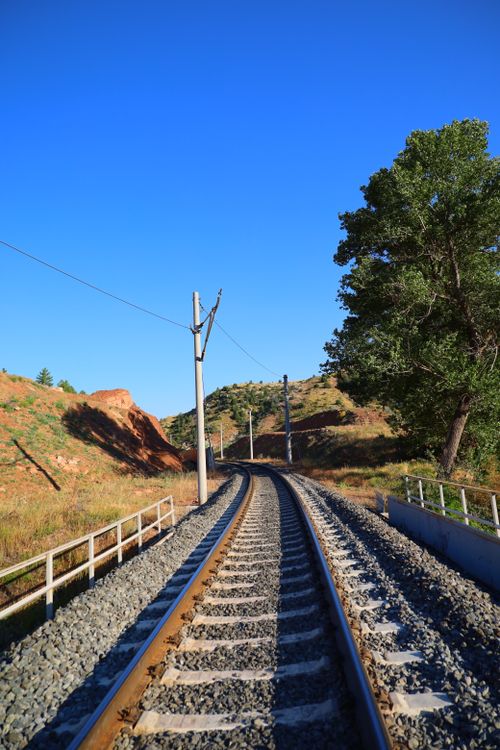
[Railroad tracks run through a scenic rural landscape, with rails, sleepers, and ballast forming the track bed.] Photograph: Railroad tracks in a rural landscape
Image Credits: Pexels
How engineers choose a gap size
Gap size depends on rail length, steel properties, and the temperature range of the location. Rails are made in standard lengths, such as 12, 18, or 25 metres, and a gap sits at each joint between them. Engineers calculate how much each length will grow between the coldest and hottest rail temperatures expected in that region.
Climate changes the answer. In Britain, gaps were often designed for a range around minus 5 to 35 degrees Celsius. In hotter climates, such as parts of India, the design range can reach 50 degrees Celsius, which demands larger gaps or more frequent joints.
Desert and arctic lines face the widest swings, and their joints are sized accordingly.
Load matters too. A gap must handle not only thermal movement but also the dynamic forces of heavy trains crossing it. Too wide, and the impact damages wheels and rails.
Too narrow, and thermal stress builds until something buckles or breaks. The final size is a compromise between those two failures, checked by inspection over the track's life.
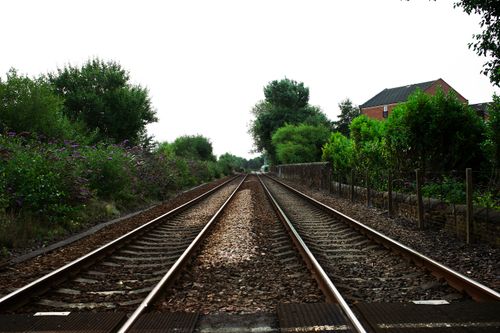
[Symmetrical railway tracks surrounded by lush greenery in the UK, showing rails, sleepers, and ballast in a traditional layout.] Photograph: Symmetrical railway tracks in the UK
Image Credits: Pexels
What this means for passengers today
For most passengers, the gap question is invisible. Welded rail gives a smooth, quiet ride, and the expansion problem is handled by engineers long before a train arrives. The only visible signs are the special joints near bridges and the occasional click on older lines.
Heat still disrupts railways, though. On very hot days, operators may impose speed restrictions so that trains cross heat-stressed track more gently, and engineers patrol for sun kinks. The physics has not changed since the first jointed lines.
Only the engineering response has improved.
If you ever walk beside an old line, look for the fishplates and the small breaks between rail ends. They are a direct record of a 19th-century solution to a physics problem. The gaps look like flaws, but they were careful design.
Without them, the railway could not have survived its first summer.
Frequently asked questions
How big are the gaps between rails?
On older British jointed track, 60-foot rail lengths carried gaps of about 5 millimetres at moderate temperatures. The exact size varies with rail length and local climate. Hotter regions need larger gaps, and colder regions see gaps widen in winter as rails contract.
Why do modern trains not clickety-clack?
Most main lines now use continuous welded rail, where rails are welded into long sections with no joints for wheels to strike. The clickety-clack came from wheels crossing joint gaps. It survives mainly on older lines, yards, and sections where joints remain for practical reasons.
Do welded rails still expand in heat?
Yes. Welding does not stop thermal expansion. Continuous welded rail restrains the rails with heavy sleepers, ballast shoulders, and controlled installation temperature, so the forces stay manageable.
Special expansion joints remain near bridges, tunnels, and switches, where movement cannot be restrained.
What happens if a rail gap is too small?
Expanding rails push against each other and build compressive force. That can buckle the track sideways, a failure called a sun kink, which can derail a train and damage fasteners and sleepers. Engineers size gaps for the hottest expected rail temperature to prevent this.
The bottom line
Trains have gaps between rails because steel grows in heat and shrinks in cold, and a line of rails has nowhere else to send that movement. Jointed track left a small, calculated gap at each fishplate joint, accepting a bumpy ride and heavy maintenance in return for safety. Welded rail now handles the same physics with fixings and ballast instead of gaps, but the principle is unchanged.
The gap, where it remains, is not a defect. It is room for the railway to breathe.
Tags: railways, trains, engineering, thermal expansion
Rive News's research desk covers everyday questions about travel, science, and how familiar systems work, using published sources and official records.
Related
- Why trains run on different track widths worldwide
- How to keep your luggage safe on trains and buses
- Why we get motion sickness in cars but not always on trains
Subscribe to Rive News for one clear explainer each day on the systems behind everyday travel.
Rive News follows a published-standards policy: claims are checked against public sources, corrections are noted on the article, and no invented quotes or statistics are used.
Related stories

The 3-1-1 liquids rule for planes: what each number means
TSA's 3-1-1 rule limits carry-on liquids to 3.4-ounce containers in one quart bag. Where the 2006 rule came from, what counts, and how
Why Is Airplane Food So Bland at Altitude?
A 2010 Fraunhofer study found altitude cuts sweet and salty perception by up to 30 percent. Low humidity, cabin pressure, and noise all

Carry-on size limits: why airlines each set their own
Airlines set their own carry-on limits because the FAA only requires each carrier to have a policy, not one global size. Why 22 x 14 x